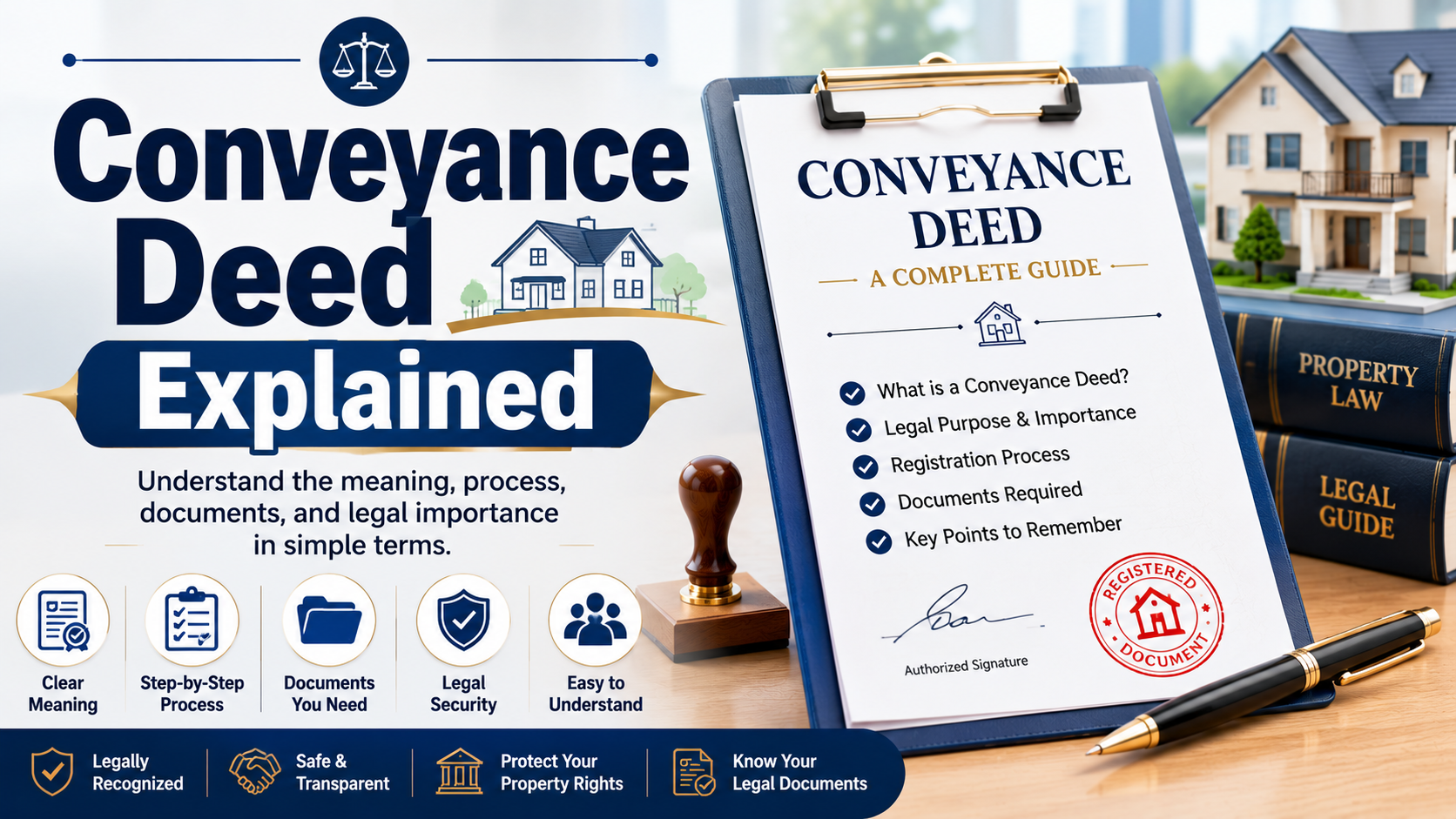
Conveyance Deed Explained
While you can fully pay off the cost of the property, hold the keys to the property and live inside it as well, without one particular piece of paper you will not be the rightful owner according to the law. That piece of paper is known as the deed. The present Deed Explained guide provides complete information about what it is, its difference from the sale deed, its various types, laws applicable to it, registration process and common errors made in its execution.
This deed acts as an instrument in transferring the property in your name no matter whether you are buying an apartment at Sector 65 Gurugram or plot land along Sohna Road.
What Is a Conveyance Deed?
A deed is a registered legal document through which ownership and title of a property are transferred from one entity to another, i.e., from the transferor to the transferee. After its execution, stamping, and registration at the Sub-Registrar's Office, the new owner gets full legal ownership of the property.
In simple language, a deed is a legal document which shows the change in ownership of the property. It shows who is giving the property, to whom he/she is giving it, what kind of property is it, and how it is being transferred. This is the document used by banks, courts, and others to prove who owns what; hence, this document is very important in mutation, home loan, and subsequent sale.
"Conveyance" simply means the process of transfer of property rights, and the deed is the instrument through which this is done.
Conveyance Deed vs Sale Deed: The Key Distinction
This is where the problem arises for many buyers. Let us clarify things once and for all. Conveyance deed is the general umbrella name for all types of documents under which ownership of the property is transferred. Sale Deed vs Sale Agreement is an important distinction many buyers overlook. A sale deed is the most widely used type of deed, where ownership is transferred in return for monetary compensation.
To put things differently, all sale deeds are conveyance deeds, but not vice versa. A sale deed requires mentioning the consideration for the sale and entails money being exchanged between two parties, whereas other forms of deeds, such as gift deed, do not require the monetary consideration to be provided at all. Thus, when you purchase a house, the document you sign is called the sale deed, which in turn falls into the category of deeds.
Knowing this distinction becomes essential since different transactions will require different deeds to be signed.
Types of Conveyance Deed
There are many types of the deeds based on how the property is to be conveyed:
Deed of Sale – This is the most prevalent type of the deeds which is made when there is a sale and purchase of a property.
Deed of Gift – Used to convey property as a gift without any monetary exchange. However, stamp duty will have to be paid.
Exchange deed – a legal instrument executed between the two individuals who have agreed to exchange their respective properties.
Lease Deed – confers leasehold interest in the property for a particular term of rent while the ownership stays with the lessor. It provides details of rent and the term of rent and the obligations of the two parties.
Mortgage deed – creates a mortgage of the property in order to secure a loan but not transferring complete ownership.
Reconciliation deed – the instrument through which a joint owner releases his or her interest in the joint property in favour of another joint owner.
Partition Deed – divides a joint or an ancestral property among joint owners with separate shares of individuals.
Settlement deed – transfers property in order to settle the disputes within the family or in respect of ancestral property.
Though each one of these instruments serves its own purpose, all of them have commonality of object.
Understanding Deed Types for Better Property Planning
The diversity of the deeds available in India reflects the complex nature of property transactions and family arrangements. Beyond the common sale deed, understanding specialized instruments like relinquishment deeds becomes crucial for property disputes. A relinquishment deed guide helps co-owners or heirs formally waive their claims to property. This is particularly useful in inheritance scenarios where one family member wishes to transfer their share to another without going through lengthy legal procedures. These alternative deed types provide flexibility and legal clarity in property matters while ensuring all parties' interests are protected within the framework of applicable laws and regulations.
Why a Deed Matters
If you skip or do not pay much attention to the deed, it will ruin all your investments. The following are the reasons why it needs to have your complete focus.
It proves that the property belongs to you. The deed is one of the best proofs that you own the property.
It facilitates mutation and loan facility. A valid conveyance deed is necessary for mutation of the property in the municipal and revenue records as well as by banks in order to give a loan on the basis of such property.
It provides security for resale. In case you sell your property in the future, whether it be an excellently located house on Golf Course Road or sector 57 Gurugram, a registered the deeds will make it easy for you and provide assurance to your buyer that everything is fine. Any flaw or unregistered the deeds will complicate and even hinder your resale.
It provides legal protection. It documents all the details relating to the chain of title, consideration, etc., thereby providing less chance for contestation in the future.
In essence, the deed is the instrument that turns a payment and possession into ownership.
Protecting Your Property Through Encumbrances and Certificates
Beyond the deed itself, property owners must be aware of encumbrances that could cloud their title. An encumbrance certificate guide helps you verify that a property is free from any legal liabilities or mortgages before purchase. Additionally, obtaining an occupancy certificate guide for new properties ensures that the constructed building meets all regulatory standards. These supporting documents work in conjunction with the conveyance deed to provide comprehensive legal and physical validation of your property ownership. Understanding these certificates prevents costly disputes and ensures smooth property transactions in the future.
Key Components of a Conveyance Deed
A properly drafted deed typically includes:
Details regarding the parties, i.e., identity of the transferor and the transferee.
Description of property, i.e., address, survey/plot number, area, and boundaries of the property.
Consideration, i.e., payment made (only for sale deeds, not for gift deeds).
Transfer clause, i.e., words by which actual transfer of property is made.
Chain of title, i.e., history of the owner of the property showing that the transferor has the right to transfer the same.
Encumbrance and indemnity clauses, i.e., a statement that the property is free from any encumbrances, and the transferor shall indemnify the transferee against any defects.
Covenants and warranties, i.e., promises made by the transferor regarding the property.
Possession and stamp duty details, i.e., when possession is taken and stamp duty paid.
Signature and witness, i.e., signed by both parties with two witnesses.
Getting these details right is essential; errors in the property description or the chain of title can create problems that surface years later.
The Laws Governing a Conveyance Deed
This type of deed does not function alone but derives its strength from multiple laws operating in harmony with each other. Understanding legal government property guide requirements is essential for all property transactions in India.
The Transfer of Property Act, 1882 forms the law that deals with the transfer of immovable property. The Indian Registration Act, 1908 makes it mandatory to register this type of deed for immovable property. This Act lays down in Section 17 that such deeds have to be registered and unregistered deeds will neither serve any evidentiary value nor create legal rights. The Indian Stamp Act, 1899 (and state stamp acts) lay down the rules regarding stamp duty applicable on the deed.
In effect, the implication is clear: a conveyance deed acquires legal validity only upon being stamped and registered. An unstamped and unregistered deed lying in your drawer will not confer any right of ownership to you notwithstanding its content.
How to Register a Conveyance Deed
Registering this type of deed follows the registry process in India with a clear sequence:
Prepare the document, usually with the help of a lawyer, making sure that the details regarding the property, the individuals involved, and other aspects are precise along with adhering to the proper format.
Paying the stamp duty, which differs from state to state and can be determined based on the higher of the market value or agreement value of the property.
Making an appointment and visiting the office of the sub-registrar with all the necessary documentation.
The document has to be executed, meaning signing the same by both parties in the presence of two witnesses.
Registering the document within the specified time limit, which is usually four months after executing it by paying the registration charges, which come around 1% of the value of the property.
Once registered, the transfer becomes part of the public record, and you can later obtain a certified copy from the state's property registration system using the document number, year, and Sub-Registrar details.
Builder Buyer Agreements and Developer Responsibilities
When purchasing property from a builder or developer, understanding the builder buyer agreement explained in detail becomes paramount. This agreement outlines the developer's obligations regarding delivery of possession, quality standards, and timeline. The agreement also specifies when this type of deed will be executed and transferred to the buyer. Many disputes arise when builders fail to follow through on their commitments within the stipulated timeframe. A well-drafted builder-buyer agreement protects your interests and ensures that the developer delivers the property as promised before transferring ownership through this type of deed.
What Is Deemed Conveyance?
However, there is another interesting scenario that should be mentioned, especially in relation to those who plan to purchase an apartment. In case a builder or developer does not perform the deed of transfer of land and title in favor of the housing society in the prescribed period of time, such a society will have the right to receive what is known as deemed conveyance with the help of the competent authority.
The concept of deemed conveyance is especially well-known in the State of Maharashtra within its housing model, but the general idea – namely, that the owners cannot remain without the title because of some delays of a developer – remains the same in any other part of India. If you want to purchase an apartment in a housing society, then it is reasonable to find out if the land conveyance was performed in this particular case.
Conveyance Deed in Gurugram and Haryana
The deed, usually a sale deed, is drafted and registered with stamp duty based on the stamp duty applicable for Haryana. The next step is to mutate the property into the name of the purchaser through the records department of Haryana.
All of this is equally applicable across sectors and corridors in the city. If you are buying a plot in Sector 82 of Gurugram, an expensive apartment on Golf Course Extension Road, or even a new launch property on the Dwarka Expressway, make sure that the deed is properly drafted, duly stamped, and registered within the required period of time. If you are buying a resale property in an already well-settled locality such as Sector 12 of Gurugram, then check out the existing conveyance deed and the chain of title.
Essential Certificates for Property Ownership Completion
Upon receiving your deed, ensure you also obtain other necessary certificates to complete your property ownership process. A completion certificate guide is essential for newly constructed properties, confirming that the builder has completed construction according to approved plans. Similarly, a property NOC guide ensures the property complies with local municipal and environmental regulations. These documents, combined with your deed, create a comprehensive ownership record. Property owners should maintain all these certificates safely as they become crucial during future transactions, refinancing, or legal disputes involving the property.
Planning for Property Transfer Through Legal Succession
For long-term property planning, understanding succession laws becomes important. A will & succession certificate guide helps you plan for property transfer to heirs and ensures smooth inheritance after your demise. This prevents disputes among family members and provides legal clarity about who inherits the property. Additionally, understanding power of attorney for property arrangements allows you to authorize someone to manage your property affairs if you're unable to do so. These legal instruments complement the deed in ensuring comprehensive property management and successful property succession in your family.
Common Mistakes to Avoid
This type of deed is only as strong as the care taken in preparing it. Watch out for these pitfalls:
Inaccurate documentation such as inconsistent survey numbers, wrong areas or no supporting documents can make the deed invalid or put off the process.
Underpayment of stamp duty – inadequate payment of stamp duty makes the deed invalid.
Delay in registering the deed – failure to register the deed within the specified period makes it invalid.
Failure to check the chain of titles – ignoring the chain of titles can cause you to have disputes in the future because of lack of rights for the transferor.
Failure to seek advice from the legal experts – although you can prepare a deed without seeking legal expertise, it is important for you to avoid future mistakes.
A little diligence at the deed stage prevents lengthy legal battles later.
Frequently Asked Questions
What is a conveyance deed? It is a registered legal document that transfers the title and ownership of a property from one party to another. Once stamped and registered at the Sub-Registrar's office, it serves as proof that the new owner legally owns the property.
What is the difference between a deed and a sale deed?
This type of deed is the umbrella term for any document that transfers property rights, including sale, gift, exchange, lease, and partition deeds. A sale deed is the most common specific type, used when a property is sold for money and involving a stated consideration.
Is registration of a conveyance deed mandatory?
Yes. Under the Indian Registration Act, 1908, registration of a conveyance deed for immovable property is compulsory. An unregistered deed is inadmissible as evidence and does not create valid legal title.
How much are stamp duty and registration charges on a conveyance deed?
Stamp duty varies by state and is generally calculated on the property's market value or the agreement value, whichever is higher. Registration charges are often around one percent of the property value, subject to local rules.
What is deemed conveyance?
Deemed conveyance is a mechanism through which a housing society obtains title and ownership of its land through the competent authority when the builder fails to execute the conveyance deed within the stipulated time. It is most commonly used in Maharashtra.
Final Thoughts
The deed is when a property deal takes legal form. It is the deed by which a buyer transforms into an owner, one that can be trusted by banks and the court system, and without which no future transaction on the property would be possible. A sale deed is the common example of it, but gift deeds, exchange deeds, lease deeds, partition deeds and many other types have the same purpose.
If you buy any property in any sector or expressway area in Gurugram and elsewhere in India, the simple advice of the Deed Explained guide would be the following. Have it drawn out properly, pay the proper amount of stamp duty, register it in time, and verify the chain of title before signing.