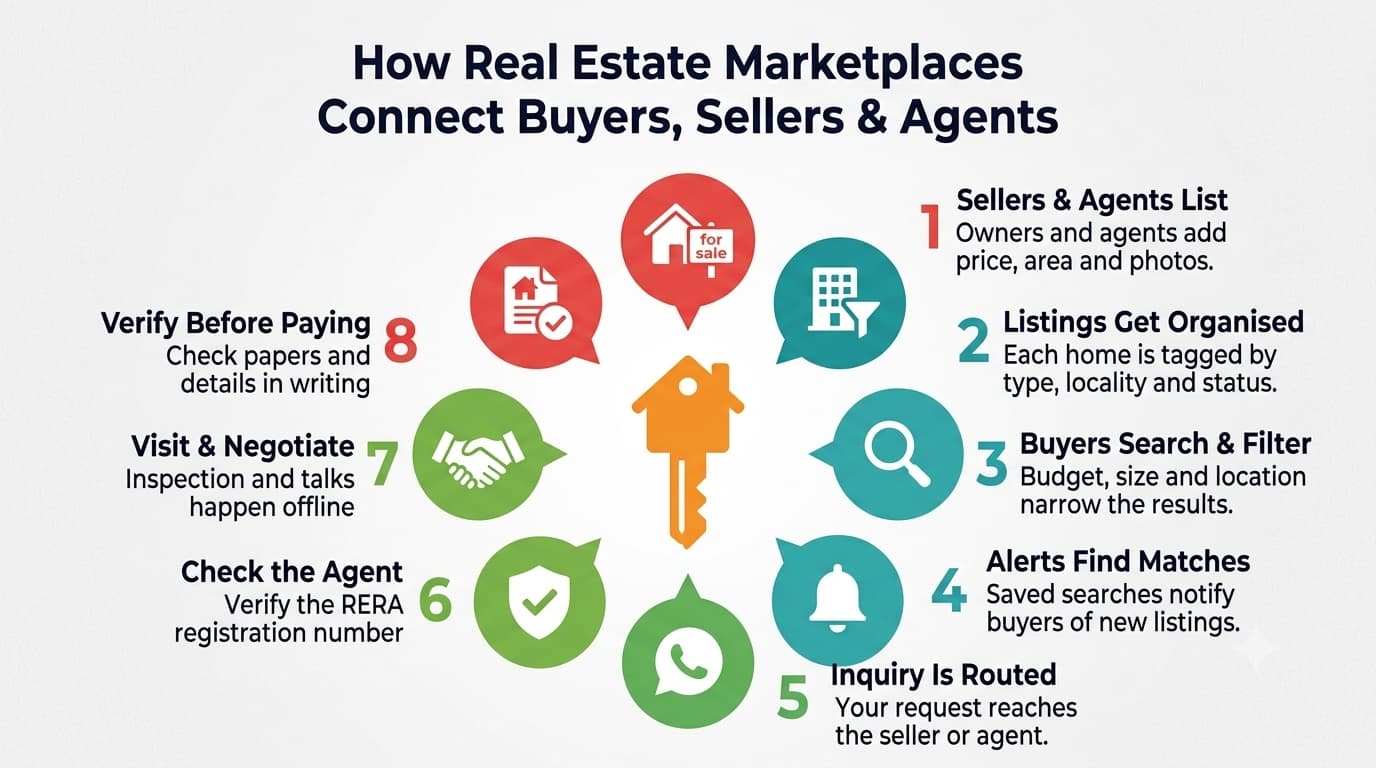
The real estate listings sites serve as the common structure for the interlinking of these three parties via one common database. The sellers/real estate agents share the necessary details, buyers search and filter the listings based on their needs and the inquiry process sends the interest of each buyer to the respective seller or the agent. After which the website plays a passive role and the visit, document checking and negotiation processes take place in physical form.
Some years ago, when a buyer looking to buy 3 BHKs in a newly developed area, had to contact three real estate brokers and visit two construction projects without knowing the actual price of the property. Today the same buyer begins the process by searching for his choice property on a listing website. The listing website is the layer that makes all these possible. It facilitates the interconnection of the four parties in an organized form.
This guide will give you insight into how such connections take place, what exactly the four parties have to do to make the best out of them and at what places these connections may fail.
Who is in the room, and what does each side want?
The website's job is to match what one side supplies with what the other side is looking for.
How the connection happens, step by step
1. Supply comes into the process. Individual sellers will put up their single property. Real estate agents may put up tens of properties. Builders put up whole construction projects. All the properties will have the same fields in the website: price, location, number of bedrooms, possession status, and photographs. So, we can match a 2 BHK from one neighborhood with that of another.
2. Information is structured on the website. Every listing is categorized by type, locality, price, and possession status. It is also mapped geographically, with the price per square foot calculated where applicable. The platform also attempts to identify duplicate listings so that the same property is not displayed multiple times.
3. Search and filtering by buyers. A prospective buyer gives his budget, preferred location and required size of space, and finds the closest properties that match his requirements.
4. Alerts make the search more active than passive. Most of the sites allow buyers to save a search and receive an alert when something new that matches their requirements comes up, for example, "2 BHK, ready to move, within budget." It works for the buyer even when he/she is not on the site.
5. The inquiry is redirected. When the buyer selects "contact," the inquiry is sent to the owner/agent with the buyer's requirements attached. Owners/agents receive inquiries in a dashboard; calls or messages between buyers and owners are usually routed by the sites to avoid giving away all details at once.
6. The communication goes offline. Following the initial exchange of messages, the buyer and seller arrange a visit to the site. The inspection, document check, negotiation and registration happen offline.
A worked example: one inquiry, three days
This is an illustrative scenario, not data from a real transaction.
Day 1 – evening: A buyer saves a search query for move-in-ready 2 BHK property in two sectors within the fixed budget.
Day 2 – morning: Alert comes about a newly listed property. The buyer examines the location marked in the map and observes that the quoted area is super built-up and asks for the carpet area, amenities included in the price, and whether the house is available to view.
Day 2 - afternoon: The buyer receives a reply from the agent after 2 hours along with carpet area, maintenance charge, and owner’s availability to view.
Day 3: The buyer asks for the RERA number from the agent and verifies the same at the state regulator’s site and fixes Saturday viewing.
The website made the introduction. The buyer's specific questions and the verification step made the connection useful.
Why agents sit in the middle
Day 1 – Evening: A buyer saves a search for a ready-to-move 2 BHK property in two sectors within the given budget.
Day 2 – Morning: The buyer receives an alert about a new listing. After studying the location highlighted on the map, the buyer discovers that the quoted area is the super built-up area and asks for the carpet area, details of amenities included in the price, and availability for a site visit.
Day 3 – Afternoon: After two hours, the buyer receives a response from the agent with details about the carpet area, maintenance charges, and availability for a viewing with the owner.
Day 4 – The buyer asks the agent for the RERA number, verifies it through the state regulator’s official website, and schedules a viewing for Saturday.
How each group can use the connection well
If you are a buyer
Begin with your budget, desired location, dimensions, and move-in dates.
In the first contact, ask specific questions like the carpet area, amenities included in the price, and whether the house is still available.
Only make inquiries for shortlisted houses. Making inquiries for 30 houses will result in many calls but no useful information.
Always keep things in writing.
If you are an owner or landlord
Ensure that all fields are filled and that the type of property is stated.
Upload recent photographs of the real house and not sample pictures.
Delete the listing immediately the home is either sold or rented out.
Reply promptly; buyers who are serious will contact a number of sellers.
If you are an agent
Place your registration number on your profile.
Never list anything that is not authorized, and never duplicate any home listing for varying amounts of money.
Be honest about fees, possession periods, and approvals.
Where the connection can break down
Stale listings. A property can still show even after being sold. Question, "Is this for sale?" and note the date of listing.
Duplicate listings at varied prices. Different agents can list the same flat at varied rates. Inquire whose is the real owner.
Bait pricing. An unrealistic low listing price can be an attempt to generate leads. Look upon it as a trigger to ask questions and not to move on.
Incomplete data. If area type, date of possession, or charges are not mentioned, that’s an opportunity to question before visiting.
Lead flooding. A lead generated from one listing can contact multiple agents. Specify your preferred means of communication in your message.
None of this means the website is unreliable. The connection works best when users apply some judgment.
What verification can and cannot do
Some sites add verification badges or agent profiles. These help, but they have limits:
Being "verified" doesn't necessarily mean that the phone number or picture has been verified; it could just be the title and any approval processes. The registration number of a listing is of no use unless you verify it at the site of the regulatory body. Reviews and ratings are subject to who writes them.
Treat verification as one signal among several. Title documents, approvals and the sale agreement should still be reviewed by a qualified professional.
How these websites earn, and why it matters
Most websites make their money by charging fees to list, premium listings, subscriptions for agents or builders, and advertising. It’s a standard business practice, but it will affect how you view things. The listings that are on the top could have been paid for, so consider the details of each listing.
Use more than one website
Since each platform sources listings in its own way, the same property may have different pricing, pictures, or other details depending on which platform one visits. For example, when looking for real estate in Delhi NCR, a comparison of real estate portals in Gurgaon will show that the more up-to-date and descriptive one is the one closer to the truth.
Websites like Prooperty make an effort to categorise listings and include buyer guides, helping people feel more organised during the initial search. While using whichever platform one prefers, a listing may lead to further communication, but it should not be treated as proof of any documents relating to the real estate.
A quick checklist before you act on any listing
Is the listing current, and is the property available for sale?
What is the nature of the seller: Owner, Builder or Agent, and is it possible to verify his/her identity?
Does the area type, pricing and costs match all listings?
Have I verified the registration status of the project with the regulator?
Have I got important information in writing?
Have I physically inspected the property before making the token payment?
Frequently Asked Questions
1. How do these websites connect buyers, sellers and agents?
They collect listings from sellers and agents in a standard format, let buyers search and filter them, and route each inquiry to the right seller or agent. After the first conversation, the site visit and deal happen offline.
2. Do buyers have to pay to contact sellers or agents?
In most cases, browsing and sending inquiries is free for buyers. Some sites offer paid extras, such as premium alerts or assisted services. Check what any paid service includes before you sign up.
3. Can sellers list a home without an agent?
Yes. Owners can usually create their own listing and receive inquiries directly. Some prefer an agent for visits and negotiation, but it is not compulsory.
4. Why do agents list on these websites?
Listing gives agents wider reach, a steady flow of inquiries and a public profile that builds trust beyond their personal network.
5. What happens after I send an inquiry?
Your request goes to the seller or agent, who can call or message you. You then discuss availability, price and details, and, if both sides are interested, schedule a site visit.
6. Are listings verified?
It depends on the site. Some check contacts or photos, but this rarely replaces legal verification. Confirm the project's RERA registration and ownership documents yourself.
7. Why does the same home appear at different prices?
Different agents may list it with their own pricing, or listings may be outdated. Ask who the actual owner is, compare details and confirm the price in writing.
8. How can I check if an agent is genuine?
Ask for the agent's RERA registration number and verify it on the state regulator's website. Also check for a traceable office, a clear profile and consistent listings.
9. What should I include in my first message to a seller or agent?
Your budget, timeline, the specific home you are asking about and a couple of direct questions, such as carpet area and total costs. Clear messages get faster, more useful replies.
10. Why do I get calls from several agents after one inquiry?
Some listings are shared across multiple intermediaries, so one inquiry can reach more than one agent. Stating how you wish to be contacted, and asking who owns the listing, helps reduce unwanted calls.
Final Thoughts
What these sites are particularly good at is putting the right people together. Supply is provided by sellers and agents, while demand is provided by buyers, and the process takes place within the structure that facilitates the match. However, this is just the start of the whole process. Take advantage of this to eliminate options, pose smart questions and check details and always meet face-to-face.