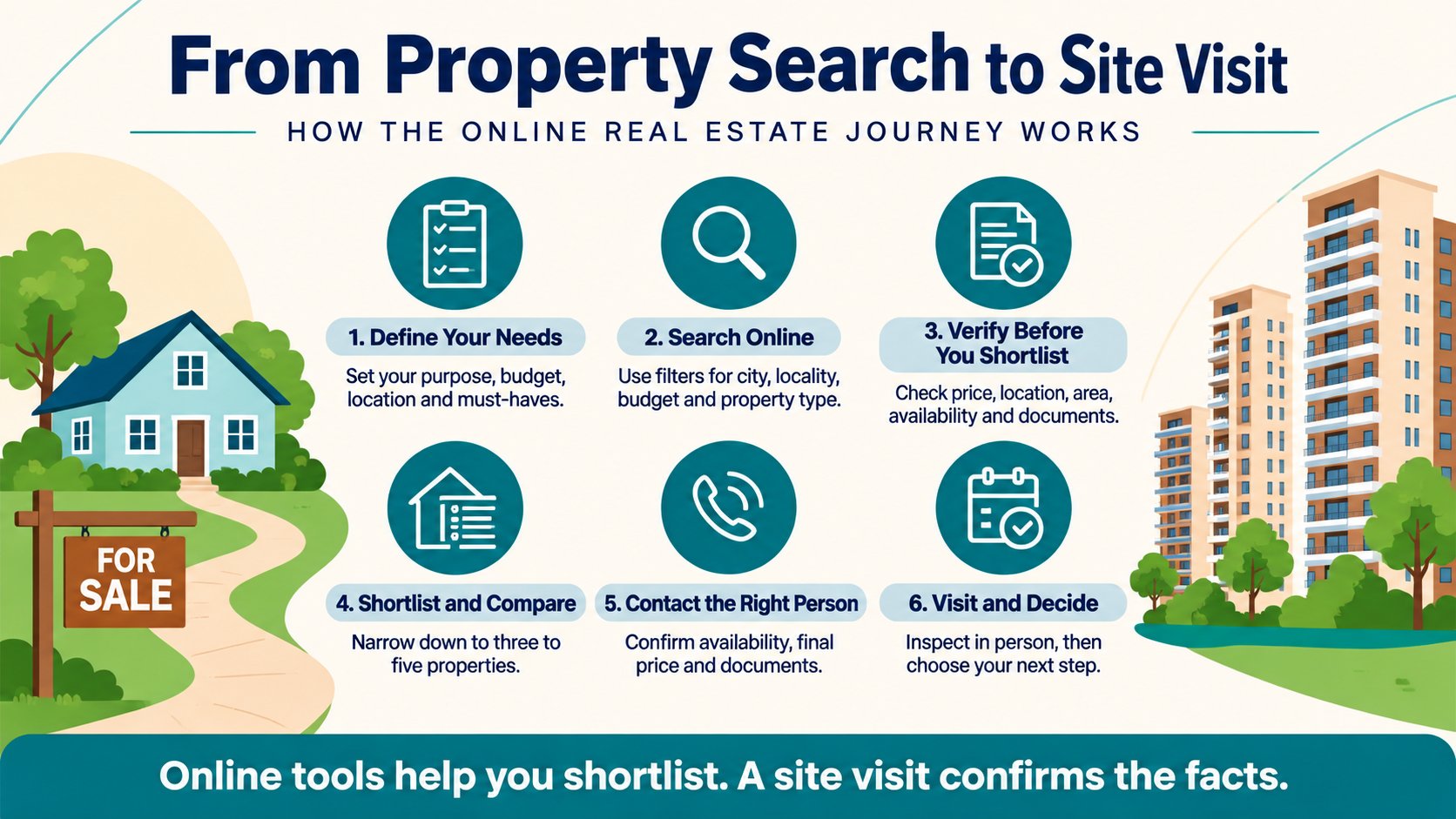
Most real estate transactions in India start with just a call or a click these days. Start searching based on city choice, sort listings based on budgets, browse through images and make some queries. However, that’s how far technology can take you. After that, you will need to walk into the home and assess the neighborhood too. This guide provides an in-depth look at the entire process of real estate search using technology in India, right from determining your needs to visiting the chosen location one day. This guide is made for home buyers, tenants, sellers, landlords and investors who intend to utilize online tools smartly. An online search is only as good as the requirements behind it. Without clear criteria, you will scroll through hundreds of listings and remember none of them. Write down your answers to these questions first: Objective: Is the real estate intended for personal residence, rental income, or long-term investment? Financial Planning: For a purchase, what is the total cost, including the down payment, home loan, registration charges, stamp duty, and other applicable expenses? For renting, what are the monthly rent, security deposit, and additional charges? Location: Which localities offer convenient commuting options, access to healthcare facilities, and proximity to essential services and everyday amenities? Type and Size: Is an apartment or an independent house preferred? How many bedrooms are required? Should it be newly launched, under construction, or ready to move into? Essential Features vs. Luxuries: Which features are necessary for daily comfort and accessibility, and which are optional? For example, a lift may be essential for elderly family members, whereas a clubhouse may be an additional amenity. Suppose a family wants a 2 BHK within 40 minutes of the husband's office, with a school nearby. Those three conditions will remove most listings immediately, and what remains is worth your time. After having established your criteria for choosing the right property, decide on where to conduct the search. You can choose between an online real estate marketplace, a builder’s website, a broker’s website, or a social network community. An Indian online real estate marketplace such as Prooperty lets you browse listings from multiple sellers in one place, so you can compare options without calling a dozen people. Some habits make the search more productive: Filters must be applied for city, locality, budget, type of the property and status (available or under construction). One may check out the same requirement in two to three neighboring localities to understand the variation in price and facilities. Promising options should be saved instead of remembering them. Every listing is just an opportunity to start asking questions. A good-looking listing is not necessarily an accurate one. Before you spend time on a visit, check what you can from your desk. Compare your asking price to the prices of similar properties that have been listed in the same area and building. Verify whether the price quoted is on a per-square-foot basis or the total amount. See whether the asking price includes any parking and maintenance costs. An extremely low-priced property needs more careful consideration. Look up the location on a map and see how far it really is from your workplace, subway stops, bus stops, schools, and hospitals. The travel time will be different than what is stated in the listing.. Take into consideration the area measurements. The carpet area under RERA is defined as the usable floor area within the apartment walls; however, built-up and super built-up areas consist of the wall and shared space measurements as well. Make sure to find out which area measurement you are talking about when there is only one measurement given in the listing. Make sure that the photos correspond to the descriptions provided, that the listing appears to be recently updated and that all the information provided is consistent. In case of vague descriptions, no photos and seemingly copied ones, be aware. Listings can remain online after a property has been sold or rented. Confirm availability before planning a visit. For an ongoing project or recently launched one, search for the registration number of RERA and verify it from the website of the concerned state RERA. As per Real Estate (Regulation and Development) Act, 2016, projects exceeding certain sizes are required to be registered with the state authority. On the other hand, for resale property, request the sale deed, receipt of payment of property taxes, society no dues, and the occupancy certificate. You do not have to verify all documents right now; but at least know that seller can furnish these documents. Whatever the listing is, it does not assure the legal position of the property. It requires verification from the documents, and if possible, from professional advice also. Aim for a shortlist of three to five properties. A table or spreadsheet works well: Keep the "concerns" row honest. Writing "maintenance charges unclear" or "floor not mentioned" gives you a ready list for your first call. Depending on the listing, you may reach the owner, a broker or a builder's sales team. Before you ask for a visit, confirm a few basics on the call or message: Is the property still available? What is the final price or rent, and what extra charges apply? Is the person the owner, an authorised agent or a developer representative? Which documents are available for review? What dates and times are open for a visit? Communicate via written methods such as WhatsApp and emails so that answers to important questions are documented. Exercise caution when dealing with individuals who force you to pay token money without having seen the property or documents. Plan visits properly instead of squeezing them in. Location-based group tours. Comparisons become easy since there will be several properties selected that can be toured in one tour. Tour the selected properties at least once during the day to assess the quality of natural lighting, air circulation and exterior of the property. It would be useful to schedule another tour after dark or on the weekend to assess the level of noise, traffic and parking availability. You should have your note pad or camera available to take notes, pictures and measure the dimensions of the rooms. You should bring along the one who will decide about buying the property - it might be your spouse, parent or co-purchaser. The tour should be scheduled at least a day before. Online real estate searches in India are useful, but they have certain limitations. Photographs are selected to present a home attractively. Wide-angle lenses can make rooms appear larger, while filters may conceal damp patches or signs of wear. Descriptions can become outdated, and floor area measurements may lack clarity. Some things only show up in person: Light, air, and real sizes of rooms Seepage, cracks, peeling of paint, or any other sign of deterioration Noise caused by traffic, construction, markets, or neighbors Pressure of water, backup for electricity supply, and power of the mobile network State of common areas, elevators, parking facilities, and security Atmosphere of the locality at different times of the day This is why the site visit is essential. Online tools help you decide what is worth seeing, and the visit helps you decide whether it is worth buying or renting. Use this as a working list and adjust it to your needs. Inside the property Open and close doors, windows, cupboards, and balconies doors. Inspect walls, ceilings, and bathrooms for moisture, stains, and cracks. Operate taps, flush toilets, and inspect water pressure and drainage. Inspect switches, plug points, fans, and lighting. Inspect flooring, kitchen fittings, and plumbing. Building and surroundings Check out the lift, stairway, parking and security facilities. Inquire about water supply, power backup and garbage disposal. Take a walk around the neighbourhood to check for noise pollution, traffic, shops and transport facilities. Observe how far the place is from where you go frequently. For tenants specifically Confirm what is included: furniture, appliances, parking and maintenance. Ask about the security deposit, notice period, rent increase and who handles repairs. Understand the rules on guests, pets and subletting before agreeing. Good questions often reveal more than a brochure. Consider asking: Buyers Reason for sale and duration on the market. What are the maintenance fees for each month and are there any pending dues? Are the documents such as the sale deed, approved plan, property tax, and occupancy certificate available? Is there any kind of dispute or loan on the property? In case of a new project - RERA registration number and possession date. Tenants What is the monthly rent, deposit and maintenance structure? What is the lease duration, and how are renewals handled? Are there society rules I should know about? How are repair requests handled? Note the answers and compare them against what the listing said. Any mismatch deserves a follow-up. Relying Solely on Photographs: Always visit the real estate in person before finalizing a deal to assess its actual condition and surroundings. Neglecting Carpet Area Calculations: Two apartments with the same advertised size may differ in their usable floor area. Overlooking the Total Cost: Maintenance fees, registration charges, stamp duty, brokerage, and interior work can significantly increase the overall expense. Making Advance Payments: Avoid paying a token amount before inspecting the premises and reviewing the relevant documents. Visiting Only Once: Consider a second visit at a different time of day to identify potential issues with lighting, noise, ventilation, or accessibility. Relying on Verbal Agreements: Ensure all important terms, commitments, and payment conditions are documented in writing. Omitting professional help. It is prudent to seek a legal review of the documents before buying. Review your notes the same day, while impressions are fresh. Score each visited property against your original must-haves, and then decide what to do next: If one property fits: request the documents for a proper check, negotiate if appropriate, and confirm the terms in writing. If none fit: revisit your filters or budget and go back to your shortlist. If you are unsure: schedule a second visit, speak to residents or neighbours, and consult a legal or financial professional. Sellers and landlords can use the same logic. Accurate listings with clear photos, honest area figures and ready documents attract more serious enquiries and lead to smoother visits. The process of transitioning from online searches to site visits becomes easier when broken down into smaller more specific tasks. Start by defining your needs, selecting a few viable options, verifying them through online tools and by asking for clarification, and finally visiting the site itself to ensure everything is true. Your next move will be an easy one; just jot down your top five needs and list three options on Prooperty or any other reliable online site.Step 1: Define What You Need Before You Search
Step 2: Start Your Online Property Search
Step 3: What to Verify Online Before You Shortlist
Price
Location
Specifications
Listing details
Availability
Documents and RERA registration
Step 4: Shortlist and Compare
Step 5: Contact the Right Person
Step 6: Schedule the Site Visit
What Online Listings Cannot Show You
Site Visit Checklist for Buyers and Tenants
Questions to Ask During a Site Visit
Common Mistakes to Avoid
After the Visit: Deciding on Next Steps
Conclusion