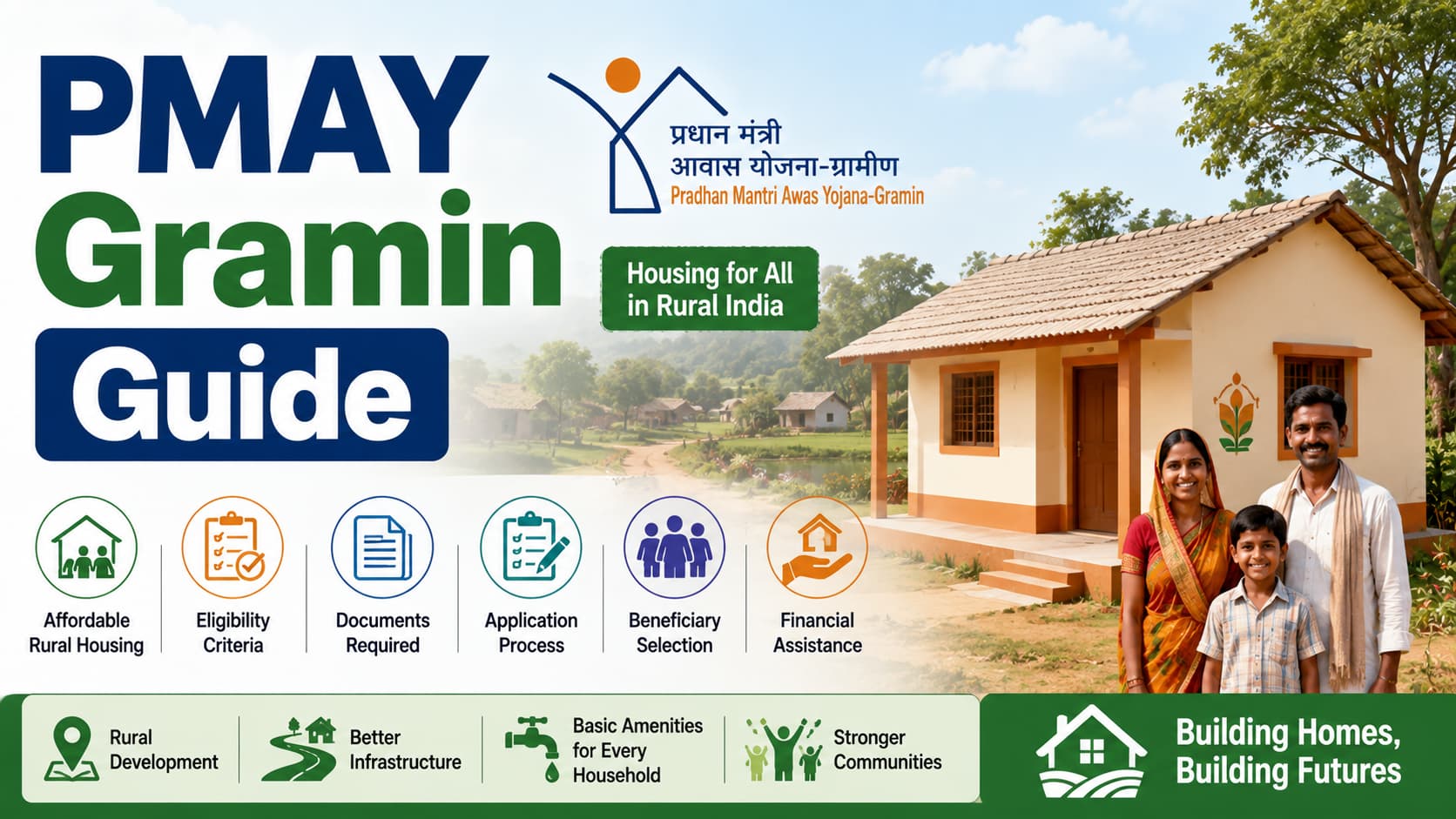
PMAY Gramin Complete Guide to Eligibility & Application
Ask any person about Pradhan Mantri Awas Yojana and he/she will explain it as an affordable housing scheme where one applies from his/her bank and gets some lakhs credited to the loan account in order to reduce EMI.
This is PMAY Urban Scheme. But, if one lives in the rural areas then most of it does not matter.
PMAY Gramin works on totally different principles. There are no banks, there are no loans, there are no interest subsidies and there are no forms to be filled by oneself. The government identifies him/her, verifies him/her and provides him/her with money for construction of his/her house.
The following article explains all about this: who is eligible, how much money can he/she receive, what is the concept behind Awaas+ survey and why is it important, what are the steps in releasing instalments and where are the most common mistakes.
What Is PMAY Gramin?
The Pradhan Mantri Awas Yojana – Gramin is the rural housing mission of the Government of India, which comes under the Ministry of Rural Development. This scheme was initiated in the year 2016 and has replaced the earlier scheme called Indira Awaas Yojana, the aim of which is that all rural families who live in kutcha or dilapidated houses get a pucca house with minimum facilities.
This scheme has been extended, and there is an obligation to provide assistance to another two crore rural families within five years.
The Core Difference from PMAY Urban
This distinction is the single most important thing to understand, and most people get it wrong.
Go through it once more if needed. PMAY Gramin gives you funds. PMAY Urban gives you loan discounts. These are not two different forms of the same scheme.
No choice can be made either. It all depends on your location. If your habitation is rural, PMAY-G is applicable. If it is a statutory town, then PMAY Urban is applicable.
How Much Assistance Does PMAY Gramin Provide?
The Unit Assistance
Plain areas: ₹1,20,000 per house
Hilly states, difficult areas, IAP districts, and North-Eastern states: ₹1,30,000 per house
This is the central plus state share combined. The cost-sharing ratio between the Centre and the state is 60:40 for plain areas and 90:10 for North-Eastern and Himalayan states.
The Convergence Stack — Where the Real Value Sits
Just having the ₹1.2 lakh by itself does not construct a house because the scheme itself did not work on the premise of the above amount. The PMAY-G scheme is one that is supposed to coexist with other government schemes, and the total package is actually much higher.
Labour under MGNREGA scheme Up to 90-95 days of labour costs for unskilled construction of your own house. This labour cost would be paid according to the state wage rate applicable for MGNREGA. In most cases this would add up to ₹18,000 - ₹27,000 worth of labour cost.
Toilet subsidy under Swachh Bharat Gramin Mission ₹12,000 in subsidy for an individual toilet attached to the house.
Ujjwala scheme Gas connection in the household.
Saubhagya electricity scheme Electricity connectivity for the household.
Jal Jeevan Mission Water connectivity for the household.
Total Package: roughly ₹1.5 lakh to ₹1.75 lakh.
Minimum House Specification
It should also have a minimum built-up area of at least 25 square meters, inclusive of an area for cooking hygiene.
Equally important is the fact that the beneficiary has complete creative freedom. There are no standard designs issued by the government. The house is constructed by the beneficiary according to his design using local materials.
This is intentional. Previous rural housing schemes which issued standardized designs gave rise to houses nobody wanted.
PMAY Gramin Eligibility: Who Qualifies
Here's where the Gramin diverges most sharply from every other housing scheme. You don't declare your eligibility. The government determines it.
The Identification Chain
Eligibility flows through a specific sequence:
SECC 2011 data – the Socio-Economic and Caste Census uses deprivation criteria to identify households
Awaas+ survey – additional survey for identifying households that were missed by the SECC or have become eligible subsequently
Gram Sabha verification – verification of the list done in public by the Gram Sabha
Appeals process – objections and appeals raised at block and district levels
Permanent Wait List (PWL) – final prioritised list from which beneficiaries are selected
If you are not on the PWL, you do not get a house — regardless of how eligible you feel you are.
Core Eligibility Criteria
Housing status: The household must be houseless, or living in a house with zero, one, or two rooms with kutcha walls and a kutcha roof.
Exclusion criteria — you are ineligible if the household has:
An auto three wheel or four wheeled machine
Automobile three wheel or four wheel agricultural machinery
A Kisan Credit Card having a credit of ₹50,000 or above
Any member working as government servant
Any non-agricultural business entity with registration from the government
Any member having income of more than ₹15,000 per month
Any person paying income tax
Any person paying professional tax
Land up to 2.5 acres under irrigation
Land up to 5 acres under irrigation for 2 or more crop seasons
Land up to 7.5 acres having one irrigation machinery
Owner of a refrigeration unit or land line telephone
Within the present stage, certain criteria of the exclusion policy have been eased to a certain extent; particularly the motorized two wheeler exclusion criterion has been abolished, monthly income cap has been increased and land holding criteria have been revised.
Priority Groups
Within the PWL, priority is given to:
Households without any form of shelter
Destitute households or those dependent on charity for survival
Manual scavengers
Primitive Tribal Groups
Released bonded labourers
SC/ST households
Minority communities
Widows and near relatives of soldiers and paramilitaries who have lost their lives while on duty
Ex-servicemen and ex-paramilitaries
Handicapped people
Households consisting of a handicapped person and no able-bodied person
The Land Requirement
This is the practical challenge.
Assistance under PMAY Gramin is meant for building on your own land. For this, you should have land, and there should be some documents confirming that land belongs to you. These include patta, record of rights, entry in the revenue record, or equivalent documents from your state.
If you do not have land, various states have programs running in parallel, which give you homestead plots, thus making you eligible for PMAY-G assistance. Without having land in your name, PMAY-G assistance alone is not possible.
Informal or undocumented possession, even after a long time, will not be enough. This is where most eligible families hit a major roadblock.
The Awaas+ Survey: The Gate Everything Passes Through
If you understand nothing else about PMAY Gramin, understand this.
What It Is
Awaas+ Survey refers to the additional survey that has been carried out for the identification of those eligible rural households that have been overlooked in the SECC 2011 data.
The present phase involves conducting an Awaas+ survey, where the use of a mobile application has been provided for both the enumerator and self-survey modes.
Why It Decides Everything
If one is really poor, homeless, and really qualified, but not there in the Awaas+ Database, then none of these matters. The Permanent Wait List is created based on the database. The selection process is from the PWL. If your name is not there, you get no house.
Every year, thousands of families realize that they have not been counted; either due to their being away at the time of the survey, the enumerator not reaching their village, or data entry mistakes classifying them as ineligible.
How to Get Yourself Surveyed
Self-survey via the mobile app:
Download the official Awaas+ application
Complete Aadhaar-based authentication (face authentication is supported)
Enter household details — members, housing condition, assets, income
Photograph the existing dwelling as required
Submit
Assisted survey: Approach your Gram Panchayat, the Panchayat Secretary, the Rozgar Sevak, or the Block Development Office. Surveyors registered on the app can enumerate your household.
Verify Your Status
Ensure that you check the list of your family on the official PMAY-G portal website using the beneficiary search option available on the website. This needs to be done as soon as possible instead of waiting till the next draw for which the list will have already been made.
What If You Have Been Incorrectly Excluded?
Gram Sabha is the place where this will happen because the draft list will be checked at this forum before any objections are registered. Thereafter, there is an official process of appeal that happens at the block and district level.
Incorrect exclusions happen quite often but can be rectified through the proper process.
How the Money Is Released
PMAY Gramin funds are released in instalments, each triggered by geo-tagged photographic verification of construction progress.
The Instalment Structure
The instalment amounts do vary slightly from state to state, but the typical instalments will be as follows:
Installment 1 – On sanction Released when the home is sanctioned and the beneficiary is ready to start construction. This usually ranges from Rs 15,000 to Rs 40,000 based on state standards.
Installment 2 – Plinth level Released on completion of the plinth level construction with geo-tagged proof uploaded and verified.
Installment 3 – Lintel/roof casting level Released on verification of the next level.
Installment 4 – Completion Instalment released on completion of the home and toilet.
Direct Benefit Transfer
All payments under DBT will be done to the beneficiary's bank account linked to his Aadhaar. There are no cash transactions, there are no middlemen, there are no contractors.
The house will be built by the beneficiary himself. This is the very basic tenet of the scheme – that the money reaches the household and the household builds the house. Anybody who comes and says he will “arrange” your PMAY-G house for you is a scammer.
AwaasSoft and the Monitoring Layer
The entire pipeline operates on AwaasSoft, the Transaction Based MIS, while the field verification for the milestones is done by AwaasApp. All milestone images are geo-tagged and time-stamped, making it difficult to falsify any progress.
You can check your own house's status, sanction, and installment history on the PMAY-G portal using the registration number.
Step-by-Step: The PMAY Gramin Process
Step 1 – Ensure that your family has been registered on the Awaas+ portal Search for the same. In case you are not there, get yourself surveyed using the app or Gram Panchayat.
Step 2 – Ensure your place on the Permanent Wait List (PWL) The PWL list is publicized and prioritized. Your placement decides your selection time.
Step 3 – Gram Sabha Verification: Make sure to attend this process. The list will be verified and objections can be raised in case something is incorrect.
Step 4 – Selection and Sanction Selected families are sanctioned an order of selection along with a registration number.
Step 5 — Aadhaar seeding and bank account verification Your bank account must be Aadhaar-seeded and active. A dormant or unseeded account stalls disbursement entirely.
Step 6 — Receive instalment 1 and begin construction
Step 7 — Upload geo-tagged progress photographs at each milestone Via AwaasApp, usually with help from the Rozgar Sevak or Panchayat staff.
Step 8 — Receive subsequent instalments as milestones verify
Step 9 — Complete the house, including the toilet
Step 10 — Final verification and completion certificate
Step 11 — Claim convergence benefits MGNREGA wages, LPG connection, electricity, water — these do not arrive automatically. You must claim them.
Documents Required
Identity
UID card for each member of the household
UID card consent form
MGNREGA job card (for the labor component)
Financial
Bank account passbook with Aadhar seeding and active
Account details with IFSC code
Land
Patta/record of right/registration in revenue records
Land ownership needs to be proved in the name of the beneficiary
Other
SBM convergent number
Caste certificate (where SC/ST category applies)
Disability certificate (where applicable)
Where PMAY Gramin Applications Go Wrong
1. Being absent from the Awaas+ list
Point number one. Everything follows from here. Know where you stand right now.
2. Gaps in land proof documentation
An informal possession of land for several decades does not mean ownership. If you've been living there for forty years without any patta, clear this issue first — in person with your Tehsildar or revenue department.
3. Bank account not seeded with Aadhaar
Your DBT transfer was a silent failure. Money was transferred to your account, then bounced and you were sure that your family was not chosen at all. Check if your bank account is seeded.
4. Incorrectly marked exclusion criteria
The surveyor ticked the wrong box and you're automatically excluded because you have a non-existent fridge or a government job. Check your Awaas+ entry line by line and complain in Gram Sabha.
5. Not submitting geo-tagged photos of progress
The installments will be released once the milestones are achieved. In the absence of proof in the form of photographs, there will be no next installment and construction work comes to a halt until the family exhausts its savings in completing the unfinished structure.
6. Trusting a middleman
It is impossible to expedite your sanction through any middlemen. The list is open, the whole procedure is done on the AwaasSoft platform, and payment is done through Direct Benefit Transfer. Beware!
7. Forgoing the benefit of convergence
Many families let go of the labor wages under MGNREGA of more than ₹20,000 because they are not informed about it.
8. Thinking that PMAY-G is similar to bank schemes
People apply in banks to receive their subsidy under PMAY. This is for urban beneficiaries. PMAY-G has nothing to do with banks. PMAY-U works entirely differently, where the subsidy is given in terms of interest subsidy based on your loan that can be calculated using the PMAY subsidy calculator.
Can You Take a Loan Alongside PMAY Gramin?
Yes. The beneficiary can avail of an institutional loan for a maximum of ₹70,000, which will be used to complement the unit subsidy if the beneficiary intends to construct something more elaborate or grander than what is covered under the basic grant.
It is purely an optional feature and neither is it a subsidy nor a mandatory one. Most beneficiaries do not make use of it and add to the grant through their own funds and efforts.
This should not be confused with the interest subsidy for PMAY Urban scheme.
What Happens After the House Is Built
Ownership. The ownership of the house is in the name of the beneficiary. Whenever it is feasible, the scheme promotes ownership or co-ownership by the female member of the family.
No resale restrictions by the scheme but there could be state-level restrictions. Please enquire at the local level as to whether you are allowed to transfer the property or not.
Only one house for one family. You have received the PMAY-G subsidy and that's all that you will get in terms of housing subsidy from the center, even PMAY urban when you migrate to the cities in future.
Proof of ownership is essential. Sanction letter, completion letter, land papers, and bank statements must be kept. Whenever you do any transaction on the property, it becomes important from the point of view of documentation. It becomes equally significant in a village whether it is in a city or not.
A Note on Rural-Urban Reclassification
India's towns are growing. The villages around the peripheries of the growing towns become either statutory towns or come under the planning jurisdiction of urban development authorities.
If your town becomes a new urban area, you move from PMAY-G to PMAY Urban, meaning a whole new scheme, new ministry, new assistance and obligation to take a home loan when you may not wish or even be eligible for one.
It happens regularly in the vicinity of growing metropolitan centers. Villages that used to fall under the influence zones of the Dwarka Expressway and Southern Peripheral Road of the Gurgaon region used to be rural but now have become fully-fledged urban planning areas.
If you find yourself living in a village where this is coming up, know which scheme you can benefit from at present and make use of that while you still can.
Frequently Asked Questions
1. Can I apply for PMAY Gramin directly, like a bank scheme?
No. There's no open application window. Eligibility is determined through the Awaas+ survey and SECC data, verified by the Gram Sabha, and finalised on the Permanent Wait List. What you can do is ensure your household is surveyed — through the Awaas+ mobile app or your Gram Panchayat. That's the equivalent of applying.
2. How much money do I actually receive?
₹1,20,000 in plain areas and ₹1,30,000 in hilly, difficult, and North-Eastern areas, transferred by DBT in milestone-linked installments. With convergence — MGNREGA labour wages, the ₹12,000 toilet, LPG, electricity, and water connections — the realistic total package runs ₹1.5 lakh to ₹1.75 lakh plus utilities.
3. I don't own land. Can I still get a PMAY Gramin house?
Not on PMAY-G assistance alone — the grant is for construction on your own land. However, most states run homestead plot schemes for landless households. Once a plot is allotted and documented in your name, you become eligible for PMAY-G construction assistance on it. Approach your Gram Panchayat or Block Development Office about the land first.
4. My name isn't on the list even though I qualify. What do I do?
Two routes. First, get surveyed — use the Awaas+ app for self-survey with Aadhaar face authentication, or approach your Panchayat Secretary or Rozgar Sevak. Second, if you were surveyed but wrongly excluded, raise it at the Gram Sabha where the draft list is publicly verified, and escalate through the block and district appellate mechanism if needed.
5. Can I build a bigger house than 25 square metres?
Yes. Twenty-five square metres is the minimum, not a cap. You have full freedom of design — the scheme doesn't impose a blueprint. Build as large as you can fund. Most beneficiaries supplement the grant with savings, family labour, and sometimes the optional ₹70,000 institutional loan.
6. What's the difference between PMAY Gramin and PMAY Urban?
Fundamentally different mechanisms. PMAY-G gives you a construction grant in cash, by DBT, to build your own house on your own land — no loan involved. PMAY Urban gives you an interest subsidy credited to a home loan account — no loan, no benefit. Different ministries, different eligibility, different everything. Your location decides which applies.
7. Someone offered to get my house sanctioned quickly for a fee. Should I pay?
No. That's a scam, without exception. The Permanent Wait List is public, the process runs on AwaasSoft with geo-tagged verification, and every rupee moves by DBT to your Aadhaar-seeded account. Nobody can jump you up the list, and nobody needs to be paid for anything.
8. Why has my instalment not arrived?
Three usual suspects. One — your bank account isn't Aadhaar-seeded, so the DBT bounced. Two — the geo-tagged photograph for your current milestone hasn't been uploaded or verified. Three — a verification query is pending at the block level. Check your status on the PMAY-G portal with your registration number, then follow up with your Rozgar Sevak or the Block Development Office.
9. Can I get PMAY Gramin if I already own a small pucca house?
No. The scheme targets houseless households and those living in kutcha or dilapidated structures with up to two rooms. Owning a pucca house — of any size — disqualifies you. If your existing house is kutcha or semi-pucca, you may well qualify.
10. If I move to a city later, can I claim PMAY Urban too?
No. One family, one central housing benefit, once. Having received PMAY-G assistance, your household is a prior beneficiary and cannot claim under PMAY Urban later. The first-time beneficiary condition is checked against the national database.
Integrating PMAY Gramin with the Broader Housing Assistance Landscape
Whether you're building in rural India or considering migration to urban areas, it's essential to understand how PMAY Urban fits within the national housing ecosystem. Start by verifying your PMAY Eligibility through the Awaas+ survey and the Permanent Wait List in your Gram Panchayat. If your village transitions into an urban area—as happens frequently around growing metro regions—you may eventually transition to PMAY Urban, which operates on an entirely different mechanism based on home loans and interest subsidies. For urban homebuyers considering a bank loan, the CLSS Scheme (now ISS) provides interest subsidy, and you can calculate your exact benefit using the PMAY Subsidy Calculator. In states like Haryana, buyers in designated areas may also explore the Affordable Housing Scheme Haryana for additional layered benefits. The key is knowing which scheme applies to your current location and life stage, then maximizing its convergence benefits. Meanwhile, if you're in a rural area today, focus on securing your place on the PWL under PMAY-G and leveraging the full convergence stack—MGNREGA labour, toilet subsidy, and utility connections—that often adds ₹50,000 to ₹70,000 in real value beyond the base grant.
Final Thoughts
PMAY Gramin is an excellent plan that usually falters in the first step itself, and not in the final one. The money is genuine, the DBT is working, the monitoring process is actually functional, and the convergence package is much better than the headline figure suggests. However, all this won't help you if your household is not in the Awaas+ database, if your land record is not clear, and if your bank account is not Aadhaar-seeded.
Therefore, the order of priority is not very glamorous but straightforward. First, verify your Awaas+ position through the portal. Second, get yourself surveyed if you are not listed. Third, make your land record clear with the revenue department if there is any doubt. Fourth, get Aadhaar seeding done from your bank branch. Fifth, attend the Gram Sabha meeting and raise objections if any at the time of listing. And finally, after starting construction, upload every milestone photograph in time.