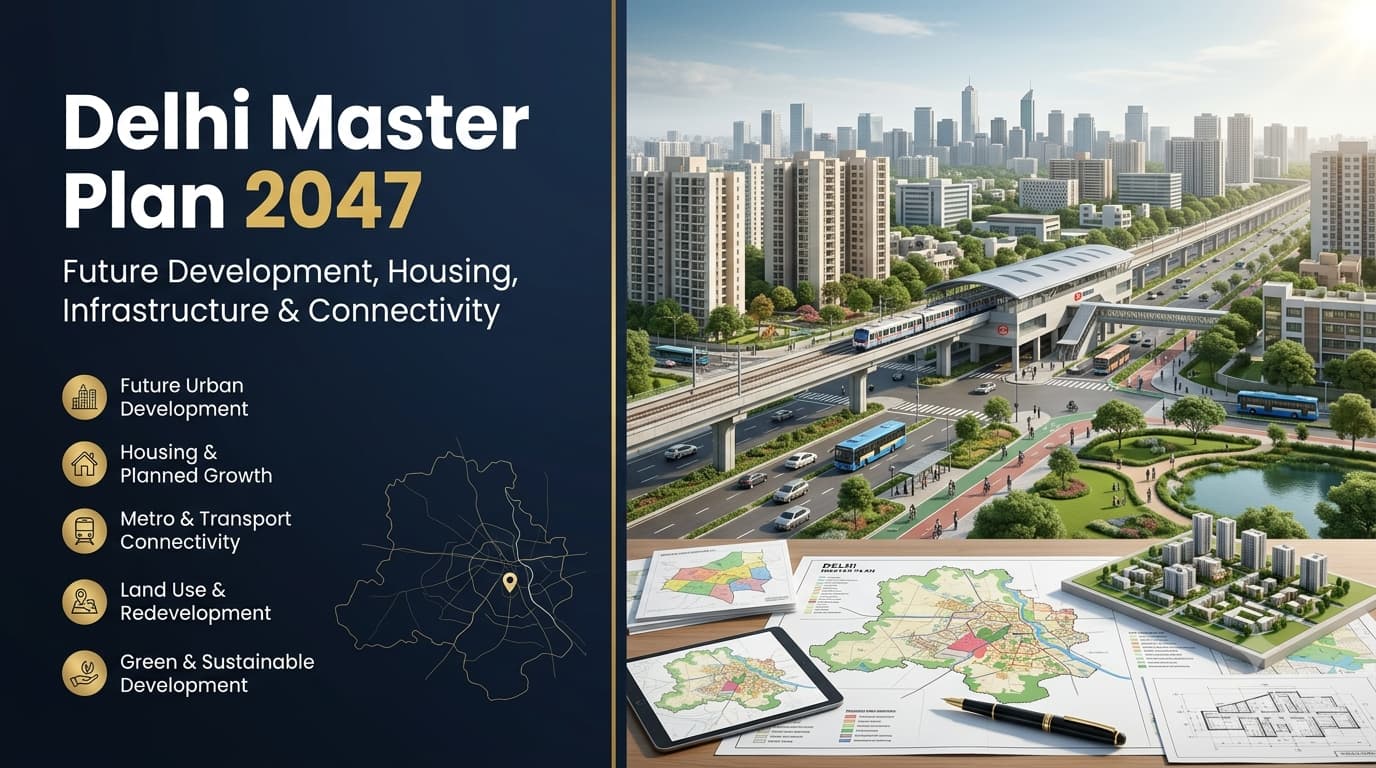
Delhi is moving into an era of transformation, as the city continues to change its population needs, infrastructure, mobility, and environment. The Delhi Master Plan 2047 offers a wider scope for the creation of a more organized, sustainable and ready-to-meet-the-future capital. The plan aims at better connectivity, facilities, efficient land usage and balanced growth while encouraging the revival of existing neighborhoods. It also addresses issues such as sustainable mobility, environment protection, infrastructure planning and development. The actual effect of the plan will largely depend on the subsequent developments that come after it. The Delhi Master Plan 2047 is a long-range plan that aims at steering the growth of the city through its various aspects, including land use, transportation, infrastructure, environment, public facilities, and urban redevelopment. The plan is an extension of the earlier MPD-2041 planning initiative with the planning period being extended up to the year 2047. Delhi has changed considerably over the years, creating new challenges for long-term planning. The key reasons for a new framework include: Population growth: Increasing demand for housing, transport, and public services. Infrastructure pressure: Existing roads, utilities, and public facilities need upgrades. Limited land: Better and more efficient use of available land is becoming important. Redevelopment needs: Older areas require regeneration and improved infrastructure. Peripheral growth: Outlying areas need coordinated development and supporting facilities. Environmental concerns: Future growth must consider green spaces and sensitive areas. Better mobility: Greater focus on public transport, walking, cycling, and connectivity. Planned expansion: New development needs proper roads, utilities, and public facilities from the beginning. The most recent framework was adopted by the DDA in August 2026, being a major breakthrough after many years of planning and revisions. Nevertheless, adoption of the framework by DDA is not equivalent to statutory notification. The framework requires additional approval and statutory notification procedures to make it provisions a part of the notified planning framework. This is important because the approval of the planning framework does not necessarily mean the change in permitted use, development entitlements, and planning position of the parcel in question. The actual effect of it will become evident during the process of implementation and issuing of other planning documents and approvals. Prior to that, potential users of this information need to check the planning position of the parcel. The framework takes a broad approach to Delhi's future and focuses on several interconnected priorities rather than a single type of development. These priorities are intended to improve the way the capital grows, functions, and responds to future challenges. Key areas of focus include: Sustainable growth: Supporting development while giving greater importance to environmental protection and efficient resource use. Better connectivity: Strengthening public transportation and improving connections between different parts of the city. Urban regeneration: Encouraging the improvement and renewal of established areas that require better infrastructure or redevelopment. Efficient land use: Making better use of available land while coordinating development with infrastructure and public facilities. Environmental resilience: Protecting sensitive ecological areas and improving the city's ability to respond to environmental challenges. Improved public facilities: Supporting better access to essential services and facilities as the city continues to grow. These priorities together create a model for more integrated urban development as opposed to simply developing physically. Success of this method will depend on how well the different parties collaborate as it is implemented. One of the major concerns is that of housing since there is a need to address the changing requirements for housing along with making use of the existing urban zones. This includes not only development of new housing but redevelopment of the existing zones with the aim of creating an integrated growth in terms of roads, transportation, infrastructure, education, and healthcare. The aim is to encourage the Zonal master Plan of Delhi as opposed to expanding in the absence of infrastructure. Land pooling may be able to assist in the merging of several parcels of land to achieve more organized development. This may be able to allow for the planning of roads, utility provisions, open spaces, residential and commercial development, among others, while minimizing fragmented development. However, inclusion in a land-pooling area does not automatically imply that there would be the allowance for development. The land use, ownership, regulations, and other requirements should be checked first. Connectivity will be one of the main factors in the growth of the city of Delhi in the coming years. Transit-oriented development entails developing public transport in relation to the surrounding development. The main priorities include: Public transport: Better integration of major transport networks. Walking and cycling: Safer and more convenient short-distance travel. Integrated mobility: Improved connections between different transport modes. Connected development: Better links between transport corridors, workplaces, and public facilities. However, a planned transport project does not guarantee future development or property appreciation. The actual impact will depend on project implementation, local planning rules, accessibility, and supporting infrastructure. Narela and other peripheral areas are expected to receive greater attention as Delhi plans for more organised future growth. Better connectivity, utilities, public facilities, and coordinated land use can help integrate these areas with the wider city. Key priorities include: Better connectivity with other parts of Delhi Improved public transport and supporting infrastructure Planned utilities such as water, drainage, and electricity Social infrastructure for growing communities Coordinated land use for organised development For buyers and investors, it is important to distinguish between planned development and projects that have already been approved or implemented. This can help avoid decisions based only on future expectations. Future growth is not limited to new development. Established areas may also see renewal where buildings, infrastructure, or public facilities need improvement. Key focus areas include: Older buildings: Potential redevelopment where regulations permit. Infrastructure: Upgrades to roads, utilities, parking, and public spaces. Better land use: More efficient use of underused urban areas. Regeneration: Improving existing areas without relying only on outward expansion. Future development must balance growth with Delhi's environmental needs. The planning approach gives importance to protecting green spaces, water bodies, ecological areas, and other sensitive locations. Key priorities include: Green spaces and vegetation Protection of sensitive areas Better drainage and water management Environmentally responsible development The framework could influence residential development through new housing, redevelopment, improved connectivity, and better infrastructure. However, the impact will vary from one location to another. Before making a decision, buyers should consider: Current land use and approvals Connectivity and existing infrastructure Development regulations Legal status of the property Actual progress of planned projects Improved connectivity, infrastructure, mixed-use development, and urban regeneration could create new commercial opportunities in selected areas. Better-connected locations may support offices, retail, and services where permitted by local planning rules. Key factors to consider include: Connectivity: Access to major transport networks Land use: Whether commercial activity is permitted Infrastructure: Availability of roads and essential services Local demand: Existing and future business activity Development rules: Applicable approvals and regulations Changes in land use, redevelopment, and land-pooling policies could create opportunities for some landowners, while restrictions may apply in other locations. The impact will depend on the property's specific planning and legal position. Landowners should verify: Current land-use status Ownership and title documents Development and redevelopment rules Land-pooling status, where applicable Required approvals and permissions Future planning can create potential opportunities, but property owners should confirm their actual rights before selling, purchasing, or developing land. Future planning and infrastructure improvements may influence property values in selected areas, but appreciation is not guaranteed. Better connectivity, public facilities, employment opportunities, and organised development can support demand when projects are actually delivered. Property values also depend on: Location and accessibility Infrastructure and services Local demand and supply Development regulations Actual project implementation People considering a property in an area associated with future development should carry out location-specific checks instead of relying only on broad planning announcements. A practical review should cover the following points: Current land use: Confirm how the land or property is officially designated and whether the intended use is permitted. Ownership and title: Review ownership records and check for disputes, restrictions, or other legal concerns. Development controls: Understand the applicable rules relating to construction, redevelopment, access, setbacks, height, and other requirements. Infrastructure status: Separate completed infrastructure from projects that are only proposed or planned. Environmental restrictions: Check whether the property falls within an environmentally sensitive or regulated area. Land pooling status: If relevant, verify whether the parcel is actually covered by the applicable policy and understand the associated process. Project approvals: For a specific development, verify the approvals and registrations that apply before making a financial commitment. The long-term plan of Delhi concentrates on connectivity, infrastructure, sustainable development, environment protection, and urban renewal. The effects on housing, business, and future development will depend on implementation and relevant land use regulations. One needs to check the land use status, permission, developments and other details before taking any decisions. In case of property searching in Delhi NCR, one can rely on Prooperty.com for discovering their dream property according to location and requirements. Delhi's latest Master Plan is a long-term framework covering land use, infrastructure, mobility, environment, public facilities, and urban regeneration. Its impact will depend on subsequent approvals, regulations, and implementation. It was approved by the Delhi Development Authority in August 2026. However, DDA approval and final statutory notification are separate stages, so the latest status should be verified before relying on specific provisions. MPD-2041 was part of the earlier planning process. The planning direction later moved toward a 2047 horizon, which is why older MPD-2041 documents may still be available. It could support housing through planned development, redevelopment, and better use of suitable land. However, actual development will depend on land use, regulations, infrastructure, and required approvals. Not necessarily. Values depend on location, connectivity, demand, infrastructure, regulations, and actual implementation. Future planning should not be treated as a guarantee of appreciation. Buyers should check: Ownership and title Current land use Development rules Required approvals Infrastructure status Environmental restrictions Yes, improved connectivity, mixed-use development, and regeneration could support commercial activity in suitable locations. However, permitted land use, demand, infrastructure, and approvals remain important. Areas linked to planned infrastructure, regeneration, land pooling, and coordinated development may receive greater attention. Narela and some peripheral areas are particularly relevant to future growth discussions. No. Buyers should first assess the property's current legal, physical, locational, and market fundamentals. Future development should be considered as a potential factor, not a guaranteed outcome. The Delhi Master Plan 2041 latest News Today is about Delhi Development Authority approved the 2047 planning framework in August 2026. It focuses on housing, infrastructure, mobility, land use, environmental protection, and urban regeneration. The framework will proceed through the required notification and implementation stages. There is no clear basis to predict a broad fall in property prices across Delhi NCR. Prices will depend on location, demand, supply, connectivity, infrastructure, and local regulations. The impact of future planning is likely to vary by location. A fifth floor is not automatically permitted under the new planning framework. Permission depends on applicable building regulations, plot characteristics, development controls, and required approvals. Property owners should check the rules applicable to their specific property. The earlier MPD-2041 was approved by the Delhi Development Authority in 2023 but was not finally notified at that stage. The planning direction later shifted toward a 2047 horizon, making the newer framework the relevant focus for future planning.Delhi Master Plan 2047 Growth
Delhi Master Plan 2047: Quick Snapshot
What Is Delhi Master Plan 2047?
Why Is a New Planning Framework Important?
What Is the Current Status?
What Are the Main Objectives?
Housing and Future Urban Growth
Land Pooling and Planned Development
Transit-Oriented Development and Mobility
Narela and Peripheral Development
Urban Redevelopment and Existing Areas
Green Development and Environmental Protection
How Will the Plan Affect Residential Real Estate?
What Could It Mean for Commercial Development?
What Does It Mean for Landowners?
How Could It Influence Property Values?
What Should Buyers Check Before Purchasing?
Conclusion
Frequently Asked Questions
What is Delhi Master Plan 2047?
Is Delhi Master Plan 2047 approved?
What happened to MPD-2041?
How could the plan affect housing?
Will property values increase because of the plan?
What should buyers verify before purchasing?
Can the framework affect commercial development?
Which areas could benefit from future development?
Should you invest based only on future development plans?
What are the latest updates on Delhi Master Plan 2047?
Will property prices fall in Delhi NCR?
Will the fifth floor be allowed in Delhi?
Is Delhi Master Plan 2041 approved?