A search for housing in India has moved from offline channels to smartphones today. A buyer in Pune goes through apartment advertisements while having lunch at work, a landlord in Bengaluru puts up images of the vacant flat, and a seller in Delhi NCR eagerly awaits the first inquiry. It may seem logical to conclude that technology has rendered the services of the agent redundant
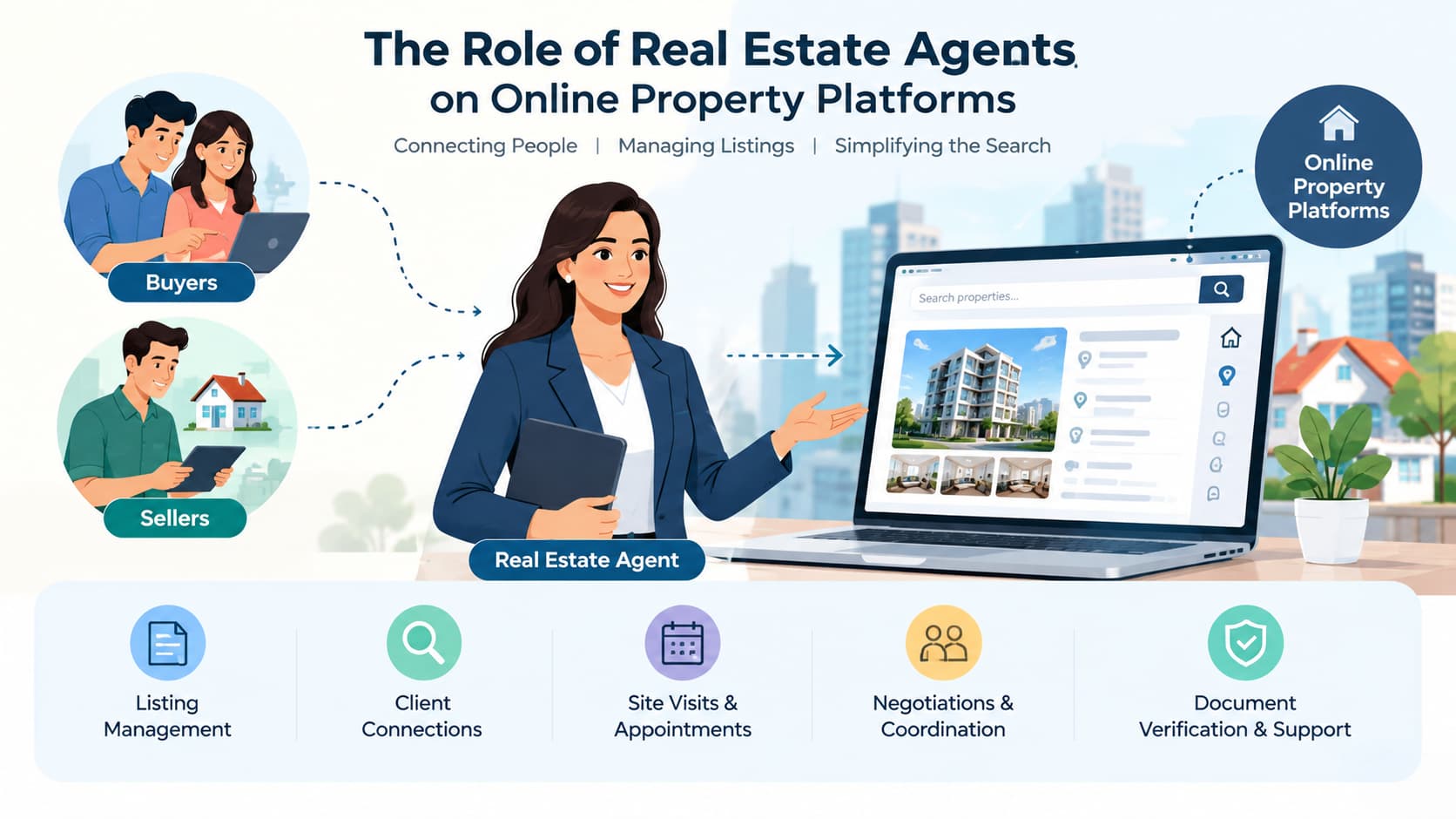
In reality, the function of the real estate agent in the online marketplace has undergone a transformation rather than obsolescence. Agents now serve as listing managers, first responders to queries, coordinators of viewings, and even brokers in most transactions who connect two strangers. This article will explore what agents do on digital real estate platforms, the ways they benefit various users, differences between online platforms and conventional brokerage and the significance of verification and inspections.
Why Agents Still Matter on Digital Real Estate Platforms
Online property portals provide a solution to a discovery problem. They bring homes, plots, and commercial places under one roof where a user can have all the options across various localities within an evening. The problem they don’t solve is the trust and coordination problem.
A listing is merely a claim by somebody. Some other individual has to verify the availability of the property, organize meetings, provide information on the locality, answer simple legal questions and coordinate between the two parties until the deal is either closed or terminated.
Real estate professionals make the difference here. A professional agent makes a listing turn into an opportunity for the buyer and a buyer's need into a lead for the seller. Prooperty, an online marketplace for real estate in India, is one of such platforms where agents, builders and owners list and answer users. The effectiveness of the interaction would depend largely on how professionally each individual performs the tasks mentioned above.
Core Responsibilities of Agents on Online Platforms
Managing listings
Preparation and revision of the listings is what most people will see of the work that goes on. Generally, an effective listing includes the type of property, its location, carpet and super built-up area, floor, orientation, age, status in terms of whether the home is furnished, price, maintenance cost, parking, and whether the flat is occupied or not.
Listing management also entails deletion of old listings. When a listing is sold or rented out, it needs to be deleted from the online property portal. Obsolete listings are some of the biggest complaints that people have when using online property portals.
It is the agent’s primary responsibility to provide accuracy for the readers. Images should depict the real estate property and should be fairly updated. The price should be in line with that which the owner has approved. Any additional costs including maintenance, parking, or transfer fee should be made known upfront. In case of a construction project, the RERA registration number and possession date should be visible. In answering an inquiry, speed is important, but it is second to detail. An effective answer provides an answer to the question, information not in the listing, and raises a couple of questions regarding budget, timeframe, intention to obtain a mortgage, and number of occupants expected. This will help make quick decisions on the suitability of the property. Site visitations are where the virtual interest turns into actual intentions. The agents fix up a site visitation either with the owners or with the current tenants; they provide the visitor with precise locations and signposts, and go with them wherever required. They may also combine a few shortlisted houses within one place to make only one visitation, thus saving a busy person their weekend. Negotiations are frequently informal in India, and a neutral third party can ensure that it remains constructive. Agents will relay offers and counter-offers, provide information about the value of comparable homes in the local area, and help each party appreciate the limits of the other. They counsel but do not decide. It is the buyer and seller who agree on the final price, and the agent should disclose if he works for both parties. Once the prices are settled, agents may come to the assistance in performing other activities like payment of token or booking amount, signing of the sale deed, mortgage documents, stamping and registration at the sub-registrar’s office, and handing over possession. If it is a rental matter, then the order would typically consist of signing a rent agreement, paying the security deposit, and, wherever applicable, doing the tenant verification. Buyers. To illustrate this, a scenario of a first-time home buyer in Pune having a fixed budget and choosing a location near her preferred school is presented. In this case, the property portal will show dozens of apartments, while an agent will filter the list by telling which societies have outstanding issues regarding maintenance and which projects are registered under RERA and which are yet to deliver the project. Sellers. A homeowner is likely to get many unsolicited inquiries but a few genuine ones. An agent helps in setting the right price, promoting the property on portals and screening the enquiries so that the property owner is able to meet the person who is really interested in purchasing the property. For the owner living in another city, the agent might be the only one available to show the apartment. Tenant. A corporate professional moving to Bengaluru from some other state might not have the time to visit before relocating. The role of an agent includes conducting a video tour of the property, verifying the rental amount and deposit, and discussing neighbourhood specifics like commute, availability of water and local markets. Landlord. Agents help the landlord locate suitable tenants, gather all required paperwork, create the rent agreement, and document the condition of the house prior to possession. In most states, the rent agreement for longer periods is supposed to be registered. This is something that one should ask the agent about. Investor and builder. Investors seek the expertise of agents for localities, demand for resale and rental, and project status. Builders seek the services of agents to market to people outside the sales network of the builders. Traditional brokerage depended on a neighbourhood agent's memory, a few local contacts and word of mouth. Digital real estate platforms add scale and searchability without replacing the human layer. The two models differ in several practical ways. The lesson from this comparison is not that one model beats the other. Online platforms improve discovery and transparency, while agents supply the judgement, local context and follow-through that a listing page cannot. Listing with an ambiguous price, copy-pasted images or ambiguous area measurement will cause trouble in the future. Carpet Area, Built-Up Area and Super Built-Up Area are distinct numbers, and an inconsistency between the two can give rise to conflicts. Those agents who clarify these things and update their listing whenever there is a change, enhance the credibility of the entire platform. Being transparent simply involves making your client understand the things that you know and don’t know. For instance, you must let the client know if there is a document from the owner that has not been provided. In the event that there are any fees to be paid on behalf of the broker whether by one or both parties, it should be mentioned before visiting but after making the offer. A late timeline in a project must be communicated as well. Agents can help collect and organise documents, but users should treat verification as a shared responsibility. Depending on the property, the documents to ask about typically include: Documents showing sale deed or allotment letter with prior owner’s documentation Encumbrance certificate to determine any mortgage or encumbrances Details of RERA registration if it is a new project Certificate of occupancy or completion of construction if it is an already completed property Receipts of property taxes and utility charges Society no objection certificate/share certificates if required Approved plans of construction For high-value decisions, an independent advocate should review the title documents. An agent's confidence is not a substitute for legal verification. The Real Estate (Regulation and Development) Act, 2016 of India placed agents under a regulation. Under Section 9, a real estate agent who helps in selling or purchasing of a plot, apartment or building in a real estate project will have to register himself with the state Real Estate Regulatory Authority. Duties of the Agent have been laid down under Section 10. The agent should not help sell an unregistered project, must keep records as prescribed, should not indulge in any unfair trade practice such as making false statements or misleading statements about the services offered by them, and should help the buyer obtain information or documents as per their right when booking the property. The task for users is easy - just ask for the registration number of the RERA of the agent from the state where he belongs and verify from the website of the respective state RERA. Digital real estate platforms are powerful tools, but they have limits that every user should understand: Pictures can deceive. Wide angle shots, strategic shots, and good lighting can disguise small spaces, wet walls, or bad views. Listing can be out of date. The property could have been sold or rented even when the listing is active. Data are unverified by the one who makes the listing. Price, size, and facilities listed by the one making the listing could be wrong or exaggerated. The environment is difficult to see. Noises, traffic, flooding, parking, and neighbors are not easy to determine through pictures. Documents cannot be guaranteed by the listing itself. Portal listing does not give legal guarantee about the titles. Because of these limits, no online process can replace seeing the property in person. On a visit, you will find out what the advertisement could not tell you. During the visit, look for signs of seepage, dampness on the walls and ceiling, water supply and its pressure, lighting and ventilation, electricity supply points, and the state of lifts, stairs, and common areas. If possible, make several visits at different hours of the day. The calm road at 11 a.m. might be quite busy at 7 p.m. and vice versa. A properly lit room in the morning might actually be facing a blank wall by the evening. In case of an under-construction project, visit the construction site, compare the progress of the construction with the stage in the RERA updates, and ask for the approved plans. In case of resale apartments, talk to the neighbors or the society office regarding maintenance and dues and any ongoing disputes. For buyers, tenants, sellers and landlords: Select some of the properties from the website, and raise your queries to the agent before visiting. Make sure that the agent is registered with RERA and that the project is registered, wherever applicable. Make yourself clear on brokerage, deposit and other charges in writing before proceeding further. Get the documents early and get the title verified by an advocate. For agents, brokers and builders: Maintain listings up-to-date and delete sold/rented properties at the earliest. Provide photos and area measurements that are accurate. Do not use a standard reply and provide appropriate details. Inform the buyer about your commission and your role in the transaction. Never facilitate sales in non-RERA registered projects when registration is required by RERA. The involvement of real estate agents on online platforms can be best explained through the integration of technology and judgement. Online property portals speed up the process of discovery and make it easy for information comparison while real estate agents help with local expertise, communication and coordination that help complete a sale. Buyers, sellers, renters and landlords receive the best outcome when they view the platform as a starting point, question the real estate agents effectively, independently verify documents and view the properties themselves. Real estate agents whose listings are correct, have good communication skills and follow the rules of RERA shall earn more trust than any advertising can give. If you want to investigate how the listings by property owners, agents and builders are advertised on an Indian online real estate marketplace, you may start from the Prooperty homepage.Presenting accurate property details
Handling inquiries
Coordinating site visits
Supporting negotiation
Coordinating the transaction
How Agents Help Different Users
Online Platforms vs Traditional Real Estate Services
Accuracy, Transparent Communication and Document Verification
Accurate listing information
Transparent communication
Document verification
RERA and Registered Real Estate Agents
Limitations of Online Platforms
Why Physical Inspection Still Matters
Practical Tips for Users and Agents
Conclusion