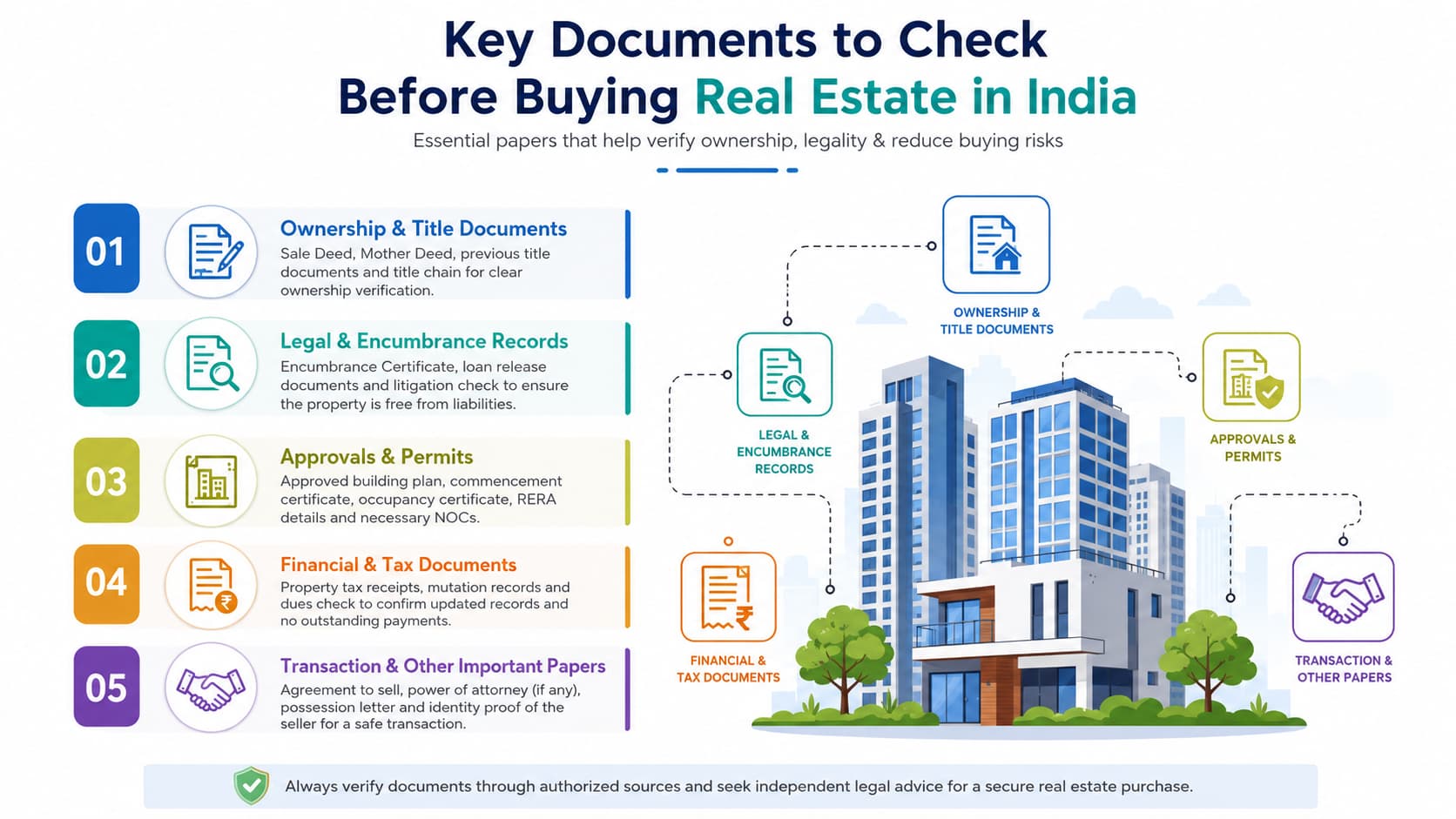
It is well-known to most people, in a broad sense, that paperwork counts before purchasing a house or land plot. However, few know precisely which papers are important, what they can prove, and what not. This manual describes the papers you should check out before purchasing real estate in India, what information they can help verify, and what cannot be verified with their help. The precise list of papers will depend on the nature of the asset and transaction.
Quick Answer: Documents to Check Before Buying Property
Not every buyer needs every document on this list. What's relevant depends on the property type, its location, how the transaction is structured, and the authority governing that asset.| prooperty.com
Sale Deed / Conveyance Deed
A Sale Deed that has been registered usually forms the most important document regarding the transfer of ownership in case of a sale, provided that it is according to the law and conditions prevailing at that time. Check the name, description of the asset, boundaries, and measurements of the area from the Sale Deed and compare them with other documents of the same estate.
Mother Deed and Previous Title Documents
A mother deed or past title deed can be used to determine the history of ownership of the property in question and to create a chain of titles. Checking out the chain of title will allow one to make sure that the seller really has the authority to sell this real estate. Any gaps in the chain should be discussed.
Encumbrance Certificate
An Encumbrance Certificate (EC) is a document that can provide assistance to a purchaser in identifying particular registered transactions or encumbrances related to the real property during a given period, for example, a formally registered mortgage.
It is important to note the limitations of the document: the EC is based on registered documents. It does not imply that the real estate has absolutely no problem at all some problems could be non-registered. Thus, consider it just one of the many inputs into your decision.
Agreement to Sell
In preparation for the final Sale Deed, the Agreement to Sell document contains the business terms, such as the price agreed upon, payment terms, the timeline for taking possession, and the obligations on the part of each party, especially if one party fails to comply with its obligations. Careful reading of this agreement can save us from potential future problems.
RERA Registration and Project Details
In respect of such projects, which come under the purview of RERA, the registration details, promoter details, and timelines announced by the promoter are kept by the concerned state authority, which can be viewed by the buyers.
However, it needs to be understood clearly as to what all it implies or not imply. It implies that this applies to the registration of the project and its obligations, but not necessarily to the title clearance and other clearances.
Approved Building Plan
In such cases, comparison between the actual construction and the sanctioned building plan assists in establishing whether the building corresponds with the approved building plan. These deviations could be additional floors, changed layout, or even intrusion into the setback that was initially approved.
Commencement Certificate
In terms of relevant construction projects, the Commencement Certificate typically indicates that there is an approval for the start of construction work. This certificate is important mainly in the case of construction projects that are already under way.
Completion Certificate and Occupancy Certificate
These two can be confused at times; however, they don't always coincide with each other. The Completion Certificate is a form that normally shows that the project was completed in accordance with the approved plans. The Occupancy Certificate, when needed, shows that the building satisfies the requirements to make it possible to use the premises.
A property may or may not possess one or the other depending on the stage the procedure is at.
Property Tax Receipts
Going through the recent receipts for real estate tax can help to prove the payment and identify any dues that should be paid by the buyer. Receipt of tax alone cannot be considered as proof of ownership since title papers are needed for that purpose.
Mutation, Khata, Patta, and Other Revenue Records
The term mutation means changing the ownership details in local revenue records after the transfer. In some states, the same is called by different terms, such as “Khata” or “Patta,” and the procedure varies from state to state and even from asset to asset. So do not assume that one particular procedure works everywhere; rather, check out the requirement for the relevant real estate.
NOCs and Other Applicable Approvals
Depending upon the project and location, some types of certificates of No Objection may become necessary – such as those from the Housing Society, Fire Authority, Environmental Authority, or any other relevant authority based on the nature of the property and location. All assets do not need all certificates.
Possession Letter
Regarding builder transactions especially, a Possession Letter is evidence that shows the official transfer of possession of the estate. Checking the date and other conditions included in the letter will show how possession was transferred.
Existing Mortgage and Loan Release Documents
When a piece of land has already been mortgaged before, the need to verify that the mortgage amount is settled arises, because there might be some complications in selling off the property even after execution of the Sale Deed.
Power of Attorney
In cases where a transaction is carried out on behalf of a real estate owner by someone else through the process of Power of Attorney, it is very critical to verify whether that particular individual really has the authority to do so. There are different requirements for valid POA in terms of registration.
Inherited Assets
Where there has been an inheritance of the property, some examples of the documentation to be considered are that of title of the previous owner, records related to the death of the previous owner, any will or succession document and records of the legal heirs.
Don't Check Documents in Isolation
Individual documents matter, but checking them against each other often reveals more than any single document does alone. A few things worth comparing across records:
Seller name — consistent across the title document, EC, and revenue records
Property, unit, or plot number — matches across the title document, approved plan, and project records
Area and boundaries — consistent across the title record and applicable revenue records
Dates and ownership details — no unexplained gaps between one transfer and the next
Inconsistencies here don't always indicate a serious problem, but they deserve a clear explanation before you proceed.
How Can You Verify Property Documents Online?
Based on their geographical locations and the kind of documents, buyers can review certain types of documents via appropriate government websites such as the RERA authority in the particular state, the registering office for transactions already recorded, the land records website and also the real estate tax status website of the municipality.
Not all records are available at all states in an online format, and even if they are, it is advisable to verify against original copies or certified copies.
Property Document Red Flags Buyers Should Not Ignore
A few signals are worth taking seriously rather than setting aside:
Inconsistency in the name of the seller in various documents
Lack of the original title deed records, only copies being available
Unaccounted breaks in the chain of title
A current mortgage/charge on the asset with no release records
Building done in apparent contradiction to approved drawings
No NOCs/approvals where normally required
Inconsistency in details provided about the real estate in various documents
Outstanding taxes or other payments
Any hint of pending litigation against the Property
Ambiguity in the power of attorney for selling estate
Being forced to pay a significant sum without verification
A reluctance by the seller to verify the documents independently
When to Hire a Property Lawyer
Independent legal analysis becomes especially valuable under the following circumstances: resale purchases, purchase of land or plots, inheritance, joint ownership, Power of Attorney transactions, older buildings, an existing mortgage, lack of documentation, problems with the title chain, potential lawsuits, and high-value transactions.
The lawyer checks the title chain, pertinent documentation, encumbrances, transaction documents, and any other relevant approvals for inconsistencies. The legal analysis is a useful risk-reduction tool; however, it does not completely eliminate all risks, as there is no perfect method of verification.
Practical Checklist
Before Paying a Token or Advance
Sale Deed and Mother Deed reviewed
Seller identity and ownership cross-checked
Relevant EC / encumbrance record obtained and reviewed
Before Signing the Agreement
RERA details reviewed, where the project applies
Approved plan compared against actual construction
Existing mortgage status confirmed
Property tax dues checked
Before Registration or Final Payment
All documents cross-checked for consistency
Applicable NOCs and approvals confirmed
Possession terms reviewed, where relevant
Independent legal review completed, if applicable
Common Mistakes Buyers Make
Relying entirely on a broker's word instead of reviewing original documents
Accepting photocopies without appropriate verification
Assuming registration automatically resolves every possible issue
Treating an EC as a complete, dispute-free guarantee
Treating a tax receipt as conclusive proof of ownership
Assuming RERA registration alone proves clear title
Overlooking differences between the sanctioned plan and actual construction
Ignoring an existing loan obligation on the property
Paying a substantial advance before verification is reasonably complete
Frequently Asked Questions
What documents should I check before buying a property in India?
Key documents typically include the Sale Deed, Mother Deed, Encumbrance Certificate, tax receipts, and depending on the RERA details, approved plans, and applicable NOCs.
Is a Sale Deed enough to prove ownership?
It's important, but ownership is generally better confirmed by reviewing it alongside the ownership chain, encumbrance records, and relevant revenue records together.
What does an Encumbrance Certificate show?
Registered transactions or charges over a specified period. It's useful, but it doesn't guarantee a real estate is entirely free of disputes.
Is RERA registration proof of clear title?
No. It relates to a project's registration status and promoter disclosures, not a confirmation of clear title.
What is a Mother Deed?
A previous or underlying title document used to trace a property's ownership history and help establish the chain of title.
What documents should I check before buying a resale flat?
Beyond standard title documents, check the existing mortgage status, prior approvals, and estate tax payment history, since resale properties often carry more transaction history to verify.
What documents are important when buying a plot?
Title documents, encumbrance records, and applicable land or revenue records, along with confirming permitted land use for the location.
What documents are needed for inherited property?
Typically the previous owner's title documents, death-related records, a will or succession document, and legal heir records — the exact combination depends on individual circumstances.
Should I verify property documents online?
Where available, online portals can be a useful first check, but original or certified documents should still be reviewed, since not every record is accessible online in every state.
Should I hire a property lawyer before buying?
Particularly worth considering for resale deals, inherited property, Power of Attorney transactions, or situations involving missing records.
Conclusion
Verification of property documents is not an exercise in compiling paperwork but rather ensuring that everything related to ownership, details, transactions, clearances, and dues match the seller’s claims. In simpler cases, a thorough scrutiny of the documents listed above is more than enough. In the case of resales, inherited properties, and other situations where there are incomplete documents or when a power of attorney is involved, it would be prudent to have a legal opinion.