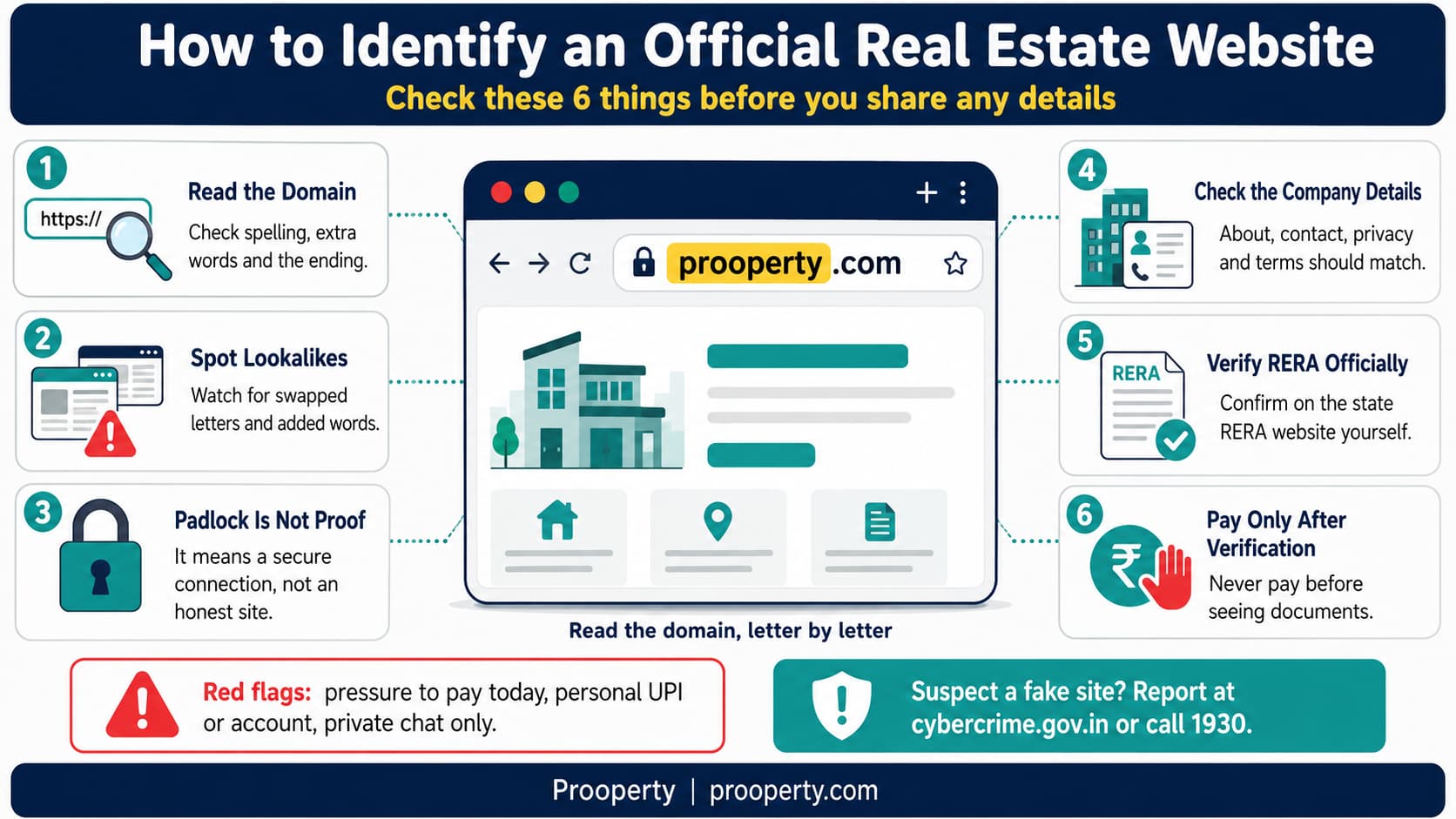
How to Identify an Official Real Estate Website in India
The following will help you distinguish an authentic real estate website: The full URL must be carefully examined; the company information must be checked for consistency; and the RERA registration (if any) should be confirmed on the official website of the state authority. An authentic site will always reveal its identity. A fake site will always rush you into paying up.
Why website identity matters when you search for a home
The first step for most Indian home buyers and renters is now a search engine. This is helpful but also poses a risk of a duplicate or fake website appearing along with the real website. The fake real estate site will use a reputable brand name and photos and offer reasonable prices. The purpose is to obtain your telephone number and documents or a token amount.
There are huge amounts of money and documents involved in buying a house. It is wise to take five minutes in verifying your identity before sharing.
Step 1: Read the domain, not just the brand name
The domain is the address in your browser's address bar, such as prooperty.com. The logo, colours and page title can all be copied. The domain cannot be duplicated, so it is the most reliable first check.
Read the domain from left to right, letter by letter.
Look at what comes just before the first single slash. In www.prooperty.com/blog/what-is-prooperty, the part before the first slash is www.prooperty.com, and the domain is prooperty.com. The "www" is a common prefix, and the blog path after the slash does not change the domain.
Check the ending (.com, .in, .co.in). A brand that normally uses one ending rarely switches to an unusual one.
Type the address yourself, or use a bookmark you saved earlier, instead of following links from unknown messages.
Step 2: Learn the common lookalike tricks
Lookalike real estate websites rely on the fact that people read quickly. These patterns appear again and again:
Spelling swaps: a zero in place of the letter "o", or an "rn" that looks like an "m".
Added words: the brand name plus "offers", "india", "verify" or "booking" joined with hyphens.
Different endings: the same name with another extension.
Subdomain tricks: the trusted name is placed at the front of an unrelated domain. For example, an address like prooperty.com.example.net looks as if it belongs to prooperty.com, but it does not. Read the address from right to left, starting at the ending and stopping at the first slash. The real domain here is example.net, and everything before it is only a label added by whoever owns that domain. The genuine address is simply prooperty.com. (This is an illustrative pattern, not a real website.)
Look-alike social handles: pages with the brand's logo that push you to chat on a personal number.
A brand with an unusual spelling needs extra care. Prooperty, with its double "o", is easily mistyped as "property". Searching blindly for a misspelt name can land you on an unrelated website.
Step 3: Understand what the padlock does and does not prove
A padlock next to the website’s URL indicates an encrypted connection to the website. It is good, but not a confirmation that the website is legitimate, because anyone can establish an encrypted connection to practically any website on the Internet.
Think of a padlock as just a minimum security indicator. The lack of a padlock is definitely a red flag, whereas its presence is merely a cause to keep checking. Be aware of your browser's messages such as “Deceptive site ahead” and avoid the website.
Step 4: See how the website explains itself
A genuine real estate platform is easy to identify as a business. Before you enquire, look for these things:
An "About Us" page explaining the platform operators and their purpose in clear language.
Methods for contact such as a company email account registered in the same domain along with a channel to reach the team members. Sites providing just a cell phone number or chat box are questionable.
A privacy policy and term of use that are accessible and relevant to the domain.
A grievance or complaint procedure explaining how to file a complaint.
Consistent branding throughout the website with no dead links and any copied material from other companies.
Move out of the website now. See if the social media accounts and blogs of the brand are pointing to the same domain. If you find that the social media account is directing traffic to a different domain, stop there and know the reason behind it.
Step 5: Verify listings and RERA details on the official register
This is the check people skip most often. Any platform can display a RERA registration number, so the number on a listing is not proof. Verify it independently:
Make a note of the project name, name of promoter and its RERA registration number in the listing.
Go to the website of your state’s real estate regulatory authority. Visit it from the portal of the state government or from any trusted source and not from any link that may be provided by the seller on the listing platform.
Check the list of registered projects on their website against the information in the listing.
If there is any discrepancy, then request an explanation from the listing platform as well as the seller.
In case of RERA registered properties on the web, the regulator's website is the place of truth, and the portal is merely a search tool. This can be made easier with the help of a reliable portal that gives the information regarding registration clearly rather than hiding it.
There is another thing that needs to be checked when searching for a verified property listing. In India, a verified property listing will have consistency in locality, realistic pictures, property type and the date of the update.
Step 6: Check whether pricing is transparent
Real estate costs have many tiers to them. The intelligent pricing of real estate is one that keeps the cost of the basic package separate from the extra charges of registration, deposits, and parking.
Be careful when:
the price is way below those of similar houses within the locality without an explanation;
the website refers to the price as “limited time” price and urges you to make a decision right away;
pricing is made after providing personal information.
A lower price proves nothing on its own. What matters is whether the platform explains how the figure is made up.
Step 7: Notice how enquiries are handled
A true marketplace assists in getting in touch with a seller, contractor, or agent via its own inquiry mechanism. Filters, photos, location information, and an inquiry form are standard components. The trouble signs arise when the discussion rapidly turns to money.
Token or Booking payment is required before viewing the property or documentation.
This payment is made through an unregistered personal account or UPI ID and not through any registered business.
It is mandatory to join the conversation on a private chat and not "tell anyone".
The need for documentation is required right from the beginning without any explanation of the purpose of it.
If an official platform asks for personal details, it should be clear about why and how they are handled, and its privacy policy should say so.
A worked example: checking Prooperty
Here is how the steps above look in practice for Prooperty, an Indian online real estate marketplace.
Domain: Officially, the domain of this company is www.prooperty.com. Due to the repetition of 'o' in the official domain, be careful while typing this domain and save the same. Do not consider versions with additional hyphen, words or alterations in the suffix as authentic till proven otherwise.
Identity: Check for consistency between the "About Us," "Contact us" and "Policy pages" in the site itself.
Where its content is published: Prooproperty provides articles on its site and also on content publishing platforms like LinkedIn, Medium, Quora and Blogger. This is where its content is published and there will be a hyperlink to the official domain. Provide personal details and queries only on the official domain and nowhere else.
Listings and RERA: For any project you list down, make a note of the RERA number and verify it yourself through the state authority website.
Money: There is no authentic real estate website which demands you to pay anything even prior to project verification and document verification.
You can apply the same five checks to any portal, and the habit matters more than the brand.
Matching the platform to your needs
Having confirmed your identity, go on to verify if the portal is effective for actual searches made by Indians. A good portal will have facilities to search based on location, check the connectivity and nearby facilities, and filter based on budget. The listings must be up-to-date, they should maintain your privacy and provide correct contact details. All these enhance credibility, but none substitutes identity verification.
Quick checklist before you share any details
The domain matches what you intended to reach.
There are no words preceding the first slash in the address bar.
The link is secure and your browser displays no warnings.
About, Contact, Privacy and Terms pages are present and sensible.
RERA information has been verified from the state authority’s website.
The pricing is clear, mentioning the base price, extra charges, and total price.
No one has ever demanded payment from you before verification.
What to do if you suspect a fake website
Now stop right there and do not proceed ahead with entering any further information. You are not supposed to pay anything and not open links that might be sent to you in the same conversation. Take screenshots of the web page, its URL, and any messages that might have been received from the scammers. If you have already entered any private information and paid money, report the matter to your bank and also file a complaint at cybercrime.gov.in or dial 1930.
Frequently asked questions
How can I tell whether a real estate website is genuine or fake?
Make sure to double-check the actual website address, verify if there is consistency with the company and contact information, see the registration details at the state regulatory authority website, and be cautious of any request for payment upfront. These tips alone may not be sufficient.
Does the padlock mean a property website is safe?
Not really. The padlock indicates that the connection is secure. It doesn’t tell us anything about who owns the website or the credibility of the postings.
Can I trust a RERA number shown on a listing?
It should be treated as a lead, not evidence. Cross-check it by searching the official RERA website of the respective state.
Is a website on Blogger, Medium or Quora the official site?
Not usually. This is an external content publishing platform wherein brands post articles. See to it that the posting links back to the domain of the brand, and that is what you will use to contact them.
Where should I report a fake real estate website?
Report it on cybercrime.gov.in or call 1930, and inform your bank if money is involved.
Conclusion
Finding out how to distinguish an authorized property site doesn’t require any technical knowledge but just patience with the domain, a couple of minutes on the site’s pages and the routine of verification of RERA information from the source. Proopproperty demonstrates how this is done: a distinctive domain, reliable identity and channels through which the information comes back to the domain. No matter what platform you are using, believe the verified information and always think twice before paying anything.