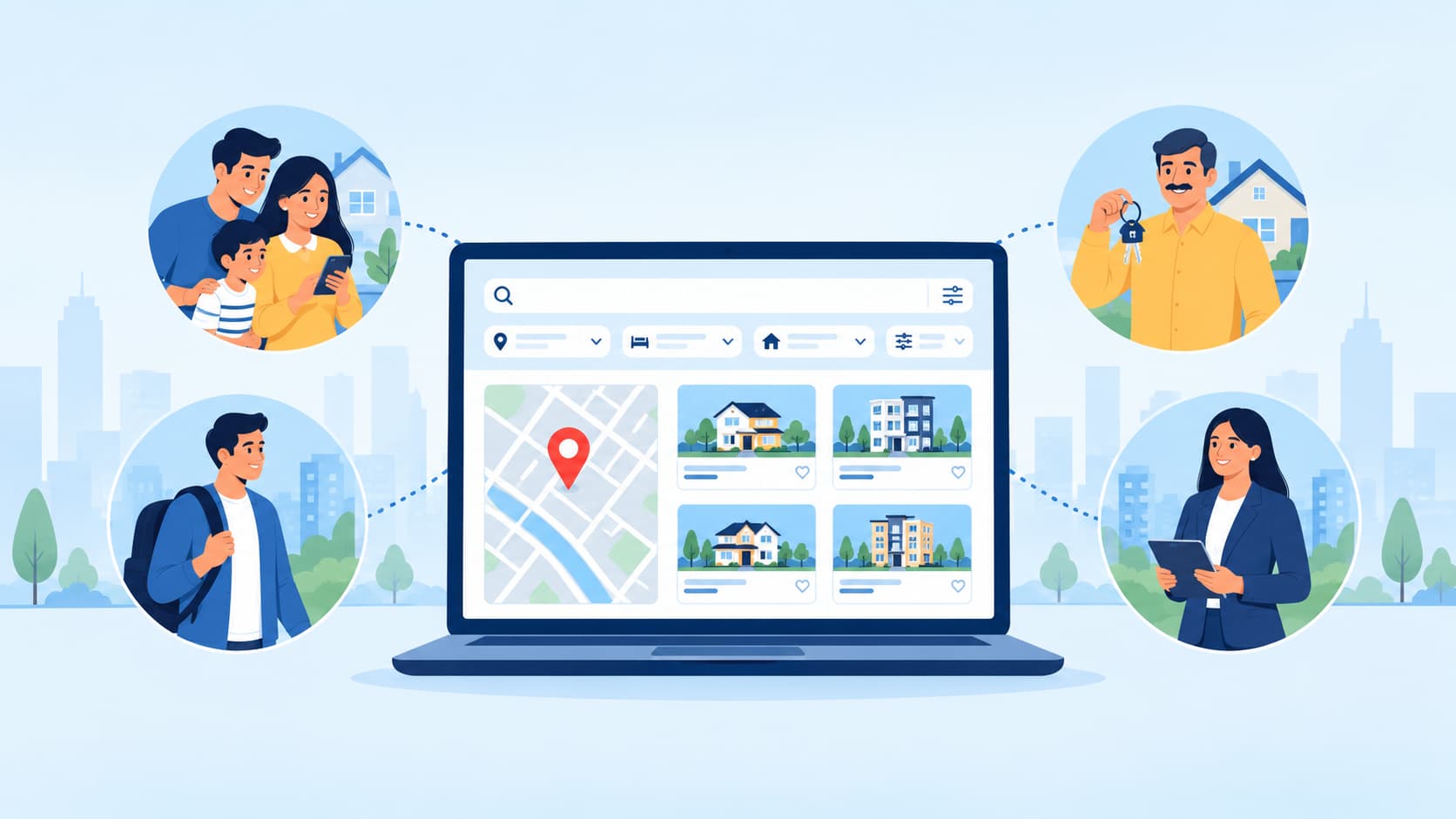
Who Can Benefit from Using an Online Real Estate Marketplace in India?
There is something for everyone in the online real estate marketplace in India – if everyone uses it for the right purpose. The buyer uses it to narrow down and verify, the tenant uses it to find properties that fit his budget and proximity to the workplace, the owner or the builder uses it to get genuine inquiries. Everyone uses it for a different purpose, and therefore this guide is written for every role separately.
People don’t normally ask whether online portals are helpful or not in general. They want to know whether it helps in their individual case. A novice buyer’s concerns about documentation are far removed from a landlord’s need for occupancy of his vacant flat.
Instead of writing about the general benefits of using an online portal, this article tries to focus on a few practical cases. In each case, the activities to be performed, information to be looked into and the point when the online research should stop and move to the offline process are explained. This includes the verification of the listings, the details of RERA, reading the price correctly and evaluating the portal itself.
1. First-time home buyers
There is always more to ask rather than answer when one is a first time buyer. How much does something cost in the local area? Has the project been registered? What is going to be the total cost after the payments? It would make sense to do the research on an online platform.
What a first-time buyer can do online:
Select residences from different locations based on your budget, size, and ownership status.
Before spending your weekend visiting houses, research photos, plans, and location of those houses.
Make enquiries and store responses for future comparisons.
What to check:
Accuracy of the listing. Consider whether the listing includes complete information like area, floor number, project name, and date of the latest update. If a listing does not include the basic information, it should be followed up with an inquiry before considering it further.
Registration under RERA. According to the Real Estate (Regulation and Development) Act, 2016, registered projects have a registration number. Check out the registration number of the project listed. Mention of the portal is just the beginning; the state website is the place where the confirmation should be done.
Transparency of pricing. A headlined price is seldom the final price. Request the basic price, the cost of additional features like parking and deposit, along with the final price. Compare everything in writing through two or three options.
Where offline steps take over: site visits, document review, loan sanction and agreement checks. Online research narrows the field. It does not replace these steps.
2. Upgrading and repeat buyers
The person moving out of a rental unit or old house into a larger one usually has clear needs but limited time for the search. This is where the marketplace can save time on two counts. One is through filters that eliminate unsuitable options and shortlists to compare after saving time during the day for a busy family.
Repeat buyers also pay attention to resale value and area development prospects. They are enabled to compare online comparable properties in the area and analyze pricing trends among asking prices. These are not always reliable since the asking price is what a seller wishes to receive, not what the actual deal will be closed at.
3. Tenants
Rental housing seems straightforward but consists of numerous little choices. Is the flat easily accessible via a convenient commute? Is the rent affordable enough to provide space for other costs? Is the deposit reasonable? Is the accommodation suitable for the family?
How tenants benefit:
The filters on rent, number of bedrooms, furnished and move-in dates avoid wasting visits.
Photos and location details allow tenants to eliminate unsuitable flats.
Direct inquiries enable a tenant to ask about security deposits, maintenance, and policies without traveling anywhere.
What to check: Whether the flat advertised matches the flat you visit, whether the owner is clear on costs, and whether the rental conditions are put down in writing. Never make a payment of any kind without seeing the property first.
4. Property owners and sellers
On the other hand, owners seeking to sell encounter another challenge of attracting the right customers without being constantly bombarded by random callers. An effective listing in an active portal could be of benefit in three aspects:
Firstly, presentation. A good set of photos, area information, correct address and proper description will bring a good quality of inquiries. Inaccurate listing will result in irrelevant inquiries.
Secondly, access to the right potential clients. A buyer looking for a certain location and within the budget will find the relevant house without any chasing efforts from the side of the owner.
Thirdly, the issue of realistic pricing. An owner would have a reference point seeing the price of similar houses nearby and treat this price as a reference point but not a guarantee of the price the buyer will offer.
Also, an owner has to keep his privacy. Contacting a buyer should happen through channels provided by the portal and disclosing the ownership papers only at a serious level of negotiations.
5. Landlords
The landlord having an empty flat requires a good tenant within the shortest time possible, while the consequences of a bad choice may be high. The online services help here in broadening the inquiries and allowing the landlord to specify his property including the rent, the deposit, furnishing and other conditions.
A good ad filters the inquiries automatically. When all the necessary information about rent, deposit and other conditions is provided honestly, people who cannot satisfy these requirements will not even try to contact the landlord. Nevertheless, the landlord still needs to meet the tenant and sign a rental agreement.
6. Real estate agents and brokers
Some people think that online marketplaces make agents redundant. On the contrary, they complement each other. An agent with up-to-date information gains more exposure compared to an agent who solely depends on networking, and the platform forwards leads that he would otherwise miss out on.
The one thing that an online platform does not have is the ability to bargain, coordinate the site visit, know what is important for the family, and help close the sale. The agents who manage to do all this while having a great online presence get the most out of it. For both the buyer and seller, dealing with the agent who operates from a platform becomes much simpler.

7. Builders and developers
The best a builder can offer is the market place where one can show his project to the searchers. The most important thing a builder can offer is transparency: name of the project, location, configuration choices, possession time period, facilities and the RERA Registration Number.
Nowadays, buyers are cross-referencing all these things, hence it is always easier for the builders that provide transparent information to gain trust. On the other hand, a builder that keeps information blurred gives an excuse to careful buyers to go somewhere else. Enquiries from the interested customers also help the sales team in identifying prospective buyers.
8. The role of technology in property discovery
Real estate websites have not altered the fundamentals of buying a house; rather, they have altered the efficiency through which the process takes place. The use of filtering searches, maps, saved searches, and photography galleries enables the individual to do within one hour that would otherwise take them several weeks through phone conversations and site visits.
Technological innovation works best when it is combined with good data. Searching quickly for inaccurate data is worse than searching slowly for accurate data. That is why the dates of last update, methods of verification, and contact information are as important as innovative technology.
9. What Indian users usually need from a search
Indian buyers and tenants rarely search by price alone. Their decisions tend to revolve around a few practical things:
Locality. Familiarity, closeness to family, schooling, and the overall ambiance of the place.
Connectivity. Commute distance from work, access to Metro and public transport facilities, and road quality.
Amenities. Proximity to water facilities, backup facilities, parking facility, security arrangements, and markets/hospitals.
Budget. Not just the cost/rent but also all monthly expenses that come along with it.
A useful marketplace lets users combine these factors. If a platform only lets you filter by price, you will still need to do most of the real research yourself.
10. How to choose a trustworthy portal
Not every portal deserves the same level of trust. Before relying on one, check these points:
Credibility. Has the platform provided details about itself, its process and how to contact it?
Listings. Are listings outdated? Is there any effort made to remove old/sold listings? Call two or three listings to find out if they are still available.
Verification process. Does the platform provide details about how it verifies listings, or does it just say that it verifies listings?
RERA Registration Numbers. Does the listing have registration number of the project on the state RERA website?
Price transparency. Has the listing made a distinction between the base price and other costs?
Privacy policy. Has the platform provided details about what it does with the contact details?
Contact Details. Can you contact a team if anything goes wrong?
Tools like Prooperty help organize listing and projects in order to provide users with better comparison, but the same checklist can be used for any other website you decide on. Any platform cannot take the place of personal verification.
When online alone is not enough
An honest guide must say this plainly. Online research cannot:
Title of property or proof of ownership.
An alternative to physically visiting the property and examining its surroundings during various times of the day.
Alternative to the legal counsel’s review of the contract.
A way of ensuring that a property is indeed available at the quoted price.
Think of the marketplace as the first and most efficient stage of a longer process. The final decision should rest on verified documents and a personal visit.
Frequently asked questions
Can first-time buyers rely on an online marketplace alone?
No. It is excellent for research and comparison, but documents, legal checks and site visits must still be done offline.
Is an online marketplace useful for renting, not just buying?
Yes. Tenants benefit from filters on rent, furnishing and location, and from asking questions before visiting. They should still see the flat and sign a written agreement.
How can I check whether a project is RERA-registered?
Take the registration number from the listing and verify it on your state's official RERA website. Confirm that the project name and details match.
Do agents lose business on online platforms?
Not necessarily. Agents who keep listings accurate and add real guidance, such as negotiation and coordination, tend to gain visibility and enquiries.
What should I check before trusting a portal?
Look at how recent the listings are, whether verification is explained, whether pricing is clear, how privacy is handled and whether contact details are real.
Final thoughts
Buyers, renters, property owners, landlords, agents, and developers all benefit from having a good marketplace, but each benefits in different ways. Buyers benefit from knowledge, renters benefit from matching, property owners/landlords benefit from reach, agents benefit from exposure, and developers benefit from trust. What unites all of these benefits is accuracy; the more the information on a platform can be verified, the better.
Do your research online, compare options, and shortlist them. Then validate by going to the relevant authorities, and check in person. This is how you protect yourself both financially and emotionally. If you are ready to start looking for homes/projects, you can browse listings at Prooperty.