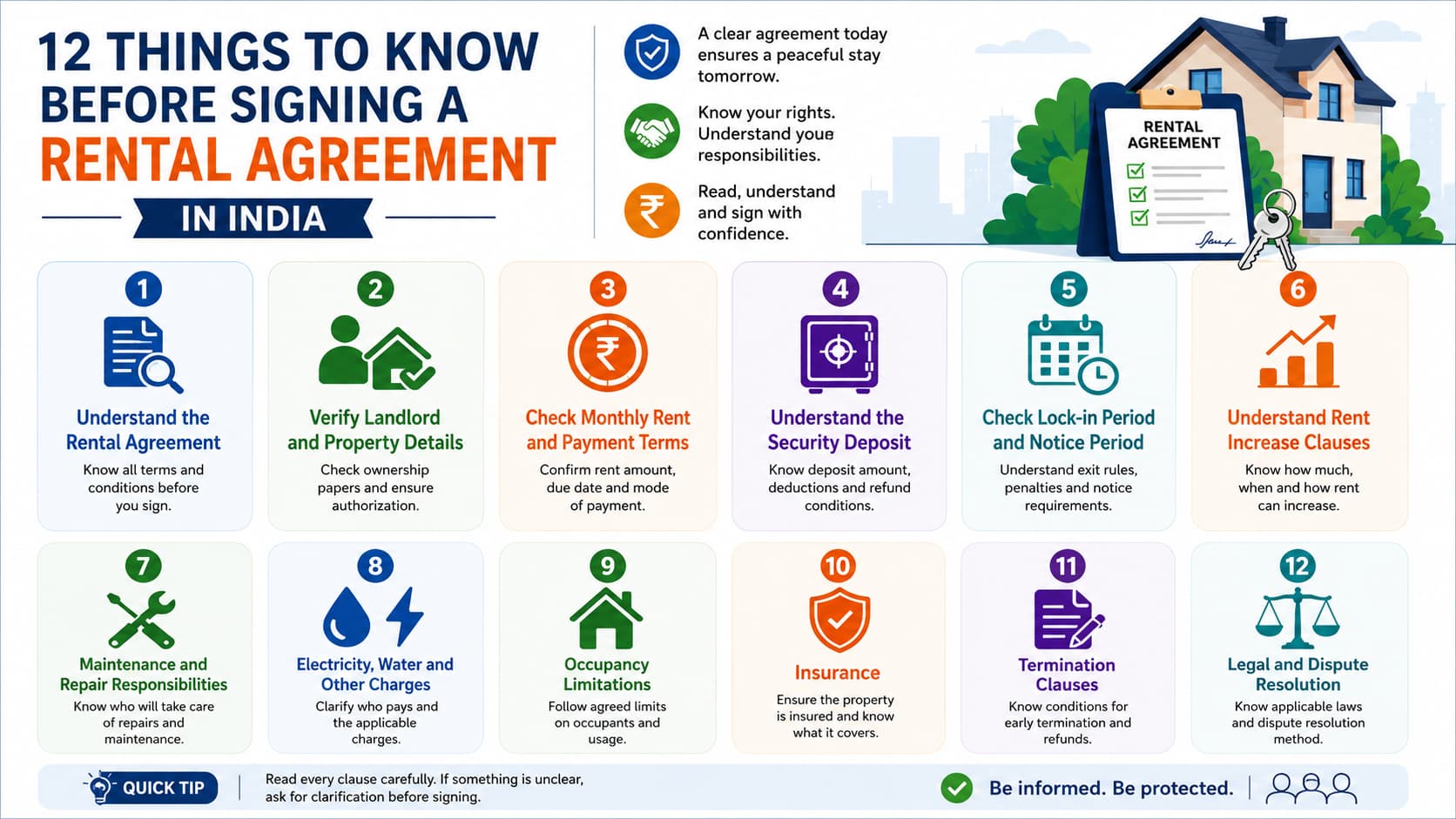
Renting a home involves more than agreeing on the monthly rent and paying a security deposit. Tenants may face unexpected expenses, maintenance issues, occupancy limitations, or disagreements over the return of their security deposits because of a misunderstanding of the rental terms prior to signing.
A rental agreement sets out the rights and responsibilities of both parties. Tenants should be aware of rent, security deposit, notice period, lock-in period, maintenance charges and other key terms prior to signing.
Before signing a rental agreement, tenants should explore rental properties on Prooperty to compare available homes and understand rental options before making a final decision.
This article highlights 12 vital things to know before signing a rental agreement in India. Regardless of whether you are leasing a property in Gurgaon, Delhi, Faridabad, or any other city, you can use this list to help you prepare.
1. Understand the Rental Agreement
A rental agreement is a written document that serves as proof of the terms and conditions agreed upon by the landlord and tenant when renting a home. It usually contains details such as the names of the landlord and tenant, rental premises, monthly rent, security deposit, rental period, and payment methods.
In some places, the agreement is known as a Leave and Licence Agreement. A lease and a licence have different characteristics and legal implications. Tenants should understand these differences before signing the agreement.
2. Verify the Landlord and Property Details
Ensure that the individual who you are negotiating with is either the homeowner himself or another individual authorised by the homeowner to let the house. Request him to show the ownership papers such as the sale deed or allotment letter along with the government identification of the landlord. Compare the name mentioned in these documents with that mentioned in the agreement.
If it is an agent or a relative of the owner signing the agreement, make sure that there is authorization from the owner. If you are in a housing society in Gurgaon, Delhi and Faridabad, then check whether the society permits the rental of the flat to tenants.
3. Check Monthly Rent and Payment Terms
It must specify the actual monthly rental, due date, and mode of payment. It is advisable to use either bank transfer or UPI, since there will be proof of payment. In case you use cash, make sure you get a signed receipt each month.
Ensure that the rent covers maintenance, parking and/or society expenses. You should check for the grace period and any charges for delayed payments as well. If a tenant rents an apartment near Cyber City in Gurgaon, it is important that he/she finds out if the rent charged already includes society maintenance or not.
4. Understand the Security Deposit
The security deposit is usually the largest sum you pay upfront, hence, needs to be clarified in the contract. Verify the amount, the mode and timing of payment, and how soon the deposit will be refunded once you move out.
Be clear about situations where deductions can be made by the landlord like late payments of rent, late utility bills, and any other form of damage beyond normal use and wear. A good clause should provide an explicit list of such instances and time for the return of the deposit, say within a certain number of days from giving back your keys. Be wary of ambiguous language such as "the discretion of the landlord." Model Tenancy Act, 2021 suggests guidelines for limiting the security deposits, but its clauses cannot be considered applicable in all parts of India. You need to ensure whether the laws regarding tenancy in your state are similar or not.
5. Check the Lock-in Period and Notice Period
The lock-in period is the period during which either party cannot terminate the lease without incurring penalties. The notice period refers to the period during which you have to inform either party regarding the termination of the lease.
It is important to read both of these clauses thoroughly. A lock-in period of twelve months may not suit your situation, especially if your job involves transferring you to another city away from Gurgaon. Find out what will happen if you exit before the completion of the contract period, whether you will lose the deposit or have to pay the outstanding rent or any fixed penalty. Make sure that the landlord is equally bound to abide by the notice periods.
6. Understand Rent Increase Clauses
Most contracts have provisions for an annual or periodic rental increase. You must be able to see what the amount of rental increase will be and when it becomes effective – whether it is expressed as a percentage or a flat rate.
Watch out for the words "rent shall be subject to revision by the landlord from time to time." This is where an escalation clause comes into play. Check the renewal terms as well, whether it will be renewed automatically or you will have to negotiate again for the next period.
7. Maintenance and Repair Responsibilities
Reparations are one of the most frequent sources of arguments in rental homes; hence, it is crucial to clarify the allocation of duties in the agreement. It is a general norm that the owner of the house takes care of the structural damages, serious plumbing and electric work, and permanent appliances supplied by them.
Note down the person responsible for taking care of expenses like geyser repairs, maintenance of air conditioning, painting on leaving the house, and pest control. Any promise made by the owner to take care of something prior to your moving in, like repairing a leaking tap or wardrobe door, must be included in the agreement with a deadline.
8. Electricity, Water and Other Charges
Clarify how much each running expense will cost. The electricity expense might be on a different meter in your name or be paid either by the landlord or by the society. It is also necessary to find out the price per unit, as there is a surcharge applicable in case of societies. Other expenses could include water, gas, Internet, DTH, society maintenance and generator back-up.
It is recommended to look at the bills to know the initial meter reading in the agreement. It helps avoid paying something that was due even before you moved there. If you live in a walled society in Gurgaon, then it should be clarified whether any kind of one-time charge exists.
9. Check Restrictions and Property Usage
Every contract will impose restrictions on the use of the property, and there are a few which will impact on your everyday routine. Make sure that you find provisions regarding pets, overnight stay, the number of people residing in the house and subleasing. Ensure that you are aware of how much parking space you will be allotted and other rules imposed by the society for visitors or deliveries.
Your contract should also include a provision indicating that the home will be used for residential purposes only. If you wish to conduct business or work from home, then make sure that it is permissible. Some landlords in Delhi/Faridabad prohibit bachelor occupancy. Also, there are societies which have their own policy with regard to tenants.
10. Verify Agreement Registration and Documentation
It is in documentation that the state regulations come into play. There are differences between states in terms of stamp duty and registration procedures for renting agreements, so what applies in Haryana does not necessarily apply in Delhi and Uttar Pradesh. You cannot make the assumption that there is one set of laws for all of India.
According to the Registration Act of 1908, there are some lease agreements that must be registered under the provisions contained in the law, such as leases from year to year and those whose duration exceeds one year.
Tenants should also understand the stamp duty on rent agreement to avoid unexpected documentation costs and ensure compliance with applicable state regulations.
An agreement for a period of eleven months is not always automatically exempt from all kinds of legal obligations. It is always wise to determine the stamp duty, registration and execution requirements before you sign any agreement, by consulting the relevant authority in the concerned state. Keep copies of all the documents for your records.
11. Inspect the Home Before Moving In
Inspect the property before moving in. Look at the walls, ceilings, floorings, windows, doors, taps, drainages, switches, lights, fans, wardrobes, kitchenware and any other equipment that comes along with the rental.
Make sure you take dated pictures and videos, then make a list of all that you receive. Get it signed by the landlord and add it as part of the contract. This document will help safeguard your security deposit upon vacating, since it proves what state the home was in upon moving in.
12. Common Mistakes Tenants Should Avoid
-
Signing without reading the full agreement, including the final pages.
-
Accepting verbal promises that are not written down.
-
Paying a large deposit in cash without a receipt.
-
Skipping the ownership check and trusting an agent alone.
-
Ignoring the lock-in, notice and early-exit terms.
-
Leaving the deposit refund conditions vague.
-
Not recording the home's condition with photos and an inventory.
-
Forgetting to ask about maintenance and utility charges.
-
Assuming registration and stamp duty rules are the same in every state.
If you are making comparisons among several choices, you may look at property for rent in Gurgaon and select the houses whose landlord will write down all the terms of agreement on paper. You may also look at other properties for rent in order to have more choices.
Frequently Asked Questions
1. Is a rental agreement mandatory for tenants?
A written agreement is strongly advised even where the law does not force you to sign one. It records the rent, deposit and terms, and it gives you proof of your tenancy for address verification and for any dispute.
2. How much security deposit is normal?
It varies by city, locality and landlord, so there is no single figure. Some states and the Model Tenancy Act, 2021 suggest limits, but these apply only where adopted. Whatever amount you agree on, make sure the refund conditions and timeline are written down.
3. Does a rent agreement need to be registered?
It depends on the term and the state. A lease of more than one year generally requires registration, and many agreements are made for eleven months to avoid it. Stamp duty differs by state, so verify the local rule before signing.
4. Can the landlord increase rent during the tenancy?
Only as the agreement allows. If the agreement fixes an annual percentage, the landlord cannot raise the rent beyond it during the term. If it is silent, discuss and record the escalation terms in writing before you sign.
5. What should I do if the landlord keeps my deposit unfairly?
Start with a written request that cites the agreement and your move-in inventory and photos. If that fails, you can send a legal notice or approach the rent authority or consumer or civil forum applicable in your state. A local lawyer can advise on the right route.
Conclusion
Take your time to go through all the terms in the rental contract before signing to ensure that you comprehend each term. Ensure that the landlord's identification, the rental cost and security deposit, notice and lock-up period, and the one accountable for repairs and other services are clear.
It is also advisable to have information on stamp duty and registration in your state. Take photographs and list down all the items in the house while noting the condition of the house at the beginning of the tenancy.
It is important to have a well-reviewed rental contract to avoid disputes during the tenancy period.