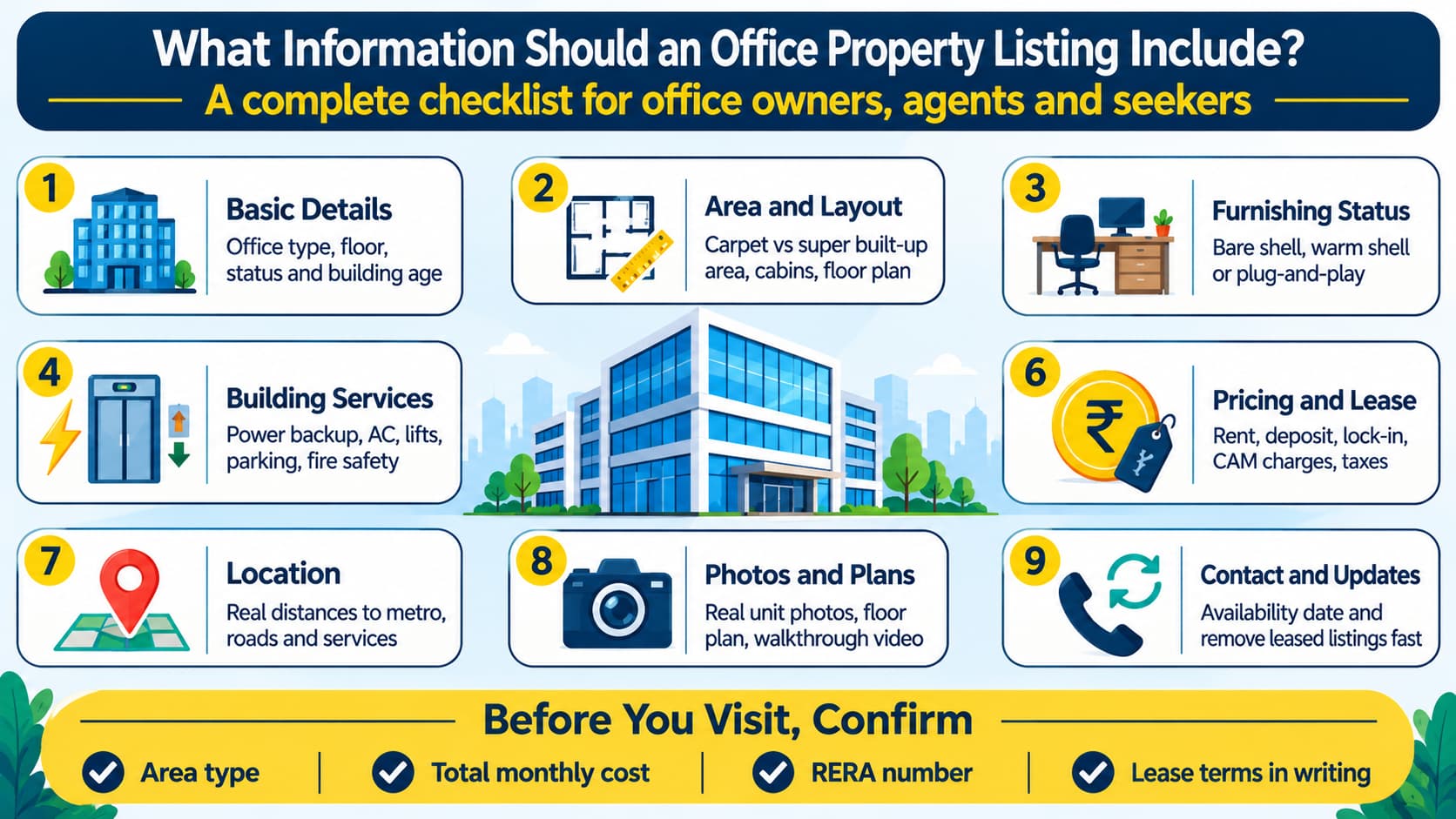
Selecting an office space is a business matter rather than purely a residential one. The wrong office may result in additional monthly expenses, an unsuitable design, and lack of capability to facilitate day-to-day activities. However, many advertisements for offices provide nothing beyond the monthly rent and pictures of the premises. The following is a list of the information that an office real estate advertisement should have. You may use it both if you want to create a listing as a seller and evaluate the available options as a buyer. The buyer/tenant looking for an apartment is interested in the number of bedrooms, price, and location. The office looking individual is concerned with a longer series of questions like how many workstations can be accommodated, whether the power backup is available for the entire load, maintenance cost, and approval for commercial use. Listing is important since offices need staff members and clients, and incur monthly expenses. It avoids wasting time on both parties because of vague listings. Start with the facts that tell a reader what kind of space this is. Type of office: independent office, shop cum office, unit in an industrial/IT park, co-working/business center space. Nature of transaction: sale, lease or rent. Condition of the office: ready to move into, construction ongoing or pre-let (occupancy by the tenant). Building information: name of the building, floor number, total number of floors, and year of completion. If the unit is pre-leased, say so, along with the lease end date and current rent. An investor needs this information before anything else. Area is the most commonly compared figure in an office listing, and also the most commonly misinterpreted. Mention the category of the area. Indicate whether the figure mentioned is that of carpet area, built-up area or super built-up area. Carpet area refers to the usable area within the office. The super built-up area consists of the carpet area plus a portion of the common area, including lobbies, corridors and lifts. The difference between the two is referred to as loading, and differs from building to building. For instance, an office listing mentioning 1,000 square feet of super built-up area might end up offering much less usable carpet area. A person comparing two offices based on the wrong area might end up choosing the more expensive office, without even knowing it. Whenever possible, include both measurements, and mention them based on the agreement or approved plan, not on estimates. Show the layout. A listing should also cover: Cabins and number of open workstation spaces Meeting room space, reception area, pantry, and storeroom Number of private or public washrooms Height of the ceiling, and columnless floor A floor plan diagram Imagine an accounting firm that requires six computers, a cabin for a partner, and a conference room. It would not learn much from a listing of just "1,200 sq ft, good location." But if there was a floor plan, it would know within minutes whether to look further. Office furnishing falls into three common categories, and a listing should say which one applies. Shell condition Bare Shell – an unfurnished and unfinished space with only basic construction. There is no flooring, ceiling and partition. Warm shell – only basic finishing has been completed. This includes flooring, ceiling and lighting along with washrooms. No partitions and furniture have been made. Plug & Play (Furnished) – the space has been completely finished and furnished for occupation. What items will be included in the fit-out should be listed, including computers, furniture, air conditioning units, partitions, and wiring. The fit-out may not be cheap, and thus the actual cost of the space will be affected by this information. Offices depend on infrastructure that homes rarely need. A good listing covers: Power: backup systems, the power capacity of the unit, and whether backup facilities are inclusive in the rental amount or paid for separately. Air-conditioning: centralized or split system, and the working hours of centralized air conditioning. Lifts and accessibility: number of lifts, service lifts, and 24-hour accessibility. Parking space: car parking slots and two-wheeler parking slots. Security: guards, security systems in common areas, and cameras in the common areas. Fire safety: fire safety facilities in the building. Internet connectivity: internet connectivity options from different internet providers. These are the features that affect daily work, so show them clearly rather than leaving them for a later conversation. Trust in an office listing depends heavily on its documents. Without turning the listing into a legal file, it should confirm the following. Ownership: The name of the owner and the proof of ownership must be there. Purpose of use: The premises are approved for commercial/office purposes. Occupancy certificate: Occupancy certificate from the local authority on the completion of construction work indicating that the building is constructed as per the plan sanctioned. Fire safety clearance: As the fire safety clearance will depend upon the state, height of the building, and purpose, the listing must mention what clearance is there. RERA Registration: If the office is in a project which comes under the Real Estate (Regulation and Development) Act, 2016, then the RERA registration number must be mentioned. The RERA Act applies to commercial projects also, just like residential ones, usually when the land size exceeds 500 square meters or when the project has more than 8 units. RERA number needs to be verified by the reader through the official website of the RERA in concerned states. Project name, name of the promoter, and validity should be matched. RERA number is not required in cases where RERA doesn't apply to that particular unit, for example, resale office of an old building. This is the section that protects both sides from later disputes. A clear listing separates the following. For rent or lease: Rental payments per month Security deposit, often in terms of months Lock-in period and notice period Annual rental increase Term of lease being offered For sale: Price per square foot and the area type it is based on Total estimated cost, including extra charges Extra charges (both cases): Maintenance/CAM Charges: Common Area Maintenance consists of shared expenses for housekeeping, elevator maintenance, security, and common electricity. State the exact figure and whether it is inclusive in the rent. Parking charges, if any Taxation: GST on rent/sale may be applicable based on the registration of the property owner and the nature of the deal, so one must check with the chartered accountant. Stamp duty and Registration Charges that vary from state to state. As far as registration of the lease agreement is concerned, the Registration Act of 1908 states that leases which are above one year in length must be registered. There are different requirements for registration of leases by states. Therefore, it is advisable to state "terms of lease and registration according to the rules of the particular state." If the rent can be negotiated, mention it straight forwardly. An offer of a rent which is not valid for the property under consideration can destroy trust more rapidly than anything else. Office seekers think in terms of commute and client access. A useful listing gives real distances instead of general phrases. Distance to the nearest metro/railway station as well as to the major roads/highways Availability of public transport and cabs/autos Availability of nearby banks, places for eating, lodging and other facilities for your employees and guests Visibility and signage, which are important for businesses dealing directly with customers like clinics and consultancies If the metro is 2 km away, write 2 km. A seeker who learns this after visiting feels misled, while one who knew it in advance does not. Photos are the part of a listing readers trust most and verify least. For an office, they should show the actual unit, not another floor or a builder's render, unless the image is clearly labeled. A solid set includes: Entrance, reception area, and main work area Cabins, conference rooms, and pantry Toilets, parking, and lobby of the building Layout Plan Short video tour, helpful for decision-makers who cannot visit immediately Shoot in daylight, keep the space tidy, and include honest views of the condition. Do not edit photos in ways that change the size or finish of the space. The last part of a good listing tells the reader what happens next. Who will answer the call (owner, agent, or builder), how to reach them, Visiting times, whether notice needs to be given, Date of possession or availability, Listing last revised date Mark the listing as leased or sold the day it happens. Stale listings are one of the most common reasons office seekers lose trust in online platforms. On an Indian online real estate marketplace such as Prooperty, keeping listing details current is part of how readers judge whether information can be relied on. Failing to specify the property type, which means the comparison will be unfair. Not mentioning any extra charges like CAM and parking fees. Using images for an alternative unit or even outdated images. Keeping the description of furnishings too general, like “semi-furnished” with no details. Missing the lock-out, notice, and escalation clauses. Citing an unverifiable RERA number or pretending that RERA applies. Keeping the office units that have been leased/sold online. Why does carpet area matter in an office listing? What are CAM charges in an office lease? Does an office lease agreement need to be registered? Does every office listing need a RERA number? What is the difference between bare shell and plug-and-play offices? A comprehensive listing of an office property saves time for all. It lets the seeker know if the property suits his group, the actual rent amount, and the supporting documents. It makes for better inquiries and reduces disagreements for the owner, agents, and developers. Be it listing an office or selecting one, ensure that you have checked the points on the list above: mention the type of area, state the total amount, verify the documents, and ensure your listing is always updated. The right information is what helps convert an inquiry to a visit to the site.What Information Should an Office Property Listing Include?
Why Office Listings Need More Detail Than Residential Ones
1. Basic Details: Office Type, Status and Building
2. Area and Layout
3. Furnishing Status
4. Building Infrastructure and Services
5. Legal and Compliance Details
6. Pricing and Lease Terms
7. Location and Connectivity
8. Photos, Videos and Documents
9. Contact, Availability and Updates
Office Listing Checklist
Common Mistakes in Office Listings
Frequently Asked Questions
The carpet area is the space your team can actually use. A super built-up area includes a share of common areas, so two offices with the same super built-up figure can offer different usable space. Always ask for both figures and the area type behind the quoted price.
CAM stands for Common Area Maintenance. These charges cover shared services such as housekeeping, lifts, security and common electricity. Listings should state the monthly amount, how it is calculated and whether it is included in the quoted rent.
Under the Registration Act, 1908, leases longer than one year generally need registration, and stamp duty depends on the state. Rules and charges differ, so confirm the current requirements locally or with a legal professional before signing.
No. RERA applies to registrable commercial projects, generally those above the prescribed land-size or unit thresholds. If an office belongs to such a project, check the number on the state RERA website. A resale unit in an older building may not carry one.
A bare shell is an empty space that the occupier fits out. A plug-and-play office is ready to use, usually with furniture, workstations and cabling. Bare shell can suit businesses with custom needs, while plug-and-play suits teams that want to start quickly.Conclusion