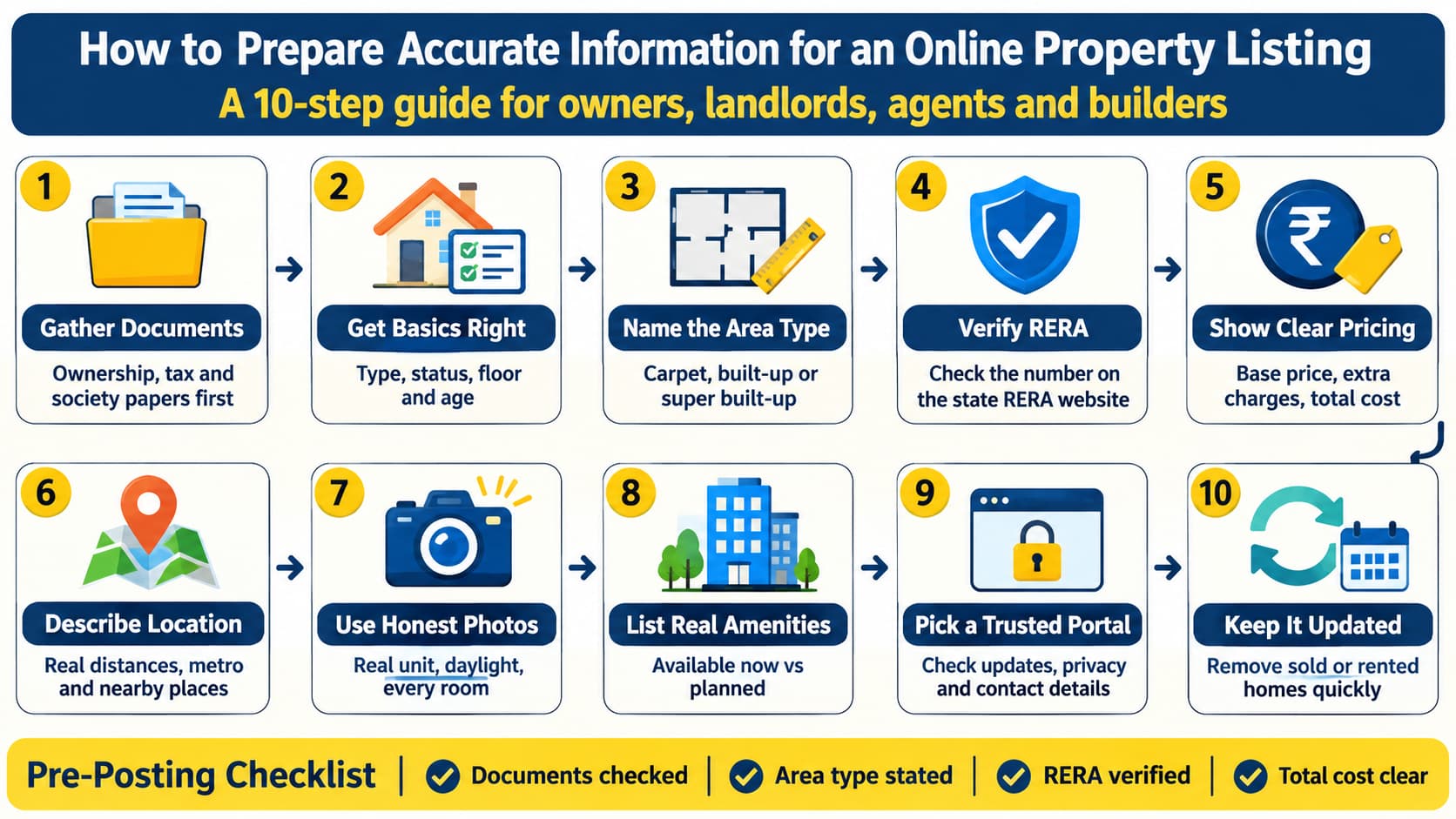
The information in your online listing may be the first thing potential customers see before arranging a visit. If the listing contains mistakes, unclear details or exaggerations, they may lose interest or make decisions based on misleading information. This guide is useful for property owners, landlords, real estate agents and builders who want to create accurate and informative listings. It also helps buyers and renters understand what to expect before making further enquiries. Buyers today select properties online before ever talking to anyone. They are looking at multiple homes side by side, and so any listing that does not have a carpet area or is priced confusingly is immediately dropped. It also shields you from problems. Getting the carpet area or price wrong means that you will face problems, and queries made on incorrect assumptions seldom convert into something worthwhile. A well-written listing weeds out unwanted people. Do this first, and everything else becomes easier. Keep these ready: Proof of Ownership (Sale Deed, Allotment Letter, or Builder-Buyer Agreement) Latest Property Tax Receipt and Maintenance/Society Charges Receipt Details of Electricity and Water Bill Payment, where applicable Details of Society or RWA, in case of pending charges For under-construction or newly launched projects: RERA Registration Details and Approved Plan Writing from documents, not from memory, is the simplest way to avoid errors. If a detail is not in your paperwork, confirm it before you publish it. Here are some of the factors buyers use for comparison. Mistakes made in any of these will cost you the highest amount of credibility. Type and status of property. Make sure to explicitly state whether it is an apartment, builder floor, independent house, plot or commercial unit. Clarify whether it is ready to move-in, under construction or resale. Area, along with the area’s type. Clarify whether the area measurement is carpet area, built-up area or super built-up area. Buyers will be comparing listings and hence, confusing all these will make your listing appear either too cheap or expensive. Refer to the number in your agreement/plan, not your estimation. Configuration and Floor. The number of bedrooms, bathrooms, balconies, floor number and total number of floors in the building. Also include its orientation and whether it is unfurnished, semi-furnished or fully furnished. If it’s a new or upcoming project, there should be a mention of the RERA registration number in the listing. However, an RERA registration number stated in the listing is only a claim, which must be verified through the state RERA website, and as a seller or developer, it is your responsibility to do so. Both the project and the name of the promoter tally with the registration number The registration is still valid The possession date and the project particulars tally with your writings “Should it be that the property isn’t registered with RERA or that the guidelines don’t apply to your resold asset, refrain from stating otherwise. The field can remain blank rather than guessing. It’s safer to say nothing than misrepresent the facts.” Price confusion is one of the biggest reasons buyers lose trust in a listing. A clear listing separates the following: Price per square feet/total price Extra charges, including parking charges, club membership fee, maintenance deposit, electricity backup, and Preferential Location Charge (PLC) Charges from the government side, for example, stamp duty and registration charge that are dependent on the state and type of transaction Actual total cost For rentals, include the rent per month, security deposit, and whether maintenance is included or is additional, along with the lock-in period if there is one. Do not quote a highly discounted starting rate for a single property that buyers can’t actually purchase. If the cost is flexible, be honest about it and do not try to hide it. Also, if you alter the pricing, make sure to update your listing on the same day. Indian buyers rarely search by a pin code. They search by locality, by what is nearby and by how long it takes to reach work. Write your location details to match that. Include: The local area, sector or social name as is popularly known by all The distance and time taken from the nearest railway or metro station, major roads or highways, if personally verified by you Schools, hospitals, market areas and office complexes nearby Water supply and alternative sources of electricity and parking facilities Use real distances, and avoid phrases like "walking distance from everything". If the metro is 2 km away, write 2 km. A buyer who finds that out later feels misled, and one who knew it upfront does not. Photos are the part of a listing people trust most and verify least, so be careful with them. No stock images or pictures of another apartment in the building or even of the building exterior. If you are using a render or artist’s impression, then make sure this is indicated Take pictures in the daytime and ensure that the room is neat and all curtains are open Photograph every single room, balcony, kitchen, bathrooms, building entrance and parking areas Avoid heavy editing, wide-angle distortion, or digitally manipulating to include furniture unless indicated Showcase what needs to be shown. This includes any defects like incomplete walls or water seepage in the ceiling. It sounds strange, but it actually establishes credibility and avoids unnecessary viewings A short walkthrough video is useful for buyers who live in another city or are shortlisting remotely. Only list what is available and working today. A "swimming pool" that is under construction, or a "gym" that is closed, is a mismatch buyers will find on the first visit. Separate the facilities into: Available now Planned or under development (with the source of that information) This single distinction removes a large share of complaints and misleading-claim problems. The description should provide details that the photographs do not capture. It should be written in simple language and should be unique to this particular house. It should not come from a builders' brochure, a similar property nearby, or descriptions for different homes. An effective description tells: Who is this home meant for (a small family, working couple, or one who wants an office at home)? What is really nice about this home (lighting, structure, quiet street, or society)? What information does the buyer need to know (floor, no lift, or old building)? Don’t engage in keyword stuffing, repetition of phrases, and hyperbole such as “best deal ever”. They decrease credibility and are the kind of low-quality content that Google’s policies against spam try to fight. Not every portal serves your needs equally. Before you post, check: Is there an explanation about the process that is used to verify listings? Are listings up-to-date, meaning that old listings are deleted after a sale or rent? Are you able to control the distribution of your phone number and email address? Are the terms of service, costs (if any) and contact information visible? The likes of Prooperty depend on the online discovery process and direct enquiries, however whichever platform you choose to go with, read their privacy policy on how they will handle your data before uploading any documentation or images. Never give out originals, banking details, or OTPs under any guise of "verifying" listings. An accurate listing is not a one-time job. Review it on a schedule: Mark as SOLD, RENTED or NOT AVAILABLE immediately when this occurs Change the price, availability, and furnishings as soon as they get updated Repost new images if there has been any visible change in the property or its surroundings Answer all inquiries with the exact information as on the listing. Discrepancy in responses will affect your credibility. Before you hit publish, confirm each of these: Verification of ownership and documentations Right Area Figure and Area Type is mentioned accurately Verification of RERA registration (if there is one) on the State RERA portal Base price and additional cost with total are clearly mentioned Photos depict the actual unit and are up-to-date The location detail uses actual distances Availability of current amenities and future amenities are mentioned separately Correct contact detail with privacy setting checked Incorrect description of carpet area, built-up area, and super built-up area Claiming a “starting price” which doesn’t apply to the available apartment Use of stock images or an image of a different flat Copy-pasting description from other listings or brochures Listing sold and rented apartments on the portal Pledging amenities that aren’t ready yet Not having RERA verification for registered projects Though listing preparation will take some extra time at first, the extra effort pays off in time savings in the long run. When your listings are consistent with the actual facts and figures of your property, clients feel comfortable approaching you with appropriate questions and with proper expectations. Listing should be done just like you would want to see as a buyer. Clear, concise and truthful listing is not only reader-friendly but also meets the new criteria of people-centric content, which is rewarded by search engines. What details should an online property listing always include? How do I verify a RERA number mentioned in a listing? Should I mention extra charges in the listing? Can I use builder photos or renders in my listing? How often should I update my listing?How to Create an Accurate Property Listing Online: 10 Tips
Why Accuracy Matters More Than a Catchy Description
Step 1: Gather Your Documents Before You Write a Single Line
Step 2: Get the Basic Property Details Right
Step 3: Verify RERA Details for Projects
Step 4: Be Transparent About Pricing
Step 5: Describe the Location the Way Real People Search
Step 6: Choose and Prepare Photos and Videos Honestly
Step 7: List Amenities and Features That Actually Exist
Step 8: Write the Description Like a Helpful Person, Not an Advertisement
Step 9: Choose the Right Platform and Protect Your Privacy
Step 10: Keep the Listing Updated
A Quick Pre-Posting Checklist
Common Mistakes to Avoid
Conclusion
FAQs
Property Type, Status, Area (along with area type), Layout, Floor, Price along with extra charges, location details, clear pictures, facilities, and contact number. In case of projects, include the RERA number.
Visit the website of the State RERA authority and perform a search using project number/registration number. Ensure that the details of the promoter, project, and validity period are accurate.
Yes. It is important to separate the base price from parking, maintenance, clubs, and all the other costs. Hidden costs are one of the key reasons why buyers lose confidence in sellers.
But only if they’re clearly labeled. For resale or rental properties, use pictures of the actual property.
Keep the listing up to date based on any changes in price, availability, or condition, and take down the listing once the property is sold or rented out.