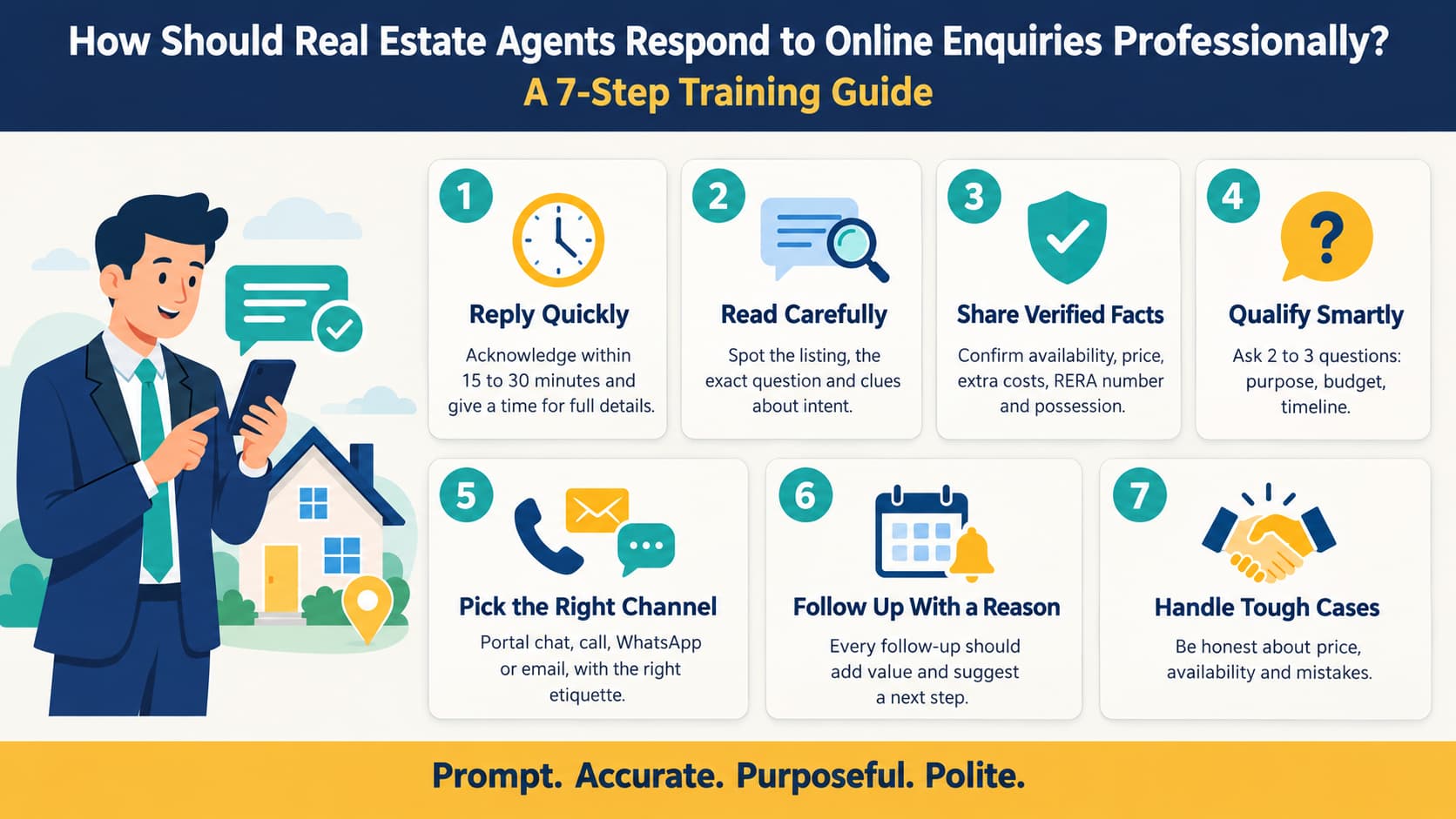
How Should Real Estate Agents Respond to Online Enquiries Professionally?
Everyone who writes an inquiry online is basically asking: "Do I trust you enough to make my choice based on your opinion?" The very first response is where the question will get answered. The following guide offers agents a clear and practical solution to the problem of answering enquiries online. The guide tells agents how fast to respond, what to check before providing information, which qualifying questions to ask, and how to follow up without being too aggressive.
The Quick Answer
A professional response to an online inquiry will be timely, personalized, precise and focused. The acknowledgment should be made immediately, the questions answered using accurate information, two or three additional questions should be asked and one course of action suggested. Then follow up politely, giving a reason for doing so each time, until the prospect decides.
Why Your First Reply Matters More Than Your Pitch
An online enquiry is distinct from a walk-in. The individual will most likely have viewed various properties and enquired with other agents. You have not met them, hence your email is the only means by which they can judge your work.
The initial reply creates three impressions:
Reliability: Did you reply, and did you reply in a timely manner?
Competence: Did you understand the query and answer the question that was posed?
Honesty: Does what you've said square with the listing and reality?
People who have done all of the above create a reputation that earns them referrals and repeat customers. This is what takes a job to a profession.
Step 1: Respond Quickly, but Not Carelessly
Speed is the first sign of professionalism. The customer, who asked a question a few minutes back, is now pondering on this home. After a few hours, he might be contacting another agent.
As a working standard (suggestion and not a statistic), one should try to give a reply in 15 to 30 minutes' time during working hours, and the following morning in case of late night queries. In case of not being able to provide all the details, state so along with a time period:
"Dear Mr Sharma, thanks for showing your interest in the 3 BHK flat available in Sector 56. I shall confirm you the exact availability by 4 pm today."
It works as it is fast, relevant and makes a promise that can be fulfilled. One must never make a promise which can be broken easily.
Practical habits for speed:
Ensure that your notifications are enabled for the portal, emails, and WhatsApp queries during working hours.
Have a set of templates for quick responses and personalize only the first line of the message.
Set aside two brief periods in the day exclusively for dealing with the queries.
In case you work in a group, ensure to allocate the ownership of each query to prevent duplication.
Step 2: Read the Enquiry Before You Reply
Many weak replies come from agents who skim. Before typing, read the message and note:
The listing number the individual inquired about, and if it is still available.
The exact question asked, like asking for the price, floor level, possession date, or site viewing.
Anything related to their intentions, like their budget, family size, location preference, or moving date.
Their communication style, in order to respond appropriately.
When an individual asks you, “Does the maintenance cost come in?” and you provide them with a general brochure, you show them that you have not even bothered to read. Answer their question first, then give any extra information needed.
Step 3: Share Only Accurate, Verified Information
This is where the professional agent sets himself apart from everyone else. The response will be your record of telling a client something, so be accurate.
Verify before you send:
Availability: make sure that the unit is still available by confirming with the owner/builder.
Price & charges: get the quotation of price and the additional expenses like parking fees, maintenance deposit, club membership, etc. Never conceal extra payments to keep the individual hooked.
Project Registration: in case of new projects, share the RERA registration number and tell the buyer to verify it on the official state RERA website. Never mention an unverified number.
Possession/Status: be very sure of whether the home is available to occupy or under construction along with its exact possession period as per official record.
Measurement/specification: be very careful about using the terms carpet area, built-up area and super area. Confusion with these terms is a common reason for mistrust among buyers.
Photos/Listings: make sure that the image and details match with the property.
When you don't have an answer, then say so. "I'll check this out with the builder and let you know today," for example, is the proper way to proceed. Making an assumption and presenting it as fact is unacceptable.
Don't use pushy statements like "Only one unit left" or "The price will be higher tomorrow," unless these statements can be verified. Indians generally make their purchase decision in consultation with their families.
Step 4: Ask Smart Qualifying Questions
Qualifying is not an interview. Qualifying is how you find out what the customer wants so that you can provide them with the proper options rather than all the options. Ask two or three questions in your first response and save the other questions for the discussion.
Core qualifying questions:
Goal: Is it intended for personal use, to rent out, or as an investment property?
Budget: What budget limit do you have in mind, and are you looking at taking a loan on the house?
Timeline: When would you like to move in or make a booking?
Location preferences: Where would you prefer it, and what is the priority, the metro station, schools nearby, or proximity to the office?
Requirements: What number of rooms are you looking at, which floor, parking availability, and any other essentials?
Other decision-makers: Are there others who might help with the decision or accompany you for the site visit?
How to ask politely:
"To help me narrow down your options, might I ask you two simple questions? Are you using this for yourself or an investment, and what is your budget?"
As you can see, the message tells the person why you are asking. They will be more willing to answer when they see the point.
What to avoid: do not ask for personal information like ID numbers, banking, or income statements in the initial contact. These should come much later, if ever.
Step 5: Choose the Right Channel and Tone
Different channels need different etiquette.
General tone rules:
Refer to the individual using his/her name and use appropriate language.
Keep sentences short and simple and avoid any technical language that a new buyer might not understand.
Do not mass-email the same email to everyone without addressing them individually.
Do not overdo with the use of emojis, caps and exclamations.
Consider privacy and communication preferences. If a person requests not to be called, try messaging.
Step 6: Follow-Up Etiquette That Builds Trust
Most deals do not close at the first attempt. Follow-up is an expected part of the task, but the manner of follow-up determines if you come off as being useful or irritating.
A simple follow-up rhythm:
The same day: send them the information you promised and tell them the next steps.
Within 2 to 3 days: give them another piece of information, like a new price, listing, or response to their queries.
Within about a week: contact them again to see if anything has changed in their plans.
Then: do not contact them anymore until you have some useful information for them, like a price change or a new launch in their area of choice.
Every follow-up should have a reason. Compare these two messages:
Hi, any news?
Hi Ms Gupta, the developer has provided the latest payment plan for the 2 BHK you liked. I have attached the same. Will Saturday work out for a site visit?
While the latter gives some worth and an action item, the former just reminds them of your existence.
Know when to quit. When a person tells you that he/she has already decided to buy elsewhere or is not interested anymore, thank them and move on. Courteous closure might actually get you a referral in return."
Step 7: Handle Common Difficult Situations
"Just send me the price." Be clear about what the price is and what is included, then put one qualification to the enquiry. Withholding price is annoying.
"Not anymore." Answer truthfully and provide two or three alternatives similar to what they requested.
Simultaneous enquiries.
Answer in sequence, answer each one and track each one on some kind of sheet or CRM so that nobody gets forgotten.
Unclear or poor quality enquiries.
Answer with politeness and ask one clarification question. Short messages can be from serious buyers.
Negative or impatient response.
Remain calm, thank them for their input, correct where possible, but do not argue.
Contradictions found afterwards.
Correct yourself and say sorry. Admitting mistakes quickly protects your reputation better than hiding mistakes.
Common Mistakes That Cost Agents Clients
Responding either late or only after the individual has gone after you.
Giving an answer that is general in nature, which does not even address the query.
Providing information that is not even verified or that differs from what is stated in the listing.
Asking too many questions in one's first query.
Using pressure tactics or creating a sense of urgency.
Calling up without notice during odd hours.
Forgotten about follow-up calls.
Keep Records: A Small Habit With Big Returns
You do not need expensive software to organise enquiries. A simple sheet with these columns works:
Name and contact method preferred
Enquired about and the date
Budget, purpose and schedule
What was provided and when
Date for the next follow-up and why
Status: new, in discussion, visit scheduled, closed or not interested
It ensures that no response is forgotten and allows you to customize each interaction. Always exercise caution with any personal information. Keep it safe, use it for the inquiry it is meant for, and never share it without consent.
A Ready-to-Use Reply Framework
You can adapt this structure to any enquiry:
Use the individual's name and address them with thanks.
Give the main answer based on verifiable facts.
Include an additional piece of information that is helpful to them but not asked for.
Ask two qualifying questions and explain why.
Suggest a further course of action like making a call or paying a visit.
End with your name and details.
Example:
"Hi Mr Verma, it's great to hear from you regarding the 2 BHK in Sector 82. The unit is available, and the asking price is ₹X. Parking and maintenance deposit is separate. I can provide the cost sheet. In order to give you the best suggestions, please let me know if you’re buying this property for personal use or investment and your desired possession period. Regards, Anil, [Agency], [Phone]."
How Professional Replies Shape Your Career
Agents often think career growth comes from more listings or more leads. In practice, a large part of it comes from how you handle the leads you already have.
Reputation: Clients will remember agents who were quick, straightforward and truthful, and recommend them to others.
Conversion: A properly qualified lead will be more apt to get into a site visit, where real decisions take place.
Repeat business: An honored agent gets a phone call when the client goes to buy, rent or sell again.
Authority: Professional communication sets you apart from all the other agents that your prospects hear about.
Treat each enquiry as a chance to demonstrate your standards. That is how an ordinary agent becomes a trusted advisor.
Quick Checklist Before You Hit Send
Do I have the person's name in the conversation, and have I quoted the question?
Is the information accurate and consistent with the listing?
Did I disclose any additional charges?
Do I have only asked two to three qualifying questions?
Is there one clear next action?
Do I know when I am following up on it and why?
Frequently Asked Questions
How quickly should an agent reply to an online enquiry?
As quickly as you reliably can, ideally within a few minutes to half an hour during working hours. If you need time to verify details, send a short acknowledgement with a specific time for the full reply.
What should the first reply to a buyer enquiry include?
A greeting, a direct answer to their question, one helpful extra detail, two qualifying questions and a clear next step.
Which qualifying questions are most useful?
Purpose (self-use, rent or investment), budget range, timeline, preferred locations and key requirements. Ask them politely and explain that you are asking to suggest better options.
How often should I follow up?
Follow up the same day with promised details, then after two to three days, then about a week later. After that, contact them only when you have genuinely useful news.
Is WhatsApp suitable for replying to enquiries?
Yes, when the person has contacted you there or has agreed to it. Keep messages short and relevant, avoid late hours and never add people to broadcast lists without consent.
What should I do if I do not know the answer?
Say so honestly, confirm the facts and reply with time. A verified answer later is better than a quick guess.
Conclusion
Professional responses to online queries can be considered an art form, and like any other skill it can be learned. Respond quickly, read thoroughly, provide accurate information, qualify with respect and add value. By doing so, you can earn the reputation of being reliable, and that is the best basis for a career in real estate.
If you would like to see how a well-structured online marketplace handles listing queries, you can check out Prooperty.