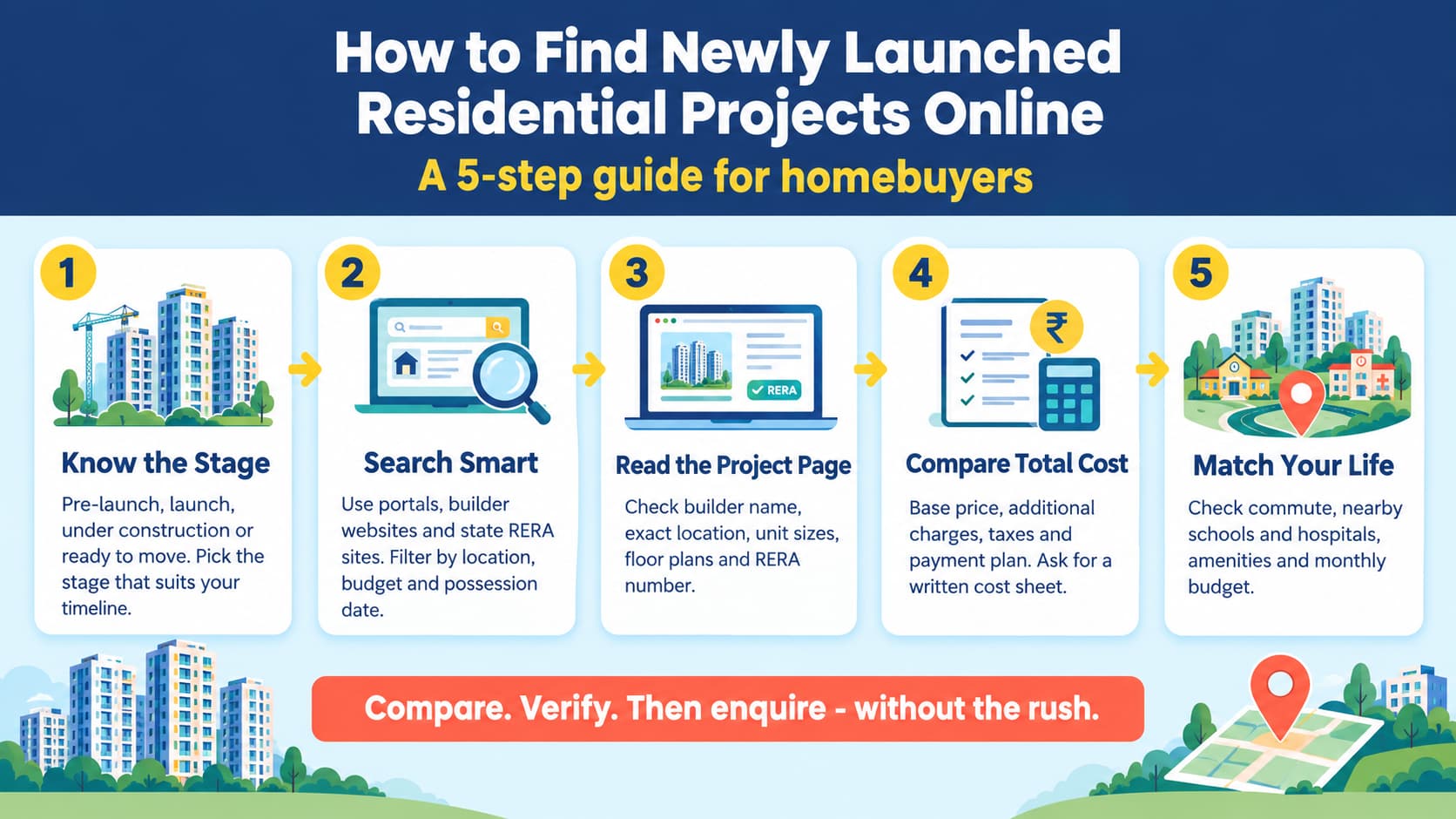
How to Find Newly Launched Residential Projects Online
Starting a project can feel like a race at times. Boarders will go up, messages start coming in, and then someone will tell you that the best floors will be sold out within a few days. All of that is mostly avoidable. If you have an idea of where to look online for information on launch, you can find new residential project launches easily and at your convenience.
This article provides guidance on where to find residential project launches online, how useful each source is, and what information to look for on a particular project page before contacting the people behind it. This article is geared towards first time buyers, upgraders, families moving to another city, and those looking to follow project launches independently.
What "Newly Launched" Actually Means
The phrase is used loosely, and the stage of a project changes what you should expect from it.
Pre-launch: The developer is creating interest. Plans and pricing are likely to be indicative, and information is sparse.
Launch: Sales begin. Information material such as brochures, plans and a pricing list should be available at this point.
Construction phase: Work is underway, and you can check on progress relative to the promises.
Possession/near completion: The real thing is there for inspection, and there is less likelihood of delay.
Think about the stage of the buying process that you are at before embarking on your research. If you need to move in after 18 months from now, then you do not want to be spending weeks on pre-launching statements.
Where to Look Online
But no single source covers everything; you must therefore use them together.
Property portals. This is where most launches are collected under one roof and can be compared against each other. The advantage is broad coverage. The disadvantage is that the quality of the listing depends on the underlying data, and a portal can be seen as a good starting point, but not an end point.
Builder and developer sites. This is where the official brochure and the plan can be found. Very useful for first-hand details, but always a one-sided perspective.
RERA websites of State Governments. Each of the registered projects gets a website on which its registration information is published. Until it helps you in discovering new launches, each of these projects is registered and you can see which projects are officially registered even though you may never have heard of them before. It is a good idea to search for launches through online search of the RERA-registered projects and make sure that the launch is indeed real.
News articles and press releases. News articles and press releases in business newspapers usually provide information about real launches. They should be treated as leads for your further investigation, but not as booking material.
Walkthrough videos and social media. Good for getting a feel for design and neighbourhood. Bear in mind that renders and video edits show intentions rather than the building itself.
It makes sense to start with a search for a launch on an online portal and then check the builder's page and state government RERA website for consistency of information.
Use Search Filters Like a Researcher
Good filters save hours. When you use online property search filters, start broad and tighten in steps.
Consider the location first. Go for 2-3 locations in preference to an entire city.
Possession status. Look for "under construction" or "new launch" to filter out resale properties.
Layout and size. Specify the number of rooms and extend the carpet area range a bit to cover a variety of layouts.
Budget. Input your actual budget, not just the cost mentioned.
Possession period. Filter based on your possession date.
Save your searches and turn on alerts where the platform allows it. This is the easiest way to track new launch projects in India without checking sites every day.
Read the Project Page Before You Enquire
A strong project page answers most of your early questions. Look for these builder project details:
Name of the builder and the name of the particular project
Location of the site with a visible map pin/address
Number of towers, number of floors and units, and size of the land
Types of units with carpet area and not "super area" measurement
Specific amenities that have been mentioned with their readiness status
Possession schedule of the unit
Floor plans with the master plan and scale legibly mentioned
Registration number under RERA
Next, pose three easy questions about what you have read. Are the facts specific? Do they fit together? And do they clearly distinguish what already exists from the promises made? Unclear writing, generic images, and lack of registration information are some of the reasons to pause.
Another step is to examine the history of the builder. Find out whether previous projects have been completed, and if so, how long they took to finish. This is one of the things you can research from the comfort of your home office.
Make Sense of Launch Pricing
Prices on new launches are rarely a single number. A transparent listing explains the following:
Base rate per square foot or per unit
Extra costs such as special site charges, parking, club subscription and deposit fees
Charges related to taxes and registration, which will be over and above the quoted price
Mode of payment - construction-based, time-based or a combination of both
Ask for a cost sheet in writing that includes all of this into one amount. Offers like “special introductory price” or “limited units at this price” should be calmly analyzed. Check out the same configuration of the project in other neighboring projects to see if the total is justified.
Match the Project to Your Daily Life
A beautiful launch in the wrong place is still the wrong choice. This is where searching by your own needs matters more than searching by hype.
Connectivity: Use maps application to check connectivity to your work place or school where your kids study at times when you actually go. Plan for future roads and metro lines, but until it actually exists consider them as plans.
Locality: See what exists around your project. Amenities like shops, hospitals, schools and parks must be available to you, not just on paper.
Amenities: Name three amenities that you will need daily and see whether these are included in first phase.
Budget: It must include loan EMI, maintenance and time period before possession during which you will have to pay rent.
If your search is around Gurgaon, a well-organised set of real estate portals in Gurgaon can help you compare launches sector by sector. The same approach works in any city: shortlist localities first, projects second.
Choosing a Portal You Can Trust
Since much of your research will happen on one or two platforms, choose them with care.
Credibility: The platform needs to be able to tell you who runs it and how to get in touch with them.
Fresh listings: Fresh dates and current listings, with no sold out listings shown anymore.
Verification: The platforms which state how they verify listings, including property listings in India, are more credible than those which don't do that.
Privacy: Make sure to read how your number and email will be used. They should not sign you up for unwanted calls automatically.
Contact details: Contact details which work matter in case you need them in the future.
Such websites as Prooperty work on integrating the process of listings, filtering, and inquiries into one place so that comparisons and discovery are made there. Regardless of the website you use, ensure to have your checks on it.
A Note for Different Kinds of Readers
New projects are mostly a buyer's market, but others find them useful too.
The buyer has the option of comparing launches and pricing possession dates.
The investor can watch out for forthcoming residential developments early on, while keeping in mind that there is uncertainty at an early stage.
The tenant can look for completed or almost completed developments, as new constructions bring in rental properties once they are delivered.
The seller or landlord can gauge how new launches in his region are being priced.
How to Enquire Without Getting Pressured
After short-listing two to three projects, ask for written information wherever possible. Get the cost sheet, payment schedule, sanctions, approval information, and possession date. Inspect the property, and compare what you have seen with what you have read. Take your time; if it is a genuine project, it will be there even after a day’s thought.
Be cautious about:
Requesting token money without first seeing a cost sheet
Usage of forceful terms like "last few units" but with no proof
Refusal to provide the registration number or permissions
Offering quotations that appear significantly lower than other projects in the neighborhood
Common Mistakes to Avoid
Evaluating a project based on renders only
Comparing just the base price, not overall cost
Depending on one source for start-up information
Not considering the past delivery record of the builder
Thinking that nearby infrastructure is already done
Giving your personal information on every form
Frequently Asked Questions
How do I find newly launched residential projects online?
Use a portal's "new launch" and "under construction" filters, check the builder's website for official details, and look the project up on your state RERA site. Save searches and set alerts to keep up with new entries.
Are pre-launch residential projects safe to book?
They carry more uncertainty because details may still change. Ask for written details, confirm registration and approvals, and avoid paying before you have reviewed the cost sheet.
What should I check on a project page?
Builder name, exact location, unit sizes, amenities, possession date, floor plans and RERA number. Look for specifics and consistency across sources.
Why do prices differ between listings of the same project?
Different floors, facings and payment plans, plus the way additional charges are quoted, can all change the total. Always compare the final cost.
Can I rely on a portal alone?
No. Use it for discovery and comparison, then confirm details with the builder and the official RERA website.
Final Thoughts
Getting a new launch is simple, but analyzing one effectively requires skill. First, think about your stage of life, budget, and location. Make use of filters to reduce options, go through the project page as if answering questions on it, analyze the total cost, and verify important details from reliable sources before deciding. With a consistent process, you will be able to track the new residential projects without getting stressed, and buy a house that suits you.