What Should You Verify About Permitted Use of Commercial Space?
Both tenants and buyers often think that when a place is labeled “commercial,” all businesses can operate there. No, they can’t. To make sure you won’t be faced with penalties, sealing, legal issues concerning insurance and expensive relocation, you should verify the use of commercial property before signing any contracts. There are two issues here – the approval of the use of the building as commercial real estate and whether the activity you intend to perform there is allowed in this particular building.
What Does Permitted Use of Commercial Space Mean?
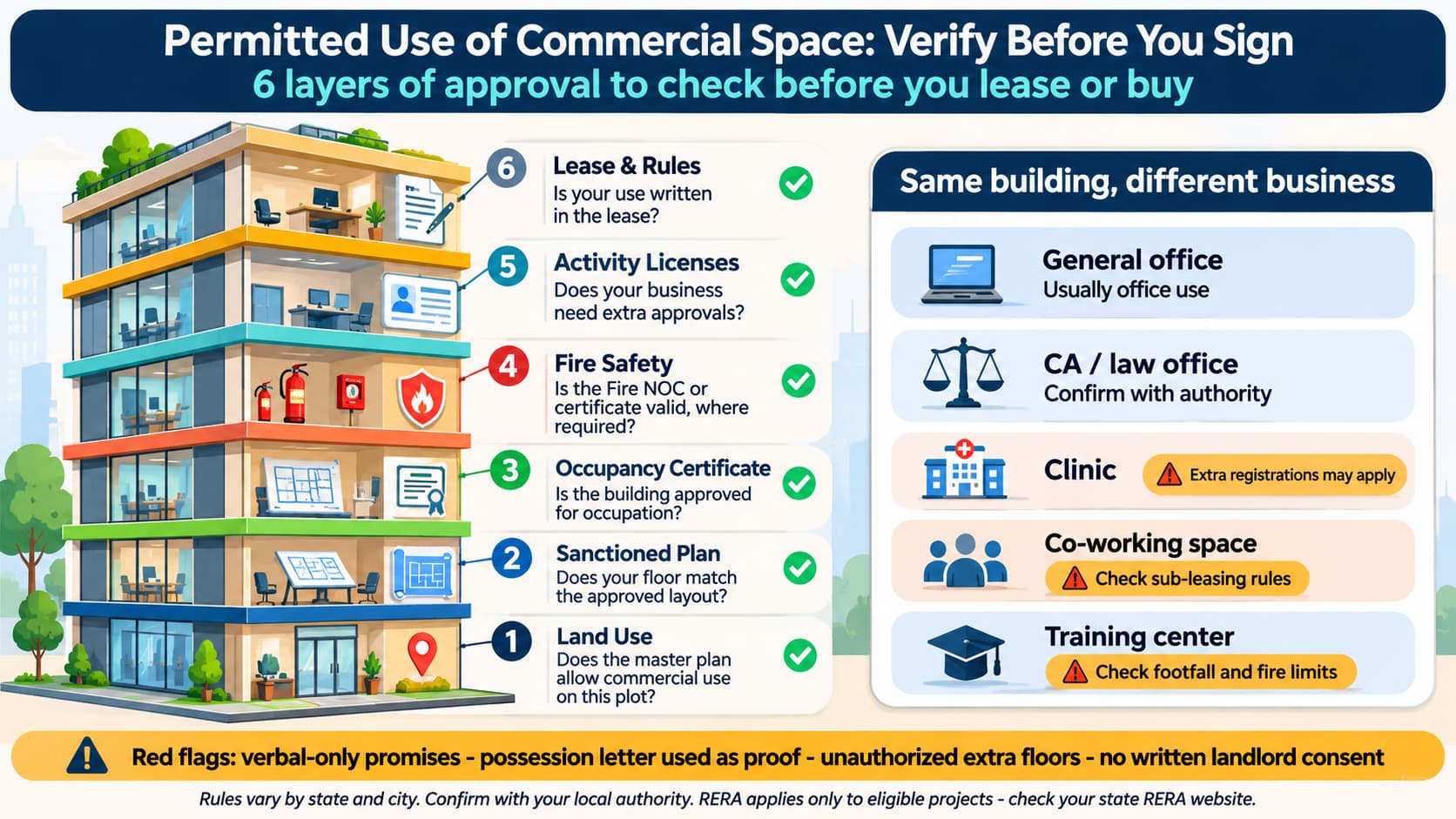
Permitted use is the activity a property is legally allowed to host under planning and building approvals. It works on three levels:
Land Use: The classification of the site in the relevant master plan/development plan.
Building Use: The intended use for which the building was approved, and subsequently, certified to be occupied.
Activity License: The licensing or registration requirements required for that particular trade.
Land can be categorized as being residential, commercial, industrial or institutional land, among others. Different categories and uses vary depending on the city or organization.
Commercial zoning does not mean that all businesses can operate on the land. It means that even after zoning commercial land, certain buildings within the piece of land could have been designated to be used for office purposes only. Even when a clinic or training center is built in such land, it must register separately.
How to Verify the Approved Land Use
Refer first to the master plan, development plan or zoning plan that has been prepared by the planning authority or development authority in your area. Verify the classification of the use of the property and inquire from the authority whether the proposed use of the land is permitted on that site.
Look out for these scenarios:
Mixed-use plots: they could accommodate offices, stores or any other use subject to stipulations for floors, share of land or street width.
Location-based restrictions: there are places that limit customer-oriented or high traffic activities even in commercial areas.
Residential plots: do not take it for granted that a residential plot or flat could be used as an office space. Some state and city governments allow a certain degree of professional use, albeit with stipulations or changing of use officially.
Check the Sanctioned Building Plan
The sanctioned building plan is the layout approved by the local authority before construction. Ask for it and check:
Purpose and Classification of occupancy of the building as approved.
Whether the floor and suite are represented in the manner that they should be according to the approved layout.
The difference between the plans and what is there on the ground including additions like extra floors and enclosed balconies and combined suites.
The fit-out and partitioning of the internal space do not give any legal authority. The residential floor will not become the office just because workstations have been fitted inside, and even if there has been a conversion, but it has not been authorized, then it is an illegal conversion.
Why an Occupancy Certificate Matters
Occupancy Certificate is an official certificate provided by the municipal authorities when construction of the building is done according to the sanctioned plan and laws. The OC certifies that the building is suitable to be occupied for the intended purpose. In case of commercial properties, it forms a crucial part of commercial property due diligence.
While analyzing it:
Ensure that it includes your specific building, tower, floor, or portion, because there are cases where certain projects are issued partial certificates.
Where appropriate, verify the certificate of completion and any conditions associated with its issuance.
Ensure that the use of the property as certified matches your own purpose.
A possession letter, handover note or advertisement is not a substitute. Possession shows who controls the space, not that the building has been approved for occupation.
Does the Building Permit Your Intended Business Activity?
Approval needs differ by activity. As a general guide:
General admin/corporate offices, IT and consulting offices: These normally come under office usage and are governed by local laws.
CA & Law offices: These normally come under professional offices usage, but this should be checked with the local authority and local building guidelines.
Clinics and other medical establishments: These might require clinical or health licensing besides office approval.
Stores and offices with shop-office combination: These might be differently handled depending on ground and upper floors in terms of approvals.
Co-working space and business centers: These might be differently handled compared to single office usage and might be restricted by lease agreement/local building regulations regarding sub-licensing.
Training centers and other customer-oriented establishments: These might have more visitors and thus might have concerns regarding parking, fire safety and occupancy limits.
However, permission granted for general use does not always give the go-ahead for all specialized operations. Clinics and medical facilities among others may require special registrations or licenses under relevant laws.
Verify Fire Safety and Applicable Building Approvals
Fire safety regulations not only ensure the safety of people but are also related to the insurance aspect and risk of being sued. If the same is mandatory, then make sure that you check for Fire NOC or Fire Safety Certificate, as well as the arrangements made for fire safety in the building.
The requirements vary depending upon the type of construction, height, occupancy, and area as per the rules of the respective state/local government. However, the National Building Code of India issued by Bureau of Indian Standards gives some national guidelines regarding the same, but enforcement is done by State or Local Fire Departments. It is important to note that not every commercial space requires separate fire clearance. In several cases, fire clearance is obtained for the entire building itself.
Check Other Activity-Specific Permissions
Depending on your business, you may need some of the following. None of these is universal for every office:
Local or Municipal Trade Licenses, in case the local authority has prescribed such licenses for carrying out the activity.
Health and Clinical Establishment Licenses, if any. The Clinical Establishments (Registration & Regulation) Act, 2010 is only applicable in those States who have implemented it, while others have separate legislation.
Approvals from pollution control authorities for such activities that are governed by pollution control laws.
Signage/Display Licenses from the local authority/building management.
Sanctioned load/electricity requirements for your business along with water supplies.
Any other specific licenses/registrations required based on the nature of your business/industry.
Check with the relevant local body or regulator for your exact activity and location.
Verify Lease Conditions and Building Restrictions
Legal approval is only one layer. The lease and the building's rules also decide what you can do. Confirm that:
Your planned business activity is explicitly mentioned in the lease deed.
Conditions relating to sublease, visitor policy, business hours, and signage are well-defined.
Provisions regarding common area usage, changes, and installation of equipment are acceptable.
Approvals of landlord or associations are taken when necessary.
It is very clear about who will be obtaining the activity-specific permissions.
Get key approvals and guarantees in writing. Verbal promises from an owner or agent mean very little in case of a disagreement. It is as important to do so for leasing as it is when buying.
When Does RERA Registration Apply?
The Real Estate (Regulation and Development) Act, 2016 (RERA) includes real estate projects, including commercial projects. As per section 3, the promoter cannot undertake advertising, marketing, booking or selling units in a project without registration in the state Real Estate Regulatory Authority. The exceptions are mentioned in section 3(2). Some of the exceptions are projects where the land area is 500 square meters or less, or where the number of apartments is eight or less (inclusive of all the phases of the project), projects which already had been issued completion certificate prior to the commencement of the Act and some renovation/repair works. Lower limits may be specified by state governments. There are separate state-specific guidelines.
Thus, the applicability will depend upon the conditions in the particular project. This does not mean that every office building, constructed, resale, or rental property separately requires registration under RERA. When the project is registered, check the registration number on the respective official state RERA website.
Documents to Request Before Finalizing the Space
Common Mistakes When Verifying Permitted Use
If each commercial building allows each type of business.
Taking just the word of the broker or the owner.
Disregarding the permitted land use zoning.
Not looking at the sanctioned plans of the building.
Considering possession as enough proof of occupancy.
Thinking that an approved office means an approved clinic.
Not considering any lease conditions or association policies.
Not considering the unauthorized change of the building use.
I think RERA registration is for all cases.
Commercial Space Permitted-Use Verification Checklist
FAQs
What does permitted use of commercial space mean?
It means the activities a property may legally host under its land-use classification, sanctioned building plan and occupancy approval. It also covers separate licenses a specific business may need. A "commercial" label alone does not mean every business activity is approved.
How can I check whether a building is approved for office use?
Ask for the sanctioned building plan and the Occupancy Certificate, and compare them with the land-use classification in the local master or zoning plan. Then confirm with the concerned development authority or local body that office use is allowed for that plot and building.
Is an Occupancy Certificate necessary for commercial office space?
It is generally the key document showing a completed building has been approved for occupation under the sanctioned plan. Requirements and procedures vary by state and local rules. Check that the certificate covers your building, floor or portion, and ask the local authority if a document seems incomplete.
Can I operate a clinic in any commercial office building?
Not automatically. Office approval does not necessarily cover healthcare use. Clinics may need clinical establishment registration or other approvals under the applicable central or state law, and the building's approvals and lease must allow the activity. Verify with the local authority and health department.
Does every commercial property require RERA registration?
No. RERA applies to real estate projects under Section 3 of the Act, and exemptions exist depending on factors such as land area, number of apartments and completion status. Many resale and lease transactions do not involve a new registration. Check the state RERA website for the project.
Conclusion
The term "commercial" in the listing is the first point of verification. Prior to making your decision, ensure that the land use, building, and occupancy approvals are in place, along with any additional approvals for activities and fire safety, and obtain the permitted use of commercial premises as an inclusion in the lease or contract. Seek advice from professionals as per your local authority regarding the concerned property. While comparing commercial premises, you can start your search on Prooperty, an Indian online real estate marketplace, and run these checks on each shortlisted option.