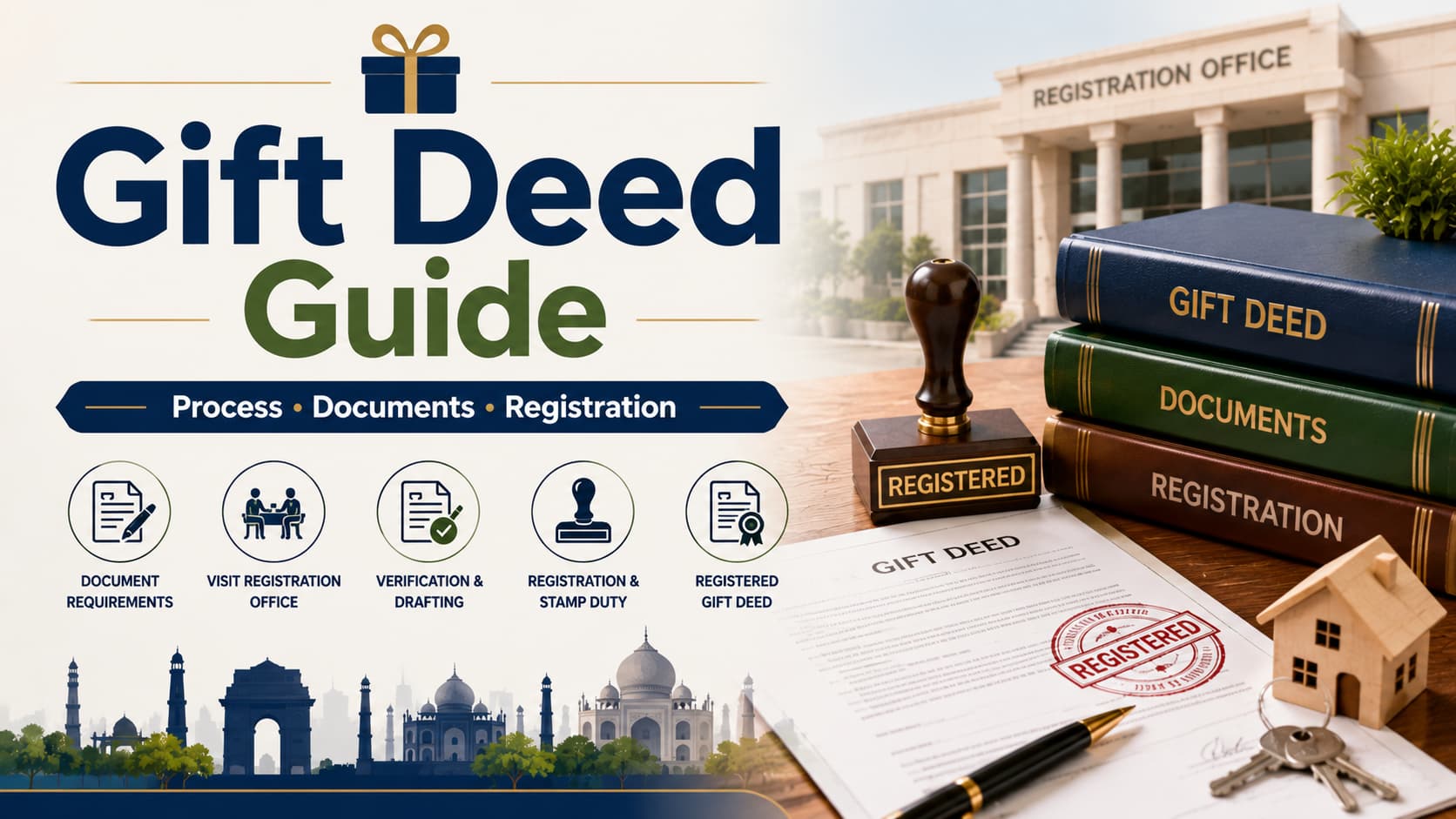
Transferring property to someone you love or choosing to pass ownership to another person is an important legal decision that needs to be completed correctly to avoid disputes or complications later. A Gift Deed Guide can help you understand the documentation, legal requirements, and important considerations involved in transferring ownership. Property can be transferred between family members, relatives, or other eligible parties through different legal instruments, depending on the purpose and terms of the transaction. Whether you are transferring a flat to your child, a plot to your spouse, or an interest in ancestral property to a family member, understanding the applicable legal process is essential. The right property transfer document can help establish the terms of the transaction and provide a clear legal record of the change in ownership. Property transfer refers to the legal process through which ownership or an interest in property passes from one person to another. In India, the Transfer of Property Act, 1882 provides the legal framework for several forms of property transfers, while registration requirements are governed by applicable registration laws. Depending on the nature of the transaction, the transfer may take place through a sale, gift, exchange, lease, mortgage, settlement, relinquishment, partition, or another legally recognised instrument. Each type of transfer has its own requirements concerning consideration, consent, execution, registration, stamp duty, and supporting documents. The nature of the transaction determines which deed, agreement, or legal document should be used. For example, a sale generally involves monetary consideration, whereas certain other forms of transfer may take place without a monetary payment. Therefore, selecting the appropriate legal instrument is important because using an unsuitable document may create difficulties when establishing ownership rights or completing registration. The parties should also verify whether the property is legally transferable and whether any restrictions, existing claims, or approvals apply to the transaction. Proper execution and registration, wherever legally required, help create a reliable record of the property transfer. For a property transfer to be legally effective, the applicable legal requirements must be satisfied based on the nature of the transaction. The parties should have the legal capacity to enter into the transaction, possess the necessary rights or interest in the property, and provide valid consent. The document or deed should accurately identify the parties, describe the property, state the nature and purpose of the transfer, and include the relevant terms and conditions. Depending on the type of transaction, payment of applicable stamp duty and registration with the competent authority may also be required. The essential requirements can vary depending on whether the transaction involves a sale, voluntary transfer, relinquishment, partition, settlement, or another form of property transfer. Therefore, there is no single set of requirements that applies to every type of deed or agreement. Before executing the document, the parties should verify the property's title, applicable encumbrances, ownership records, and any restrictions imposed by law or the relevant authority. Proper documentation can reduce the possibility of future disputes and make the ownership record easier to establish. Donor and donee. There have to be two individuals who can make the gift one to another; the giver and receiver of the gift. Existing property. One can gift something that actually exists and belongs to him/her. Future properties cannot be gifted. Free voluntary transfer. The gift has to be made voluntarily; there should be no coercion or duress. No consideration. There should not be anything in return for the property given. Acceptance by donee. The acceptance by donee should take place while the donor is alive. If donee dies without accepting the gift, then the deed becomes invalid. Registration. Gift deed relating to immovable property should be registered. Only when all these elements come together does a Deed become a solid, legally recognised transfer of ownership. The confusion with respect to these three documents runs deep among buyers as well as family members, but each one of them fulfills a completely different function. The basic knowledge about what sets them apart will help you select the appropriate instrument based on your requirements. Firstly, the Gift Deed is an instrument that facilitates the transfer of property instantly and without any payment, which takes effect during the lifetime of the donor once it has been registered. However, the Sale Deed vs Sale Agreement is an instrument through which property is transferred against money. In case you are interested in a detailed explanation of how a transfer against money takes place, read our article on the difference between a sale deed and a sale agreement. Lastly, the Will & Succession Certificate Guide is an instrument which facilitates the transfer of property only after the death of the donor, and can be altered anytime during his lifetime. The Gift Deed, on the other hand, cannot be revoked once it is made and accepted. Preparing the right paperwork in advance makes registration smooth and stress-free. While requirements vary slightly by state, the documents generally needed for a Deed are: Draft of Deed written on stamped paper of the right amount. Identity proof of donor and donee (Aadhar, PAN card, passport, or voting ID). PAN cards of the both donor and donee. Passport-sized photographs of donor and donee. Documents that prove ownership of the property and the title papers. Encumbrance Certificate Guide proving that there are no loans or dues on the property. Property tax receipts and recent utility bills. Property NOC Guide from the society/authority wherever required. Two witnesses along with their identity proofs. Keeping certified copies of each document ready avoids last-minute delays at the Sub-Registrar office. Registration is compulsory for certain transactions involving immovable property, depending on the nature of the transfer and the applicable law. Under Section 17 of the Registration Act, 1908, specific instruments relating to immovable property must be registered when the law requires registration for them to have legal effect. Registration creates an official record of the transaction and can help establish the transfer of rights in the property. The exact requirements may vary depending on the type of deed, agreement, or other legal instrument being used. The following steps provide a general overview of the property transfer registration process. Engage an advocate or qualified legal professional to prepare the relevant property transfer document according to the nature of the transaction. This document should contain essential particulars such as the names and details of the parties, their relationship where relevant, a clear description of the property, the nature and purpose of the transfer, and the applicable terms and conditions. The document should accurately reflect the parties' intentions and comply with the requirements applicable to that particular type of deed or agreement. Stamp duty is generally calculated according to the nature and value of the transaction and the applicable laws of the state or Union Territory where the property is situated. The amount can vary significantly depending on the type of transfer, property value, location, and relationship between the parties where concessional rates are available. Before executing the document, the parties should verify the prevailing stamp duty and any applicable exemptions or concessions with the relevant authority. The parties may need to schedule an appointment with the Sub-Registrar Office having jurisdiction over the property. Several states provide online facilities for appointment booking, document submission, or payment of applicable charges. The parties should confirm the required procedure, supporting documents, identification requirements, and appointment rules applicable in their jurisdiction before visiting the office. The parties involved in the transaction generally appear before the concerned registration authority on the scheduled date and execute the relevant deed or legal document. Depending on the applicable registration process, photographs, signatures, fingerprints, identity verification, and other biometric information may be collected. The exact procedure can vary between states and registration offices, so the parties should follow the instructions issued by the competent authority. After completing the verification and registration formalities, the Sub-Registrar records the document in accordance with the applicable registration procedure. The registered instrument may then be made available to the parties either physically or electronically, depending on the facilities provided by the relevant authority. The processing time can vary from one jurisdiction to another, so applicants should retain the registration receipt and other acknowledgement documents until the registered deed or instrument is received. After completion of the property transfer, the new owner or entitled party may need to apply for mutation of property records with the relevant revenue, municipal, or other competent authority. Mutation updates the applicable property records to reflect the change in ownership or interest. It is important to understand that mutation is generally a record-update process and does not, by itself, create or extinguish title. The cost of a property transfer can include stamp duty, registration charges, documentation expenses, and applicable professional fees. Stamp duty varies across Indian states and can also depend on the nature of the transaction, property value, location, and relationship between the parties. Certain states provide concessional rates for particular types of transfers or transactions involving specified family members, but these concessions are subject to the applicable state law and conditions. For example, property-related charges in Haryana can vary depending on the location of the property, nature of the transaction, ownership structure, and applicable government rules. Therefore, a fixed percentage should not be presented as universally applicable to every property transfer. Registration charges are separate from stamp duty and may be subject to prescribed rates or maximum limits depending on the applicable rules. Since stamp duty rates, concessions, valuation methods, and registration charges can change, parties should verify the current applicable charges with the relevant state registration authority before executing the deed or agreement. Whether a property transfer can be cancelled or revoked depends primarily on the nature of the transaction, the terms of the document, and the applicable law. A completed and legally valid transfer cannot generally be cancelled simply because one party later changes their mind. However, certain transactions may contain legally valid conditions relating to revocation, cancellation, or termination, while other circumstances such as fraud, coercion, misrepresentation, lack of legal capacity, or other recognised legal grounds may provide a basis for challenging the transaction. The applicable legal position can differ according to the type of deed, agreement, or transfer document involved. For example, Section 126 of the Transfer of Property Act, 1882 specifically addresses circumstances in which a gift may be suspended or revoked, but those rules should not automatically be applied to every form of property transfer. Therefore, before attempting to cancel or challenge a registered property document, the parties should examine the specific terms of the instrument and obtain appropriate legal advice. A change of mind alone is generally not sufficient to undo a legally completed transaction. The transfer of a property through gift involves tax considerations that need to be understood by both the donor and donee prior to making such transactions. According to the Income Tax Act, gifts of immovable property from one's relative – which includes those mentioned specifically in the act like one's spouse, parent, child, sibling, and some others – are normally exempted from being taxed under income from other sources of the donee. That is why family gifts are considered very attractive. On the other hand, in case where a property is gifted from someone who is not a relative but whose stamp duty value is more than ₹50,000, the value of the gift might be taxable as income from other sources of the donee. Moreover, at the time of selling the gifted property by the donee, the gains might also become taxable according to the original owner's cost of purchase and period of holding. While gifting is one way to transfer property without monetary consideration, there are other legal methods suited to different scenarios. If the property transfer involves a temporary occupancy arrangement rather than permanent ownership, a Lease Deed Guide would be more appropriate to establish the terms of use for a specific period. When purchasing newly constructed properties, Builder Buyer Agreement Explained governs the relationship between the developer and purchaser before the final transfer. In situations where the property owner cannot personally execute the gift deed, a Power of Attorney for Property enables a designated representative to sign on their behalf. For families with jointly-owned properties that need to be separated, a Partition Deed Guide facilitates the division of ownership among co-owners with individual title deeds for each share. Additionally, when an owner wishes to voluntarily surrender their rights to jointly-owned property, a Relinquishment Deed Guide is used to formally renounce all claims and transfer them to other owners. Each of these alternatives serves specific property transfer needs and circumstances. In Gurgaon, otherwise known as Gurugram, there are various residential sectors, well-established localities, villages and urban development zones. This means that there can be transfers of property within a family in respect of different forms of property such as flats, builders floors, independent houses and plots. Where it is intended to make a Gift Deed in Gurgaon, it will depend on where the property is located in determining the appropriate Sub-Registrar Office for the transaction. The donor and donee must find out the documents that are to be filed in respect of the particular property. This process does not change much depending on the part of Gurugram, however, the supporting property records are different depending on the type of property and locality of the transaction. For instance, a gift within the family of an apartment in sector 63 would have a different set of records from that of a gift within the family of an independent house in sector 22 or plot in sector 84. Properties that are situated close to urban corridors like MG Road and Sohna Road can also come under various registration jurisdictions based on their address. Hence, location of the property will be a crucial factor for the identification of the right registration office and associated documentation requirements. For those who are planning to transfer their properties via Gift Deed, they also need to take into account the existing stamp duty and registration rules in the state of Haryana. The benefit or any kind of concession provided by the state government in such transfers depends upon existing state laws and conditions. Even a simple family transfer can go wrong if key details are overlooked. Watch out for these common pitfalls: Skipping registration. Unregistered Gift Deed for immovable property fails to confer title. Unclear drafting. Unclear description of either the property or the relative relationship may cause conflicts. Disregarding acceptance. It is essential that the donee accept the gift in his lifetime. Missing mutation. Failure to make necessary entry in the municipal records after the registration leads to problems related to property taxes. Neglecting tax implications. Every gift is assumed to be tax-free without verification of the relative definition. Giftting a title-deed in question. Giftting a property with unclear or dubious title. Avoiding these mistakes ensures your Gift Deed stands firm and protects both the donor and the donee. Is registration mandatory for a property transfer document? Registration is mandatory for certain instruments relating to immovable property under the Registration Act, 1908. Whether registration is compulsory depends on the nature of the transaction and the specific deed, agreement, or legal document being executed. The parties should verify the applicable registration requirement before completing the transaction. Can a registered property transfer be revoked? It depends on the type of transaction and the legal terms governing it. A completed and legally valid transfer generally cannot be cancelled simply because one party changes their mind. However, certain transactions may be cancelled, challenged, or revoked in specific circumstances recognised by law, such as fraud, coercion, misrepresentation, or a valid contractual or statutory condition. Is stamp duty lower for transfers between family members? In some states and for certain types of transactions, concessional stamp duty may be available when property is transferred between specified family members. However, the applicable concession depends on the state law, nature of the transfer, relationship between the parties, and other prescribed conditions. The current rate should always be confirmed with the relevant state registration authority. Do I have to pay tax when property is transferred? The tax implications depend on the nature of the transfer, relationship between the parties, consideration involved, and applicable provisions of the Income Tax Act, 1961. Certain transfers may receive specific exemptions or different tax treatment, while others may have income-tax or capital-gains implications. Therefore, the parties should assess the transaction under the applicable tax provisions rather than assuming that every property transfer is tax-free. Can a property transfer document be challenged in court? Yes. A deed, agreement, or other property document may be challenged on legally recognised grounds such as fraud, coercion, undue influence, misrepresentation, lack of legal capacity, defective execution, or absence of valid ownership rights. Proper drafting, execution, registration where required, and verification of the property's title can help reduce the possibility of disputes, but they cannot completely eliminate the right of an eligible party to challenge a transaction before a competent court. A properly documented property transfer can provide a clear legal record when ownership or an interest in immovable property is transferred from one person to another. The appropriate deed, agreement, or legal document should be selected according to the nature and purpose of the transaction, while the applicable stamp duty, registration requirements, and supporting documentation should be verified before execution. Completing the registration process, where legally required, and updating the relevant property records through mutation can help maintain accurate ownership records. The procedure and costs can differ considerably between states, so the rules applicable to a property in Gurgaon may not necessarily be identical to those governing property in another part of India. Before executing this type of document, it is advisable to verify the property's title, existing encumbrances, applicable government charges, and registration requirements. If the transaction involves complex ownership rights, ancestral property, multiple parties, disputed title, or significant tax implications, professional legal and tax advice can help identify potential issues before the document is executed. This guide should be treated as general informational guidance, while the exact legal requirements should be confirmed according to the applicable law and the circumstances of the particular property transfer.Gift Deed Guide: Everything You Need to Know Before Transferring Property as a Gift
What Is Property Transfer?
Essential Elements of a Valid Property Transfer Document
Gift Deed vs Sale Deed vs Will
Documents Required for a Gift Deed
How to Register a Gift Deed: Step-by-Step
Step 1: Draft the Property Transfer Document
Step 2: Pay the Applicable Stamp Duty
Step 3: Book an Appointment at the Sub-Registrar Office
Step 4: Execute the Property Transfer Document
Step 5: Collect the Registered Document
Step 6: Apply for Mutation
Stamp Duty and Registration Charges on a Property Transfer Document
Can a Property Transfer Be Revoked?
Tax Implications of a Gift Deed
Alternative Methods of Property Transfer
Gift Deed for Property in Gurgaon: A Local Perspective
Common Mistakes to Avoid With a Gift Deed
Frequently Asked Questions
Conclusion