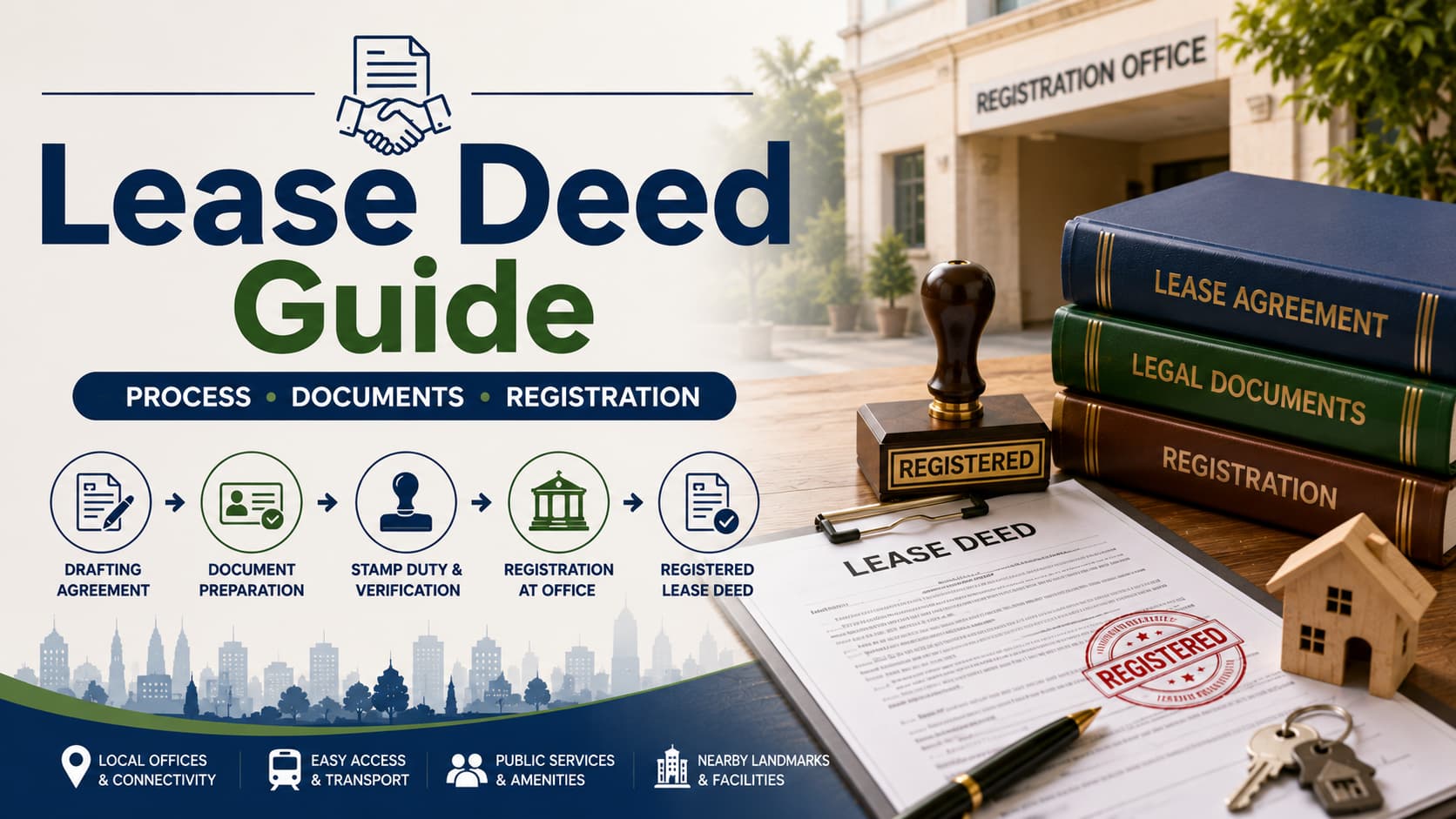
Renting of a property or hiring of a property on rent on a long-term basis is much more than just a hand shake and payment on a monthly basis. When the arrangement is for years, then it requires a proper and legal agreement, which will benefit both parties. This agreement is called a formal lease agreement. A Lease Deed guide is an agreement in writing that grants the tenant a right to occupy a property for a specified period in return of payment of rent. No matter whether you are a landlord, letting out your commercial shop, or a business firm looking for office space on rent or a tenant who wants to take residential space on rent for long-term, a proper understanding of how a lease arrangement functions saves you from disputes, eviction and liabilities. This lease agreement guide covers the meaning of lease agreement, clauses involved in the lease document, its registration procedure, stamp duty and some common errors to avoid. The lease document is a legal instrument through which the owner of the property, called the lessor or landlord, confers the right of possession and enjoyment of the property to another individual called the lessee or tenant for a defined period of time in consideration of the payment of rent or lease amount. It must be noted that there is no transfer of ownership of the property but merely the right of enjoyment for the agreed period. The leases of immovable property in India are regulated mainly under Section 105 of the Transfer of Property Act, 1882. According to Section 105 of the Act, a lease is a transfer of the right to enjoy immovable property for a specific period of time in consideration of rent. The rental may be payable periodically like on a monthly basis or even as a lump sum. The basic difference between the Lease Deed and a licence is that in case of a tenancy agreement, there is an interest created in the property in favour of the tenant for the lease period. These terms are used interchangeably, but each carries its own significance in law. This will help you make the right choice. Lease agreement is used where duration is longer, usually exceeding one year and gives interest in property in favor of the lessee. Registration is compulsory along with the payment of stamp duty for the lease contract. Rent agreement, on the other hand, is a term used for shorter duration, usually the well-known period of eleven months where the duration remains less than one year to avoid registration in most cases. License is another term where permission is granted without transferring any interest. In short, go for the written agreement if the arrangement is for a longer time frame. A strong lease document leaves nothing to assumption. Each important term should be written down clearly to prevent future disagreements. The essential clauses in the legal agreement include: Parties' particulars. Full names and addresses of the lessor and the lessee. Description of the property. Description of the leased property including address and size. Lease term. Exact starting date, ending date and length of the lease period. Rental charges and payment. Rental charges per month, payment date and method of payment. Deposit. Amount to be paid as a deposit and conditions for return. Rent increases. Agreed annual increases in rental charges during the lease period. Maintenance arrangements. Arrangements for maintenance and utility payments. Usage of the property. Residential, commercial or particular usage of the property. Subleasing. Terms and conditions regarding subleasing of the property by the lessee. Termination and notice period. Terms and conditions for terminating the lease. Renewal of the lease. Renewal of the lease upon expiration. Covering these clauses thoroughly is what transforms this document from a basic formality into genuine protection. Preparing the right paperwork in advance makes execution and registration smooth. While requirements vary slightly by state, the documents generally needed for a Lease Deed are: The drafted Lease Deed on stamp paper of the right amount. Proof of identity of both the lessor and the lessee (Aadhar, PAN card, passport, or voter identity card). Pan card of both the parties. Passport size photographs of both the lessor and lessee. Ownership proof and title deeds of the property. Property tax bills and recent electricity and water bills. Property NOC Guide (No Objection Certificate) from the society/authority, if any. Two witnesses with their respective proofs of identity. Keeping certified copies ready avoids last-minute delays at the Sub-Registrar office. Registration requirements depend on the lease term. Under Section 17 of the Registration Act, 1908, a lease of immovable property from year to year, or for a term exceeding one year, or reserving a yearly rent, must be registered. In other words, long-term leases must be registered to be fully enforceable. Here is the step-by-step process. Engage a lawyer to draft the Lease Deed with all essential clauses. Accuracy at this stage prevents disputes later, so both parties should review every clause carefully before signing. Calculate and pay the stamp duty applicable to the lease. Stamp duty on a Lease Deed is usually based on the lease term, the annual rent, and any premium or deposit, and it varies from state to state. Book a registration slot at the Sub-Registrar office that has jurisdiction over the property's location. Many states allow this to be done online for convenience. On the appointed day, the lessor, the lessee, and two witnesses appear before the Sub-Registrar. All parties sign the Lease Deed and provide their photographs and fingerprints for biometric verification. After verification, the Sub-Registrar registers the deed and returns it, usually within a few days to a couple of weeks. Once you receive the registered Lease Deed with the official seal, the lease is legally recorded and enforceable. Stamp Duty and Registration Charges on a Lease Agreement Another important cost element for a lease agreement is the stamp duty, which varies from state to state. While stamp duty in a case of sale is based on the value of the property, stamp duty for a lease document depends on the formula based on the lease period and the rent of the property for the entire term, including the security deposit or premium, if applicable. In general, the longer the lease period, the higher the stamp duty that needs to be paid. Shorter leases require lower stamp duties whereas very long-term leases may end up costing almost as much as a sale. The registration fees are a separate cost and are quite low. These are normally limited to a certain percentage. For Gurgaon, being part of Haryana, the stamp duty and registration fees related to lease in Haryana State depend on the schedule set out by the state government and is revised every once in a while. Since the slab depends on the lease term and rent arrangement, it is better to know the stamp duty for lease agreements in your state/city at present. A Lease Deed is essentially a two-sided obligation, wherein both the parties have specific responsibilities. For instance, the landlord has to ensure that the property is handed over peacefully to the tenant such that there are no hindrances faced by the latter while making use of the same and major repairs should be made by him/her unless stated otherwise in the agreement. It is also his/her duty to respect the occupancy rights of the tenant for the agreed period. On the other hand, the tenant is bound to pay rent timely, use the property only for the purpose agreed upon, maintain it in good order, and return it at the end of the period. He/She must not do any harm to the property and abide by the terms and conditions stipulated in the lease document. The lease agreement is not eternal, and both parties must know how to bring the lease arrangement to an end or renew it. The lease automatically expires upon the expiry of the term agreed in it. However, the lease can expire earlier, provided that it permits the same. This happens through giving of notice within the time stated in the agreement. Reasons for terminating the lease include failure to pay the rent, violation of terms of the lease, and using the property against the intended use. The inclusion of the term will protect both the parties. There is also the provision for the renewal of the lease. Most leases have a clause of renewal that allows the continuation of the lease for another agreed term. In case there is no renewal clause in the lease document, then another lease agreement may be entered into and registered. Gurgaon, or Gurugram, is one of the most active leasing locations in India with immense requirements for leasing houses as well as offices. Therefore, knowing how to proceed with the lease agreement in the area will come in handy. The registration is done in the Sub-Registrar office corresponding to the tehsil, where the particular property is situated. Since the area is large with many sectors and corridors, the landlord and tenant must know which office to approach depending on their location. For example, an office that will be leased by a company from a convenient location like Sector 63 Gurgaon or a prestigious residential location like Sector 56 Gurgaon should find out the jurisdiction. Lease documents of existing residential belts remain active as well. A lease agreement of a builder floor in Sector 30 Gurgaon and an individual property in the functional low rise sector of Sector 25 Gurgaon is registered in the way that was explained above. Tenants looking to find premises in developing areas, like Sector 84 Gurgaon should check all the approvals and title of the property prior to signing the contract. Well connected zones become very attractive for commercial lease deals. Commercial and office spaces along well-known MG Road Gurgaon and developing Sohna Road Gurgaon are regularly leased for long periods of time. All lease agreements in these zones go through the same Sub-Registrar process. When leasing properties in urban sectors like Sector 36 Gurgaon and Sector 44 Gurgaon, tenants and owners have to consider current lease stamp duty in Haryana. Even a straightforward lease can turn sour if key details are overlooked. Watch out for these common pitfalls: The absence of registration of a long-term lease, which reduces its enforceability. Ambiguous provisions relating to rent increase, repairs or notice period that may cause disagreements. Neglecting the terms of security deposits and their refund. Failure to clarify the purpose of the property, resulting in disagreement about residential or commercial purposes. The neglect of subletting clause leading to unwarranted occupiers. Underpayment of stamp duty, thus rendering the deed unenforceable in law. Avoiding these mistakes keeps your Lease Deed strong and your leasing relationship trouble-free. For leases exceeding one year or reserving a yearly rent, registration is mandatory under Section 17 of the Registration Act, 1908. Short-term arrangements under a year may not require registration in every state, but registering still adds legal strength. A lease agreement is generally used for longer terms and creates an interest in the property, usually requiring registration and stamp duty. A rent agreement is typically short-term, often eleven months, and kept under a year to reduce registration requirements. Stamp duty on a lease document is usually calculated on the lease term and the total rent payable over that term, sometimes including the deposit or premium. Longer leases attract higher duty, and rates vary by state. Yes, if the agreement includes a termination clause. Either party can usually end the lease early by giving the agreed notice, or on grounds such as non-payment of rent or breach of key terms. This depends on the agreement. Typically, major structural repairs fall to the landlord, while day-to-day maintenance falls to the tenant, but the exact split should be clearly written into the lease document. A lease deed is the core component of any lease arrangement and safeguards the interests of both the parties involved. Right from drafting clauses to paying stamp duty, from registration with the Sub-Registrar to preparing for termination and renewal – everything is done to ensure that the lease agreement is safe and controversy-free. By learning the procedure and cost elements associated with lease documents and knowing the rights of each party, one will be able to confidently lease the property not only in a busy area of Gurgaon but also anywhere else across the country. In case the situation demands, one must contact a lawyer and get the document prepared while using this lease agreement template.Lease Deed Legal Overview for Landlords and Tenants
What Is a Lease Agreement?
Lease Agreement vs Rent Agreement vs Licence
Key Clauses Every Lease Agreement Should Contain
Documents Required for a Lease Deed
How to Register a Lease Deed: Step-by-Step
Step 1: Draft the Lease Deed
Step 2: Pay the Stamp Duty
Step 3: Book an Appointment at the Sub-Registrar Office
Step 4: Execute the Lease Deed
Step 5: Collect the Registered Lease Deed
Rights and Responsibilities Under a Lease Agreement
Termination and Renewal of a Lease Agreement
Lease Agreement for Property in Gurgaon: A Local Perspective
Common Mistakes to Avoid With a Lease Deed
Frequently Asked Questions
Is registration mandatory for a lease agreement?
What is the difference between a lease agreement and a rent agreement?
How is stamp duty on a lease document calculated?
Can a lease agreement be terminated early?
Who pays for repairs under a lease arrangement?
Conclusion