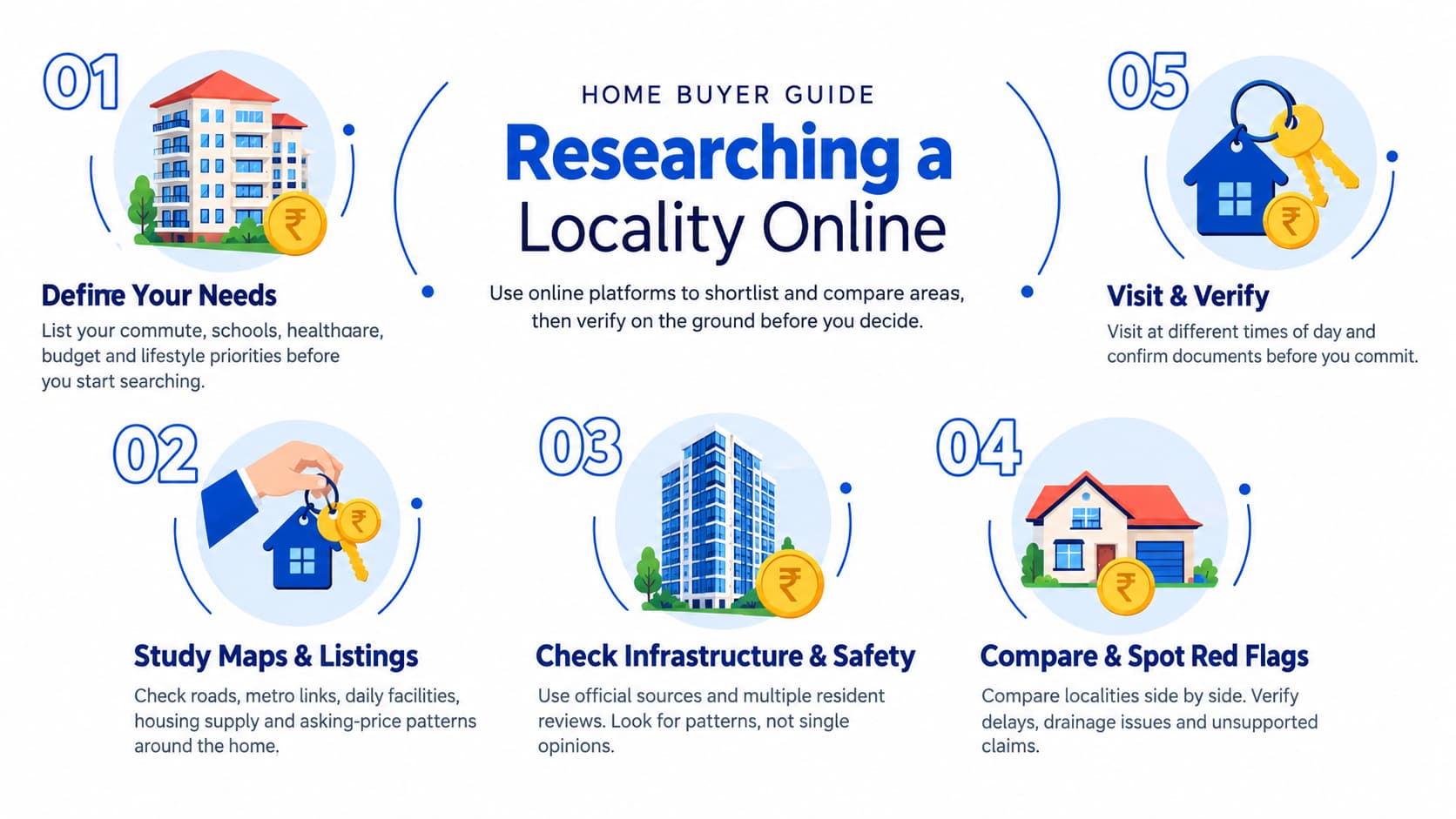
A well planned apartment can be a daily nuisance if located in an unsuitable area. Your surroundings will determine your commuting, that of your kids to school, medical facilities nearby, and ease of selling or renting out the apartment in the future. This is why researching the locality is equally important as checking out the apartment itself.
Online research will provide you with information about the character of the locality, its connectivity, educational institutions, healthcare, shopping and other facilities, means of transport and infrastructure, safety measures, development activities, trends in pricing, availability of accommodation and chances of future developments. It should be seen more as a screening and comparative tool. It can eliminate some poor options and shortlist good ones for you, but it can never substitute your firsthand experience of visiting the place.
Start With Your Own Requirements
There is no universally "best" locality. An area that suits a young couple working in a business district may frustrate a family with school-going children or retired parents. Before opening any website, write down what matters to you:
Work location and acceptable daily commute
Family needs, including schools and healthcare access
Reliance on public transport, and access to major roads or transit
Lifestyle preferences and tolerance for traffic, noise or ongoing construction
Budget and preferred housing type
Future plans, such as a growing family or a possible move
Rental requirement, if you intend to let the home out
Resale considerations
Turn this list into a personal checklist and weigh each item. Every later step becomes a test of whether an area meets your priorities, rather than a search for whatever is popular.
How to Research a Neighbourhood Online
Work from the wide view to the narrow one:
Begin your search for the locality in question on a map and on various listing sites to see what you have in front of you.
Sub-localities and residential clusters should be identified.
Large areas usually have very distinct pockets that differ by housing age, density, and accessibility.
Look at the map, not at listings. Listing are done to sell and maps show you what is actually there.
Find out roads, transit nodes and important destinations like offices, universities and airports.
Identify the presence of educational institutions, hospitals, markets and everyday facilities.
Make comparisons between several areas near the one in question.
Select areas worth exploring further.
It is always advisable to conduct your research on the surroundings of the home rather than focusing on the home alone. While the apartment may look beautiful in photos, there will be no information regarding the path to the apartment, the intersection where there are traffic jams during evenings, or the vacant land nearby.
When searching for a home in Gurugram, the real estate portals in Gurgaon will help you understand how the supply of homes is different in old versus new zones, and you can observe that from the map view.
Online Tools for Locality Research
Each type of tool answers different questions, so use them together.
A. Listing Platforms
Listings provide details about inventory, housing types, pricing patterns, project concentration, rental options, new launches, and resale inventory. Websites like proopproperty.com enable filtering on the basis of area, budget, and configuration, allowing one to identify the type of housing that prevails in a particular locality and pricing distribution. Consider listings to be asking figures only.
B. Digital Maps
Roads, the metro network, the railway, busses, schools, hospitals, malls, office buildings, airports, and famous places can all be located using maps. Satellite images and street images can help you determine how developed, green, or congested an area is.
C. Government and Civic Sources
Official sources can be employed to verify infrastructure projects, zoning or master-plan details, public works, civic facilities, and transportation projects. The state RERA website, the development authority, and the municipal corporation would be the ideal sources to begin with in such cases. Any document from the official source holds more weight than the marketing one.
D. Community and Review Sources
Qualitative information like water sources and society maintenance can be gained only through resident communities, review websites, and discussion boards. Keep facts and personal opinions distinct. The opinion of a resident community member is important to prove your experience, but it cannot be considered an authentic source.
How to Check the Safety of a Locality Online
No single website or review can establish that an area is safe or unsafe. Look at several indicators together:
Crime-related information from official sources and local police notifications, wherever available
Level of street lighting, road condition, and access roads
Presence of activity within the area during different times of the day, and isolation of areas to be passed through
Availability of public transportation at night
Emergency service facilities, including the distance to the nearest hospital and police station
Recurrent issues raised by residents
While going through the reviews, make sure to distinguish between facts (such as official notifications, news articles), experience of the residents (eyewitnesses), personal opinions (general impression) and old posts (those that were posted before any changes occurred). There is absolutely no point in considering a place dangerous just because of one single incident.
What to Look for in Locality Reviews
Check out reviews for common patterns in areas like availability of water, electricity, traffic, parking, noise pollution, cleanliness, drainage, garbage disposal, construction work, maintenance, public transport facilities, social amenities, and problems specific to seasons like water logging in monsoons.
The important thing is to see the pattern. Sometimes one positive or negative review will be a reflection of one community, one building, or one bad day. But when you see the same problem highlighted by different individuals, that’s worth taking seriously. Newer reviews tell you about present conditions, whereas old reviews help you know how the area has improved or worsened over time.
Check Connectivity and Infrastructure
Connectivity by road. Look for major and arterial roads, intersections, roads likely to have traffic jams, and alternate routes in case the main road is closed.
Public transport. Find out about any metro lines, buses, and trains available, and consider your last mile transport – how are you going to get from your house to the station?
Essential services. Locate schools, hospitals, chemists, grocery shops, markets, banks, and ATMs, public parks and recreational areas. Consider which services you will be able to access on foot and which require a car.
Map distance ≠ travel time. A distance that looks small on your map can actually take a long time to cover in reality. Verify your route during peak hours, and be aware of possible bottlenecks, bad condition of the road surface, one way system, construction, and weather related challenges, like monsoon rains.
How to Evaluate a Neighbourhood Before Buying a Home
Score each shortlisted area against a consistent framework:
Daily convenience
Commute
Family suitability
Infrastructure
Environment
Housing supply
Current development
Future development
Rental demand, where relevant
Resale considerations
Civic services
Potential risks
Use your own priorities to compare areas. Popularity alone is a weak reason to choose a neighbourhood, because a much-discussed area may be crowded, overpriced or mismatched to your needs.
How to Check Price and Appreciation Potential Online
Online data cannot guarantee future appreciation, and no honest source will promise it. What you can do is gather evidence:
Historical asking-price trends and recent listings
Rental levels compared with purchase prices
Supply and demand indicators
Announced infrastructure and transport improvements
Employment hubs and new commercial development
New residential supply
Vacancy indicators, where reliable data exists
Differentiate between asking price and transaction price. The listings indicate what sellers are looking for, but not the transaction price of buyers. Inquire about past registered transactions in the same project or same lane and compare the same kind of unit.
An increase in the asking price does not mean that there would be an increase in the future; rather, it may indicate just optimistic attitudes, and the launch of a new project may increase prices temporarily. Even a plan or announcement of a new project is not any assurance, as the time schedule gets changed in between. Verify each and every information from at least two or three sources.
How to Compare Two or More Localities
A simple table keeps comparisons honest. Copy it into a document or spreadsheet and fill each cell from your own research, noting the source and date beside each entry.
Seeing your findings side by side often reveals trade-offs that are easy to miss when you read about each area separately.
Red Flags During Locality Research
Watch for these warning signs:
Repetitive complaints about infrastructure
Conflicting or ambiguous development information
Frequent flooding or drainage issues
Serious traffic congestion
Very few access paths
Insufficient basic amenities
Very high levels of vacancy
Large quantities of competing supply
Inconsistent information from different sources
Outdated listings left active well beyond the point when they should have sold
Exaggerated marketing without any evidence
Development which has been postponed many times before with credible evidence of this
A red flag does not automatically mean you should reject an area. It means the issue needs verification before you commit.
Why Online Research Is Not Enough
The screen will not be able to tell you anything about street noises, traffic levels, smell, pollution, water pressure, parking practices, neighbourhood dynamics, construction disruption, building maintenance, actual road conditions, feelings of local residents, and the atmosphere of the area during various times of the day.
After shortlisting your options, visit each one. Visit the area during a weekday morning, a weekday evening, and a weekend. If drainage is an issue, try visiting the area following rain. Consider this process as validation of your findings from the internet rather than assurance of future behaviour of the area.
A Practical Locality Research Workflow
List your requirements and prioritize them.
Select a number of locations, not just one location.
Analyze maps to know about layout, roads, and surroundings.
Look into the availability of houses and their prices.
Check for infrastructure details through official sources.
See the transport time according to your schedule.
Look into the safety details through multiple sources.
Go through residents’ opinions and see the patterns.
Check out present and future developments.
Compare locations based on the table above.
Find out the warnings and things that need verification.
Visit the shortlisted locations at different timings.
Verify the important claims before investing your money.
Final Checklist for Home Buyers
Does the locality fit my daily routine?
How long is my real commute at peak hours?
Are essential services nearby?
What is public transport access like?
What infrastructure exists today?
What infrastructure is actually planned, and where is the evidence?
Are there recurring resident complaints?
Are there environmental or drainage concerns?
Is housing supply increasing?
Are asking prices supported by comparable evidence?
What risks still need physical verification?
Have I visited at different times?
Conclusion
Online forums can be extremely effective if used to compare, verify and shortlist. If their list and ratings are taken blindly, there are risks involved too. Effective locality research entails the use of online research, a variety of sources of information, comparative analysis, official information, experience of the residents and on-site inspection. Each of these individually may not be sufficient, but in combination they can help you make an informed choice.
Frequently Asked Questions
1. How do I research a locality before buying a home?
Define your priorities, shortlist areas, study maps and listings, check infrastructure and transport, read resident feedback, compare options and then visit in person.
2. Which online tools are useful for locality research?
Listing platforms for supply and pricing, digital maps for connectivity and facilities, official civic and RERA sources for approvals and planned work, and resident forums for lived experience.
3. How can I check whether a neighbourhood has good connectivity?
Trace roads, metro and bus links on a map, then test the actual route at peak hours. Distance alone does not reflect travel time.
4. How can buyers research safety online?
Combine official information, street and lighting conditions, emergency-service access and patterns in resident comments. Avoid judging an area from one review.
5. How can I assess a locality's future growth potential?
Look at confirmed infrastructure, employment growth, new supply and rental demand. Growth cannot be guaranteed, so verify each claim independently.
6. Is online research enough before buying a home?
No. It is ideal for screening, but a physical visit at different times and verification of documents are essential before you commit.