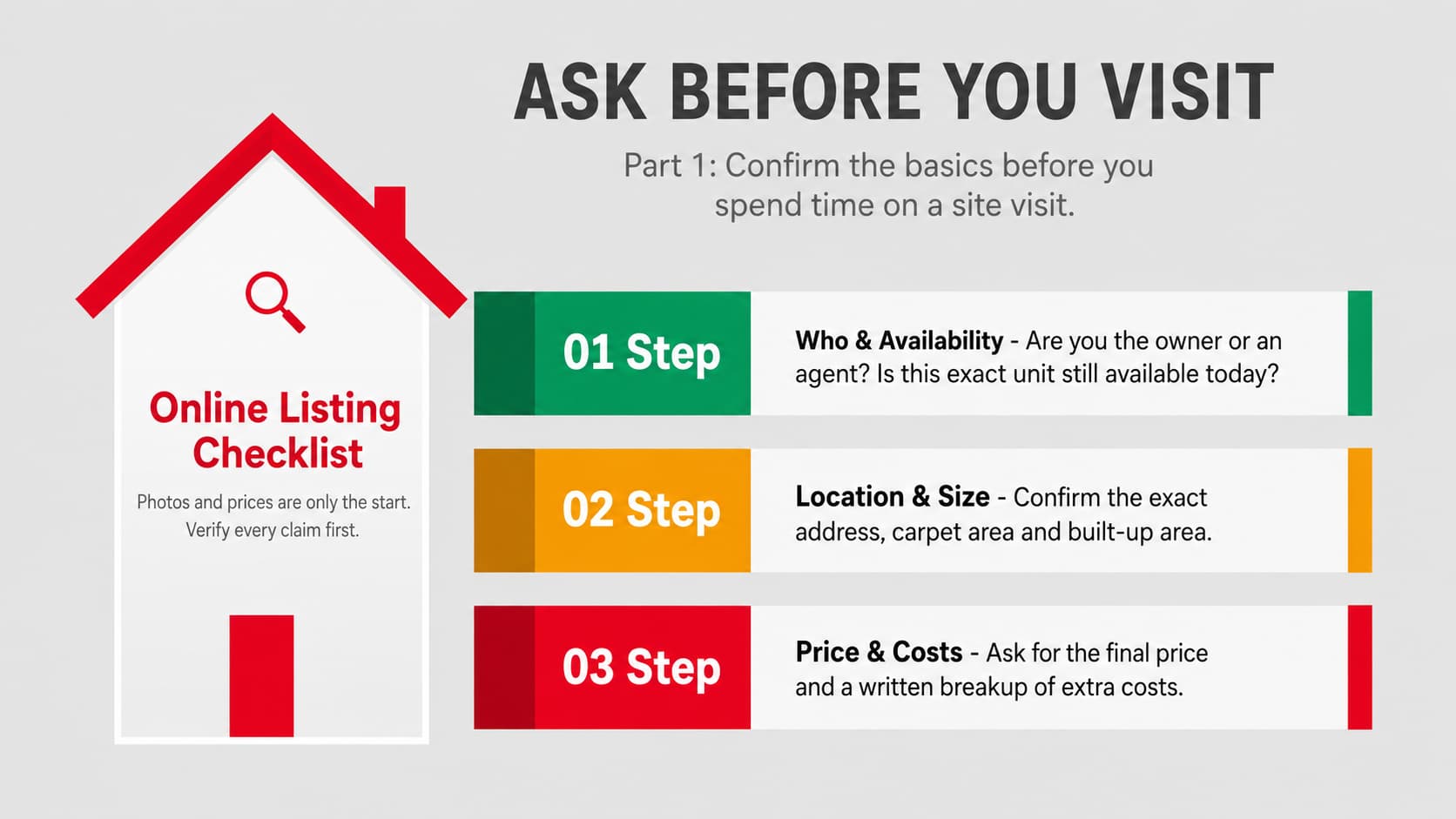
Good pictures and a good price will let you know the existence of the listing but will not guarantee that the property is available, is listed properly or is priced fairly. Online platforms like prooperty have a lot of listings but the information in them is provided by the sellers/agents and might be out-of-date or incomplete.
Right questions should be asked to avoid disclosure of your private information or any payments at early stages.
What Should You Ask First After Finding a Listing Online?
Start by establishing who is offering the unit, whether it is still available and where it actually is. Then confirm what is included, what it will cost overall and whether the listing matches current reality.
First-contact checklist
Are you the owner or an agent?
Is this exact flat still available?
What is the full address, tower and floor?
What is the final price, and what is excluded?
Which documents can you share?
Are the listing details current?
What Should You Ask the Seller?
An owner should be able to answer plainly. Ask:
Are you the owner, and are there co-owners?
Is the unit available now, and is anyone occupying it?
Why are you selling or renting, and how long has it been listed?
Has the asking price changed?
Is there an existing loan?
Are there any pending disputes a buyer should know about?
Treat every answer as a claim to verify, not as proof.
What Should You Ask a Real Estate Agent?
An agent should be able to explain who they represent and where the information came from.
Do you represent the owner, buyer, tenant or builder?
Who authorised you to market this unit?
How recent are the listing details?
Is the price negotiable?
What has been independently verified?
Are there brokerage or service charges, and are other parties involved?
Can documents be shared for review?
Is the same unit advertised elsewhere?
What Should You Ask About the Location?
The location pin or name may be approximate. Request the precise address and locality along with its access routes. Enquire about the proximity to major roads, public transport, educational institutions, hospitals, workplaces, shopping areas, and parking facilities. Also find out about traffic pollution, water logging, and connectivity during peak hours.
Whenever you compare the same property on different real estate portals in Gurgaon or any other city, make sure there are no discrepancies with respect to the address, prices or images shown.
What Should You Ask About the Size and Configuration?
Carpet area is the usable area inside the walls of the unit. Built-up area includes the area taken by walls and balconies. Super built-up area includes even a proportion of common areas like lobbies and elevators. If the price is based on super built-up area, it does not reveal much about the usable area.
Ask:
Where does the price refer to, and what are the three numbers?
What is the number of bedrooms, bathrooms, and balconies/terraces?
Which floor does it belong to, and what is its orientation?
Are parking spaces, storage space, and furniture included?
What is the age of the building, and do you have a floor plan?
Where measurements matter, ask for support from the agreement or approved plan.
What Should You Ask About the Price?
The advertised price is rarely the total amount you will pay. Ask:
Is the quoted price final?
Is it a lump sum or based on area?
Are parking, maintenance, brokerage and taxes included?
Are amenities charged separately?
What is the booking or token amount, and what is the payment schedule?
What conditions apply to any discount?
Charges vary by state, project and agreement, so do not assume a standard percentage.
What Additional Costs Should You Ask About?
Ask for a written divorce document. In some cases, expenses will be incurred in terms of registration fees, stamp duty (if any), maintenance, society or RWA charges, parking, brokerages, utility deposits, move-in fees, transfer fees, as well as unit charges and any renovations/repairs. It is not true that all these expenses will be incurred in each and every case.
What Should You Ask About Availability?
Make sure to ask if the unit is still available, when it can be occupied, and if it is currently occupied. If it is occupied, ask when it can be vacated. Ask if there are any other offers or bookings on the property.
Even though the listing may have been taken down, listings usually remain up even after a unit has been booked.
What Should You Ask About Ownership?
It does not necessarily mean that the individual talking to you over the Internet is the owner. Check the owner(s) of the unit, check if there are many owners and who has the authority to sell or rent the unit. Check if there is power of attorney or any authorization in place and if there is any loan pending.
Check documents for the same. Answering will not make you the owner.
What Documents Should You Ask For?
The exact papers depend on the transaction, but these are commonly requested:
Title deeds or ownership documents and transfer deeds or other documents of conveyance
Earlier documents of transactions, if any
Documents pertaining to any encumbrances
Approved building or plan drawings
Completion or occupancy documents, if any
Tax documents and RWA documents
RERA particulars, if applicable
Identification or authorization documents, if any
Read everything carefully. Professional legal verification is worth considering before you commit money.
What Should You Ask About RERA Registration?
RERA is the regulatory system through which most of the residential schemes must get registered with a particular state authority. Find out whether the scheme is registered, the registration number, and which particular state authority it has been registered with.
Then cross-check on the state RERA official website as well. Ensure the names of the project and promoter match, along with other relevant dates. The number entered in a listing proves nothing in itself, and registration is no assurance for everything in the transaction process.
What Should You Ask About the Home's Condition?
Inquire about the age of the structure, the repairs that have been done, and the conditions of plumbing, wiring, fittings, doors, windows, flooring, and painting. Ask about any leaks or moisture problems, any structural problems, water supply, state of the elevator, backup system, and any appliances supplied. Request for the maintenance record. Any assertion regarding the property should be verified physically.
What Should You Ask About the Surrounding Area?
The immediate environment is what affects your everyday existence. Inquire about noise pollution, traffic, construction work, drainage facilities, water-logging, road lighting, and condition of roads. Consider what shops, schools, hospitals, public transport and parking facilities are available in the area around the house.
Consider only tangible matters like entrance gates and lighting as far as safety is concerned. If there is any concrete information available, inquire about future development plans.
What Should You Ask Before a Site Visit?
Pre-visit checklist
Will I get to see the very unit that is listed?
Can you confirm the floor level and unit number?
Who will be meeting with me?
What documents do I need to bring along?
Is photography or videography allowed?
Is there any kind of access restriction?
Am I allowed to view the parking area and common areas?
The goal is to avoid spending a trip on a listing that misses basic expectations.
How Do You Know If a Listing Is Worth Pursuing?
There is no universal formula. A listing may deserve further attention when:
Core details are consistent and the source is clear
Availability is confirmed
Price and major costs are understandable
The location suits your needs
Key documents can be reviewed and RERA details checked
The actual condition matches the description
No major questions remain unresolved
Pause and clarify if there is no explanation for important information, if the details are constantly changing, or if there is no authority. The same goes for not being able to discuss the paperwork, costs being unclear, location being vastly different than the description, or the need to pay right away.
Quick Questions to Ask Before Moving Forward
Are you the owner or authorized representative?
Is this particular unit available today?
What is the complete address of the property, tower, and floor number?
On which basis is the price determined, along with carpet area, built-up area, and super built-up area?
What is the total cost, and what does it consist of?
What additional costs will be incurred, and can a breakup be provided to me?
Who is the owner of the unit, and is there any loan or dispute related to it?
What documents can I see before payment?
What is the RERA number, and do the records of the state authority conform to that?
What is the condition of the property, including repairs needed, dampness, and water supply?
How is the environment around the property during the daytime and nighttime?
Frequently Asked Questions
What questions should you ask after finding a property online?
The first thing to check will be the seller, if the property is still for sale, its exact location, the total cost and the supporting documents. From there, one will then go into ownership, RERA particulars, condition and surrounding areas. The main intention is to confirm that what you see is real before committing money or visiting.
What should you ask the seller after finding a property online?
Question them regarding their being a sole owner, occupancy of the property, reasons for sale or rent, and any change in price. Other important questions are regarding loans, co-owners, and any dispute if there is any. All answers must be taken as claims that need to be corroborated from documents.
What should you ask a real estate agent about an online property listing?
Find out who the agent works for and who gave him/her the authority to list the property. Make sure you get an idea of the age of the information and what has been verified. Find out if the price is flexible and which brokerage the listing belongs to.
What should you ask about the property's location?
Ask about the specific address and the access roads. Consider the distance from key areas such as major roads, transport, educational institutions, hospitals, and workplaces and the nature of traffic flow at rush hour. The location of the map pin may not be accurate, so verify the exact location yourself.
What should you ask about the property's size and configuration?
Enquire about the locality where the price has been fixed, as well as carpet, built up and super built up square footage figures. Verify the number of bedrooms, bathrooms, balconies, floors, parking space and storeroom, and ask for a floor plan or copy from the agreement.
What should you ask about the property's price?
Ask about the quoted price being final, whether the price is fixed or per square feet, and what is covered in the quote. Find out more about parking, maintenance, brokerage, and taxes, along with the booking fee and the payment schedule.
What should you ask about additional costs for the property?
Request a letter of breakup that includes issues such as registration fee, stamp duty, maintenance, society charge, parking, brokerage, deposit, move-in charge, transfer charges, and repairs. Every issue will not apply to every agreement. It is therefore important to know those that apply to your case.
What should you ask about the property's availability?
Ask whether it is still available, when the possession can take place, and whether someone already lives there. See if another party has offered on the unit or made a reservation for it. Double-check right before you visit because units tend to stay listed even if they have been sold.
What should you ask about the property's ownership?
Who owns the property? Are there any co-owners and who has the authority to sell or lease it? Inquire if there is a power of attorney, an existing loan or any dispute. Request for documents of ownership, but please note that the responses alone cannot guarantee legal ownership.
What should you ask about the property's documents?
Seek out title documents, conveyance deeds, encumbrance documents, approved plan documents, completion/occupancy documents if necessary, tax documents, society documents and RERA information. These can differ depending on the transaction, and it is advisable to have everything vetted legally before making any payments.
What should you ask about RERA registration after finding a property online?
Request the registration number and the state authority from them, then you must visit the RERA website yourself to verify the details. Make sure the name of the project, the promoter, and the relevant dates match the ones mentioned in the advertisement. Registration is an effective measure of transparency, though it doesn't ensure everything about a deal.
What should you ask about the property's condition?
Inquire about the age of the structure, any repairs, leaks, dampness, plumbing, electricals, fittings, doors, windows, and floors. Find out about water supply, lift, power back-up, and maintenance records. Cross-check the information physically rather than just through pictures.
What should you ask about the surrounding area and amenities?
Ask about noise, traffic, construction, drainage, waterlogging, lighting and road condition. Check nearby schools, hospitals, shops, transport and parking pressure. Visit at different times of day, and speak to residents or the society office where practical.
What should you ask before scheduling a site visit?
Check if there will be a display of the unit and floor, as well as the person who will be meeting you and the documentation required on your part. Discuss the following: photography restrictions, access restrictions, as well as inspection of parking and common areas.
What questions can help you decide whether an online property listing is worth pursuing?
When listing details are consistent, the source is clear, the availability is confirmed, costs are easily understood, and documents can be viewed, a listing needs more attention. Stop when explanations are constantly being changed, the source of authority is not known, or cost information is ambiguous.