Just a couple of decades ago, hunting for a house in India meant a visit to the local agent, some newspaper classifieds, and lots of phone calls to friends and relatives. Now, people often make a call to their cell phone even before they make one to a living being. People have already thought about budget, area, size, and they've scrolled through dozens of pictures within minutes that take to finish a cup of tea.
This revolution in property searching is one among many changes that have occurred in the domain thanks to digitization. It has transformed who has the knowledge, how the price was figured out, how the trust was built and what was the expectation from a prospective buyer. This guide tells you more about this transition and what has been good and bad in the process.
How Home Search Worked in the Offline Era
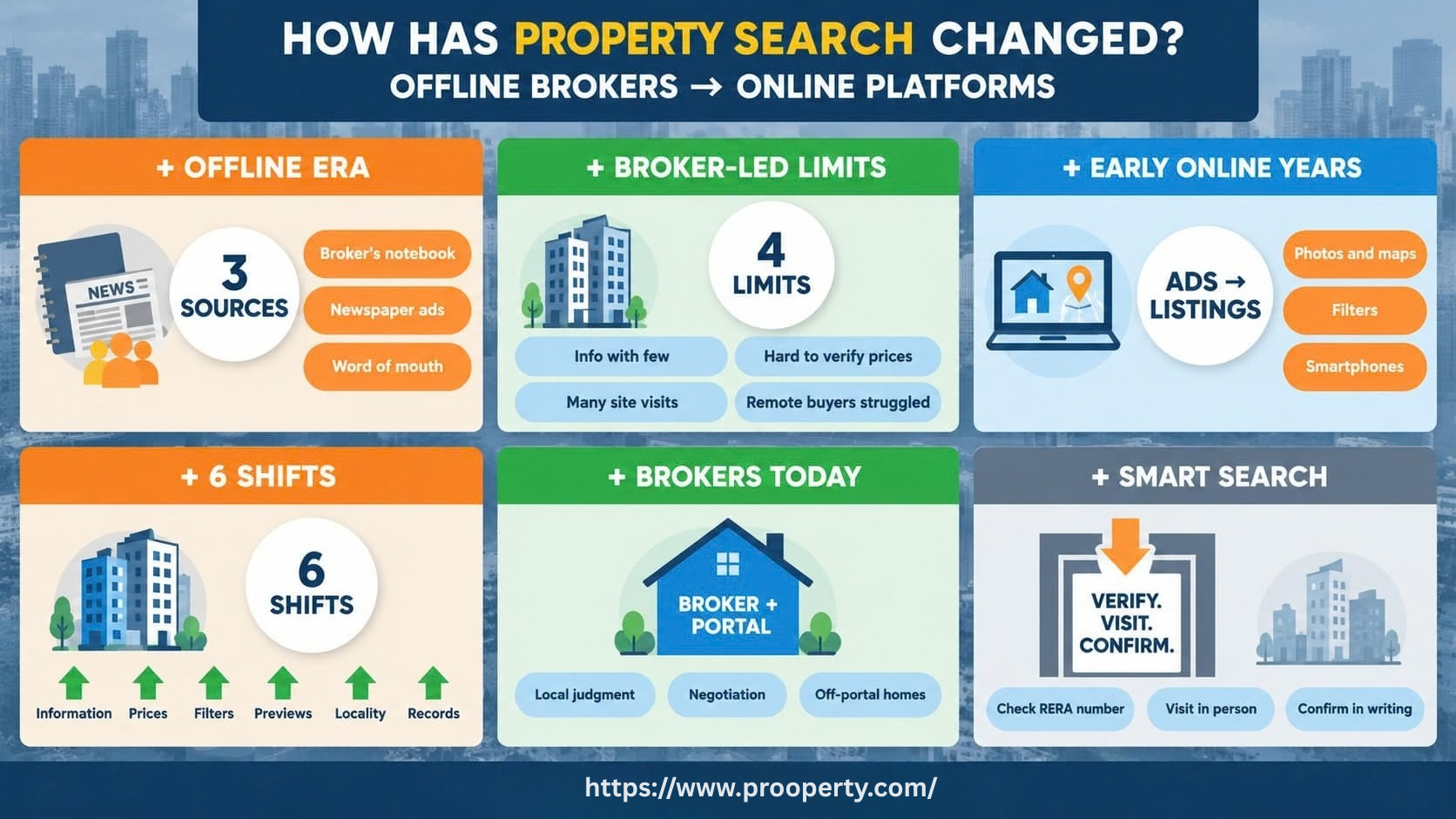
Before the internet became a daily habit, a home search was local and personal. Most information lived in three places:
Memories of the broker and notes. A real estate agent in that area knew about the empty flats and the building with problems as well as those willing to make deals.
Classified ads from newspapers and hoardings. Classified ads provided the location of the building, an estimate of its size, and a telephone number. Projects of builders were advertised using banners, brochures, and sales offices.
Word-of-mouth. Recommendations by friends, colleagues, and family members.
It was a straightforward but lengthy process. You informed the broker of your requirements, then waited for calls, visited properties one by one, and went back to the same broker if none of them satisfied you. It might have taken weeks or even months to make a selection from two or three localities or two cities.
Why the Broker-Led Model Had Limits
This system functioned due to the fact that the brokers knew well their part of the city. The information was highly valued. However, there were some built-in flaws in this system.
Information remained in possession of a few individuals. They showed you what they wanted to show. Thus, if there was a better deal waiting for you at another broker just around the corner, you would not be aware of this fact.
Pricing was difficult to verify. With very little comparative information available to you, it was impossible to tell whether the price offered is really fair. Negotiation relied on the amount of information one possessed.
There was time and labor involved. Each shortlisted home needed a physical visit. Something that seemed ideal on the phone could be too small, too dark or too far away from the metro.
It was hard for the remote buyers. The people who moved places for jobs or Indians living abroad who wanted to buy a home in their own country were dependent on another person’s description.
There was lack of record keeping. Information about any property used to exist in paper form, scribbles and promises. Comparing two different houses meant memorizing rather than comparing side by side.
None of this implies that the offline method was wrong. This is just to say that it was designed for an information deficient world.
The Early Online Years: Classifieds Move to Screens
The first Internet action was simple. Websites borrowed from the concept of the classified ad: brief description, price, phone number. What mattered was scale. The owner could now get attention not in a neighborhood alone but across an entire city or even country. And the searcher could check out several listings without leaving his house.
Portals soon added some form. The plain-text format evolved into a common template with fields such as location, number of rooms, floor, furniture, possession and amenities. Pictures came to dominate listings. Mapping tools were introduced. Filters cut down a lengthy search into a shortlist within seconds.
Smartphones sped up the process. The task of searching shifted from a computer in the evening to a cell phone on the go during the day: while commuting, during lunch or waitings at a doctor's office.
Six Major Shifts From Offline to Online
1. From scarce information to abundant information
Where a seeker once had just a few choices to consider, there are now countless options to think about at one time. This tips the scales, because now the seeker comes to the discussion well-informed.
2. From guesswork to price awareness
Seeing numerous identical houses next to each other provides you with an idea of what is normal in that location. You will have to check the specifics, but at least you have a starting point.
3. From phone calls to filters
Rather than having to repeat your requirements each time, you put your requirements in one go: budget, number of rooms, possession date, furnishing, distance from office. Filters perform the initial filtering process on your behalf.
4. From physical visits to virtual previews
Pictures, floor plans, and virtual tours give you the opportunity to rule out those houses that do not fit your needs without going through the hassle of visiting them during the weekend.
5. From local knowledge to locality research
Today’s portals are adjacent to neighborhood exploration tools such as schools, hospitals, transportation options, and shopping centers. The buyer gets to understand the area even before visiting it.
6. From private deals to documented trails
With messages, inquiries and shortlists having been recorded digitally, it becomes easy to track, follow up on and even keep track of the promises made.
The Role of Regulation and Transparency
The rise of digital search was not an isolated event; there was also a move towards increased transparency within the Indian real estate market with respect to the passage of the Real Estate (Regulation and Development) Act, popularly known as RERA, along with the creation of state-level regulatory authorities.
This was important in light of the transition from an offline search system to an online one. If a listing included the registration number, the potential buyer could confirm its authenticity independent of the statements made by the seller. This task was made easy by digital platforms, although the burden of verification continued to remain on the buyer.
What Do Brokers Still Do Well?
It would be incorrect to claim that brokers have gone away. A lot of them now work through portals directly, using online listings to increase their exposure. The difference is that the value that brokers provide has evolved.
The best agents still provide what the internet can’t:
Local-level decision-making. They are aware of which roads flood, in which society there are maintenance issues, and which builders are prompt.
Coordination and negotiation. Arranging site visits, coordinating between owners, and sorting out paperwork takes time.
Assurances by humans. Purchasing a home involves an emotional decision for most people and having a trusted advisor helps.
Information about off-portal inventory. Many properties are first sold or leased without even being put on the portals.
The modern model is less "broker versus portal" and more "broker plus portal." The portal widens the field, and the agent helps you act on it.
Where Digital Search Still Falls Short
The truth about any picture is that there must be some negatives in it.
Stale/incorrect details. The property may have been sold, rented, and its listing may be active even when it isn't. Photos may be outdated compared to how things look in reality.
Inconsistent information. While some listings are well-written, others lack some details like the type of area, costs, and ownership details.
Paid promotion. Top positions may not guarantee that the listing suits you best. Be careful and attentive when looking at the listings.
Overloading with information. The abundance of listings and options may confuse you until you know what you want.
Fraud. Excessive promises, low prices, asking for payment in advance, and refusing to give the address may signal you that the offer is not trustworthy.
All these reasons make clear why you should use only online listings as a source and verify everything else.
A Note on Regional Search
Urban belts that grow quickly generate a lot of new launches and resale properties; hence, the need for digital searches in this case becomes obvious. Comparing real estate websites in the Gurgaon region within the Delhi NCR is an illustration of how varying websites offer varied presentations of locality information, project information, and contacts. One needs to analyze the completeness of the information, its recency, and seller identification.
How to Combine Offline and Online Search Wisely
You do not have to choose one world. A practical approach blends the strengths of both.
Start the search online by making a precise brief. Prepare your budget, list of requirements and constraints in advance, and start browsing.
Make a shortlist of five to eight houses. Save all the offers and then compare the prices per square foot, total cost, location category, amenities, commuting time and possession period.
Compare across sources. In case the same house comes up in different sources, compare the information.
Verify the property before visiting it. In case of new projects, verify the registration number on the official website of the regulator. Get the exact address and ask about the seller's involvement in the process.
Visit the property yourself. Check the lighting, ventilation, noise level, water supply, parking facilities and conditions of common areas. None of these aspects can be verified through pictures.
Consider the use of a local advisor if necessary. An experienced real estate agent may provide additional information and assistance with coordination without taking over the decision-making process.
Get all the information in writing. Make sure the price, area, charges and other details as well as the terms of possession are clear before making any payments.
Consult an expert on legality. The title, approvals and agreements need professional advice.
Platforms such as Prooperty aim to support this process with organized listings and practical guides, so that research feels clearer and less overwhelming.
What Comes Next in Digital Real Estate
The direction of change points toward more clarity and convenience for home seekers. Several trends are already visible:
Media upgrades. Quality pictures, floor plans, video walkthroughs, and neighborhood maps make it easier for buyers to assess their choice before they visit the property.
Intelligent searching. Technologies that understand your needs and show you the relevant choices save you time and effort scrolling through results.
More verification indicators. Easily recognizable information about registration, documents, and identity of the seller helps build trust.
Greater assistance in remote decision-making. NRIs and migrating families have the capacity to prepare a list of homes remotely already, and technologies for that will only improve in the future.
Planning assistance. Budgeting, financial forecasting, and cost calculation are increasingly becoming parts of the search process.
Whatever tools arrive, the basics will remain the same. A good decision still depends on accurate information, careful comparison and personal verification.
Frequently Asked Questions
How has home search changed in India over the years?
The process evolved from broker memory, newspaper advertisements, and word-of-mouth to search portals with filters, pictures, mapping tools, and local information. The seeker now has many more options available and is more knowledgeable before the conversation begins.
Do online portals replace brokers completely?
No. Portals expand choice, but agents provide local expertise, coordination and negotiation assistance. Increasingly, buyers and renters are utilizing both at the same time.
What is the biggest advantage of searching online?
The most important benefit is scale. You will be able to evaluate many properties in no time, learn about average prices, and avoid bad choices.
What are the main risks of online home search?
Risk factors include old ads, lack of information, paid exposure, and false offers. Verification of document, registration, and web site helps to minimize these risks.
How can I check whether a new project is registered?
Request the registration number of the project from the seller and check it on the website of the regulatory body for real estate in your state. Compare it with the details available in the advertisement.
Final Thoughts
It’s not a tale about replacement of the offline brokers by online services. It’s the tale of information becoming accessible for everyone and home buyers getting an opportunity to find out all the details, analyze and ask questions before making the decision. The online technology helped to achieve this goal, and personal confirmation guarantees its safety. Use portals to search (real estate portal in Gurgaon ) and use people to get the inside information, and make the decision based on your own data.