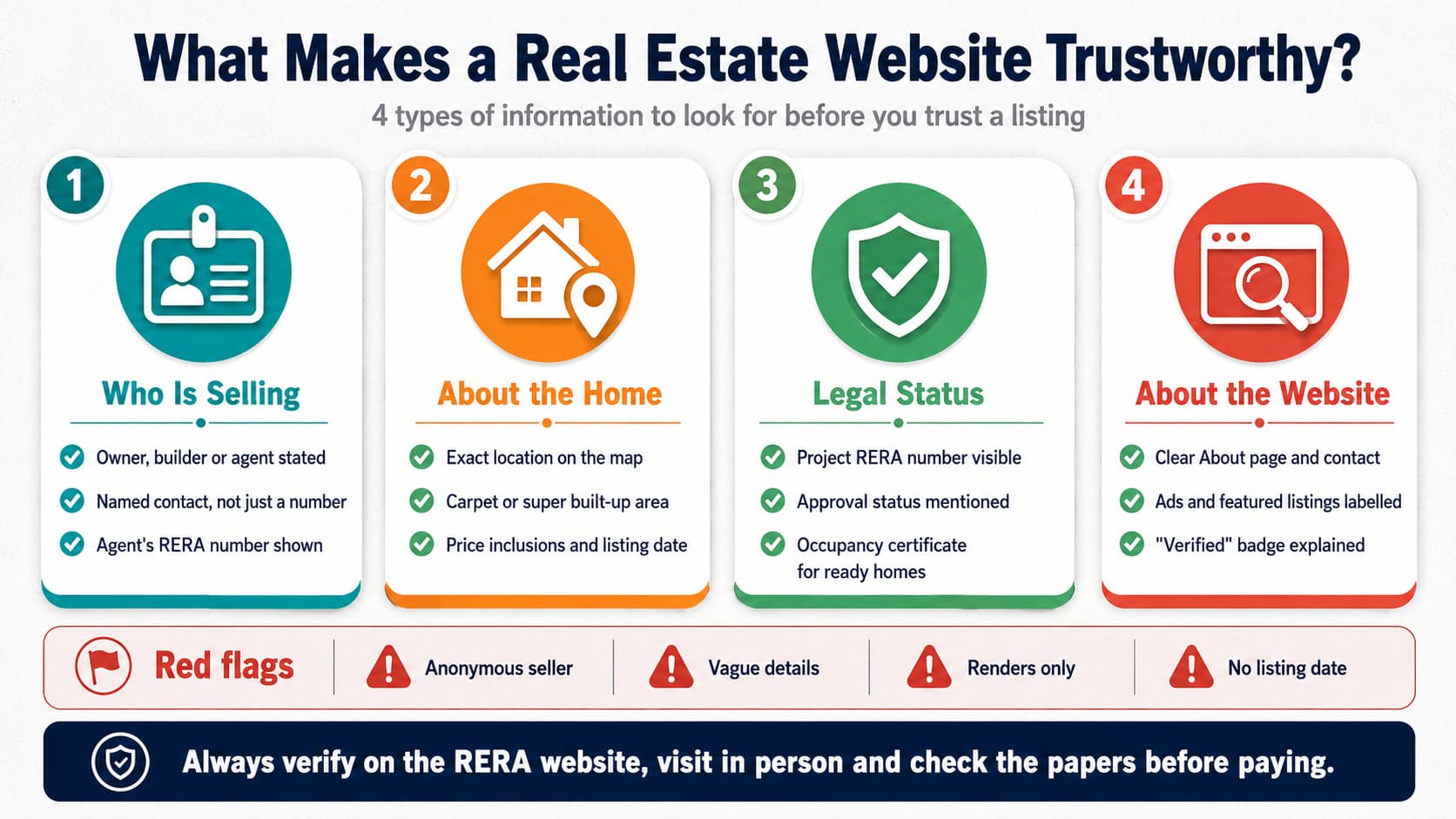
An honest listing directory indicates who owns each listing, what has been checked for validity, the timeliness of the information provided, and how the directory generates its income. If all four criteria are transparent and verifiable, you can place more trust in the information being provided by the directory. If they are not clear, consider each listing as just a lead.
Key takeaways
Find sellers/agents who have a valid RERA registration number rather than anonymous sellers.
Details about an exact listing (type of area, inclusions, good quality photos, listing date) carry more weight than marketing.
A website with information on the meaning of the “verified” logo is much more trustworthy than just displaying the logo.
There isn’t any website that can verify all your documents.
The first step that everyone takes while searching for homes online involves taking a huge risk of trust based on price, images, and a phone number. Whether or not a real estate website merits that kind of faith often rests upon the information that the site provides—or, rather, lacks.
Here we have listed the information that increases the level of credibility of real estate websites, along with ways to verify that data and how to cope with the lack of that. This article is intended for assessing websites and not promoting them.
1. Information about the people behind the listing
A listing without a traceable person is a weak listing. Look for:
Seller. The listing needs to mention whether the seller is the owner of the property, or the agent or the builder.
A contact person. Instead of just a “contact seller” button, a contact person with name and telephone number is much more desirable.
RERA registration number of the agent. According to the Real Estate (Regulation and Development) Act of 2016, an agent who trades registered properties needs to be registered with the RERA authority of that particular state. A good agent would be willing to give you this number and you can verify it at the website of the regulatory authority.
Details of the builder firm.
Red flag: a seller who will not say who they are, or who gives only a mobile number and no other detail.
2. Information about the home itself
Specific listings are harder to fake and easier to verify. Reliable listings usually include:
Actual place corresponding to map pin, not just locality name.
Type of area. The listing must specify if it is a carpet, built-up, or super built-up area. Since under RERA new homes are supposed to be bought on carpet area, a listing that shows carpet area will give you a better comparison.
Price and extras. Parking, maintenance deposits, and any other charges must be specified separately.
Possession condition. Ready for occupation, or under construction with estimated delivery date.
Pictures of the actual place. Photographs of the actual apartment, staircase, parking, and surroundings. Renderings show intention, but not the real thing.
Date of posting and latest update date. This helps you know if the apartment is still available or not.
Red flag: vague lines such as "great deal, call now", missing area type, or photos that appear on several unrelated listings.
3. Information about legal status
This is where credible sites separate themselves from careless ones. Useful signals include:
A registration number of the RERA of the project listed, either along with a link or an indication of where you can check it.
Status of approval of new projects like sanctioned plans mentioned either in the listing itself or on the project page.
Whether there is a completion or occupancy certificate for ready homes.
This site is not verifying the legality of the project through the registration number. This site is providing you with what is required to verify the project. Visit the site of the state regulatory body and verify the number, project name, and promoter.
Red flag: An unregistered project or an invalid registration number.
4. Information about the website itself
Trust is also about the site, not only the listing. Check whether the site:
Has an actual "About us" page that provides information about the name of the company, the company's team and the contact address.
Explains how it makes money. Listing fees, premium listing, subscriptions and advertising are typical ways of making money. It is important that any paid or featured listings are clearly marked as such.
Explains what the verification badge means. The badge that shows exactly which information was verified (for instance, seller's phone number or registration number) is more useful than the simple tick.
Provides information on authors of the guide. An article that has a named author, reviewer and the date of update can be considered more reliable than an anonymous one.
Has a way to report a fake listing and a Privacy Policy explaining how your inquiry will be used.
Red flag: no company details, no way to report a problem, and "verified" labels with no explanation.
A trust scorecard you can use in ten minutes
Give each row a score of 0 (missing), 1 (partly there) or 2 (clear). A site that scores 12 or more out of 16 is giving you a solid base to work from. A site that scores below 8 deserves extra caution.
A worked example (illustrative scenario)
This is an illustrative scenario, not data from a real transaction.
Imagine the same 2 BHK flat appears on two websites.
Site A shows "2 BHK, great deal, call now", a price, three computer renders and a single mobile number. There is no listing date and no area type.
Site B shows the carpet area, the maintenance charge, six photos of the actual flat, the listing date, the seller's name as an agent with a RERA registration number and a "report this listing" link.
Neither site demonstrates that the flat is a worthwhile purchase, but Site B provides you with eight aspects to consider while Site A offers you nothing. In the case where both listings offer the same price for the property, Site B is definitely the one to contact first. In addition, in the event that Site B's registration number does not tally with the regulatory body's records, you learn something useful as well.
What trust signals cannot prove
Even the best information has limits:
A "verified" tag may mean a contact number or photo was checked, not that the title and approvals were legally cleared.
A registration number on a listing is only useful if you check it on the regulator's website.
Ratings and reviews depend on who chooses to write them.
A well-designed site is not the same as a well-verified site.
Treat each signal as one piece of evidence. Title documents, approvals and the sale agreement should still be reviewed by a qualified professional before you pay anything.
Use more than one site
Same property can be listed with different prices, images or areas depending on the website that one visits. When you are doing research on Delhi NCR area, visiting websites that list real estates in Gurgaon will help you know which of the websites gives the best information about the same property. This will depend on the level of details offered.
The websites like Prooperty try to present organized listings in addition to giving buyers guides, hence making the process of searching easy. No matter which website you visit, listing of the property may just be enough to start your search but not to confirm all documents, so do a physical inspection and review all the documents before you buy any property.
A quick checklist before you trust a site
Is the seller identified in each listing?
Is there a way for me to crosscheck the RERA ID of the agent and the project on the regulatory body’s website?
Does the listing specify the property type, price include and possession status?
Are the pictures that of the actual property?
Does the listing carry any date?
Does the site tell me how they make money and what the badges mean?
Is there a way to report an incorrect listing?
Frequently Asked Questions
1. What makes an online real estate platform trustworthy?
A credible site shows who is selling, what has been verified, how recent each listing is and how the site earns money. Specific details, real photos and checkable registration numbers are stronger signals than design or claims.
2. What information should every listing show?
Exact location, price and inclusions, area type, possession status, real photos, the seller type and a listing date. For new projects, the RERA registration number should also be visible.
3. How do I check a RERA registration number?
Open your state's RERA authority website and search for the registration number or the project name. Confirm that the promoter, project name and location match the listing.
4. Does a "verified" badge mean a listing is safe?
Not necessarily. It usually means a specific check was done, such as a phone number or photo. Look for a clear explanation of what was verified and still check the documents yourself.
5. Why does carpet area matter?
Carpet area is the space you actually use inside the walls. Super built-up area includes shared spaces, so comparing homes on carpet area gives a fairer picture of price per usable square foot.
6. Are featured or premium listings less reliable?
Not automatically. They are usually paid placements, so position reflects visibility, not quality. Read each listing's details instead of trusting its position.
7. How can I tell if a listing is outdated?
Check the listing date and the last-updated date, and ask the seller whether the home is still available. An old listing with no update history may already be sold.
8. Is it safe to pay a token amount based on an online listing?
Do not pay anything before you have visited the home and checked the documents. Ask in writing whether the token amount is refundable and under what conditions.
9. What should I do if I suspect a fake listing?
Do not pay or share personal documents. Use the site's report option, and check whether the same photos or details appear on other listings with different contacts.
10. Should I rely on one website?
No. Compare at least two sites. The same home can show different prices, photos or area figures, and the differences help you spot outdated or incomplete information.
Final Thoughts
A good site can be trusted by virtue of the information it is ready to give out: the person selling, the verification of what is being sold, the currency of that information, and how the site is able to earn its money. These are your guides to determining what listings merit your attention and what not. But it is your duty to check up on the significant ones.