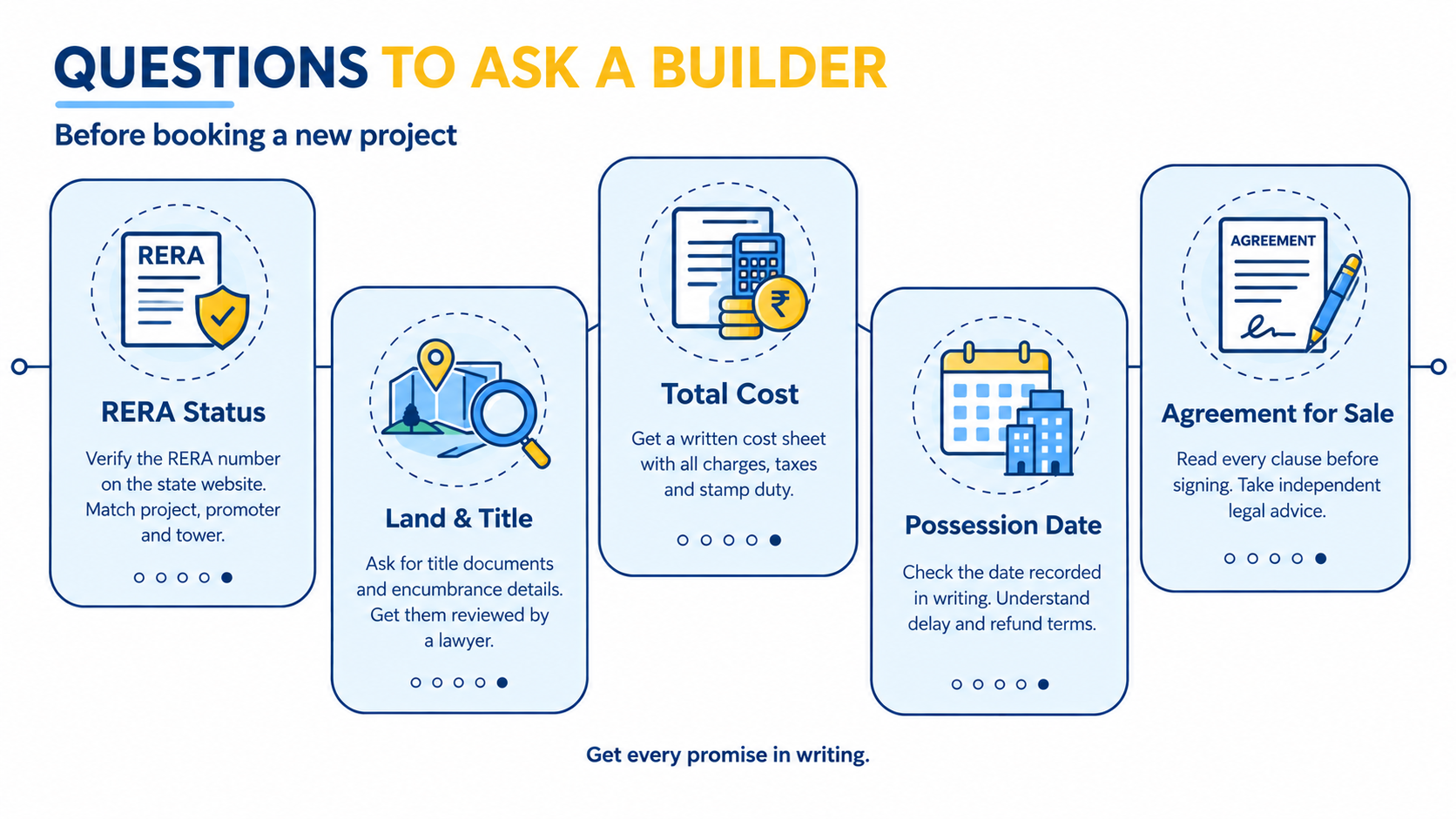
You have gone through the sales office, viewed the model apartment and heard that "possession is about two years away" and that the existing price is good only until the end of the weekend. Now is the time to take things easy. Booking payment is a genuine financial responsibility but the vast majority of things stated during the sales talk are either verbal or stated in a brochure that has not been signed by anyone.
There is an easy way to go about it: for each significant pledge made, inquire where it is stated. Here are the questions that one needs to ask in the order most buyers encounter them, accompanied by a list of important documents to be acquired. You do not need to appear skeptical. Good builders are used to such questions.
RERA registration and project status
Start with the basics:
What is the registration number of the project under the RERA?
On which website of the state authority can I check it?
What is the completion date registered?
Are towers or phases registered separately?
In most states, any residential project over a certain size needs to register with the state’s Real Estate Regulatory Authority. And these requirements vary from state to state. Registration details will generally include the name of the developer along with the location of the project and its completion date. You need to verify that these are the same as the information provided to you.
Registration gives you a regulation to operate under, but that does not mean that a project becomes risk free.
Land ownership and legal rights
Identify whether the land is owned by anyone and the status of ownership of the builder (whether he owns the land or just has development rights). In case the project is being constructed as per the terms of a Joint Development Agreement (JDA), seek all the details about the same.
Then ask:
Is there any mortgage, encumbrance, or lien on the land?
Is there any legal case pending against the land or the proposed development?
May I see the title deeds and ownership history?
Always request copies and never take any promises at face value. This is because the documents involved in this process are technical in nature and need to be assessed by a professional real estate attorney prior to making any substantial payment.
Exact unit details
Salespeople often describe a home in general terms, so pin down the specifics of your unit:
Tower/Floor/unit number
Area of carpet and how it compares to super area quoted
Layout, facing and view
Size of balcony/terrace and whether this area is included in total area
Parking facilities: covered/uncovered, and whether allocation of specific parking slot is included
Specifications: Flooring, Kitchen and Bathroom fittings, Doors, Windows, Electrical points
Make sure that the dimensioned plan along with a detailed specification list is given to you, and compare it against what was promised to you. According to RERA guidelines, the carpet area should be the basis for calculation of area. Quoting the price based on a super area could make the property appear cheaper than its actual cost.
Total cost, not just the quoted price
The figure in an advertisement or message is often only the base price. Ask for a written cost sheet listing:
Base rate and area of application thereof
Floor rise charges
Location premium (view of park, corner, and other locations)
Parking charges
Charges for club/amenities membership
Maintenance advance/corporus fund
Other one-time charges like utility connections and documentation, where applicable
Applicable taxes
Additionally, find out what costs in terms of registration, stamp duty, and others will be incurred in the process of transaction. Since these figures vary with states and times, do not rely on the number given to you from a conversation, but confirm these figures through your attorney or the local registration authority. Calculate the whole thing and compare the projects accordingly.
Construction progress and possession
Ask:
Where does my tower currently stand in the phase of construction?
What are the future milestones and their due dates?
What is the possession date mentioned in the RERA registration document? What will the agreement say?
What will happen in case there is a delay in the possession of the property?
An “expected possession” talked about in a meeting does not mean the same as the date in your contract or registration document. It is only the date in the contract or registration document that matters. Take note of how the developer deals with delays: Does he give you grace period, what are the grounds for his excuses, and how do the compensation or refund payments work? Delay provisions exist in RERA, but these will vary depending on your contract and laws in your state.
Approvals and sanctioned plans
Requirements for approvals vary by location. You can ask the contractor to give you a list of the required approvals and their current status for this project. Some of these usually involve the approved building design plans, approval of the design layout, starting permit, environmental or fire clearance, etc., and, ultimately, the occupancy permit.
Ask:
Is my unit reflected in the approved plan in precisely the manner I have seen?
Are there any modifications in the plan made or proposed to be made?
Are there any critical clearances that are pending and when is it expected?
Ask to see the sanctioned plan and compare your unit's location and size against it.
Amenities and common areas
Brochure images are marketing illustrations. A written commitment with a timeline is something else. Ask:
Which are permanent and which are planned?
What is the deadline for completion? Are they before or after occupancy?
Do they appear in the contract or in the project documentation?
Is there any extra fee for using them or membership?
Who takes care of maintenance? When will the common areas transfer to the residents' association?
If a clubhouse or pool matters to your decision, ask that it be named in the agreement.
Maintenance and future running costs
The purchase price is paid once, but maintenance continues for as long as you own the home. Ask:
What is the monthly maintenance cost? What is its basis?
Is it for security, cleaning, lifts, electrical, water supply, landscaping?
How many months’ advance is collected for maintenance? Is there any corpus fund?
Are there any additional costs like club, parking, or common area charges?
What are the utilities costs?
Ask for the estimate in writing, and remember it may change once the building is occupied. A project with extensive facilities will usually cost more to run than a simple one.
The Agreement for Sale
This is the document that actually governs your purchase, so ask about it early. Ask for a draft before you pay a large booking amount, so you have time to read it.
When will it be executed? RERA caps the amount of money that the promoter may claim as an advance prior to executing a registered agreement. Clarify this in relation to your own state.
What are the payment terms? See if there is any relation between the amount of the payments and their phases with regard to construction.
What are the conditions for cancellation and refunds?
What are the possession and delay conditions?
What are the specifications? See what would happen in case of modifications to plans or specifications made by the builder. RERA caps certain modifications without your consent, but check how it is regulated in the agreement.
What are your obligations? See deadlines of payments and interest charged for delays and consequences of defaults.
What are the promoter’s obligations? This relates to the liability to defects after possession of property. It is already provided for under the law.
The states usually have a standard format of the agreement and hence you may want to know whether this is in conformity with that format. Go through all clauses and annexures and raise any queries regarding the points you find confusing.
Booking amount, cancellation and refund
Before paying, ask:
How much is the booking amount, and what written receipt or booking form will I get?
Under what conditions can I cancel, and what deductions could apply?
How and when would a refund be processed?
What happens if the buyer defaults, and what happens if the project is delayed?
No standard policy of refund or cancellation applies to everyone. Conditions vary based on the documentation, project, and local laws, so always check the booking document's terms before you make the payment. Inquire about its refundable nature prior to signing the contract and have your question answered in writing. Make the payment via bank transfers to the specified account of the builder and save all receipts.
Home loan and payment process
Ask:
Which lenders are familiar with this project, and can I use my own bank?
What documents will the lender need from the builder?
Is payment construction-linked or on another plan, and how are disbursements made?
What do I pay during construction, such as interest on disbursed amounts?
Lender approval is not a substitute for your own legal due diligence. A bank assesses its own risk in lending. It is not advising you on whether the title is clear or the agreement is fair to you.
What to observe during a site visit
Go with a checklist, and go more than once if you can, at different times of day.
Progress in construction: Is your building at the stage it was supposed to be? Is construction taking place at the moment?
Access Roads: How good are they? How can you access the main road from the site?
Environment: Keep an eye on nearby construction sites, open drains, industries, high tension lines and traffic/railroad noise.
Site conditions: Check for water logging, dust and drainage.
Comparison between sample flat and construction: The room sizes, ceilings and other finishing might not match the sample one.
Amenities: Note what is under construction and what is still just open ground.
If you shortlisted the project through an online platform such as Prooperty, use the visit to check that the listing details match what you see on the ground.
Final pre-booking checklist
Before you pay, confirm the following:
The RERA registration number is checked on the website of the state authority, and the project, promoter, and tower coincide
The title and encumbrances have been verified by a lawyer
You have a cost sheet that is in writing along with the charges and taxes, and you have made the estimate of transaction costs
The unit number, carpet area, floor plan, and specification sheet are in writing
The possession date has been recorded, and you know about the delay clause
You have seen the approved plan and permissions, and have noted pending ones
Communal facilities along with their timelines are in writing
Maintenance charges and deposit details are in writing
You have received and gone through the draft Agreement for Sale
Cancellation and refund conditions of booking are in writing
Your loan eligibility and documentation requirements are known
You have visited the site
Online research can make this preparation easier. Browsing real estate portals in Gurgaon, Prooperty included, can help you compare shortlisted projects and gather initial details. Treat listings as a starting point, though. Each detail still needs to be checked against the RERA record and the actual documents.
Conclusion
It is more important for you to know what you see in writing rather than what a builder tells you. Ensure that all the crucial promises are clear, put into writing and confirmed. The fact that a builder has no problem answering your questions and providing you with relevant documents is a positive signal. If answers remain vague and change from one moment to another, this is also information. Do not rush when making up your mind about anything.