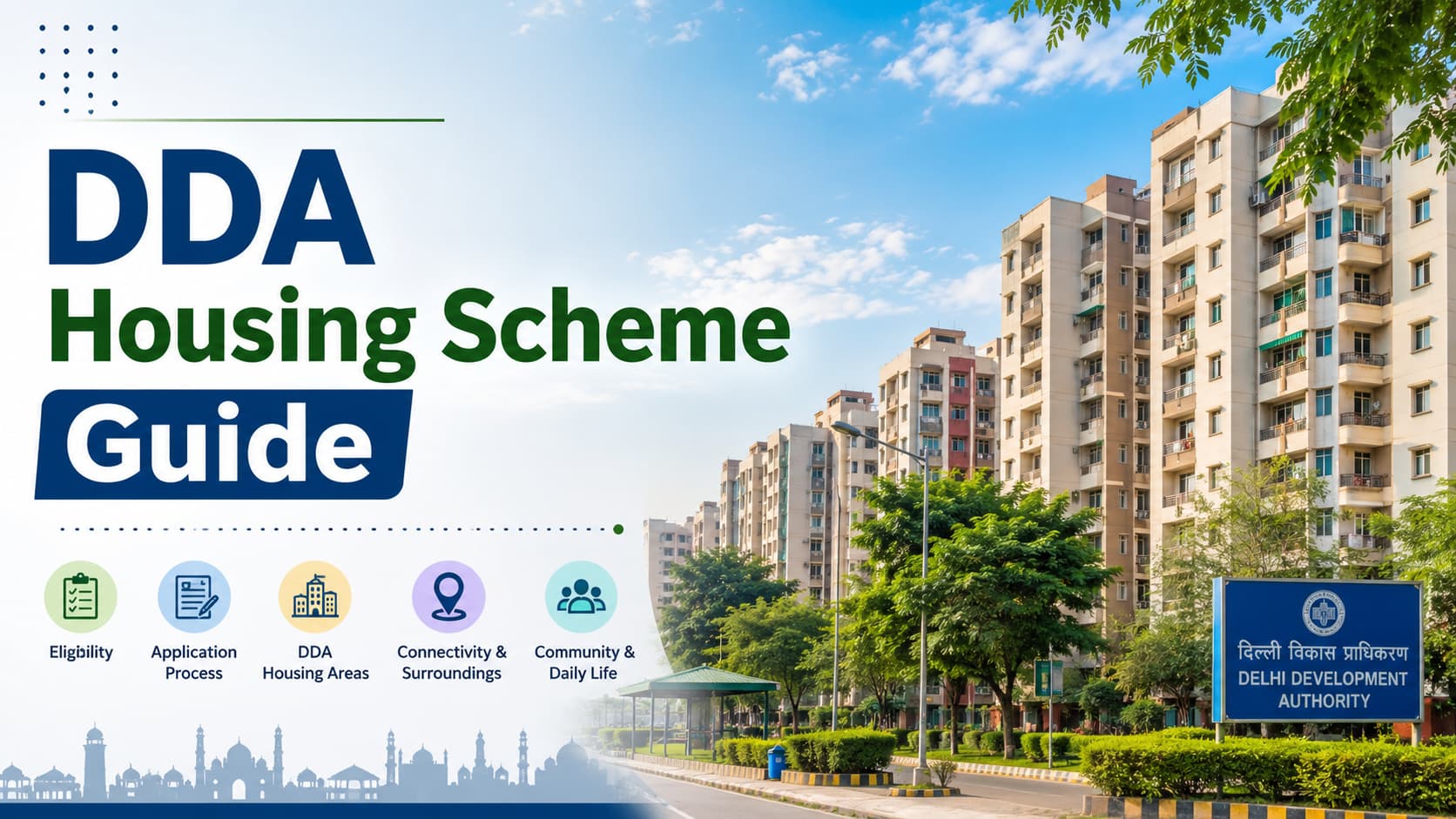
DDA Housing Scheme Guide
Every Delhiite who has spent years looking for affordable housing can tell you just one thing: the DDA Housing Scheme. Because of it, a middle class family is able to have a flat in India's capital without having to pay a premium charged by builders and because of it, lakhs of applicants visit the DDA website every time a new draw takes place.
However, the DDA Scheme has changed quite a bit since those days. The old lottery-only system has been replaced by the first come first served principle for many groups, prices have been modified, locations have gone beyond the usual spots and eligibility criteria have been relaxed in an almost unnoticed manner.
Everything about it is covered in this guide: DDA Scheme, flats available and their locations, real prices, eligibility criteria, whole application procedure, financing and common mistakes of first time applicants.
What Is the DDA Housing Scheme?
The Delhi Development Authority is the organization created by statute that undertakes development in an organized manner in the National Capital Territory of Delhi. The authority was established under the Delhi Development Act 1957. Its scope includes land acquisition, master planning, infrastructure development, and perhaps most notably housing.
DDA Housing Scheme is the medium through which the Authority provides ready-made flats to the general public at rates cheaper than those prevailing in the private market sector.
Why the DDA Housing Scheme Still Matters
Three reasons, in order of importance:
Price. DDA flats are priced on a cost-recovery basis rather than a profit-maximisation basis. In practical terms, this often means 20% to 40% below private market rates for equivalent locations in Delhi.
Title clarity. DDA is the allotting authority and the land-owning agency. You are not dealing with a builder who may or may not have clear title, may or may not deliver, and may or may not have RERA registration in order. This eliminates an entire category of risk that plagues private purchases.
Ready possession. Unlike under-construction private projects where you pay EMIs and rent simultaneously for years, most DDA scheme flats are complete or near-complete at the time of allotment.
The trade-off is equally real: DDA flats are generally older in design, located in areas with variable infrastructure quality, and offer fewer amenities than a comparable private project on, say, Dwarka Expressway or Sohna Road.
How the DDA Scheme Has Evolved
Understanding the shift in model is essential to applying correctly.
The Old Model: Lottery Draw
DDA has run a pure lottery based system for decades. The DDA would put out a scheme with set inventory, take applications along with the registration fee, and hold a computerised draw. The chances of success have been harsh; many times 1 in 20.
The registration money is returned back to those not lucky enough.
The Current Model: First-Come-First-Served (FCFS)
DDA has progressively moved several schemes to an FCFS model, particularly for inventory that repeatedly went unsold in lottery draws. Under FCFS:
Flats are listed with location, category, and price
Applicants browse available units on the portal
You select a specific flat, not a category
Allotment is confirmed on payment, in order of application
No draw, no waiting for results
This is a fundamental change. It means speed matters more than luck. Applicants who have their documents, financing pre-approval, and portal registration ready in advance simply get better flats.
Special Schemes
DDA also periodically runs targeted schemes:
Sasta Ghar Housing Scheme — heavily discounted EWS/LIG inventory
Diwali Special Housing Scheme — festive-timed offerings, often with price concessions
Premium Housing Scheme — HIG and penthouse category units in prime locations
Land Pooling Policy allotments — a separate track for landowners
DDA Flat Categories and Typical Specifications
EWS (Economically Weaker Section)
Typical carpet area: 25 to 30 sq. m.
Configuration: 1 room, kitchen, toilet — or compact 1BHK
Typical price band: ₹8 lakh to ₹15 lakh
Common locations: Narela, Siraspur, Rohini extension pockets, Ramgarh
Best suited for: First-time buyers with household income under ₹3 lakh, or investors targeting rental yield in developing pockets
LIG (Low Income Group)
Typical carpet area: 30 to 50 sq. m.
Configuration: 1BHK, sometimes compact 2BHK
Typical price band: ₹15 lakh to ₹30 lakh
Common locations: Narela, Rohini, Dwarka (older sectors), Jasola, Loknayakpuram
Best suited for: Salaried households in the ₹3–6 lakh annual income range
MIG (Middle Income Group)
Typical carpet area: 60 to 90 sq. m.
Configuration: 2BHK, some 3BHK
Typical price band: ₹35 lakh to ₹75 lakh
Common locations: Dwarka, Rohini, Vasant Kunj, Jasola, Loknayakpuram, Narela
Best suited for: The core middle-class buyer — this is the most competitive category
HIG (Higher Income Group)
Typical carpet area: 100 to 140 sq. m.
Configuration: 3BHK, some 4BHK
Typical price band: ₹1 crore to ₹2.5 crore
Common locations: Vasant Kunj, Dwarka (prime sectors), Jasola
Best suited for: Buyers wanting a Delhi address with clear title at below-market rates
Penthouse / Premium
Typical carpet area: 150 sq. m. and above
Typical price band: ₹2 crore and above
Common locations: Vasant Kunj, select Dwarka pockets
Note on pricing: DDA revises rates scheme by scheme. The bands above are indicative for 2026 and vary significantly by location and floor. Always check the specific brochure for the live scheme.
DDA Housing Scheme Locations: The Honest Assessment
Location is where the DDA Housing gets genuinely interesting — and genuinely risky. Not all DDA locations are equal, and the price differences reflect that.
Vasant Kunj
Crowning glory. South Delhi locality, good connectivity, well-developed infrastructure, mature social environment. The prices of DDA flats in this locality sell at a sizable discount compared to private stock but are still highly priced. HIG and Premium segments predominate.
Conclusion: Go for it if you can afford it. Good resale market.
Dwarka
Delhi’s most successful sub-city built on the principles of urban planning. Connected through metro lines of Blue and Grey line, closeness to IGI Airport and Dwarka Expressway that links to Gurugram have made this place what it is today. The inventory of DDA here includes all from LIG to HIG.
Completion of the Dwarka Expressway is real value catalyst – as the whole corridor now links to New Gurgaon and Gurugram’s employment hub.
Verdict: Very strong buy. Best risk-reward opportunity within the DDA pipeline.
Rohini
North-west Delhi, well-established, Metro Red Line connectivity, solid social infrastructure. Large DDA inventory, particularly in older sectors. Prices are reasonable and resale demand is steady.
Verdict: Solid, unspectacular, low-risk.
Narela
This is the one where honesty is paramount. Narela is located on the extreme northern part of Delhi, close to the Haryana border. DDA has vast unsold inventories here with several thousand flats available in EWS, LIG, and MIG types at prices that appear to be unreal.
The prices appear to be unreal since the infrastructure is still not complete. The metro linkages are planned and partially in place but the ecosystem including schools, hospitals, retail, and employment is sparse. Several allottees have already given up flats rather than shift in.
Verdict: A pure speculation. With Narela's infrastructure getting completed, you win big time. Without that, you get stuck with a flat that does not sell or lease out easily. Only buy for a 10 years plus period with money that you can afford to lock-in.
Loknayakpuram
West Delhi, newer DDA development, MIG and HIG inventory. Reasonable connectivity, improving infrastructure.
Verdict: Middle-ground option. Better than Narela, cheaper than Dwarka.
Jasola
South-east Delhi, close to the Okhla commercial belt and reasonable Metro access. Limited inventory, decent fundamentals.
Verdict: Good if available, but supply is thin.
Siraspur, Ramgarh, and Peripheral Pockets
Similar profile to Narela — cheap, undeveloped, speculative.
DDA Housing Scheme Eligibility Criteria
The rules are more permissive than most applicants assume.
Core Eligibility
Age: Applicant must be at least 18 years of age on the date of application.
Citizenship: Must be a citizen of India.
Property ownership: The applicant, spouse or minor dependant children should not possess any residential flat or land plot of 67 sq. m. or more in Delhi, New Delhi, or Delhi Cantonment area irrespective of whether it is held on freehold or leasehold tenure. Possession of property in other areas of India is not a criterion for ineligibility.
This happens to be the most misunderstood eligibility requirement. You can have a property in Lucknow, Jaipur or Gurgaon but can still apply for DDA flats. It is specific to Delhi only.
Domicile: It is not a requirement for being eligible for DDA housing scheme flat application.
Income: No income cap exists for general category flats. Income consideration is applicable in cases where a specific scheme has provision of quota for EWS/LIG under a specified income limit.
PAN: Mandatory.
One Application Per Person
One can make only one application under any one of the schemes. Making more than one application would cause the rejection of all the applications along with the loss of the registration fee.
Important Note: Although the husband and wife can make separate applications, in case of their success only one application can be considered.
Reserved Categories
DDA reserves inventory for:
Scheduled Castes and Scheduled Tribes
Persons with Disabilities (PwD) — with a defined benchmark disability
War widows
Ex-servicemen
Delhi Government / DDA employees
Resident Welfare Association nominees (in select schemes)
Reserved category applicants must upload the relevant certificate at application. Claiming a reservation without valid documentation results in rejection.
Documents Required for DDA Housing Scheme Application
Assemble these before the scheme opens, not after.
Identity and Address
PAN card (mandatory)
Aadhaar card
Passport-size photograph (digital, as per portal specification)
Signature scan
Financial
Bank account details with IFSC
Cancelled cheque
Income certificate (only if applying under an income-linked reserved category)
Category-Specific (where applicable)
SC/ST certificate issued by a competent authority
Disability certificate with benchmark disability percentage
War widow certificate
Ex-servicemen discharge certificate
Employee ID and department certification for the employee quota
Post-Allotment
Loan sanction letter (if financing)
Affidavit as prescribed in the demand-cum-allotment letter
Possession-stage documentation
Step-by-Step: How to Apply for a DDA Housing Scheme
Step 1: Register on the DDA Portal
Create an account on the official DDA housing portal. You'll need PAN, mobile number, and email. Complete this well before the scheme opens — portal traffic on launch day is heavy and registration failures are common.
Step 2: Complete Your Profile and KYC
Upload PAN, Aadhaar, photograph, and signature. Get this verified in advance. An unverified profile cannot proceed to application on launch day.
Step 3: Study the Scheme Brochure
When a scheme is announced, DDA publishes a detailed brochure covering:
Complete inventory list by location and category
Pricing for each unit type
Payment schedule
Registration amount
Key dates
Terms and conditions
Read this. Actually read it. The brochure contains the specific rules for that scheme, which may differ from previous ones.
Step 4: Pay the Registration Amount
Registration deposits vary by category and scheme. Payment is online. Keep the transaction reference.
Step 5: Select Your Flat (FCFS) or Category (Draw)
Under FCFS: Browse the live inventory, filter by location and budget, view the specific flat details, and select. This is where preparation pays — decide your target flats and rank them before the portal opens.
Under draw: Select your preferred category and locality. You are entering a lottery, not choosing a unit.
Step 6: Submit and Await Confirmation
FCFS allotments confirm quickly. Draw results are announced on a published date.
Step 7: Demand-cum-Allotment Letter
Successful applicants receive a Demand-cum-Allotment Letter (DAL) specifying the flat, the total cost, and the payment schedule. This is the critical document — the payment deadline in it is not negotiable.
Step 8: Complete Payment
Pay per the schedule, either from own funds or through a sanctioned home loan. Delays attract interest; extended delays result in cancellation and forfeiture.
Step 9: Conveyance Deed and Possession
On full payment, DDA executes the conveyance deed. Understanding the distinction between the allotment stage and the actual title transfer matters — much like the difference between a sale deed and a sale agreement in a private transaction. The allotment letter is a promise; the conveyance deed is your title.
Register the conveyance deed with the Sub-Registrar, pay stamp duty, and take possession.
DDA Housing Scheme in the Context of Government Housing Assistance
The DDA Housing Scheme represents one of Delhi's most accessible pathways to affordable homeownership, and it works best when layered with other government benefits. Before applying, verify your PMAY Eligibility to understand whether you also qualify for interest subsidy benefits under PMAY Urban—DDA flats are among the few properties where both benefits can be combined for maximum savings. If you're a salaried buyer taking a home loan for a DDA flat, you'll likely benefit from the CLSS Scheme (now ISS under PMAY-U 2.0), which provides interest subsidy directly credited to your loan account. For rural applicants, PMAY Gramin operates differently—offering a construction grant instead—so this scheme applies only to urban DDA properties. In states like Haryana, buyers in designated zones can also compare DDA offerings against state-backed projects under the Affordable Housing Scheme Haryana to determine which provides better value. Once you know which scheme applies, use the PMAY Subsidy Calculator to calculate your exact benefit and understand your true cost of ownership on a DDA flat.
Financing Your DDA Flat
Home Loans
DDA flats are readily financed by all major banks and housing finance companies. The title clarity works in your favour — lenders process DDA cases faster than many private builder cases.
Typical terms:
LTV: up to 80% for loans above ₹30 lakh, up to 90% for loans below ₹30 lakh
Tenure: up to 30 years
Rate: prevailing repo-linked rates
DDA has tie-ups with several banks that streamline the sanction process for scheme allottees.
PMAY Subsidy on DDA Flats
This is where the majority of applicants go wrong. DDA housing schemes are some of the most frequently subsidised under the Pradhan Mantri Awas Yojana scheme. As long as your household income and carpet area of the flat fall into the eligible slabs, you will be entitled to get an interest subsidy ranging from ₹2.30 lakh to ₹2.67 lakh.
Run the numbers using a PMAY Subsidy Calculator before you finalise your budget. An EWS or LIG DDA flat plus PMAY subsidy is arguably the cheapest legitimate route to homeownership in Delhi.
Total Cost of Acquisition
The flat price is not the final number. Budget for:
Stamp duty: 4% (for women) to 6% (for men) in Delhi
Charges for registration: 1%
Charges for execution of conveyance deed
Maintenance advance / corpus
Charge for electricity and water connections
Interior works — DDA flats are usually delivered bare shell
Realistically, add 10% to 15% to the quoted price.
The Surrender and Cancellation Problem
A distinctive feature of the DDA Housing Scheme is the high surrender rate, particularly in peripheral locations.
Why people surrender:
Alloted flat is at Narela or a place like that
True state of flat is not as expected
Alloted floor/block is not satisfactory
Money arrangements fail
Applicant had applied just out of speculation
What surrendering costs you:The deductions made by the DDA are proportional to the time that has elapsed since the deposit was made. The higher the period, the greater will be the deduction. The exact figures for deductions are mentioned in the brochure for each scheme.
Practical implication: Surrendered flats become available again. This implies that many DDA schemes have a rolling availability pattern, whereby the flat that was not available in the previous month is available this month.
DDA Housing Scheme vs. Private Property: An Honest Comparison
In short, if a DDA flat is on offer in Dwarka, Vasant Kunj, or Rohini in your price range, chances are high that it is going to be a more economical choice compared to a similar private flat. But in case there are no other options apart from those in Narela, you would do better to opt for a good location on the Golf Course Extension Road or Southern Peripheral Road of Gurugram.
Common Mistakes Applicants Make
1. Applying without seeing the location
Narela on a map is 30 km from Connaught Place. Narela in reality is a different experience. Visit before you commit. DDA conducts site visits for scheme inventory — use them.
2. Treating the registration deposit as risk-free
It is refundable if you're unsuccessful in a draw. It is not fully refundable if you're allotted a flat and then surrender. Understand the deduction schedule.
3. Missing the payment deadline in the DAL
The Demand-cum-Allotment Letter deadline is enforced. Have your loan sanction letter in hand before you apply, not after.
4. Not checking the specific flat's floor and block
Under FCFS, you're choosing an exact unit. Ground floor versus fourth floor in a walk-up block is a material difference for older buyers. Check.
5. Submitting multiple applications
Two applications from the same PAN cancels both and forfeits the deposit. There is no upside to trying.
6. Ignoring the PMAY overlay
Applicants routinely leave ₹2.5 lakh on the table by not raising the PMAY declaration at the loan application stage.
7. Assuming DDA flats are move-in ready
Many are bare-shell. Budget for flooring, kitchen, wardrobes, and painting.
8. Not verifying the maintenance status
Older DDA pockets sometimes have contested maintenance arrangements. Check what you're inheriting.
Who Should Apply — and Who Shouldn't
Apply if you:
Looking for a property in Delhi with a definite title at bargain prices
Do you fall into the category of first-time buyers who qualify for PMAY?
Are you aiming for Dwarka, Rohini, or Vasant Kunj?
Have you got 10 years or more as your investment horizon and are okay with an undeveloped property?
Don't apply if you:
Requires modern facilities — club house, gym, landscaped podium
Wants to customize his own unit
Has a short-term investment plan and interested in peripheral stock
Unable to make payments within DAL timeline
Speculative buyer with no intention to hold
Frequently Asked Questions
1. Do I need to be a Delhi resident to apply for a DDA Housing Scheme flat?
Not really. There is no such requirement of a dwelling place. An applicant must be any citizen of India who is not less than 18 years of age. It is one of the most misunderstood issues regarding the program.
2. I own a flat in Gurugram. Can I still apply?
Yes, but the rule pertains only to properties located in the areas of Delhi, New Delhi, and Delhi Cantonment. Owning properties elsewhere in India—be it in Gurgaon, Noida, or any other place—does not matter.
3. What's the difference between the draw system and FCFS?
In case of draw system, you apply to the category and computerised draw determines allotment. In FCFS, you look at the live stock, select your flat and secure your selection by payment. FCFS works on the principle of being ready; draw on being lucky.
4. Is my registration money refundable?
If you have failed in your draw, then yes, there is a refund. If you have been allocated a flat but give it up, DDA reduces a certain percentage according to the duration for which the allotment was made. These slabs are listed in the brochures of each scheme.
5. Can I get a home loan on a DDA flat?
Yes, and usually more easily than in the case of a private developer project. All leading banks and HFCs provide finance against allotment in DDA housing societies. The clean title ensures that the process of underwriting is easy.
6. Are DDA flats eligible for PMAY subsidy?
Yes, subject to PMAY conditions, i.e. income level in the respective slab, carpet area in the respective category slab, no ownership of pucca house in any part of India, and being a first-time beneficiary. The DDA schemes are one of the most subsidized in PMAY-Urban.
7. Why are Narela flats so cheap?
Due to the fact that the development process in Narela lacks completion.Narela is a suburb on the northern side of Delhi with weak social infrastructure, job availability and poor connectivity that has been largely on paper. The cheapness of the property is justified by the risk involved and not due to any mispricing that you have rightly noticed. Buy only if you have a long time horizon.
8. Can husband and wife both apply?
Both are free to apply separately. But if both succeed, then only one application can be accepted while the other should be relinquished. Remember that in case one person applies for both, then both of them will automatically be rejected.
9. What condition are DDA flats handed over in?
This can vary. Modern schemes have everything done already to standard. Older stock which has been sitting unsold might require considerable renovations — floorings, pipework, wiring, and paint. Do your homework before making your final decision, and be prepared to pay 10–15% more than the price of the flat itself.
10. How often does DDA launch new schemes?
There isn't any set schedule. In general, major schemes from DDA have been introduced on a yearly basis, while in-between schemes are festive ones. Using the FCFS system, the availability of inventory becomes continuous since the flats that get surrendered and not sold keep getting into the inventory again.
Final Thoughts
The DDA Housing Scheme is one of the few really good deals still remaining in Indian real estate – provided that you choose the right scheme, in the right area, with proper planning.
It’s a simple recipe to follow and a tough one to implement: sign up on the website early, KYC ahead of time, get loan pre-sanctioned, know the brochure inside out, look at Dwarka or Rohini or Vasant Kunj if your finances permit, go for peripheral stock cautiously and not without years in mind, and add the PMAY subsidy on top of it if you do qualify.
If you manage the basics correctly – if you ensure your conveyance is properly authenticated, if you understand what you’re signing up to in each step, if you physically inspect the apartment before paying, and if you consider the connectivity of the area as it is and not as it is supposed to be, whether in a Delhi area, the Dwarka Expressway