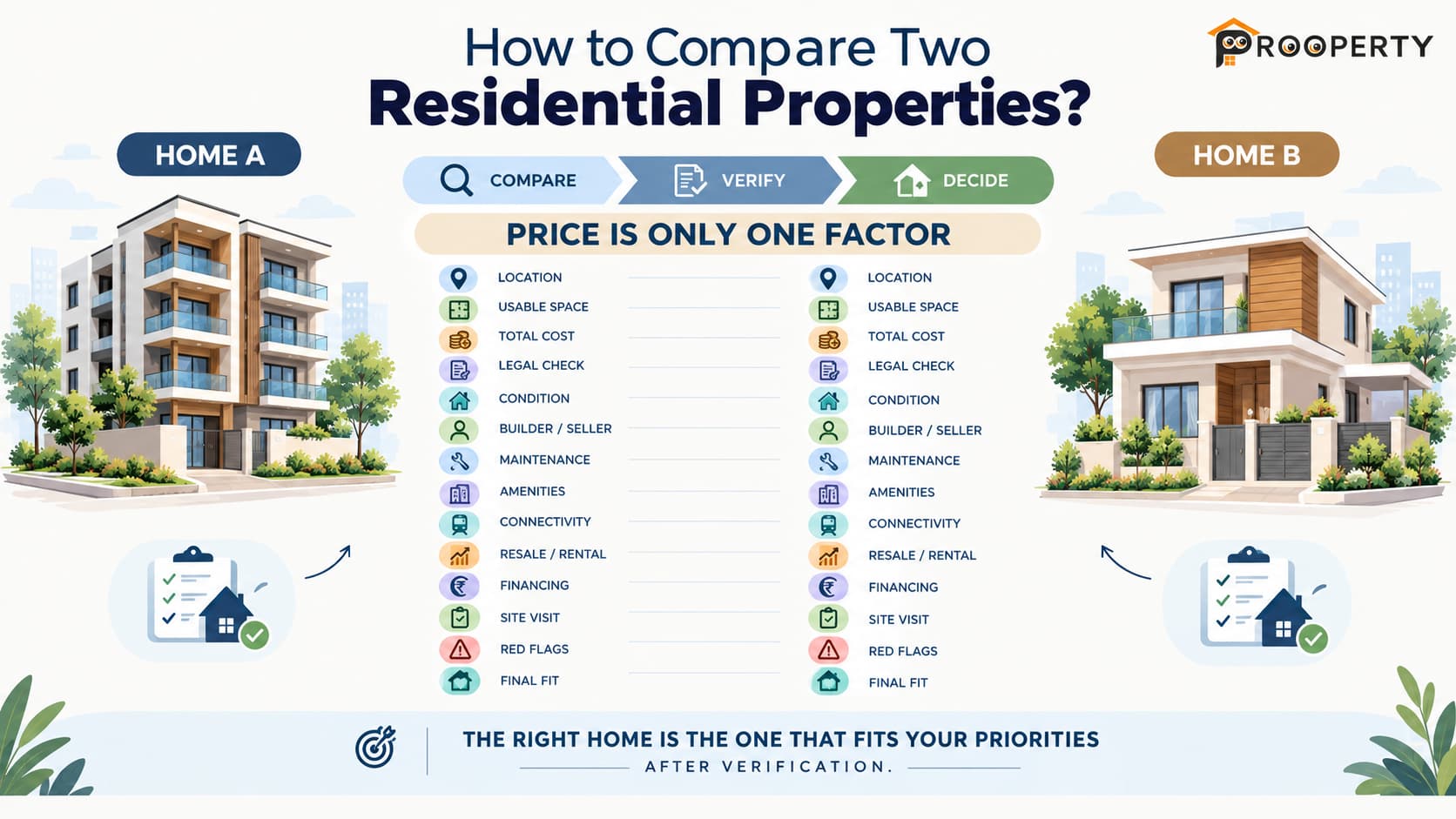
How to Compare Two Residential Properties?
You have shortlisted two houses. These are affordable, seem good enough in pictures, and in every way that matters on paper, both seem similar enough. However, there is likely to be an obvious choice between the two, but just the price will not show which one is better suited for you.
The first reaction of most people would be to rely on the number on the brochure. But this could prove fatal in making a comparison because even two properties that are priced only slightly different from each other can vary greatly in terms of utility, legality, maintenance costs, and how they will be suited to your needs five years down the line. This means that making a proper comparison involves much more than just looking at the price.
This article provides you with a practical guide for the same.
Start With Why You're Buying
It is important to establish your reasons for buying before proceeding to compare the features of the two houses since, for the same two houses, the value may vary based on whether you are buying for yourself, for a growing family, for rental purposes, or for reselling in the future.
If one person needs good transport links to his work place or school, the choice criteria will be different from that of another person who is interested in renting the house. One person who intends to stay in the house for 15 years will consider the layout and construction features of the house differently compared to a person staying there for just three years before reselling.
Compare Location: What Exists, Not What's Promised
Don't limit the comparison of locations to which one "looks better." Analyze the connectivity, the proximity to major roads, public transport, and where applicable, metro or railway lines. Estimate how far you would be from the nearest schools, hospitals, shopping centers, and your place of work and try to understand the realistic pattern of daily traffic.
The crucial difference between the two in this case is that between current infrastructure and something that will supposedly appear in the future. An announcement about the construction of a metro or an expressway could become reality, but not necessarily in time or ever. Take into account the existing infrastructure, while future plans should be regarded as a bonus.
Compare the Actual Property, Not Just the Advertised Size
This is when most buyers tend to be misled. An apartment listed with a bigger super built-up area does not necessarily guarantee additional living space. Compare carpet area, which represents the actual usable floor area, and do not simply go for built-up or super built-up area which includes common areas, walls, etc. and differ from project to project.
Apart from area, there are other factors that one needs to consider including layout efficiency, size of rooms, balcony and utility space, floor level, orientation, natural light and ventilation, privacy, and noise levels. Two apartments of the same carpet area may differ immensely in terms of actual livability owing to layout and orientation.
Compare the REAL Total Cost, Not Just the Quoted Price
The purchase price is just a single factor that will determine your overall expenditure. The cost comparison needs to be made taking into account all the other additional costs such as parking fees, deposit on maintenance, fees for club / amenities, stamp duty, registration costs, taxes, brokerage fees, and also interiors and furnishing if you are planning to move in soon.
It may so happen that two houses which seem almost identical in terms of quoted prices have very different costs when you take all the above factors into consideration.
Read Price-Per-Square-Foot Carefully
Rate per sq. ft. is an easy term to use, but it can be misleading without knowing what it’s based on. A rate which is quoted on the basis of super built-up area will seem more favorable compared to that which is quoted on the basis of carpet area for the same property – and here’s how you can be fooled while comparing two properties if one quotes based on carpet area and the other on super built-up area.
Legal and Documentation Comparison
This requires your serious consideration, not a mere cursory look. For each individual property, examine the ownership papers, ensure that the seller has the right to sell the property, and examine whether there are any encumbrances, charges, or dues against the property.
For properties which are still under construction or newly launched properties, examine the RERA registration details for the property. This is not necessarily applicable in all cases but depends on whether the property qualifies for RERA. The above information on legal matters in connection with buying a property can be seen as a preliminary effort and does not replace checking documents, especially in case of valuable or complex transactions. If you want a deeper walkthrough of this stage specifically, our guide on how to verify a property before paying the token amount covers seller verification, encumbrance checks, and receipt terms in detail.
Compare the Builder or Seller
In a scenario where a builder is involved, consider their experience in terms of delivery times, quality of construction in past projects, management of post-delivery problems and reputation amongst current occupants, as opposed to marketing information from the builder.
When considering resale homes, this means being aware of who you are dealing with and validating the individual as the genuine owner of the property.
Do not judge the builder based solely on his/her brand awareness. The fact that they are famous does not mean that all of their projects deliver the same results.
Compare Construction Quality and Physical Condition
When it comes to movable property, there is information that only a physical inspection can provide. Inspect walls, ceiling, and floors for cracks or irregularities, plumbing and electrical connections and water pressure, any seepage and dampness especially in the bathrooms and around windows. Test the doors and windows, kitchen and bathroom fittings, lift and common area conditions, and parking, as well as the fire safety provisions where they are necessary.
When it comes to houses under construction, a full physical inspection is not possible. Now you need to assess the quality of the construction of other houses from the same builder and the construction progress payment scheme.
Compare Society and Ongoing Expenses
These include the monthly charges for maintenance, the sinking or reserve fund, and the general maintenance of the common areas. While the low cost of purchasing the property may sound attractive at first, it may become less appealing once you factor in the monthly maintenance charges or if there is some big expense that is around the corner and will be hard to cover from the reserve fund. Find out about the finances of the society.
Compare Amenities by Actual Usefulness
It is not just about checking out the amenities but to see whether you would be using them or not. Gym, swimming pools, and clubhouses are great if they are working and maintained well and your family can actually utilize them. This is because there will be an increase in monthly expenses due to maintenance of these facilities.
Resale and Rental Potential
In the case of income from resale or rental activities, one must look at desirability of the location, the configuration of the unit, connectivity, present demand for properties in the area, and how much competition there is from other supply sources. That being said, there is always uncertainty regarding future performance because nothing is ever guaranteed.
Financing and Monthly Affordability
Not only do you need to verify if you are eligible for a loan, but you also have to consider all costs associated with owning the property such as the initial down-payment, EMI, cost of interest, pre-EMI during construction, along with maintenance costs. "The issue isn't whether you can afford to get a loan; the issue is whether you can afford the total bill." This is an individual decision, which varies from person to person.
Do a Structured Site Visit
Use the same checklist while inspecting both the homes so that you can make a consistent comparison. See the approach road, entryway, parking facility, state of construction of the building, elevator, and common areas before going inside the home where you have to see lighting, ventilation, noise level, water pressure, and network connectivity.
If possible, visit both the homes at different times during the day since traffic, noise, and environment conditions vary drastically between morning on a weekday and night.
Red Flags Worth Pausing For
Be on guard for an insistence that payment be made right away, a question of title that is unclear, incomplete records, a lack of explanation regarding discrepancies between what is being advertised and what is actually present, or an unwritten promise that should be in writing. An unusually low cost that is not explained is another cause for concern.
None of these things in themselves constitute anything suspicious, although they all serve as a good cause for verification.
Side-by-Side Comparison Framework
Once you've gathered the details above, lay them out together:
Filling this in for both options, side by side, makes gaps and trade-offs visible in a way that mental comparison rarely does.
A Practical Decision Method
Identify your factors into those that are necessary and those that are desirable. Factors that you consider necessary would include legal issues, good location, affordable cost, sufficient space, and connectivity. Those that you consider desirable could be a club house, additional facilities, improved view, or even quality finishing.
Evaluate your two properties based on the necessary factors. If one of your two properties does not meet the necessary factors, then nothing can help it because of such factors as legal problems, bad location relative to your commuting needs, or unaffordable cost. It makes no sense to evaluate desirable factors before meeting the necessary ones.
Making the Final Decision
However, after the comparison of both property locations, costs, documents, conditions, and overall compatibility with your needs, it is easy to see which property is better, but only when your criteria and verified facts are involved in the decision process and not some universal laws, such as "cheaper is always better" or "bigger is always better."
The legality and affordability are two aspects that you should keep in mind for sure, but then you can use other criteria.
FAQs
What's the single most important factor when comparing two properties?
There isn't one universal answer — it depends on your priorities. That said, legal clarity and total cost (not just asking price) are must-checks regardless of what else matters to you.
Should I always choose the property with a lower price per square foot?
Maybe not — make sure that both quotes are quoted for the same measure of the area (carpeted or super built-up), otherwise, it will create an illusion of being cheaper just from that factor alone.
Is RERA verification necessary for every property comparison?
However, this only applies to the projects covered by RERA, which normally include under-construction and new projects. It is important to ascertain the relevance of the application of RERA to your particular properties.