You’ve come across a property you fancy. You like the price point, it’s located where you want it to be, and you’ve gone through the negotiation process, and at some point during the negotiation process, the seller or the broker requests for a small amount of money to hold the deal. It sounds simple enough and just another formal process you need to do as a buyer before anything else.
But this token payment shouldn’t be underestimated. As soon as money comes into play, the dynamics of the negotiation process change. If one is not sure whether he’s dealing with a legitimate real estate owner and whether there haven’t been any prior checks on the ownership, documents, dues, and approvals, a buyer may find himself in a difficult situation to fix later.
What Is a Token Amount in a Real Estate Deal?
The token amount refers to the small sum paid by the buyer to indicate his/her seriousness for buying the property. It is used to keep the estates off the market until further agreements and deeds are made.
In this context, it is important to know the differences between token amount and other payments. An advance payment implies a large sum and is linked to some milestones of the deal, whereas booking amount implies the sum paid for the projects under construction and is linked with the agreement between the builder and buyer. The token amount, however, is considered to be the first small amount.
What many people fail to realize when making a token payment is that the effectiveness of such an action greatly depends on what was actually written in documents. The oral promise that "you'll get your money back if anything goes wrong" is of little significance if it is not stated in any document.
Why You Should Verify the Property Before Paying
Every real estate transaction carries some risk, but many common issues can be identified through proper verification before any payment is made. Typical concerns include unclear ownership, incomplete title records, an existing mortgage or lien, unpaid dues, missing approvals, or differences between advertised details and records held by the relevant authority. In some cases, several people may have rights in the same asset, or the person collecting the token amount may not have proper authorization to receive it.
Nothing here implies that all transactions are risky. This is simply stating that the buyer's task is to verify basic information before payment is made.
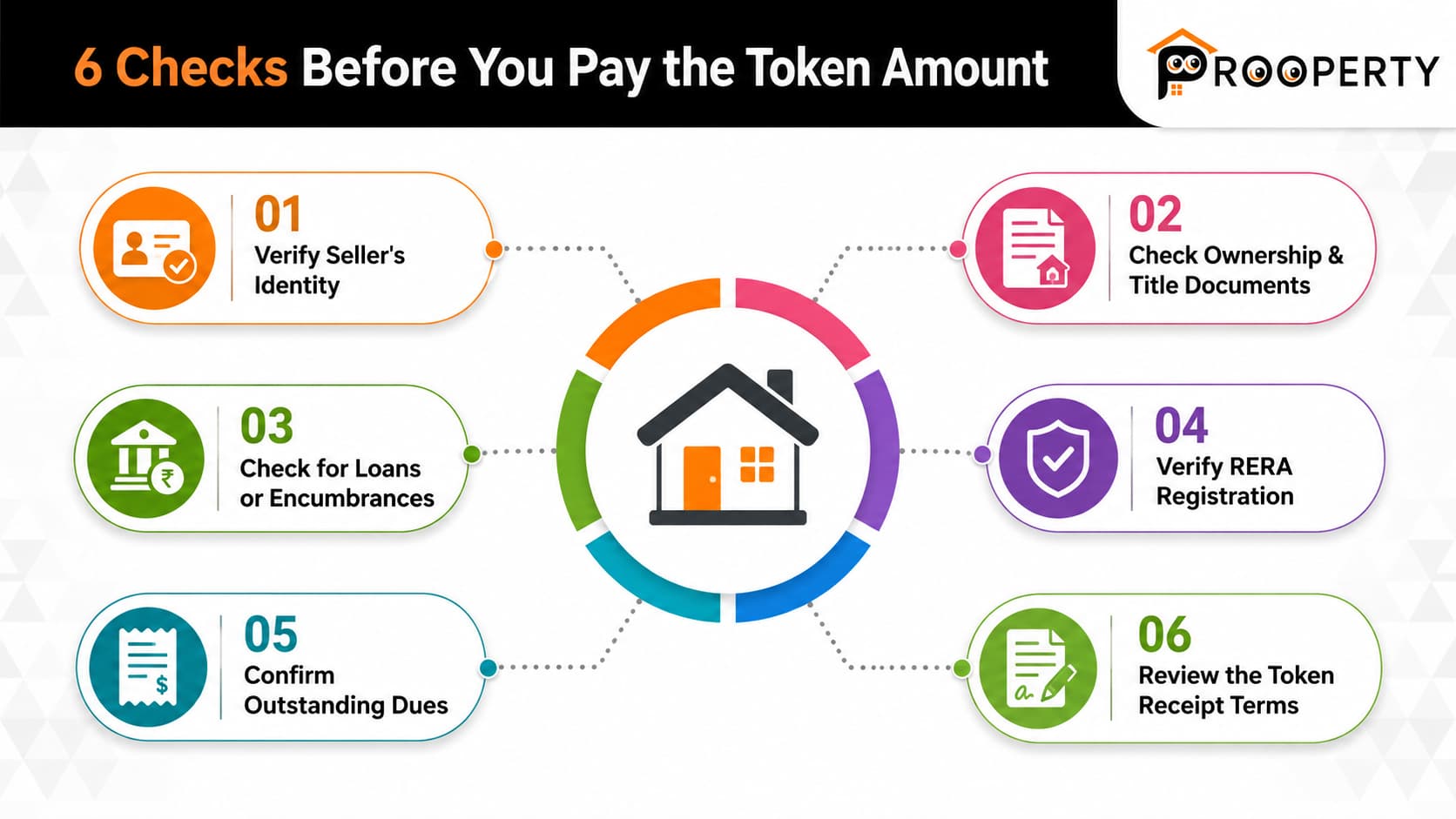
10 Checks to Complete Before Paying the Token Amount
1. Verify the Seller's Identity
Verify the name in the official identity card of the seller, which should match that in the records of the property. In case there is another person who collects money for the owner, such as a relative, attorney, or broker, then ask for proof that he is authorized to collect money for the owner.
2. Check Ownership and Title Documents
Ask for the sale deed or conveyance deed and in case the transaction involves high value or in case the ownership chain appears complex, the legal scrutiny is advisable. It is important to ensure that the names, description of real estates, and area figure consistently in the documents.
3. Check Encumbrances, Mortgage and Charges
Check to see whether there are existing loans on the property such as a mortgage. If there are, you must be aware of the terms in which that debt is discharged either before the purchase or during the purchase.
4. Verify Property Details
Compare your address, unit number, plot number, area, floor number, and parking arrangement with that mentioned in the relevant documentation. In case of built-up properties, crosscheck sanctioned construction details wherever necessary. Any discrepancy needs to be sorted out before making any payment.
5. Check RERA Details for Applicable Projects
In cases where the transactions are within the ambit of RERA, the registration number, promoter details, and information about the project may be sought from the concerned State RERA authority’s records. This should be compared with the details of the marketing being done. All transactions do not come within the purview of RERA.
6. Check Approvals and Building-Related Documents
Depending upon the nature of the real estate, various documents like approved plans, occupancy certificate, municipal approvals, and sometimes even documents for change in use may be significant. Since there is great variation in requirements across cities and transactions, it would not be advisable to apply the same checklist to all situations.
7. Check Outstanding Dues
Check whether there are any pending maintenance fees, electricity bills, water bills, property taxes, or any society fees. Make sure that you clarify who will be paying for each of these expenses and get a written confirmation.
8. Confirm the Actual Sale Price and Included Items
Before making the payment of the token money, make sure to know how much you have agreed to pay for the property and also what is included in the amount, such as parking, fixtures, furniture, and appliances. This will be among the most frequent causes of dispute in the future.
9. Review the Token Receipt or Written Agreement
This is one of the most crucial steps, which buyers tend to skip the most. This document must clearly list the names of both the buyer and the seller, the asset being bought, the token amount, the date, the entire sum, the means of payment, the purpose of this money, whether it will be refundable or forfeit under certain conditions, what the next step will entail, and, finally, the signatures of the respective parties. There is no one-size-fits-all format – it will depend on your transaction.
10. Confirm Who Is Receiving the Money
See if the money is being transferred to the seller's own bank account, or the bank account of the broker or, in case of new ventures, to the account of the developer. Do not depend on a photograph, a WhatsApp message, or an oral confirmation as evidence of authorization of the person receiving the money.
Documents to Ask for Before Paying
These may differ on a case-to-case basis, but for a basic start-up list:
Resale Property: Sale deed, all past title deeds, proof of taxes paid, documents regarding any encumbrances, and NOC from society, wherever applicable.
New Project: RERA Registration Information, Draft agreement between Builder & Buyer, Sanctioned plans, Payment schedule.
Plot: Land Title Deeds, Conversion or Land Use Deeds if any, Survey details.
Commercial Property: Ownership Deeds, Municipal Approvals, Lease/Occupancy Details if leased.
Questions to Ask the Seller or Broker Before Transferring Money
Who is the rightful owner of the property?
Is there an existing loan/mortgage on the said property?
Are there any dues payable – for maintenance, taxes, or utilities?
Is the property presently subject to any dispute?
Are all clearances already in place?
Is the stated price inclusive of all the items discussed?
On what conditions will the token money be refunded?
Who will sign the receipt/agreement and does he/she have the authority to do so?
When will the next document be signed?
Does the person receiving this payment have the authority to receive the same?
Red Flags That Mean You Should Pause Before Paying
Watch out for situations where there is insistence on immediate transfer of funds, reluctance to produce original documents, conflicting names in the documentation, lack of clarity in the location or unit description, requirement for payment into an account not in the name of the owner, lack of information on refunds, complex ownership without proper justification, lack of necessary approvals, lack of issuance of a written receipt, and "verification after payment" suggestion.
A single warning sign alone does not imply anything. This means that further clarification is required.
How Online Real Estate Portals Can Help and What They Cannot Verify
Online research usually marks the start of the house-hunting journey. Research portals such as Prooperty make it possible for potential buyers to evaluate listings, analyze local trends, learn about projects and prices, and gain some insight into the people who are selling houses in an area.
However, a listing is not able to provide information about ownership rights or encumbrances, as well as the authenticity of documents; all this must be checked in official sources and sometimes even by a professional. It is also applicable to researching real estate portals in Gurgaon and any other region: online information must be used only as an initial step in the research process.
When Should You Involve a Property Lawyer?
The value of legal analysis comes into play especially in the case of high-value transactions, properties with an ambiguous or lengthy title history, inherited property, properties with several parties involved, power of attorney sales, transactions involving properties with an ongoing mortgage, land or plot transactions, commercial transactions, or any transaction that involves redevelopment of any kind. The job of a lawyer in this context is different from the one of a broker.
Final Pre-Payment Checklist
Seller identity verified
Ownership documents reviewed
Property details matched
Encumbrance/loan status checked
RERA details checked where applicable
Approvals reviewed
Outstanding dues clarified
Final price confirmed
Token refund/forfeiture terms written
Payment recipient verified
Proper receipt obtained
Legal review completed where required
Conclusion
The idea behind the checklist is definitely not to complicate everything for each transaction or assume that everyone selling something is a potential threat. The goal here is to ensure that before you pass the token amount, you know exactly what you are buying, who is going to be receiving it, what documentation supports the transaction, and what will happen in case anything goes wrong. This approach will turn the token stage into an important part of your due diligence process.