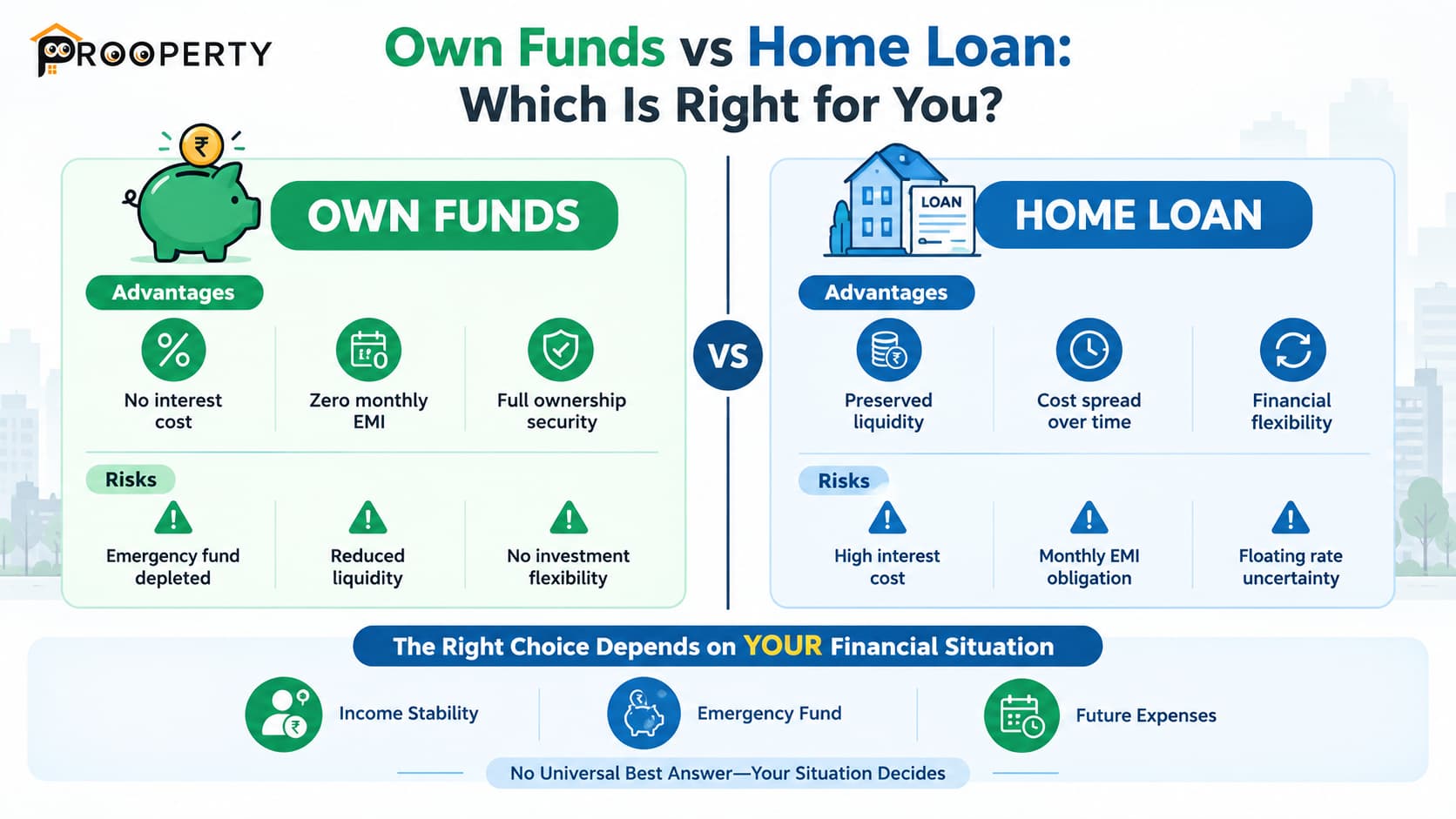
Home purchase is one of the most significant financial decisions people usually undertake during their lifetime. However, how people fund such a decision gets not the attention it needs. Buyers tend to consider whether they can manage the monthly payments or have enough money in their pockets to buy a house. The process of funding a home is, however, about much more than that.
Whether you want to spend your personal savings or obtain a loan for a house purchase or combine the two depends not only on your salary but also on your general financial situation and even the interest rate provided by a bank. It should be affordable for you, liquid, inexpensive, secure, and flexible.
This paper discusses both options and shows how to choose which is suitable for your situation and preferences.
Home Loan vs Own Funds: What Should Buyers Choose?
In the process of buying a property, buyers have the following three choices for funding purposes:
Using own funds implies utilizing one's savings, fixed deposits, and liquidation of investments in order to fully cover the total cost of the property (or most of its cost).
Taking a home loan implies borrowing money from a lender and paying it back in monthly installments called equated monthly installments over a certain period of time (for instance, 15 to 20 years).
It is possible to combine both options by making use of savings for providing a down payment and then taking a loan.
The right choice cannot be provided in advance as there is no universal solution that suits everybody and every financial situation. It is up to the buyer depending on his/her financial situation, including such factors as income, other financial obligations, savings, emergency funds, job security, age, future financial obligations, ability to deal with financial obligations, etc.
Home Loan or Own Funds: What Should You Consider?
Before assessing the pros of each, you need to understand your available money.
Most buyers tend to assume that the money they have in the bank is available money. This is a grave mistake. The real available money must be determined by taking into consideration the following:
Liabilities lower your available funds. If you owe any debts such as credit card debts, personal loans, car loans, or even business debt, you are likely to use some of your money to settle these debts, and therefore lowering your ability to borrow money for buying the house. Your available money should include liabilities as well.
Reserves refer to the money that should be kept separate from the property purchase. Many financial planning approaches suggest maintaining around three to six months' worth of essential expenses in an easily accessible fund. However, the appropriate reserve can vary depending on income stability, the number of dependents, existing debt, and other financial commitments. If a health issue, job loss, or another unexpected event occurs soon after the purchase, having insufficient cash reserves can create significant financial pressure.
Immediate financial commitments should also be considered. If you expect major expenses over the next one or two years, such as education costs, a wedding, relocation, or a business investment, that money should not be treated as available for the purchase. Keeping it separate can help prevent a situation where a major upcoming obligation becomes difficult to manage.
Purchase-related expenses are also commonly underestimated. Registration and stamp duty, applicable taxes, legal charges, lender fees, repairs, furnishings, and other associated costs can materially increase the overall amount required, depending on the location and type of purchase. These expenses should be planned for separately and paid from the surplus remaining after the main transaction rather than relying on emergency savings.
The important thing here is the difference between being able to afford and being able to afford comfortably. While a person might very well be able to afford purchasing a house of worth ₹50 lakhs with his savings of ₹50 lakhs, it does away with all his savings.
Should You Use a Home Loan or Own Funds?
The solution can frequently be found by analyzing at which point one method makes sense to use, while the other causes possible complications.
One’s own money makes sense in the case when there are sufficient savings far exceeding the cost of the property, when one’s earnings are very reliable and prove their stability for many years, when there is enough money saved aside as a reserve fund not connected with the purchasing fund, when there is no need for liquidity for some period ahead, and when lowering the costs of borrowing makes sense.
It becomes difficult to use all or most of the savings in such a way that you will not have much liquidity left after that, if your source of income has any kind of risks involved, if you have dependents to take care of, if there are some big expenses expected in the next 3-5 years from now, if you do not have an emergency fund separately, or if your ability to cope with unexpected situations is going to be affected by the depletion of savings. Many working professionals often encounter some unexpected expenses related to their health, business or career changes in the next 3-5 years from buying a home. Using up savings while buying a house makes you vulnerable.
Home loan facilities give you more flexibility, since the money that you spend on buying a home will be spread over time and you can keep yourself with some liquidity and save money for the future needs and opportunities.
Advantages of Using Own Funds
The advantages of purchasing a home through your own savings are numerous.
Saving on overall interest payment is perhaps the biggest advantage. In this case, you save on interest payments. Interest cost throughout the loan term depends on the size of the loan, the interest rate, and the tenure. In your case, you will be saving these interests since there is none.
Your month-to-month payment obligation is much less or even zero. The absence of an EMI means that the amount paid per month is only for the upkeep of the house, taxes, and utilities.
More security is also gained from the fact that you are not bound by lenders' policies and changes in interest rates. If you have the property free from debts, then no lender will ever dictate anything.
In the absence of any loan obligations, there is a reduction in conditions imposed by lenders. Nevertheless, you are still under other obligations when you own the house.
Even with these benefits, buying through your own funds may not always be the best approach for all buyers.
Risks of Using Too Much Own Money
Here is where most people commit huge financial errors. Though possible, using up almost all your savings on a property purchase is very risky.
The first danger here is the absence of an emergency fund. When your savings get used up during the purchase, there will no longer be any financial safety net in case of a problem. Medical emergencies, job loss, or the need to carry out urgent repairs at home can quickly become serious financial pressures.
Lack of liquidity reduces your financial flexibility. If you come across a great investment opportunity, if your child needs money for college, or if your business requires additional capital, your savings may already be depleted. This can force you either to borrow or miss the opportunity.
The cost of ownership can also surprise you. While your purchase may appear to be in perfect condition, there might be repair work that needs to be carried out in the future. Water infiltration, structural problems, electrical rewiring, or termite infestation—any of these issues discovered months or years later can require significant spending.
Financial disruptions can become severe when savings run out. Employees may experience job changes or periods without income. For business owners, earnings can fluctuate. Medical situations or family emergencies may temporarily reduce earning capacity. If savings have been exhausted during the purchase, such disruptions may compel an individual to make difficult decisions, such as taking expensive loans or selling assets.
The element of opportunity cost is also usually ignored. Any amount spent entirely on the purchase will not be available for other uses. Some individuals might have generated better results through diversified investments. Real estate can be one means of wealth creation, but putting all your money into a single asset reduces diversification.
The basic concept is simple: affordability and financial comfort are two separate issues. Comfortable ownership requires sufficient financial flexibility even after the purchase.
Advantages of Taking a Home Loan
Home loans have several financial benefits which are often underestimated by people owing to their cost implications.
Retention of liquidity is the foremost benefit. By taking a loan, the individual maintains money for future financial shocks and investments. This money helps in cushioning the individual financially.
The cost spreading is another benefit that helps in handling large purchases. For example, paying ₹50 lakhs all at once can be financially shocking. However, paying the same through monthly EMIs spread across 15 to 20 years will make it possible for the individual to purchase and still manage other financial transactions.
It will be easy to save and invest more money without the worry of having to spend all of it on purchasing something.
There is much significance of financial flexibility in future years. It will help handle future events such as higher education of a child, a business opportunity, relocation, etc.
Inflation factors can influence your decision under certain situations. As you pay back a definite amount of money throughout the years, the situation may alter as a result of the economic scenario, but this must never be considered as an excuse to borrow money.
This benefit becomes even more important if your income fluctuates or you have future plans that require you to spend a significant sum of money.
Risks and Disadvantages of a Home Loan
There are certain disadvantages associated with home loans which need to be taken seriously.
Cost of interest is quite high. The total amount of interest which one will have to pay is determined by the loan amount, rate of interest, and tenure period. At normal rate and tenure, the buyer may end up paying a significant amount of interest in addition to the principal loan amount.
The long-term obligation to repay the loan keeps one bound to maintain regular income for a period of 15-20 years. In case of irregular income or loss of job, the loan repayment obligation stays.
EMI becomes a burden in tough times. Unlike other discretionary expenditure which can be minimized in difficult times, one has to keep paying the EMI even if his/her income level falls or some other expenses crop up.
Interest rates floating (common practice in India) mean that your EMI would fluctuate if your lender decides to alter his interest rates. It all depends on terms of the lender and the terms and conditions of the loan taken out.
Risks associated with disruption of income generation include job loss, downturn in the business, illness, etc. Non-payment of EMI affects your credit score and makes the situation legally complicated.
Over-borrowing is a risk too. Your lender is likely to finance a significant percentage of your property's value, which could vary on the basis of applicable lending rules, policy of the lender, the property itself and your financial profile. But the availability of a loan doesn't mean that you should borrow it to the maximum. People usually do that and later realize that monthly EMIs are too high for them and thus lower their quality of life.
Looking at EMIs alone is wrong. Reasonable monthly EMI can be associated with significantly higher total cost of repayment when considered with total amount to repay.
Home Loan or Own Money: Which Should You Use?
A compromise approach, whereby part of your savings is used as down payment while the rest is borrowed, might just be the most reasonable choice worth considering.
This strategy would work out fine if you have decent savings but not enough to buy the entire property, if you wish to have a financial buffer without much borrowing, if you wish to cut down on interest payments but not completely eliminate them, or if you need to make your monthly EMI more manageable.
For instance, if a person with ₹30 lakhs in savings wished to buy a ₹50 lakh property, he could use ₹15 lakhs of his savings as down payment, borrow ₹35 lakhs, and keep ₹15 lakhs aside for emergency purposes.
This strategy allows for a number of objectives being achieved at once: it cuts down on the loan amount (hence on total interest); it brings down the EMI to a reasonable level; it leaves you with liquidity, and it lowers financial risk as well.
This middle option is not the one-size-fits-all best choice but it can be quite effective in many cases.
How to Compare Home Loan and Own Funds?
A structured comparison framework helps clarify the choice. Consider both options across these dimensions:
This comparison clarifies that the choice is not simply about cost, but about balancing cost against financial flexibility and security.
How Should Buyers Fund a Property Purchase?
A practical seven-step framework helps buyers systematically evaluate their options:
Step 1: Calculate Total Acquisition Cost
Never consider only the quoted sale price. Property purchase involves multiple costs that vary significantly by location, transaction type, lender, and project:
Down payment (typically 20-30% of property value)
Registration and stamp duty
Property taxes and civic authority charges
Loan processing fees (if borrowing)
Legal fees
Initial repairs and maintenance
Interior furnishing (if required)
Utility connections and setup
Moving expenses
Society or community fees
These additional costs can materially increase the amount required beyond the quoted sale price. Calculate your specific numbers before proceeding.
Step 2: Calculate Emergency Reserves
It is imperative that one figures out the financial buffer they need to have, based on their salary stability, dependents, debts, and other factors. It needs to be entirely independent of the money meant for purchasing the house.
Step 3: Calculate Comfortable EMI Capacity
Avoid borrowing the maximum amount approved by your lender. Rather, calculate the EMI you can afford, without compromising on the standard of living and other financial obligations you undertake.
Buyers can use a conservative debt to income analysis to decide on a comfortable EMI, considering factors such as existing EMIs, number of dependents, basic expenses, and income stability.
Step 4: Compare Total Borrowing Cost
Compute for the full interest cost of your loan and not just the interest rate. Your total interest expense will depend on the amount borrowed, the interest rate, the term, and the mode of repayment. This is an enormous expense to consider.
Step 5: Assess Income Stability
Assess your income status fairly. Are you sure that your income is steady? Is your income from business volatile? Is there a chance that your income might change due to changes in your employment or market status in the period of the loan term?
Step 6: Consider Future Financial Commitments
Account for anticipated major expenses: children's education, medical insurance, potential marriage-related costs, or business investments. If significant expenses are foreseeable, maintaining liquidity becomes more important.
Step 7: Stress-Test Your Decision
Ask critical questions:
What if there is a temporary reduction in my income by 20 percent?
What if the property requires extensive repair work within one year?
What if there is an increase in interest rates?
What if I need to move to another location suddenly?
What if my employment status changes?
A healthy financial decision should feel manageable even under moderately adverse scenarios, not only under ideal conditions.
Common Mistakes Buyers Should Avoid
Observing common errors helps clarify sound decision-making:
Utilization of all savings means lack of financial buffer
Using all the money that one is eligible to borrow means exceeding one's capacity to repay
Determining financial capability from EMI alone means ignoring the overall cost of interest payments
Neglecting issues of registration fees, taxes, and transaction costs means facing an unpleasant financial surprise
The assumption that the borrower will get income increments in the future means ignoring income volatility
Neglecting existing liabilities means misjudgment of one's borrowing capacity
Utilization of emergency funds for down payments means lack of any financial buffer
Selection of a loan purely based on its lower interest rate means overlooking other charges of the lender
Neglecting comparison of lenders can mean either a higher cost of borrowing or a loan which is not the best one
Not taking into account prepayment provisions means lack of flexibility in the future
Looking at tax savings as the primary purpose of borrowing means misinterpreting the financial logic
Acquisition of an expensive property due to availability of financing means mixing borrowing capacity and affordability
Sound decisions avoid these pitfalls by maintaining honesty about true financial capacity and priorities.
A Simple Decision Example
Consider a working professional with these characteristics:
Savings: ₹40 lakhs
Gross Monthly Income: ₹1,00,000
Outstanding liabilities: Car EMI at ₹500, nothing else
Emergency Fund: ₹8 lakhs (kept aside)
Price of the intended property: ₹50 lakhs
Fund available for investment: ₹32 lakhs (₹40 lakhs savings less ₹
Option 1: Mostly Own Funds
Use ₹32 lakhs as down payment
Borrow ₹18 lakhs
Monthly repayment: Approximately ₹13,000
Remaining liquidity: Minimal
Total interest cost: Depends on loan terms
Option 2: Larger Loan
Use ₹10 lakhs as down payment
Borrow ₹40 lakhs
Monthly repayment: Approximately ₹29,000
Remaining liquidity: ₹22 lakhs
Total interest cost: Higher due to larger principal
Option 3: Balanced Combination
Use ₹20 lakhs as down payment
Borrow ₹30 lakhs
Monthly repayment: Approximately ₹22,000
Remaining liquidity: ₹12 lakhs
Total interest cost: Moderate
Each option presents different trade-offs. Option 1 minimizes borrowing but leaves minimal liquidity. Option 2 maximizes liquidity but increases total interest. Option 3 balances both concerns reasonably well. The appropriate structure depends on the buyer's financial position, risk tolerance, other financial goals, and income certainty.
Questions Buyers Should Ask Before Deciding
Before finalizing your approach, honestly answer these questions:
How much cash will remain after all property-related costs are paid?
Do I have a separate emergency reserve appropriate to my circumstances?
Can I comfortably manage the proposed EMI if my income temporarily falls 20%?
What is the total amount I will repay over the loan tenure?
How much interest will I pay, and what does this represent relative to the principal?
Have I accounted for applicable tax implications in my jurisdiction?
Do I have other loans or major upcoming expenses within the next 3-5 years?
Would using most or all of my savings materially reduce my financial flexibility?
Am I choosing to borrow because the property requires financing, or simply because I am eligible for a large loan?
Have I compared loan offers and terms from multiple lenders?
Do the loan's prepayment terms allow flexibility if my financial situation improves?
Can I continue saving for other goals—retirement, education, investment—after buying this property?
Thoughtful answers to these questions clarify the appropriate funding approach for your circumstances.
Final Takeaway
There is no such rule that can determine the proportion of financing from personal funds versus borrowing funds. It depends on the individual situation and consists of factors such as stability of income, financial obligations, savings and emergency fund, future expenditures, and risk preferences.
The decision should consider the following factors: cost of financing, payments affordability, financial flexibility, stability of income, financial obligations in the future, and risk preferences. There are people who would logically choose to finance the house mostly through personal funds. There are other people who would choose to have larger mortgages in order to remain financially flexible. And there are many people who will find the balance between both choices.
What we should do is to choose rationally so as to feel financially secure even after purchasing the house.
While looking into the characteristics of homes and the financing options, a lot of buyers would benefit by utilizing such resources that will help clarify the real estate market Platforms specializing in gurgaon real estate and similar market-specific platforms give you the opportunity to compare the prices of property, financing options, and even data about neighborhoods, which may be helpful while making a decision.
Make your decision based on your overall financial situation, and not only on the cost of the home and your ability to get a mortgage. The right way of financing the house purchase is the one that is right for you and your financial future.