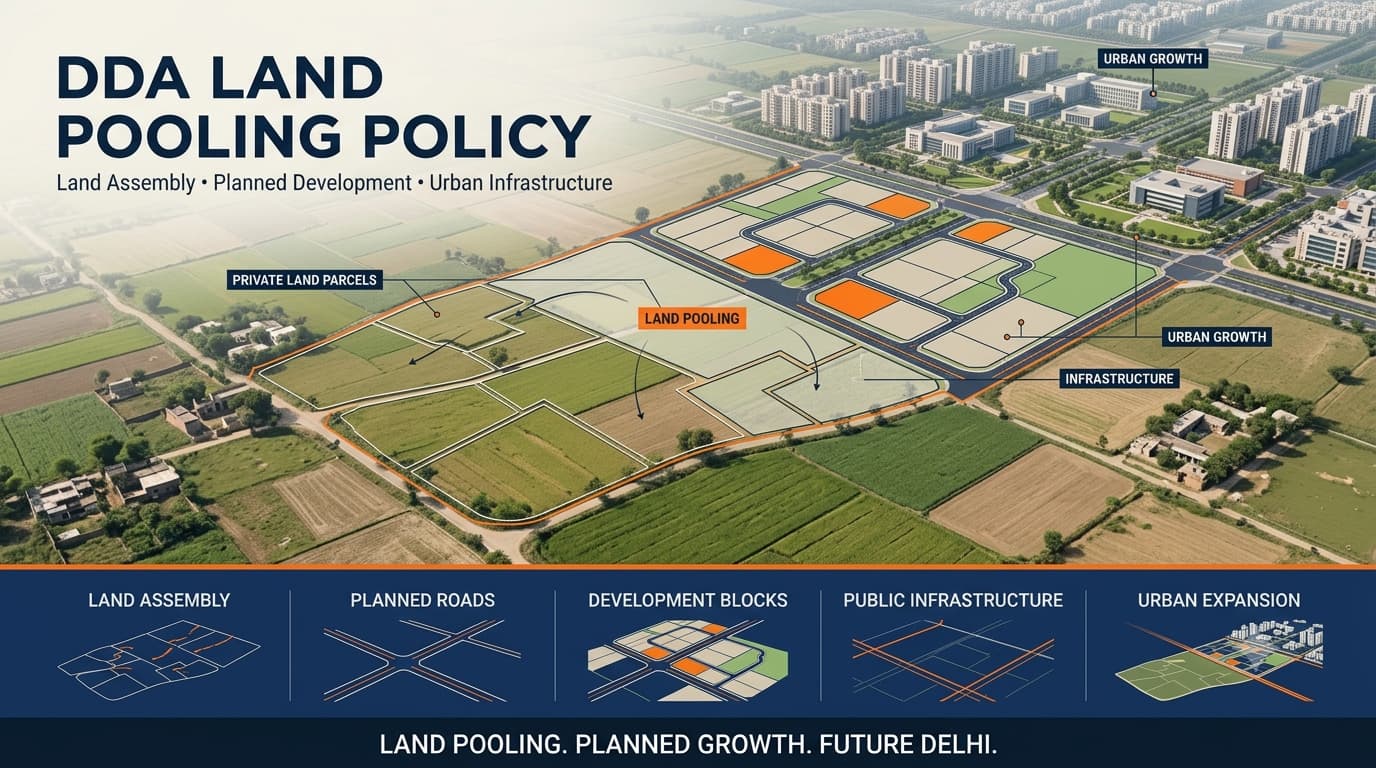
DDA Land Pooling Policy Delhi
The Delhi development authority launch an essential policy for well planned urban development in Delhi City. This DDA Land Pooling policy aims to pool land parcels of considerable size for infrastructure led development rather than developing the land parcels independently. This policy is significant for the landowners, purchasers, investors and developers because the condition of the particular land parcel will have an impact on the planning and development of the land. The existing land pooling framework involves 105 villages within six planning zones where the land is divided into 138 sectors and covers around 20,422 hectares.
What Is DDA Land Pooling?
In the DDA Land Pooling Development Model, there is involvement of land owners through the pooling of land in the framework of common planning. In place of allowing each individual land owner to develop his piece of land individually, there is aggregation of lands sector wise. In this way, it becomes possible to plan for roadways, utilities, public facilities, residential and commercial areas all together.
What Is the DDA Land Pooling Policy?
The DDA Land Pooling Policy provides the framework through which land pooling is implemented.
It establishes important principles related to:
Landowner participation
Sector-level planning
Land pooling and land distribution
Consortium formation
Infrastructure development
Development permissions
Residential and commercial planning
Public and social infrastructure
Conditions for sector-level development
The modified policy was notified in October 2018, followed by regulations for operationalisation later that month.
DDA Land Pooling vs DDA Land Pooling Policy
History of DDA Land Pooling
The concept of land pooling developed as part of Delhi's long-term urban expansion strategy. The framework went through several stages before the modified policy was notified in 2018.
The policy should therefore not be viewed as a newly introduced concept. What has changed recently is the movement from policy formulation toward sector-level implementation.
What Is the 60:40 Land Pooling Model?
One of the most important features of the framework is the 60:40 land distribution model.
Broadly, the model provides for:
This does not mean that an individual landowner simply receives 60% of the same original plot back.
The land is planned at the sector level. Roads, infrastructure, public facilities and other requirements have to be accommodated before the resulting land distribution is implemented.
What Is the 70% Requirement?
The 70% condition is important because participation alone does not automatically make a sector ready for development.
A sector needs to achieve the required level of contiguous pooled land before it can move toward development under the applicable framework.
This distinction is important:
70% participation is not simply about the number of landowners. It relates to the required pooled land area and its continuity within the sector.
Sector 8B in Zone P-II has been identified as the first sector to reach the required 70% contiguous pooled-land threshold and move toward development. Current planning material also includes a 60:40 sector land distribution plan and layout planning for the sector.
DDA Land Pooling Zones
The current framework covers six planning zones.
Current material refers to 105 villages, while older documents may show different figures such as 95 or 104 villages because the coverage and development notifications have evolved over time.
Villages and Sectors
A village name alone is not enough to determine the development status of a property. Land pooling works through sectors, and a single village can have land falling into different planning situations.
For a specific property, buyers should identify:
Village name
Khasra or land parcel details
Planning zone
Sector
Whether the land is pooled or unpooled
Participation status
Applicable land-use planning
Consortium status
Development status
DDA has published sector-wise pooled-land maps for various zones, showing why sector-level verification is more useful than relying only on the village name.
What Is a Consortium?
A consortium is a collective arrangement involving participating landowners within a sector. Since development requires coordinated planning across multiple parcels, individual landowners generally cannot treat the entire sector as separate independent plots. The consortium structure helps bring participating landowners together for the development process.
It can involve matters such as:
Participating landowners
Land contribution
Development arrangements
Sector planning
Distribution of land
Coordination with the development authority
Implementation requirements
Consortium formation is therefore an important milestone when assessing the progress of a particular sector.
How Does the Land Pooling Process Work?
The broad development process can be understood in the following stages:
Landowner participation
Eligible landowners express their willingness to participate.Document and land verification
Land and ownership details are examined.Mapping and reconciliation
Participating and non-participating parcels are mapped.Sector assessment
The level and continuity of pooled land are assessed.70% threshold
The sector moves forward when the applicable pooled-land requirement is achieved.Consortium formation
Participating landowners form the required consortium structure.Sector planning
Roads, land use, infrastructure and public facilities are planned.60:40 distribution planning
The sector land distribution is prepared according to the applicable framework.Approvals and development arrangements
Required planning and development procedures are completed.Physical development
Infrastructure and permitted development can progressively take place.
What Infrastructure Can Be Developed?
The objective is not simply to create residential plots.
Planned development can involve:
Internal roads
Major road networks
Water supply
Sewerage
Drainage
Electricity infrastructure
Parks and green areas
Schools
Healthcare facilities
Community facilities
Residential development
Commercial areas
Mixed-use areas
Other public and social infrastructure
The exact land use and facilities depend on the applicable sector plan and development controls.
What About EWS Housing?
Economically Weaker Section housing is also part of the broader planned housing approach. The objective is to ensure that large-scale urban development does not focus only on premium or market-rate housing. Planned residential development can include provisions for different income groups as required under the applicable planning framework.
Current Status of DDA Land Pooling
The policy is now moving beyond its earlier stage of simply being a framework. Sector-level mapping, consortium-related notices, land distribution planning and layout planning show increasing implementation activity. However, the entire Land Pooling Policy should not be considered fully completed. Sector 8B in Zone P-II is currently a significant milestone because it has achieved the required contiguous pooled-land threshold and has moved into further planning and development-related processes. There is still no single fixed completion date for the entire land pooling programme.
What Does DDA Land Pooling Mean for Buyers and Investors?
For buyers and investors, land pooling can create long-term development opportunities, but it should not be treated as an automatic guarantee of price appreciation. A property may appear to be located in a land pooling village but still have a different status at the parcel or sector level.
Before purchasing, buyers should verify:
Ownership and title
Khasra or parcel details
Planning zone
Sector number
Pooled or unpooled status
Participation records
Consortium status
Land-use designation
Road access
Development status
Applicable permissions and restrictions
Major Risks to Consider
Land pooling can offer significant development potential, but buyers should understand the risks.
Fragmented Ownership
Multiple owners can hold land within the same sector, making coordination more complex.
Pooled vs Unpooled Land
A property located inside a land pooling area is not automatically pooled.
Development Timeline
Policy implementation can take time. Buyers should not assume that infrastructure or construction will begin immediately.
Planning Changes
Sector plans, land use and development requirements can change during implementation.
Title Issues
Ownership disputes, incorrect records or incomplete documentation can create serious problems.
Misleading Investment Claims
Statements such as “guaranteed appreciation,” “immediate development” or “approved project” should never be accepted without verification.
What Should Buyers Verify?
The safest approach is to verify the property at the parcel and sector level, rather than relying only on the location name.
Check the following:
Seller's ownership documents
Khasra and parcel details
Planning zone
Sector boundaries
Pooled-land status
Participation status
Consortium records
Applicable land use
Proposed road alignment
Development status
Required approvals
Physical site access
A property should be evaluated based on its actual planning and legal position, not simply because it falls within a land pooling area.
Frequently Asked Questions
Is DDA Land Pooling the same as the DDA Land Pooling Policy?
No. The policy is the framework and rules, while land pooling refers more broadly to the implementation and development process under that framework.
Is the 60:40 model applicable to every individual plot?
No. The 60:40 model operates at the sector and planning level. It should not be interpreted as an individual owner simply receiving 60% of the original plot.
Does 70% participation mean a sector is fully developed?
No. Meeting the required pooled-land threshold is an important eligibility milestone, but infrastructure, planning, approvals and physical development still involve further stages.
Is every property in a land pooling village automatically part of land pooling?
No. Buyers must verify the specific parcel, pooled status and applicable sector records.
Is DDA Land Pooling already completed?
No. The programme is progressing sector by sector and remains under implementation.
Can land pooling guarantee property appreciation?
No. Future value depends on planning, infrastructure, development progress, market conditions, legal status and several other factors.
Conclusion
The DDA Land Pooling Policy is intended to transform large areas of Delhi into planned urban development zones through coordinated land participation and sector-level infrastructure planning. The 60:40 model, 70% contiguous pooled-land requirement, consortium structure and sector-based planning are central parts of the framework. For buyers and investors, understanding the planning status of a specific property is essential before making a decision. Prooperty.com helps users explore real estate opportunities with a focus on property information, location and development context, making it easier to research before taking the next step.