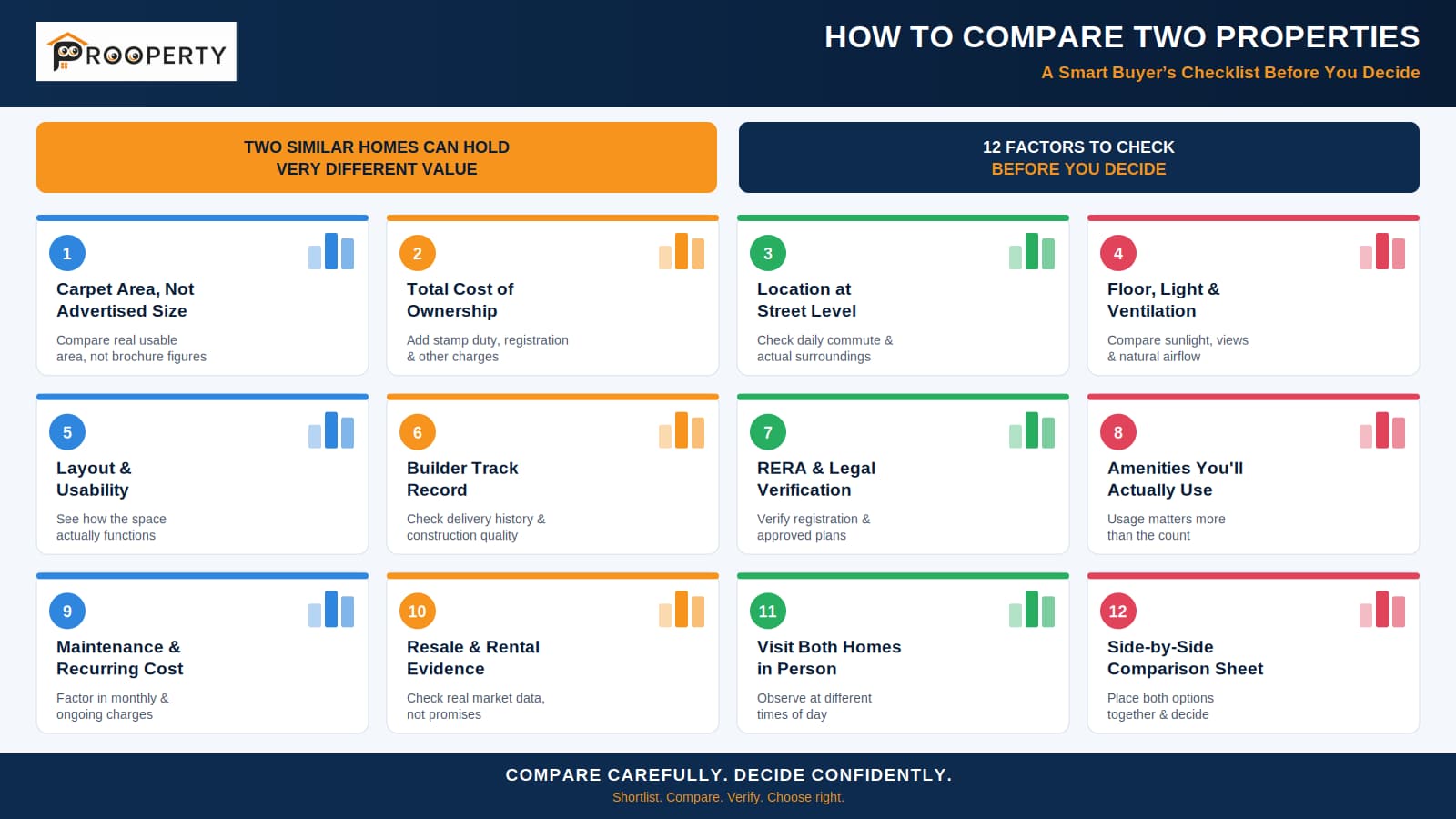
Making a decision between two homes that seem identical in terms of locality, price and size could be more difficult than expected. However, upon closer scrutiny, one home proves superior to the other by a significant margin. The discrepancy between the two homes cannot be determined simply by looking at their pictures and brochures; rather, it can only be established in terms of layout, usability, true cost and living experience.
This document provides a practical approach towards comparing your two homes and making a decision without any uncertainties.
Start With Your Own Requirements
But before you proceed to compare the two homes, you have to determine first what you really want. Is it for personal use or for investment? How many bedrooms will your family really need? What is your daily commute, and will the two locations accommodate this need? Will there be a need for your children to study in a certain school or for you to be near a certain hospital? What is your highest price, and when should you move in?
In any case, there is no such thing as the "better" choice. It all depends on your situation.
Compare Carpet Area, Not Just Advertised Size
The prices are usually quoted on a built up or super built up basis which includes common areas such as lobbies and staircases. The actual living space is the carpet area and that is the area that needs to be compared.
One of the easiest methods for comparing prices of homes: Price per square foot = Price ÷ Carpet Area
For instance, if Home A is quoted at ₹80 lakhs for a carpet area of 1,000 sq ft, its price per sq ft comes to ₹8,000 while the cost of Home B that is quoted at ₹82 lakhs for a carpet area of 1,100 sq ft will be about ₹7,455 per sq ft. At face value, Home B seems like the cheaper choice; however, this is not the only thing that matters.
Look at the Total Cost, Not Just the Sticker Price
The quoted price is usually not all you need to consider. Include the sum of the amount required for parking, stamp duty, registration, taxes, maintenance deposit, clubhouse charges, brokerage fees, and any other costs involved. Two properties that may have a similar quote price might differ by lakhs once all the figures are tallied.
This depends on individual states, projects, and different types of transactions; hence, it makes sense to prepare a basic cost sheet.
Compare the Location at Street Level
The two addresses within the same neighborhood might be quite different when it comes to everyday living. Inspect the road access in reality, the proximity to the main road, traffic in peak times, proximity to schools and hospitals, transportation, and current constructions around. Try going down the real route you will be taking every day instead of trusting the marker on the map. Don’t allow yourself to be seduced by the promise of future infrastructure that cannot be confirmed.
Floor, Direction, Light and Layout
However, higher floors provide better view and less noise; however, there is increased wait time for the elevator. There is no one direction which is always better that depends on the climatic conditions and ventilation of the place and exposure of the particular unit. More important is how functional the space is: size of the bedroom, usability of the kitchen, position of the bathrooms in relation to the bedrooms and wastage of circulation space through passageways.
Builder Track Record and Project Standards
Take a look at what the builder has accomplished before, the ongoing state of construction work, management of common areas, and the views of present residents. Consider RERA information, where applicable. Don't take any claim at its face value without verification.
Legal and Registration Checks
It is not necessary that you become an expert in law, but you need to make some comparisons of certain things in relation to the options available such as RERA registration, carpet area mentioned, project and phase details, approval plans, and possession of property. When we talk about purchasing a property of this magnitude, then consulting a lawyer is worthwhile.
Amenities: Use, Not Count
An increase in the number of amenities does not necessarily mean an increase in value; it can also lead to increased recurrent costs. Find out which amenities will really be used by you and their current state of maintenance.
Recurring and Maintenance Costs
These include monthly maintenance costs, parking costs, utility bills, as well as any other sinking funds that might come into play. Even if the initial price is lower, the unit may end up costing more in total over five years due to higher recurring costs.
Resale and Rental Evidence
In case you care about long-term gains, consider the resale and rental rates of comparable units, instead of believing anything the salesman tells you. Remember that any promises of future gain or rental income are not certain, but what the market currently says.
Visit Both Options in Person
Pictures and brochures won’t give you an idea of how much noise a particular road produces by 8 a.m. Neither will pictures or brochures give you any idea of how a hallway smells like during the monsoon season. Check out both properties on the shortlist at different hours.
Build a Side-by-Side Comparison Sheet
Once you've gathered everything, put it into one simple table:
Copy this into a spreadsheet and fill it in for both listings. Avoid assigning arbitrary scores — the goal is clarity, not a forced winner.
Making the Final Call
Once your sheet is complete, ask yourself:
Which one really matches my needs, not just my desires?
Which one has the clearer, loaded cost?
Which provides better value for money?
Which location really suits me in my routine life?
Which claims can I verify independently?
Which recurring costs can be handled easily by me?
Which one looks good even after the marketing language is peeled off?
Have I done the paperwork verification?
The right choice is the one that holds up against your own priorities — not simply the cheaper of the two.
Quick Comparison Checklist
Did I compare carpet area, rather than just square footage offered?
Did I calculate the total cost including everything?
Did I survey the route to the project and its surroundings?
Did I compare floor plan, lighting, and functional layout?
Did I check the past projects of the developer?
Did I ensure compliance with RERA and other regulations?
Did I ensure I will actually need amenities offered?
Did I calculate maintenance costs for both options?
Did I see the evidence of resale/rental and not just promises?
Did I visit both locations physically?
Did I fill a side-by-side comparison table?
Did I make my decision according to personal criteria, not only price?
When you're browsing and shortlisting options online, say, on a platform like Prooperty.com or any real estate Gurgaon portal you're using for your search this same framework applies: don't let a clean photo or a low headline price decide things for you. Pull both listings into one sheet, verify the details that matter, and let the comparison itself point you to the better fit.