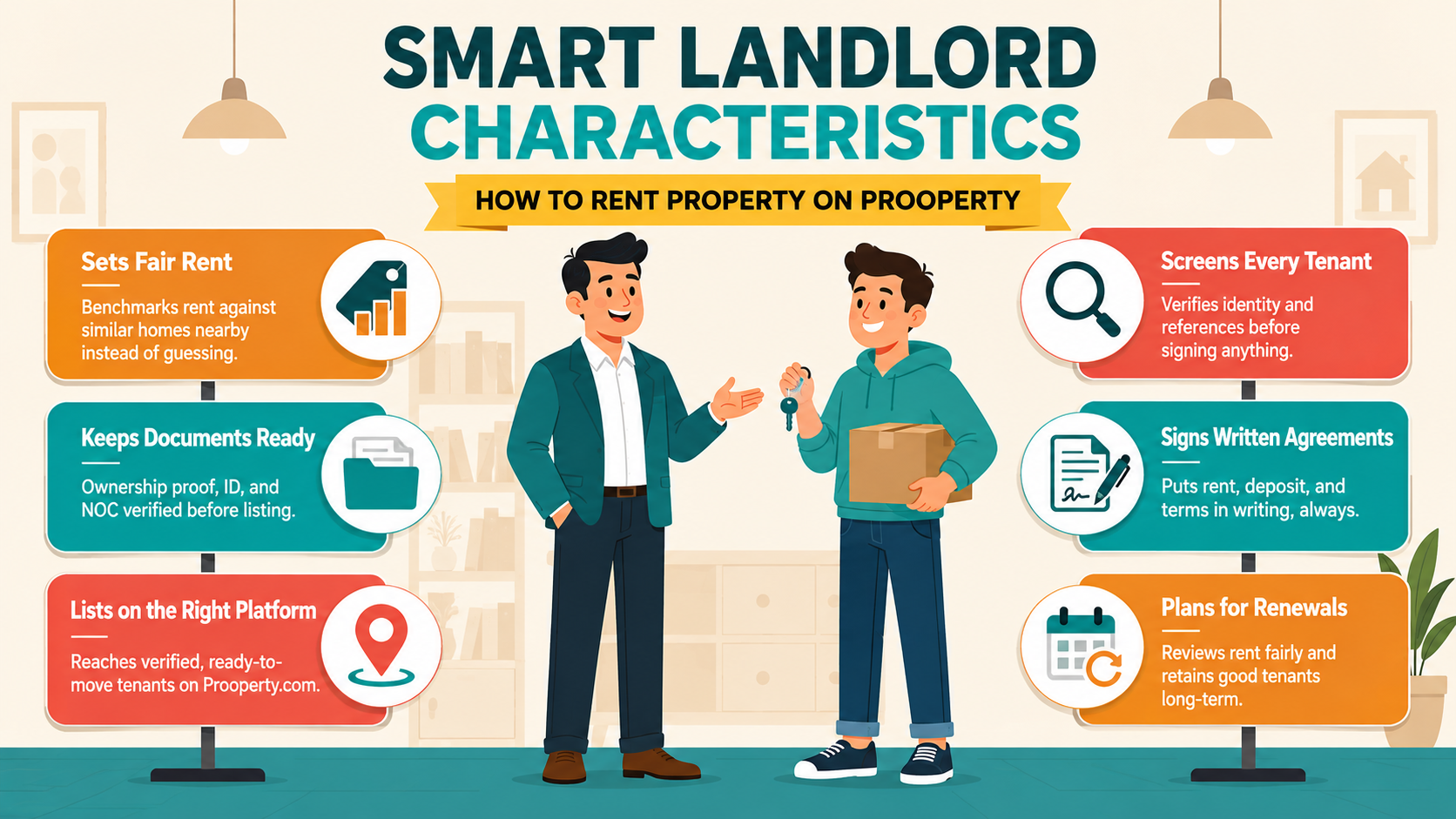
How Do You Rent Property on Prooperty?
A Complete Guide for Landlords and Owners
Leasing a property, whether house, apartment, or business premises is not like selling it; what is required here is a regular and guaranteed source of income, with trustworthy tenants. Otherwise, you risk finding yourself in situations when you receive late payments, damages, or long vacancies that silently reduce your earnings. It is exactly prooperty.com that gives you an easy-to-follow, straightforward and guided way to lease out your real estate asset.
In this guide, we will answer the question faced by every landlord at some point: how does one properly lease their premises, from calculating the rent to completing the lease agreement? In addition, we provide you with the full leasing process, documents checklists, tips on screening tenants, common errors to avoid, and answers to most frequently asked questions tailored especially for you.
Who This Guide Is For
This does not serve as a manual for those looking to sell their properties but serves the purpose of aiding landlords, new owners who wish to rent out their inherited real estate, property managers and investors in general, and those who are unsure about whether to rent out or sell a house that they don’t reside in anymore.
Understanding Rental Demand Before You List
Demand changes from one season to another and is different depending on the area, hence the need to feel the pulse of the area before setting a price or an entry date.
In areas near universities or centers for information technology, the demand is high during the admission and recruitment periods
Areas with many families are likely to appreciate longer tenancy than short-term tenancy
Furnished apartments sell faster in areas with a mobile population
This can be measured by the number of similar properties that are now available around and how fast they go away. If similar homes disappear in a few days, there is high demand, and hence you can negotiate prices. If they take weeks to get off the market, you might have to change the rental price.
Step-by-Step Guide: How to Rent Out Your Home Successfully
Rental of a property is an ongoing process, not just a one-off action, which is why it’s important to set it up right from the start, as it makes future renewals easier..
Renting out your home is an ongoing process, and not just a one-time occurrence, so getting things right the first time around will save you effort down the line.
2. Determine the Appropriate Rent
Setting the rent too high means the house remains unoccupied for months; setting the rent too low means losing money each year.
Do a comparison with similar properties in your neighborhood and building
Consider floor, degree of furnishings, parking, and other amenities
Take into consideration the demand pattern – apartments in proximity to colleges or business districts change according to the season
Build in some room for negotiation, which is normally 5-10%
2. Prepare Your Rental Documents
A landlord with incomplete paperwork attracts fewer serious tenants and risks disputes later.
3. Prepare the Home for Viewing
Attend to minor repairs: leaks from taps, problems with switches and locks immediately discourage prospective renters
Thoroughly clean prior to viewings – even kitchens and bathrooms
Photograph your home in good light and do not forget to advertise its close proximity to transport facilities and schools
Plan ahead what you are providing: furniture, equipment, parking facilities or maintenance services
4. List on the Right Platform
This process determines how quickly and effectively you can rent out. When you advertise your property on Prooperty, you will be placed before tenants who have been verified and are really looking for a house in your neighborhood and within your price range.
5. Screen Tenants Carefully
A good tenant is worth far more than a slightly higher offer from a risky one.
Establish proof of identity and current employment/business information
Request references from the past landlord, if applicable
Establish the number of people and how the property will be used (residential or business)
Your intuition during the interview is very valuable, do not discount it
6. Fix Rent, Deposit, and Lease Terms
Clarity here prevents almost every future dispute.
Determine the amount of the security deposit (usually one to three months of rent)
Set the period of the lease and any termination/renewal provisions
Determine which party is responsible for repairs, society fees, and maintenance
Set down the dates by which rent should be paid
7. Sign a Proper Rental Agreement and Register It
However, it is insufficient to have a verbal agreement. It would be better for both landlord and tenant if you draft an agreement in writing regarding rent, deposit, notice, and duties and register it when required by the local laws.
Renewal and Long-Term Tenant Retention
Getting a great tenant may be just the first step, because retaining them will help you to save money in the long run.
Be sensible when reviewing rent upon renewal — a modest raise will work better than a huge one that forces your tenants to move out
Take care of maintenance problems in time, as being too slow with fixing things is the main reason why good tenants decide not to sign a new lease
Send the renewal notice in advance to give enough time to discuss the conditions or find another place
Always communicate via e-mail or in writing to make sure all the conditions of the renewed lease are on paper
Retaining a dependable tenant for two or three lease cycles is almost always more profitable than repeatedly finding new ones.
Quick Reference: Renting Out vs Selling — Which Fits Your Situation
Practical Tips to Rent Property Faster
Use precise terms to describe your listing such as furnished/unfurnished, pet policy, and move-in date
Reply promptly to all inquiries as good tenants won’t wait around when the landlord is late in responding
Be flexible with showings and include evening and weekend viewings
Focus on real information that renters seek such as parking, water availability, electricity, and proximity to commute
Be consistent with images and rental price in all of your listing platforms
Provide information about house rules up front to avoid losing tenants after emotional investment
Common Mistakes Landlords Should Avoid
Hurry to make the transaction because there is no tenant verification – this is by far the most frequent source of conflict.
Set rental price not on the market but on personal preference.
Make no written contract that will confuse both parties when any conflict occurs.
Not being aware of the security deposit structure and creating chaos at check-out.
Listing on just one medium and slowing down renting because of that.
Avoiding pre-rental maintenance before showings and sending the wrong signal about the property's maintenance.
Tax and Cost Considerations When You Rent Out a Home
The rent you receive is taxed on an annual basis, hence maintain all records of all amounts paid to you
It’s important that you know what expenses you can deduct — local regulations may apply
It’s important that you identify who shall pay society charges or association fees in the contract
If there are any fees incurred through the broker or online platform, they should be considered in your rental return
Vacancy period lowers annual return hence consider occupancy rate in income estimation
Legal and Safety Considerations for Landlords
Beyond the agreement itself, a few legal basics protect you as a landlord and keep the arrangement smooth for both sides.
Register the contract according to the laws of the jurisdiction in which you are located – an unregistered contract can be difficult to use in court in case of a conflict.
Check the identification of the tenant by the ID document issued by the government.
Get familiar with the laws concerning the notice period before incorporating additional conditions into your contract.
Incorporate insurance that will cover structural damage and liability issues separate from the personal belongings of the tenant.
Learn about local eviction procedures beforehand even if you don’t think that you’ll ever need them.
Taking these basics seriously upfront is far less stressful than dealing with a legal grey area mid-tenancy.
Quick Checklist Before You List for Rent
Rent amount benchmarked against similar homes nearby, not guesswork
Core documents (ownership proof, NOC, ID proof) verified and ready
Minor repairs completed and the space deep-cleaned
Clear terms decided: rent, deposit, lease duration, and included items
Tenant-screening process planned in advance
Written, registered rental agreement template ready to use
Frequently Asked Questions
Q: How do you rent property without hassle?
A: Price it correctly using local comparisons, keep documents ready, screen tenants properly, and sign a clear written agreement — most rental problems come from skipping one of these steps.
Q: What documents are needed to rent out a home?
A: At minimum, ownership proof, identity documents, a No Objection Certificate if required, and a written rental agreement.
Q: How much security deposit should a landlord ask for?
A: This varies by city and property type, but one to three months' rent is common practice.
Q: Is it better to rent through a broker or an online platform?
A: An online platform typically offers wider tenant reach and lower ongoing costs, while a broker may help with local paperwork and negotiation. Many landlords use both together.
Q: How do I choose between renting out and selling?
A: If you want steady income and plan to keep the asset long-term, renting usually makes more sense. If you need a lump sum immediately, selling is the more direct route.
Q: Can I rent property without a written agreement?
A: It is possible but strongly discouraged — a written, registered agreement protects both landlord and tenant if a dispute arises later.
Q: How often should a landlord increase rent?
A: Most landlords review rent at each renewal, typically annually, with modest increases in line with local market rates rather than steep jumps that risk losing a good tenant.
Q: What is the biggest reason rental listings sit vacant?
A: Overpricing is the most common reason, followed closely by poor photos and slow responses to inquiries — all of which cost landlords far more in lost rent than a small price adjustment would.
Final Thoughts
The key to renting your property effectively lies in preparation: setting an appropriate price, providing proper documentation, properly screening potential tenants, and putting everything down in writing. Those who neglect doing these things tend to regret their negligence through empty apartments, conflicts, or problematic tenants. Adhere to the above procedure of renting out your apartment: pricing, providing documents, showing your place, screening your future tenant, and drawing up an agreement.
If you are ready to get a good tenant for your apartment, there is nothing easier than placing your property on Prooperty.com.