How Do You Sell Property on Prooperty.com?
A Complete Guide to Selling Your Home the Right Way
sale of a property, whether it be a house, flat or piece of land, is considered a huge step in life which, if done improperly, may lead to losses of various sorts, including financial loss, loss of precious time and stress. The sale of a real estate asset requires the seller to perform certain activities such as pricing of the asset, filling forms and paperwork and negotiating the final contract terms and conditions. This is exactly the point where the role of Prooperty.com is revealed, providing sellers with easy steps of selling a real estate asset without any complications.
This guide covers the main questions which are raised by many sellers. They concern a step by step way to sell a real estate asset, the necessary documents for this and all the important aspects related to this activity. Here one can see the whole process of selling a real estate asset, the list of documents needed, useful tips, mistakes to avoid, a review of the current market situation and the answers to most commonly asked questions.
Why Selling the Right Way Matters
Annually, many sellers suffer financial losses just because they have wrongly priced their property, failed to conduct legal inspections, or marketed it inefficiently. Over-staying on the market gives an impression of being a stuck listing and, therefore, decreases the bargaining power for negotiation purposes. However, a well-planned listing with accurate documents, proper photographs, and proper pricing could close the deal in a matter of weeks rather than in months. The purpose of this guidebook is two-fold: first, to take you through the step-by-step process of selling; second, to reveal why following this process makes the job easier.
Understanding the Market Before You List
When you’re considering whether to sell or not, it would be beneficial for you to determine which phase of the real estate market cycle your property is currently experiencing. Real estate markets go through different phases — seller’s market, buyer’s market, and balanced market.
For example, when in the seller’s market (inventory low, demand high), you can charge more and get offers sooner
When in the buyer’s market (inventory high, demand low), getting the price right is much more critical from day one than pricing high
When in the balanced market, presentation, documentation, and responsiveness are what determine whose house sells first
A quick way to gauge this is to check how many similar homes are currently listed in your area and how long they have been active. If listings are moving fast, demand is strong. If they are sitting for months, you will need to work harder on pricing and presentation to sell competitively.
Step-by-Step Guide: How to Sell Property Successfully
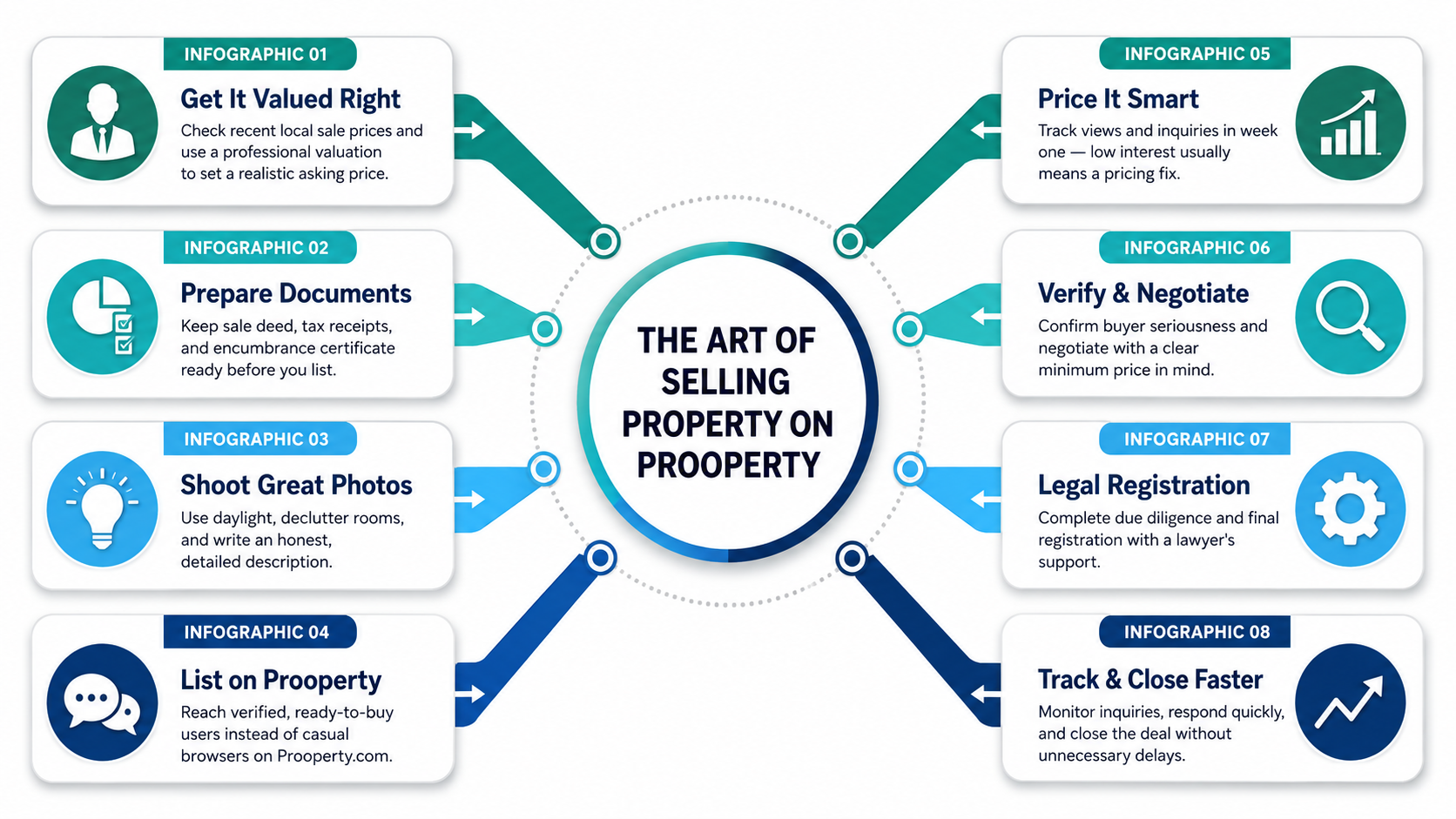
Selling a home is not a single action — it's a sequence of smaller decisions. Here is the complete process broken down into manageable steps.
1. Get Your Property Valued Correctly
Before making any listing, you have to have a realistic price. Overpricing drives potential customers away; underpricing ends up costing you actual money.
Examine the latest prices of comparable properties in your local area
Use the online real estate valuation software or have a professional valuation done
Consider age of construction, floor, facilities, and any locational advantage
Have some negotiating room (5-8%) included in your listing price
2. Prepare Your Property Documents
The consumers are very careful today, and having incomplete documentation in the listing will definitely cause loss of buyer's trust immediately. Make sure that everything is prepared before putting up your listing for sale.
This will definitely save you some weeks before closing, as most of the delays experienced during closing arise from the missing documentation rather than buyer’s backing out.
3. Take Professional Photos and Write an Honest Description
Listings with high-quality photos consistently get more views than listings with blurry or poorly lit images. Along with photos:
Emphasize natural light, layout, and use of space
Include mention of schools, hospitals, markets, and transportation facilities
Don’t lie about the condition of the home – credibility sells better than hype
Use floor plans if possible, as serious buyers are always looking for them
Photograph in the daytime and declutter the rooms before photographing
4. List on the Right Platform
This is precisely where most sellers waste a huge amount of time or save a lot of time. Putting your property up for sale on Prooperty.com makes sure that it is seen by people who actually want to buy, and not just browsing around. This saves a lot of time in dealing with irrelevant people, and ensures that the listing finds a buyer soon.
5. Set the Right Price and Stay Flexible
After being listed, observe the number of views and inquiries in the first two weeks. If there is not much interest, then this indicates that the problem lies in the price. Minor adjustments in the price earlier will do much more good than major ones later.
6. Negotiate with Confidence
Buyers will almost always negotiate. Prepare for this in advance:
Have your bottom line ready before you engage in the dialogue.
Differentiate between “want” and “need” when listing your terms.
Do not divulge your lowest point early in the discussion.
Stay calm and professional in responding to offers that appear low.
Ask for verification of finances before you engage in serious negotiations.
7. Complete Legal Verification and Registration
After the buyer has been identified, both the seller and the buyer generally sign the document for sale, after which due diligence takes place and finally registration is done at the office of the sub-registrar. At this point, one should engage the services of a lawyer/documentation expert to avoid misunderstandings at the last minute.
Quick Reference: Traditional Selling vs. Selling Through a Property Platform
Practical Tips to Sell Property Faster
Clear out the space before pictures or viewing — prospective buyers react emotionally to decluttered spaces
Consider seasonality when listing the property — more buyers are available during the spring and after festive periods
Respond promptly to queries from the buyer — a late response drives the buyer into other properties
Be flexible in scheduling viewing times, even at weekends and evenings
Clearly state the asset’s USPs — corner lot, ample parking, minimal maintenance, security gated, and others
Price uniformly on all platforms where you list the asset — conflicting prices will raise suspicion among buyers
Fix minor issues before listing the home — leaking tap or faulty switch may make buyers wonder about other issues
Common Mistakes Sellers Should Avoid
Neglecting the legal safeguard — a defective title can hold up or kill the transaction at the end, after the buyer has committed to a price.
Emotionally charged pricing without reference to the market value, thus subtly discouraging genuine buyers from making offers without any feedback.
Poor quality listing pictures that don’t do justice to the real situation of the property and limit the amount of inquiries received.
Negotiating for weeks with buyers without ascertaining their genuine interest first.
Neglecting to write up any agreements during the initial negotiation period, which frequently results in future conflicts.
Limiting oneself to listing on just one marketing channel.
Tax and Cost Considerations When You Sell Property
Selling a home usually involves more than just the sale price. Before finalizing a deal, factor in:
Capital gain tax that depends on the period for which you have held the asset
Fees for brokerage or online platform service, if any
Charges for registration and transfer that may be shared between the buyer and the seller
Loan repayment if the real estate asset is still mortgaged
Clearance fees for society/association in case of apartment complexes
Understanding these costs upfront prevents surprises at the final settlement stage and helps you calculate your actual net proceeds accurately.
Quick Checklist Before You List
Use this as a final run-through before you go live with your listing. Missing even one of these steps is often the difference between a quick sale and a listing that sits idle for months.
Evaluation based on recent comparable sales, no assumptions made
All important documents (sales deed, tax certificates, encumbrance certificate) verified and available
Good daylight photography taken from all key angles, even outside the property
Honest description written, describing size, facilities, and landmarks in vicinity
Listing price set, with some margin for negotiations planned
Basic repairs carried out to ensure there is no distraction during viewing
A well-defined plan about how you will answer the inquiries
Ticking off each item here before you publish your listing sets the foundation for a faster, smoother sale.
Frequently Asked Questions
Q: How long does it usually take to sell property?
A: On average, a well-priced, well-documented listing sells within 6 to 12 weeks, though this varies by location and market conditions.
Q: What documents are compulsory to sell property?
A: At minimum, you need the sale deed, encumbrance certificate, tax receipts, and identity proof. Additional documents depend on home type and local regulations.
Q: Is it better to sell through a broker or an online platform?
A: An online platform typically offers wider buyer reach, transparent pricing tools, and lower costs, while a broker may offer more hands-on local negotiation support. Many sellers now use both together for the best results.
Q: How do I decide the right asking price?
A: Compare recent sales of similar homes nearby, factor in your home's condition and amenities, and leave a small margin for negotiation.
Q: Can I sell property without a lawyer?
A: It is technically possible, but strongly discouraged. A lawyer or documentation expert helps verify title clarity and prevents costly disputes after the sale.
Q: What is the biggest reason listings fail to sell? A: Incorrect pricing is the single biggest reason. Poor photos and incomplete documents are close behind, since both directly affect buyer trust and inquiry volume.
Final Thoughts
The art of selling your property is based on a number of principles, such as accurate pricing, documentation, presentation, and proper exposure. Without any one of them, the whole process becomes much longer than it is supposed to be and often results in greater expenses for the seller than the savings on commissions initially hoped for. If you follow the above list of steps: appraisal, documentation, photography, listing, negotiation, tax planning, and closing, you become in the best possible position as a seller.
Are you prepared to move forward? The listing of your real estate asset at Prooperty.com is the fastest way to implement all these steps and reach out to the real buyers while keeping the whole process structured from the very beginning to the final registration.