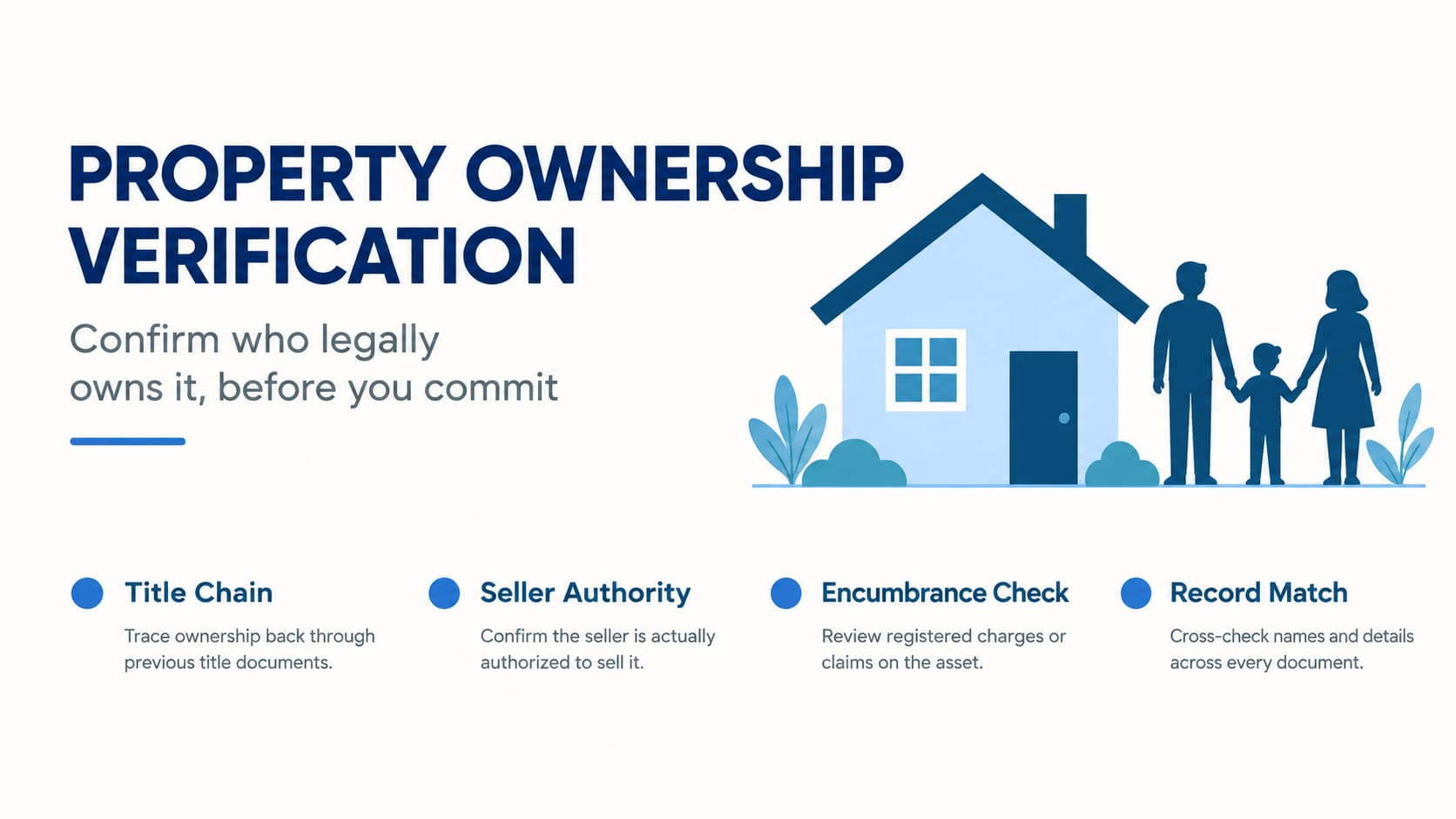
When buying property in India, the primary issue that comes up is not the cost of the property or its plan. The first step is finding out if the party who is trying to sell the property has the legal rights to do so. This is because the sale notice or photographs alone cannot prove the ownership. Ownership needs to be established by verifying records and documents and cross-referencing them with other documents. This manual deals with the process of establishing ownership and what needs to be done if there are discrepancies in the records.
What Does Ownership Verification Actually Mean?
Fundamentally, checking for ownership requires determining who the current owner of the asset is, examining the paper trail that leads up to the title of the asset, determining the history of the title's ownership and that the one selling is entitled to sell it. This is an additional step which includes being aware of discrepancies such as misspellings of names, missing links in the chain of ownership, or any other discrepancies between two documents.
While similar in some ways to due diligence, the issue at hand is actually different from the general process. In this case, it is not a matter of building quality, pricing or amenities, but rather a matter of legal ownership of the real estate and the ability to sell it. The buyer might be able to successfully conduct all other checks, yet have problems with this particular one.
Which Records Help Verify Ownership?
None of the documents alone will tell the complete story. There are some types of documents which serve a specific purpose.
Sale Deed or Registered Title Document
A document which registers the transfer of the title to the present possessor is normally used as the first step. It will show the way in which the person got the title to the property and normally serves as the main document to be examined.
Mother Deed or Previous Title Documents
Other title documents that trace the ownership of the asset back through time will help to create a complete picture of how it has passed from one person to another. More history is usually better than a more recent transfer.
Encumbrance Certificate
This certificate may provide some of the registered transfers or charges against a particular property, for example, a mortgage during the last few years. It is an important piece of information, but only what has been registered and not necessarily what doesn’t exist.
Mutation or Land Records
Mutation means updating of the local revenue accounts regarding a change in ownership of the property. Mutation is an appropriate indicator of support; however, one cannot consider it as conclusive evidence of title since the mutation accounts record administrative changes and not a substitute to the title documents.
Tax or Municipal Records
Records of dues paid maintained by the municipality provide additional information on who has paid dues concerning that property. The tax records do not give conclusive proof of title; they normally rely on the information provided by the concerned person.
How Do You Confirm the Seller Is the Actual Owner?
A practical sequence helps here:
Identify the seller by means of proper government documentation.
Compare this name with the relevant title document registration.
Identify whether there are joint owners that must also get involved.
Investigate previous title documents to see how the seller obtained the property.
Make a comparison regarding descriptions (address, size, boundaries) between the documents obtained.
How did the seller obtain his/her ownership of the property – was it a purchase, a transfer by inheritance or by gift or a partition, as each is documented in different ways.
If a Power of Attorney has been given to someone to sell the property, ensure you properly verify this document.
In case of an inherited property, check the relevant documentation on the inheritance.
If it is a company/entity that owns the title, find out who has the authority to sell on behalf of the company.
None of these steps needs to happen in strict isolation — in practice, most buyers work through several of them together as documents become available, revisiting earlier steps if something new comes to light.
How to Trace the Ownership History
A simple approach to this would be as follows: Owner A assigns it to Owner B, Owner B assigns it to Owner C, and finally, Owner C assigns it to the present seller. Every connection in the above chain needs to be traced as it is just a history of how the title has been transferred from one legal owner to another through the years.
Look out for connections within each assignment, prior title documents verifying each assignment, and any gap where an assignment seems to be missing without any reason. Any inconsistency in name or description from one document to another or any contradictory ownership from an unexpected source may warrant further investigation.
How Verification Changes in Different Situations
Resale property: In this case, the emphasis is largely on establishing the history of how the present seller came into possession of the property.
Inherited property: In this case, there is an importance of succession/inheritance papers, along with verifying the fact that all the heirs or co-owners, if any, have indeed been taken care of in the transaction.
Jointly-owned property: It requires the participation in the transaction of all necessary co-owners or at least a person representing all of them because the deal with one co-owner among many is an incomplete deal.
Developer/new development: There is an important distinction between such an arrangement and the resale transaction, as title usually comes through developer/project related documentation.
Land/plot: There is some significance attached to state-specific revenue and land records.
What If Two Records Show Different Owners?
This needs to be taken seriously rather than being dismissed. The reason why there may be a discrepancy in the record is numerous, like a mutation that has not been documented, a transaction that has not been updated in all the records, inheritance that has not been recorded, name differences, undisclosed joint tenancy, or simply because of delay in updating records. It could also be a legitimate dispute on the property.
The proper course of action is not to try to determine which record is correct, but to find out which one is the correct one.
Can Tax Records Prove Ownership?
But not necessarily. There are tax registers maintained by the municipality that have information about people who have been paying taxes associated with an asset. This is a helpful supporting indicator, but it is normally done on the basis of information that has been submitted rather than serving as independent proof of title.
Can Mutation Records Prove Ownership?
Neither is this conclusive. Mutation means administrative updating of revenue accounts after the transfer, and is a very valuable indication that the transaction has been entered in local accounts. By itself, however, mutation does not constitute conclusive evidence of title; the actual registration documents are of greater importance, and must be considered along with them.
Common Red Flags During Ownership Verification
Name of Seller does not tally with the titles
Previous title documents have gone missing
There is an inexplicable gap somewhere in the chain of title
Some records are contradictory
There is an undisclosed co-owner
Power of Attorney powers are not clear
There are missing documents relating to inheritance
Description of the asset varies from one record to another
There are unanswered questions in the registered transactions history
The Seller is unwilling to provide ownership documents
None of these alone confirms a serious problem, but two or more together are worth taking seriously before proceeding further.
When Should You Consult a Lawyer?
An independent legal review becomes especially handy when there is some discrepancy in the documentation regarding the owner of the property, if there are issues with the inheritance of the property, if there are multiple owners of the property, if the Power of Attorney is involved in the transaction, if the title history of the property in question is really complicated, if any disputes or claims arise, or if the transaction poses significant financial risks. The information provided herein is for educational purposes only.
The analysis of the entire title history together with the accompanying documents by a lawyer in such cases normally includes searching for inconsistencies between different documents and drawing attention to any facts that may need to be clarified before any financial decisions have been made. It does not guarantee that no problems will ever arise; it just decreases the probability of such occurrences substantially.
If buyers want to browse for property for sale through a real estate portal in Gurgaon or any other city, a good tool for doing this would be Prooperty.com.
Frequently Asked Questions
How can I verify ownership in India?
Review the registered title document and previous title records together, trace the ownership history for gaps or inconsistencies, and confirm the seller's identity matches what's recorded before proceeding.
Which document proves legal ownership in India?
A registered title document is generally the primary evidence, though it's best reviewed alongside the ownership chain and supporting records rather than relied on alone.
How do I check if the seller is the legal owner?
Match their identity against the registered title document, check for undisclosed joint owners, and trace how they acquired it through the relevant previous documentation.
Can ownership be verified online?
In some states, certain records are accessible through relevant government portals, though availability and the exact process vary by state and record type.
Does a sale deed prove ownership?
It's important evidence of a transfer, but confirming ownership is more reliable when it's reviewed alongside the broader chain of title rather than in isolation.
Can mutation records prove ownership?
Not conclusively. Mutation reflects an administrative update to revenue records and is a useful supporting signal, not a substitute for the underlying title documents.
Does a tax receipt prove ownership?
No. It shows who has been paying dues, which is useful supporting information, but it isn't independent confirmation of legal title.
How do I check the ownership history?
Trace previous title documents back through each transfer, looking for continuity, consistent names and descriptions, and any unexplained gap in the chain.
What should I do if records don't match?
Don't assume either record is automatically correct. Seek clarification and appropriate professional verification before moving forward with the transaction.
Do I need a lawyer to verify ownership?
Not always for straightforward cases, but it's particularly worth it when records conflict, inheritance or a Power of Attorney is involved, or the transaction carries significant financial risk
Conclusion
It is not an issue that can be resolved through the use of one document alone. Ownership can only be proved by comparing the pertinent title deeds, by tracking down the ownership trail, by weighing the supporting documents such as mutations and tax certificates as well as by ensuring that the seller has the right to sell. Discrepancies among the documents should ring the alarm bells.