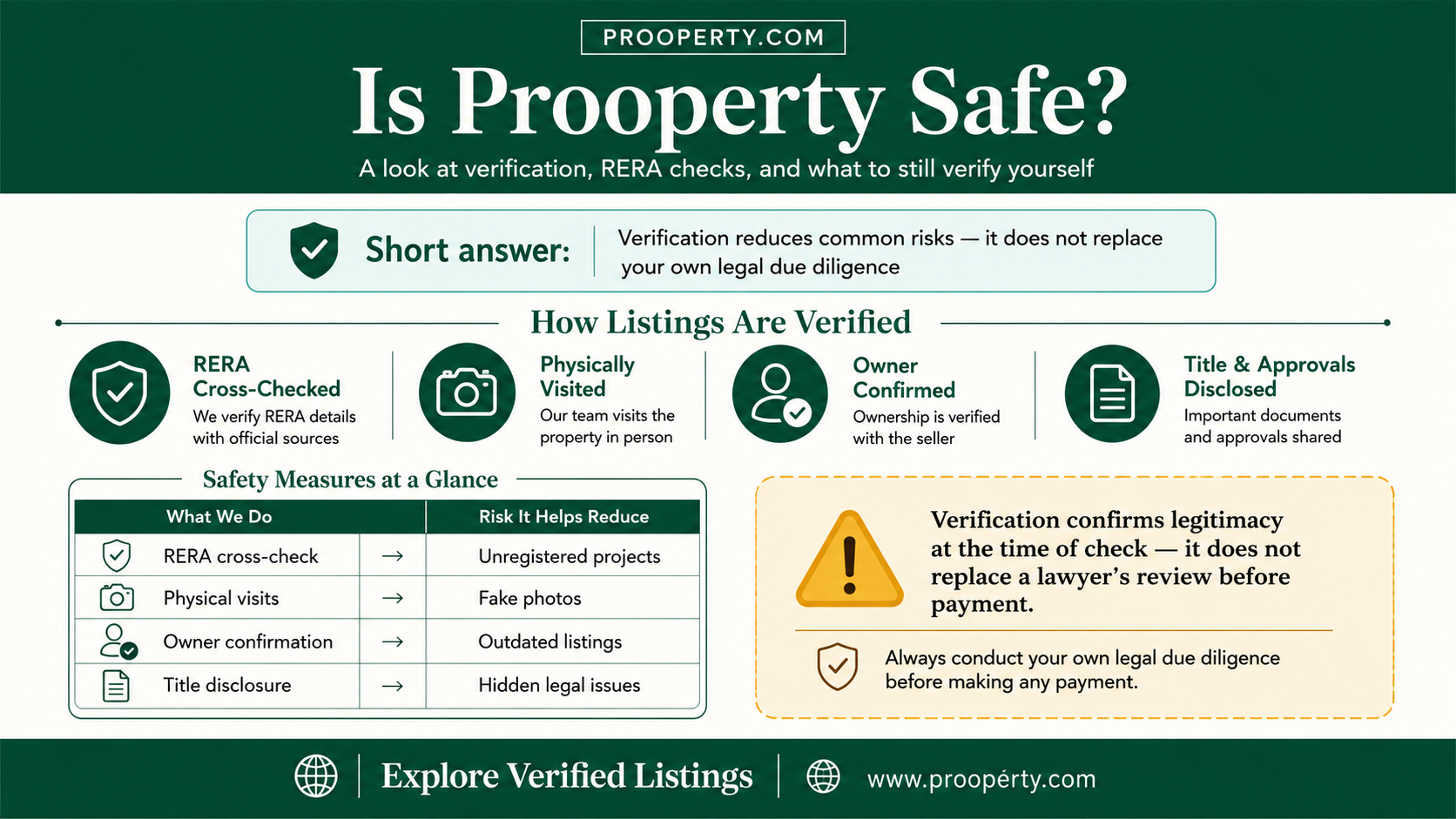
Is Prooperty Safe for Buying and Selling Property?
It goes without saying that real estate transactions are one of the most significant monetary investments that people make in their lives; therefore, it’s perfectly valid to ask before utilizing a certain platform: is it really safe? Before getting into that, it helps to quickly answer a simpler question first — what is Prooperty, and what does it actually do?
Unfortunately, there is no platform capable of making such transactions absolutely safe because they require legal documents, governmental permissions, and tangible property which cannot be controlled by a platform entirely. All a good platform can do is decrease some typical problems which are false listing, obsolete data, and unverified seller.
In this article, we will examine in detail the safety measures, their capabilities and limitations, and the things one still needs to verify personally.
Why This Question Matters
Trust is an issue that Indian real estate listings have faced for years. There have been cases where listings remain live for months despite not being valid anymore. Pictures from other properties are used. Even some "brokers" do not have any connection with the property. These are issues faced by all platforms alike.
This is precisely the reason why safety and verification need an honest response. The following is an honest look at what really exists.
How Listings Are Verified
RERA validation. Both project and broker’s RERA registration numbers are verified with the respective state authorities prior to listing going live. This ensures legal registration of the project, which is one of the minimum requirements for the majority of residential projects in India.
Physical verification, whenever possible. Instead of relying only on pictures provided by the lister, the team tries to conduct a physical inspection, recording video footage instead of using standard or old pictures.
Confirmation with the owner or channel partner. Price and availability are verified with the person in charge of the property instead of taking the data from the listing which may have become inaccurate over time.
Disclosing any problems upfront. Any known problem with the title of the project, legal proceedings or approvals pending are disclosed immediately.
Safety Measures at a Glance
This table is indicative of the checks that the platform performs prior to and during listing. The actual process of transfer of ownership of property does not fall within this category, as this takes place separately from the listing websites.
Staying Safe as a Buyer
Verify the RERA number yourself
On an even verified listing, it only takes a couple of minutes to trace the RERA number from the official RERA portal in your state. This is perhaps the easiest verification step you could take that will tell you the project is registered.
Inspect the property physically
There is nothing better than inspecting the property yourself physically and ensuring everything in the listing is true.
Seek a legal expert to verify the title
Verification of the title is a legal exercise and cannot be verified by any listing website. A legal expert will help you verify whether there are no disputes, liens or any issue whatsoever.
Do not pay huge amounts without verifying documents
You should never make booking amounts or token amounts until you have gone through some key documents such as the sale deed, encumbrance certificate, approved building plan and RERA certificate.
Staying Safe as a Seller
Do not send sensitive information to everyone
Sending your title documents is not required for each person contacting you. First, you can send some information and send the full documents only to those buyers who have proven their true intentions.
Verify the buyer's identity before meeting him in person
It's a very simple thing to do before going to see your house in person, especially if it's an empty or unoccupied one.
Hire a lawyer for making the final agreement on the sale
Even having a willing buyer, the agreement on the sale needs to be prepared by a lawyer.
Common Red Flags in Indian Real Estate
These apply regardless of which platform a listing comes from, and are worth watching for:
An unusually low price relative to the local market price without any obvious reason
Being coerced to pay a “booking amount” without seeing any papers
Resistance to providing the RERA number or doing so orally but not in written form
Requests to make payments in a personal account instead of a company account
The "agent/broker" cannot give a clear answer to your question about their connection with the owner/developer
Ads that have different numbers when called several times
What Verification Doesn't Cover
It's worth being direct about the limits here, since overstating safety helps no one.
The verification process just confirms the listing to be genuine, but it does not guarantee anything will not happen after that.
The RERA registration process just confirms the compliance of the project with the required disclosure requirements, but it does not guarantee that it will get completed as planned.
Physical inspection only confirms the presence of the property and that it is more or less similar to what is described in the listing, but not that the title does not have any legal issues.
In short: verification lowers the chance of dealing with a fake or wildly inaccurate listing, but the legal and financial closing of a real estate deal is still something buyers and sellers need to handle carefully, ideally with professional help.
A Note on Payments and Transactions
No listing platform is ever supposed to be the intermediary for the financial transaction itself; payment happens directly between buyer and seller using banking channels, and documentation. Be careful of anyone, on any platform, who suggests that you make payment through an alternative channel.
General rule applicable universally: never transfer a substantial sum of money on the basis of a phone call and/or a listing alone; demand documentation of some kind, preferably in the presence of a lawyer.
Agent and Builder Safety
The idea of verified listings benefits not just individual customers but agents and builders as well. An agent benefits from the fact that buyers will automatically feel more comfortable buying from a listing that has passed the RERA checks, saving time on building rapport. Similarly, a builder benefits because listing that's been verified tells buyers that the legal requirements have been met, thus reducing the number of those who back out halfway through the process.
Having said that, the agents and builders themselves are expected to be compliant regardless of whether a listing platform is verifying things on its side or not.
Frequently Asked Questions
1. Is Prooperty completely safe to use?
There is no guarantee that any website will make your transactions completely safe and risk-free. However, verification procedures will help you avoid the risks of encountering a fraudulent or out-of-date listing.
2. How are listings verified?
The RERA numbers are verified against the state registries, visits are made to the listing physically, and prices and availability are confirmed from the owners or channel partners.
3. Can I trust the photos on a listing?
Verified listings use real photos or footage from an actual visit, rather than stock images, but you should still visit in person before making a final decision.
4. Does RERA verification guarantee a project is risk-free?
No. It confirms the project is legally registered and disclosed, not that construction timelines or quality will meet expectations.
5. Should I still hire a lawyer?
Yes. Title verification and sale agreements are legal matters that should go through a property lawyer, regardless of how verified a listing appears.
6. How can sellers protect themselves from time-wasters or scams?
Share sensitive documents only with serious, verified buyers, confirm identity before site visits, and use a lawyer for the final sale agreement.
7. Does the platform handle payments?
No. Payments happen directly between buyer and seller through proper banking channels — no listing platform should be the go-between for money transfers.
8. What should I do if a deal feels off?
Slow down and verify independently — check RERA status yourself, ask for documents in writing, and avoid paying large amounts before seeing them.
9. Are agents and brokers verified too?
Broker RERA numbers are checked as part of the listing process, though agents are still expected to maintain their own independent compliance.
10. Is it safe to pay a booking amount before seeing documents?
It's safer to see key documents — sale deed, encumbrance certificate, RERA certificate — before paying anything beyond a small, refundable token amount.
Conclusion
The prooperty system of verification — involving RERA validation, on-site visit, and owner verification — aims to minimize the most frequent dangers in India's real estate market, namely false postings, outdated data, and lack of seller validation. This is certainly an important level of protection, but it does not absolve you from taking your own safety measures.
Go to the site of the property. Verify the RERA number yourself. Consult a lawyer before any signing or payments. Together, your efforts and the safety mechanisms of the website create a far more secure purchase/sale process than each one separately.