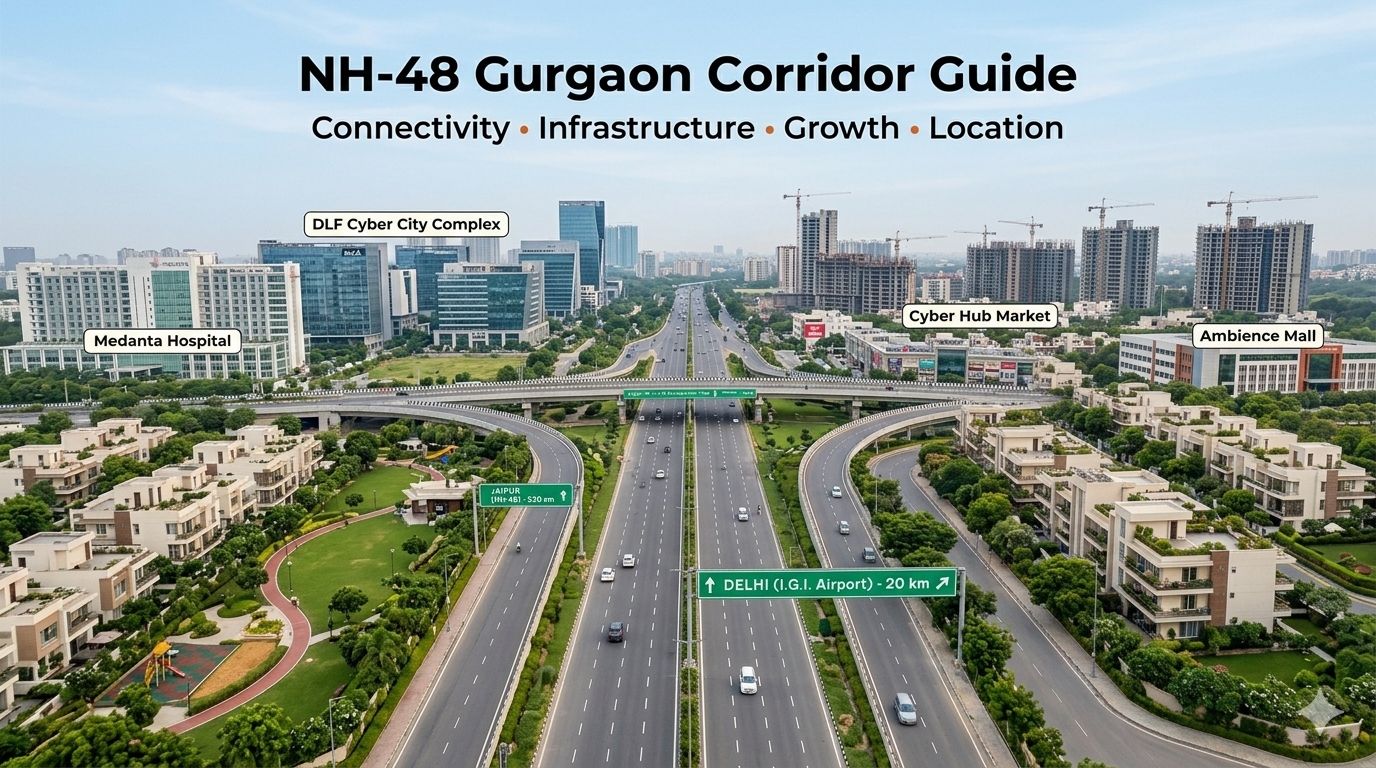
Introduction – NH-48 Gurgaon Corridor
NH-48 Gurgaon is an important connector road in Gurgaon, serving as a vital link from Delhi to other locations in North India. This road is connected to the highway connecting Delhi to Jaipur, playing an important role in making commuting possible in the region.
Due to its proximity to many business areas, many developments and industries have taken place around the road area, turning it into a combination of residences, industries, and corporate areas. Being close to the business hubs has increased traffic on NH-48.
Another major strength of NH 48 is that it is highly connected to important junctions, including Rajiv Chowk and the internal roads of the city, making commuting easy to different destinations like offices, hospitals, schools, and shopping complexes.
There have been constant improvements made in the infrastructure for this road that includes wider roads, flyovers, and an efficient transport system to accommodate vehicles. Although there can be occasional traffic jams in the rush hour due to the high volume of vehicles, there have been measures taken by authorities for improvement in this regard.
The impact of the NH 48 on the expansion of the city is quite substantial since places adjoining this road have been reaping the advantages of improved accessibility and sustained development through time.
Strategic Location Advantage and Connectivity Framework
The corridor of National Highway 48 is a vital component of the accessibility framework of Gurgaon. The placement of the corridor enables easy access from Delhi to Gurgaon and beyond to Jaipur, making it an extremely convenient means of transport both for regular commuting and long-distance traveling.
The highway is in direct connection with several urban nodes, including Rajiv Chowk, which is a central node facilitating traffic flow into other parts of the city. From here, various roads connect to different sectors within the city for easy transportation within. Well-developed link roads further make it easy to access other zones without having to take a roundabout route.
It is also worth noting that this corridor is close to many commercial and employment centers. This makes it highly advantageous as people can easily reach their workplaces and back home from here without having to spend too much time on the road.
Notably, the connectivity advantage is not restricted to transportation via roads. There are many metro station facilities as well as public transport services that provide the users with various commuting options. The use of both highways and public transport facilities has made this entire connectivity model quite effective and efficient. Moreover, there have been significant improvements made to the infrastructural facilities in this area, such as the construction of flyovers, service lanes, and better traffic management facilities. All these efforts have been taken to manage the traffic load and ensure a smooth flow during rush hours.
Finally, the advantage in location offered by this particular corridor includes connectivity of areas along with reduced commuting time.
Location Advantage (Detailed Coverage)
Connectivity
Surrounding Development and Land Use Pattern
The areas surrounding NH-48, Gurgaon exhibit a diversified and well-knit land use pattern within the city. This strip is not restricted to one particular form of development but rather accommodates different forms of development including residential settlements, commercial centers, industries, and institutions, thus forming one of the busiest urban strips in the city.
The residential development in the area consists of high-rises, builder floors, and plotted colonies. Several sectors adjacent to the highway have been developed taking advantage of their accessibility to the highway. Thus, they provide convenient living to people who look for connectivity without affecting their daily conveniences. There exist different types of houses ranging from budget to luxurious, providing a balanced residential environment.
Commercial activity is yet another important part of this corridor. Business centers, office parks, and corporate buildings have been established in the area, thus contributing significantly towards employment opportunities and economic activities. This has attracted many professionals in the area, thus resulting in high demand for residences.
Moreover, industries and logistics parks, especially in the Udyog Vihar region, further complement this development pattern. Such zones play an integral part in enabling logistics and industrial connectivity. Therefore, such a corridor is of relevance not only in terms of residential development but also in terms of industrial and logistical connectivity.
Finally, institutional development in the form of school/college campuses and hospitals is present throughout various sectors in the vicinity. This is of great importance as it ensures easy accessibility to essential services.
To conclude, this land-use pattern is well-balanced where there is a perfect balance between residential, commercial, and industrial development. Such a development pattern highlights the significance of this corridor in Gurgaon.
Social Infrastructure and Lifestyle Ecosystem
NH-48 corridor of Gurgaon city possesses a good social infrastructure network; hence, the area becomes an efficient urban center. The region is characterized by availability of services required in various aspects like education, healthcare facilities, retail markets, and many others. As a result, life in the area will be more convenient without having to travel long distances.
It is important to note that the existence of schools, health facilities, retail centers, as well as office centers, makes life easier for people living in the area. Additionally, the proximity of industries offers job opportunities in the area. Transport facilities, hospitality, and recreation are part of what makes the area an efficient urban center.
Real Estate Trends and Market Dynamics
The real estate scenario of the NH-48 corridor in Gurgaon shows that the market is vibrant and demand-driven owing to the presence of excellent connectivity and consistent urbanization in the area. The corridor has become a sought-after zone because of the proximity of Delhi and parts of Gurgaon, which makes it favorable for residential and commercial activity.
Another unique characteristic of the market is the range of properties available in the zone. These include high-rise residential projects, builder floors, plotted houses, and commercial spaces in various proportions. In essence, the presence of this diverse portfolio of housing means that there will be something to suit all needs and demands.
The driving factor behind the demand in the region can be attributed to the close proximity of important employment centers like Cyber City and Udyog Vihar. People living in such areas tend to prefer those with highway access. As a result, the demand remains steady, preventing any erratic fluctuation in prices. Another aspect that influences the market is commercial growth in the corridor. The number of office spaces, shopping malls, and mixed-use projects continues to rise, resulting in more economic activities taking place in this area. This contributes to more housing demand and creates more value for other nearby locations.
Furthermore, improvements in the transportation network, including road widening, flyovers, and an efficient traffic management system, could add more appeal to the corridor. Despite the issue of traffic at rush hour, improvements are gradually being made, and the situation is becoming more manageable.
In summary, the characteristics of this market can be seen in terms of good connectivity, diversity of development, and steady demand for housing.
Advantages and Limitations of the Corridor
The NH-48 corridor in Gurgaon presents a practical mix of strengths and challenges that shape its overall usability and appeal.
Strong Connectivity: Direct linkage to Delhi and key hubs like DLF Cyber City and Udyog Vihar makes daily commuting efficient and supports seamless intercity travel.
Developed Road Infrastructure: Wide carriageways, flyovers, and service lanes help manage large traffic volumes and improve movement across major junctions.
Access to Social Infrastructure: Schools, hospitals, retail centers, and daily markets are located within a short radius, ensuring convenience for residents and working professionals.
Continuous Urban Growth: Ongoing commercial and mixed-use developments enhance economic activity and maintain consistent demand in surrounding areas.
Traffic Congestion: Peak-hour traffic remains a concern due to heavy usage, particularly near central junctions and entry/exit points.
Noise and Pollution: Being a major highway corridor, certain stretches experience higher noise levels and air pollution compared to internal residential sectors.
Infrastructure Pressure: Rapid development in nearby areas can occasionally lead to stress on local roads and civic services.
Overall, the corridor offers strong connectivity and growth advantages, while its limitations are mainly linked to high traffic movement and urban density.
Future Growth Potential and Development Outlook
NH-48 Corridor in Gurgaon will experience systematic growth because of infrastructure improvements and increasing demand in urban areas. Being a major highway, it will always be under the watchful eye of developers, thus making it a promising area for future development.
One of the main growth factors will be infrastructure improvements. Road widening and new junctions will help alleviate traffic pressure and make commuting easier. Improvements in traffic management systems will contribute to this trend. Commercial growth is another factor that will influence the development of the area. Presence of major centers such as DLF Cyber City and Udyog Vihar, as well as availability of business opportunities, will continue to draw people to the area and increase demand for accommodation.
Furthermore, residential growth in surrounding sectors will provide housing options based on connectivity benefits. Roads such as Sohna Road, Golf Course Extension Road, and SPR will complement this benefit.
Future Growth Factors Chart
Who Should Consider This Corridor
The NH-48 corridor in Gurgaon is suitable for a wide range of users due to its strong connectivity and mixed-use development. However, it is especially ideal for specific groups based on lifestyle and daily requirements.
Working Professionals: Individuals employed in major hubs like DLF Cyber City and Udyog Vihar benefit from shorter commute distances and direct highway access, making daily travel more efficient.
Frequent Travelers: People who travel regularly to Delhi or need quick access to IGI Airport will find this corridor highly convenient due to its direct connectivity.
Business Owners and Entrepreneurs: The presence of commercial zones, logistics movement, and office spaces makes it suitable for those involved in business operations requiring easy transportation access.
End Users Seeking Connectivity: Residents who prioritize accessibility over isolation will find this corridor practical, as it connects major parts of Gurgaon and nearby regions efficiently.
Long-Term Investors: Those looking for stable growth potential may consider this area due to continuous infrastructure upgrades and consistent demand driven by employment hubs.
Not Ideal for Low-Density Preference: Individuals looking for completely शांत and low-traffic environments may prefer interior sectors, as highway proximity brings higher movement and activity levels.
Overall, the corridor is best suited for people who value connectivity, accessibility, and proximity to work and transport hubs over quiet and isolated residential settings.
Price Trends and Demand Overview
There is an effective and demand-based pricing system in operation in the NH-48 Corridor in Gurgaon because of high connectivity and continuous urbanization activities. As against other residential zones, this corridor has been influenced by residential, commercial, and industrial activities and, therefore, demand has been sustained all along. The price pattern here is greatly affected by the zone in which the property falls. Properties that are located closer to DLF Cyber City and Udyog Vihar zones have a higher price tag than those located at interior spots. The reason for this trend is simple, as those spots enjoy better connectivity.
Demand for this corridor is fairly steady because of the presence of a continuous stream of working professionals. Residential demand in the zone is influenced by connectivity issues whereas demand in the commercial space continues to escalate.
Price Trend and Demand Chart
FAQs
Q1. Where is NH-48 Gurgaon situated?
NH-48 Gurgaon is a significant highway corridor that passes through Gurgaon and connects Delhi to Jaipur.
Q2. Why is this particular corridor significant?
This highway corridor plays an essential role in facilitating transportation, commuting, and logistics due to its connection with city hubs and intercity highways.
Q3. Is the connectivity of this corridor good enough?
This particular corridor is well connected to Delhi, other roads in Gurgaon, and prominent locations such as DLF Cyber City and Udyog Vihar.
Q4. Can I reside in this corridor?
Yes, since the adjacent sectors provide residence opportunities for those individuals who prefer being close to their workplace and having high connectivity.
Q5. Are there good amenities in this sector?
Yes, this sector provides access to schools, medical services from hospitals such as Medanta - The Medicity, shopping centers, and even convenience stores.
Q6. What are the drawbacks associated with this sector?
High traffic volume during peak times and noise pollution are two primary drawbacks of this highway corridor.
Q7. Who should opt for this location?
Working individuals, regular travelers, and entrepreneurs can benefit from living in this corridor.
Q8. Is there any growth potential in this corridor?
Yes, there is considerable scope for growth due to the constant development activities.
Overall Summary
NH-48 can be called an extremely significant backbone of urban connectivity in Gurgaon. Not only does it serve as a means of connecting people from one part of Gurgaon to another but also links the entire city to other cities via this thoroughfare. One of the main advantages of NH-48 is that it provides perfect access to various development opportunities. Since it allows easy connectivity to other locations including Delhi, it creates high demand and helps in sustaining the flow of people using it. Thus, it can become a great place to live for businessmen and workers who need convenience in traveling.
Another advantage of NH 48 is that it provides people with everything they need in terms of their living conditions. From social infrastructures to commercial areas and living space, all necessary facilities are located near NH 48, and residents do not need to cover long distances to meet their basic needs. Future developments in the area and continuous improvements in infrastructure are expected, which will increase the significance of NH-48 even more. However, the current issues connected to NH 48 are mostly caused by its extensive usage.
Overall, the corridor remains a strong and reliable urban link that combines connectivity, functionality, and long-term growth potential within Gurgaon.