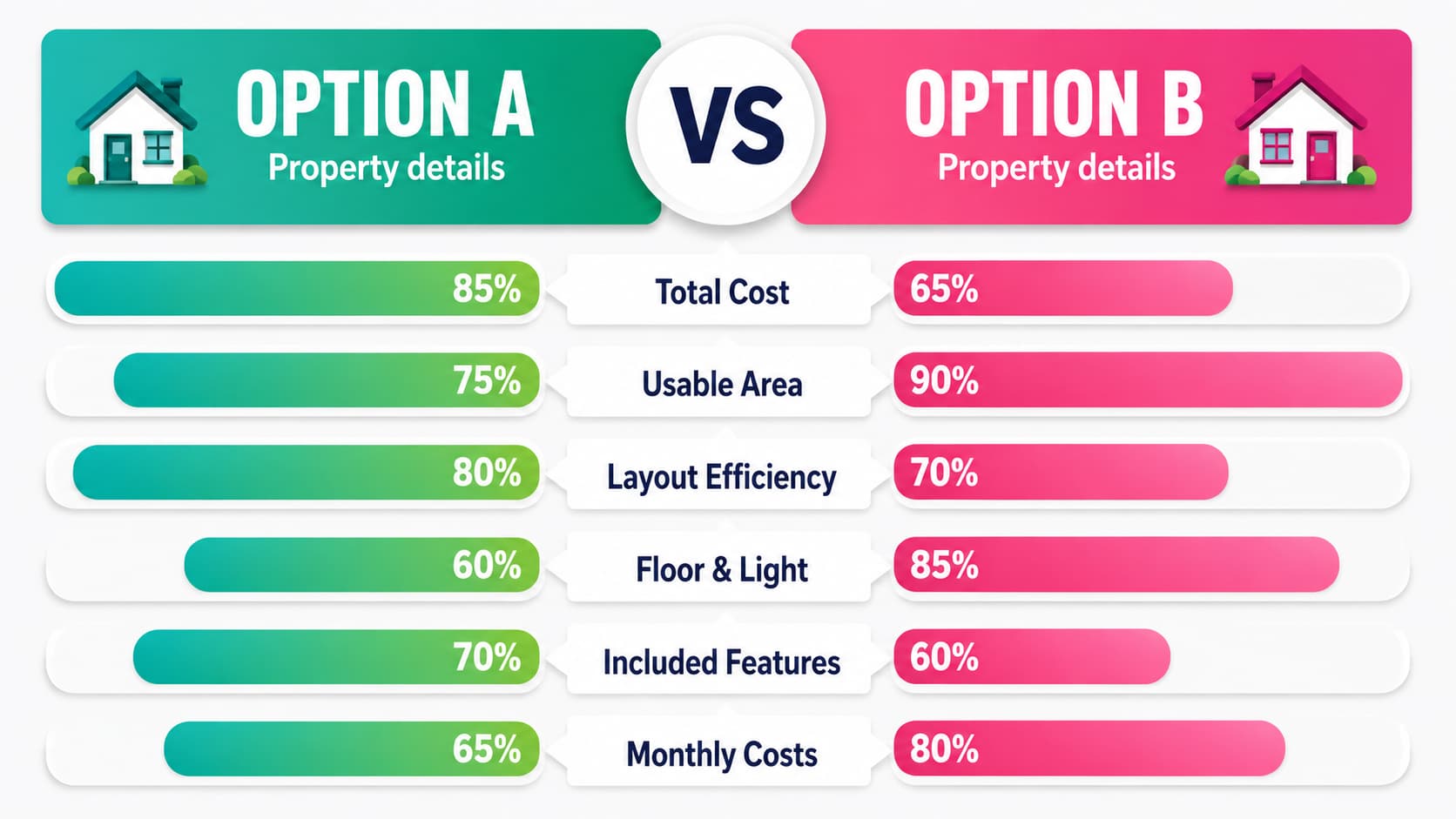
Search will yield a list, but comparing is what leads to the decision. Most people take weeks just looking around and have five or six tabs open at once, each one different in its own right and no good way of knowing which one is actually better. The purpose of this guide is all about the second part – not about finding the options available on Proopproperty, or anywhere else, but about how to compare the options you’ve already found and make a decision.
Why Comparing Is Different From Searching
In essence, searching is all about finding and is characterized by casting a broad net to eventually filter through some obvious criteria such as price and location. Comparison on the other hand is about evaluation, which involves considering several comparable options and making an informed decision as to which is the best choice after analyzing all the facts. The two concepts appear closely linked but need different approaches.
When You Have Multiple Options to Compare
It becomes imperative to start comparing when there are multiple choices available that may work for you. Having just two choices is fine to start off with, but after five to six choices, most consumers realize that it becomes difficult for them to process all the information simultaneously. In case your list of choices has become too long, you can shortlist the choices on the basis of your hard requirements first, followed by a comparison process given below.
The concept of timing also needs to be taken into account here. Early comparisons without seeing enough choices that tell you what a good choice looks like in the market, can result in choosing a good enough choice due to the lack of availability of a better alternative.
Choose the Same Comparison Criteria for Every Option
There is only one error that will ever be made when comparing anything, and it is to judge the option based upon what makes it unique – one by its view, another by its price, and so forth. This may seem like a logical way to go about things, but it actually makes true comparison impossible. Set your standards from the outset, and use them consistently.
Build a Comparison Sheet and Work Through It Row by Row
Any spreadsheet or notepad app would work just fine in this case; what matters is the practice of writing something down, not its format. List the criteria you have selected as rows and all short-listed choices as columns, and fill it in with data. The whole point is that looking at everything in one place, rather than spread all around the Internet and in your mind, is what helps you see connections.
The way you do that is just as important as the sheet itself. Do not go into comparing option A vs option B and then B vs option C. Instead, work on each criterion for all options simultaneously. First, look at all prices, then all locations, then all sizes and so on. That will help you notice any irregularities or outliers that would never be caught using the method of pair comparisons.
How to Handle Different Area Measurements
Comparisons between area numbers may often become incorrect, because one of them may be based on the carpet area figure, while another will provide a higher figure of super area. Make sure to standardize every single number before starting to make comparisons between sizes, to avoid a situation when a smaller house loses out to an allegedly bigger one.
How to Compare Different Configurations
The comparison between 2BHK and 3BHK is very simple, but there may also be differences in other configurations as well; some 3BHK configurations may have smaller rooms compared to others, while some may merge two rooms into one. Not only should you consider the number of rooms, but also what purpose those rooms are meant to serve.
How to Compare Layout Efficiency
Two dwellings that have the same area figure may have very different feels, depending on what one does with that space. Unused areas in the hallway, odd-shaped rooms, or a lot of space taken up by columns will decrease the amount of the space that is actually useful. When there are floor plans to work with, compare those.
How to Compare Floor and Position Differences
Floor level influences light, noise, view, and even prices in certain cases, and it may be very easy to overlook this aspect in favor of other more important aspects. Being on a higher floor would result in better lighting and quieter environment, but at the same time, there is likely to be more time spent waiting for elevators during busy times.
How to Compare Orientation and Other Listing-Specific Differences
Orientation plays a part in determining the amount of natural light and heat that the space will have on a day-to-day basis and is typically one of those criteria mentioned in the listing without explanation. A northern or eastern exposure will provide less heat and softer morning light, while a western exposure can get very warm in the afternoon. As well, there are other listing-specific oddities to be aware of – such as the shared wall or unique plot shape or private access.
How to Compare Included vs Excluded Features
The two alternatives that are similarly priced may turn out to have large differences once one considers what is included in the price. There could be a provision of fittings, parking, and even some basic furniture, while the other offers a lower price but includes everything above as an additional expense. Inclusion of a column for the inclusions can help explain the difference in prices.
How to Compare Similar Homes With Different Asking Prices
If there are two real comparable choices that have different prices, then there is always a reason for that — it could be a condition, a location, some features, or just the level of desire of the seller at the moment. Do not simply assume that the lower-priced choice is always the better one. Trace down the reason for the price discrepancy first.
How to Compare the Total Financial Requirement
It is highly unlikely that the asking price will be the total amount required. Add to each choice the cost of registering the property, fees for the brokers, immediate renovations, and relocation costs, as sometimes an asking price lower than others might actually turn out to be costlier due to this discrepancy.
How to Compare Ongoing Costs
Apart from the initial cost, the other costs including the maintenance cost, society charges, and utility variations could also make a difference to which choice is relatively cheaper. The more expensive option initially could be cheaper after just two years when all the expenses are considered together.
How to Weight Important Factors Instead of Counting Them Equally
Every element on your spreadsheet does not require the same level of significance. Your location may be way more significant to you than another feature; yet, using just a simple spreadsheet that does not differentiate between features gives every item equal significance unless you make them different somehow. One way to do this is by making some elements of higher priority than others.
How to Give Each Option a Comparison Score
With the weightings now understood, a scoring system can be employed to convert the mountain of data into something more easily comparable. The options are scored against each criterion, let’s say 1 to 5 for simplicity, with any high priority criteria multiplied together. This doesn’t supplant good judgment, but it certainly goes further towards giving an overview than poring over data points alone.
How to Identify the Strongest and Weakest Point of Each Option
Besides a rating out of ten, you can give a single strength and a single weakness for each of your options. This is important because it will make you more honest than using a rating out of ten alone. A particular option could be reasonable, yet have a particular flaw that the rating won’t reveal.
How to Handle Missing Information in a Comparison
This is a fairly frequent occurrence – there may be no mention of the maintenance number or orientation in a row. These should be marked as unknowns, not assumed numbers that may subtly influence your results. This applies especially to gaps in rows that are at the top of your priority list.
How to Compare Options When None Is Perfect
In reality, there is no perfect solution that meets all the criteria, and expecting one can sometimes mean waiting forever. Here, go back to your weighted list and think about what trade-offs are truly acceptable and what trade-offs would be too bothersome on a day-to-day basis. It’s not so much about looking for perfection here, but making an educated decision about imperfections.
How to Make a Final Shortlist From the Comparison
The two or three most appealing choices will emerge from the comparison process as you score and weight your list. Don’t make any firm decisions at this point — all you’re trying to do is narrow down your choices. A list of two or three candidates gives you room to maneuver.
What Should Be Verified After the Online Comparison
An online comparison is dependent on the accuracy of the data used for making the comparisons, hence before coming to any conclusions, it is important to first verify the critical facts that you considered in your decision in real life — the exact size, the state of the house, and any other thing highly weighted in your scoring sheet.
Common Comparison Mistakes Buyers Make
Examining alternatives as pairs rather than presenting all the criteria at once
Allowing the last interaction to take precedence over the findings of the comparison chart
Considering all criteria as equally important instead of prioritizing them
Failing to consider the costs that will occur in the future and thinking only about the price
Giving up on comparisons the first time an alternative seems appealing, without comparing it to the other alternatives
Including too many alternatives in comparisons at one time, which causes more confusion than clarity
A Practical Comparison Worksheet
Here's a ready-made version of the sheet described earlier, filled in with the exact criteria this guide has walked through — copy it directly into a spreadsheet or notes app rather than building one from scratch.
Fill it in as you gather details on each shortlisted option, one row at a time across all three columns — the same discipline covered earlier, just with the groundwork already laid out for you.
Final Comparison Checklist
Same standard for all choices, without exception
Measurements converted to a consistent base before assessing their size
The full cost determined, not just the asking price
Costs beyond the initial asking price were considered
Criteria prioritized, not given equal weight
Information not provided was noted, not ignored
Two or three finalists, depending on final inspection
FAQs About Comparing Properties Online
Q: How many options should I actually compare before deciding?
A: Two to five works well for most buyers. Fewer than two isn't really a comparison, and significantly more tends to overwhelm rather than clarify the decision.
Q: What's the most common reason a comparison goes wrong?
A: Comparing options one at a time instead of laying every criterion out together across all of them — it hides inconsistencies that only become obvious when everything is visible at once.
Q: Should I trust a lower price without understanding why it's lower?
A: No. Trace any meaningful price gap back to a specific factor — condition, inclusions, or floor — before assuming the cheaper option is genuinely the better deal.
Q: Is a scoring system really necessary, or is a simple list enough?
A: A list works for very small comparisons, but once weighting matters — some criteria mattering more than others — a basic score makes trade-offs far easier to see at a glance.
Q: What should I do if my top two options end up scoring almost identically?
A: Revisit your highest-weighted criteria specifically and let those decide the tie, rather than defaulting to whichever one you saw or visited most recently — recency tends to bias decisions more than people expect.
Q: Is it worth comparing options that are quite different in price?
A: Only if they're otherwise genuinely comparable in what you need. Comparing a well-matched option against one wildly outside your range mostly wastes time better spent refining your actual shortlist.
This structured approach is exactly the kind of comparison Prooperty.com listing format is built to support, since every option follows the same consistent fields, making a side-by-side sheet far easier to fill in accurately from the start.