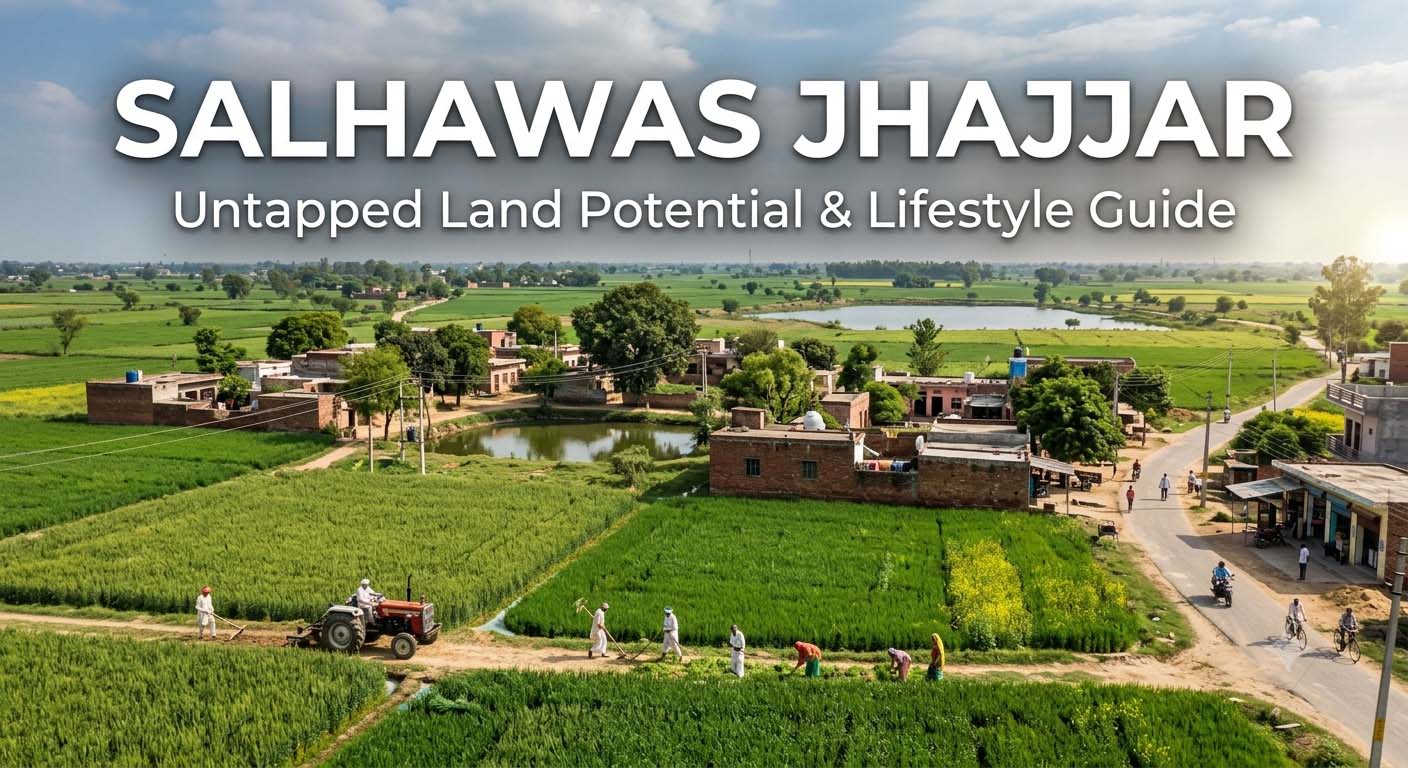
Salhawas is a major village and an administrative centre of the Salhawas block and sub-tehsil. At present, the administration of the Jhajjar district treats Salhawas as one of the development blocks and the only sub-tehsil of Jhajjar district. Earlier census records have mentioned Salhawas under the Matanhail administration block. Thus, prospective land purchasers should take care to find out the current revenue jurisdiction while seeking documents related to their land transactions. Salhawas Jhajjar is a major rural area and the administrative centre of southern Jhajjar district, Haryana. This locality is famous for agricultural land, individual housing units, essential public amenities and connectivity to the towns of Kosli, Matanhail, Jharli, Rewari and Jhajjar town. Unlike the highly developed urban block, Salhawas is a comparatively less developed and community-oriented locality. The market for real estate at this location is mostly driven by the agricultural lands, residential plots, individual houses and small roadside commercial establishments. The total area covered by Salhawas is about 1,471 hectares, and the 2011 census recorded a population of 5,962 people belonging to 1,165 households. Agriculture is one of the major activities along with education, government sector, local trade and industries in the vicinity. Population and infrastructure figures may have changed since the 2011 Census. Buyers should verify current records with the relevant local authorities before making a property decision. Salhawas are strategically situated between the Jhajjar, Kosli, Matanhail, Jharli and Rewari belts. The village is situated on the Jhajjar-Kosli Road and makes it easy for the people to move around to the nearby markets, schools, administrative offices, railway stations and employment areas. The major strength of the area is the convenience of being in the vicinity of the region rather than metropolitan conveniences. Most of the day-to-day necessities can be met locally, and the bigger requirements can be fulfilled at Kosli, Jhajjar and Rewari. Salhawas can be practical for: Families with an inherited or professional link to the locality Farmers owning agricultural lands Educators, medical professionals, and government employees stationed nearby Local small traders supplying villages around People who are moving to Matanhail, Jharli, Kosli, or Jhajjar People interested in purchasing bigger plots away from the city The distances are estimates and can be different depending on the chosen route, starting village, and traffic situation. Nearby settlements are Bithla, Dhakla, Nilaheri, Humayupur, Birar, Bhindawas, Niwada, and Amboli. Salhawas rely mostly on road transportation. Both the bus terminal and trade centers are located near Jhajjar-Kosli Road. Buses, taxis, private cars, motorbikes, and farm machines form the most widely used means of transportation. Various bus routes linking various towns like Dhakla, Subana, and Chhuchhakwas serve on the wider route of Kosli-Jhajjar. Nonetheless, the level of the services offered may not be as frequent as in the cities. Those who use these transport services on a daily basis for work and educational purposes ought to check the schedules and last return time. The Jhajjar district comes under the National Capital Region (NCR), and it is linked with other regional highways through routes like NH-352 and NH-334B. However, the Salhawas area is not a metropolitan commuting suburb. The travel duration needs to be considered in peak hours for any regular trips to Gurgaon/Delhi. The real estate sector in Salhawas Jhajjar is mainly land-oriented. Deals normally include agricultural land, residential land plots inside or outside the village abadi, standalone buildings, and small commercial establishments on busy streets. There isn’t much of an apartment or gated community housing market in the region. Potential buyers can expect to come across individually-owned land, agricultural lands, village houses and roadside shops rather than large multi-story building complexes. Demand is influenced by: Residential norms for locals Usage for agriculture purposes and land consolidation Road frontage and commercial presence Nearness to the main bus stand Proximity to Kosli and Jhajjar Employment activities near Matanhail and Jharli Availability of electricity, water, and all-weather access road 1. Agricultural Land – Agricultural land makes up one of the significant segments in the local property market. Classification of parcels could vary based on irrigation, cultivation, and revenue details. While purchasing, it is essential for the buyer to ensure khasra no., area, share of ownership, possession, mutation, irrigation, and approach road. 2. Residential Plots – Residential plots may be found within the existing village settlement, extension of abadi, and adjoining road linkages. Usability of plot varies based on the type of land, width of approach, drainage facilities, and suitability for residential construction. 3. Independent Houses – Village has self-built independent houses in various sizes and ages. The old houses need to be verified for structural conditions, boundaries, passageways, drainage, and utility linkages. 4. Commercial Properties Adjacent To Roads - Such properties include shops, workshops, centers of services, storage areas, and even mixed-use properties. The commercial value of these properties is highly dependent on factors such as road frontage, traffic flow, parking, and land use. 5. Rental Properties - The supply of rental properties in these areas is less formal and smaller than that of cities. Some rental properties include independent floors, rooms, small houses, and even shops. There will be demand for such properties from families, teachers, medical personnel, small traders, and workers from nearby areas. The Jharli region is home to large scale power generation projects such as Indira Gandhi Super Thermal Power Project and Mahatma Gandhi Thermal Power Project. Though these projects provide employment opportunities to local people and contractors, purchasers must know that the existence of these projects does not mean that property prices will rise. For anyone who plans to purchase land near the industrial belt, a physical survey for traffic movements, roads, air, noise, drainage, and land usage must be done. Salhawas provides essential village-level facilities, while higher-level education, advanced healthcare, large shopping centres and specialised services are concentrated in nearby towns. The H.D. Senior Secondary School is an English medium co-ed school that comes under CBSE board affiliation. However, parents should confirm the latest curriculum, mode of transport, admission dates, and senior secondary courses from each institution separately. The Primary Health Centre caters to general health needs; however, in case of an emergency, it may be necessary to visit either Matanhail, Jhajjar, or Rewari. It is advisable to ascertain the nearest 24-hour hospital and ambulance service ahead of time, especially when it comes to elderly people. The branch of the bank is situated close to the central bus stop located at Jhajjar-Kosli road, which is a reminder of the importance of the place as a servicing point for the neighboring villages. Salhawas does not have a major shopping mall. Residents generally depend on local markets for everyday requirements and travel to larger towns for branded shopping, multiplexes or family entertainment. BMG Mall is one of the better-known organised shopping and entertainment destinations in Rewari. Travel time can vary considerably according to road conditions. Religious activity is centred on village temples, local shrines and community events. Larger temples can be visited in Kosli, Jhajjar, Rewari and surrounding villages. Visitors should confirm local directions, access and festival timings with residents, as smaller religious places may not have fixed public schedules. Formal urban parks and large sports complexes are limited within the village. Recreation is more closely linked to school grounds, community spaces, open fields and nearby district-level facilities. Open agricultural land should not automatically be treated as a public recreation area. Visitors must respect private ownership, crops and local access restrictions. Salhawas does not function as an urban club or nightlife destination. Social life is primarily organised through village institutions, religious functions, schools, family events and community gatherings. Practical options include: Halls of villages Schools and Institutions ground areas Banquet area in local area Sports facilities at Kosli & Jhajjar Hotels in Rewari Community activities done by local institutions Residents seeking gyms, indoor sports, swimming facilities or formal membership clubs will generally find more choices in Jhajjar or Rewari. The local area features farming land, private farms, and countryside event facilities. But, the existence of an agricultural property does not necessarily mean that there is approval for any hospitality, event planning, or building on a farm. Before purchasing property for farmhouse use, verify land classification, permitted construction, approach road, fire safety, water supply, electricity load, parking and commercial-use approvals. The local eating places are mainly provided by small restaurants, confectionaries and dhabas on the roadside. A more diverse range of hotels, restaurants, banquet halls and food joints can be found in Jhajjar and Rewari. Travellers should check recent reviews, room availability, event schedules and late-night food service before visiting. Salhawas is much quieter and not as crowded compared to big cities. There is an impact of agriculture, village markets, school systems, and other institutions on the surroundings. Individually owned houses tend to provide more room compared to flats in cities. But sometimes people have to go far for specialized medical care, further education, organized recreation, quality shopping, and some professions. There is public transport but having one’s own car makes life much easier. People moving here from the city need to consider: Bus frequency Proximity to schools and work places Connectivity through mobile phone and Internet Electrical power availability Source of drinking water Drainage during monsoon System for waste collection Home delivery services available Medical help availability Road condition at night Such a place would suit people who appreciate spacious environments, community living, and private property. Such a locality is unlikely to suit those who are seeking urban-style transport services, flat living facilities, nightlife, or direct access to business hubs. Verify Ownership Chain - Review previous sale deeds, proof of succession, partition papers and the identities of all the owners. In case of joint ownership, the sale should never be made on a verbal assurance of any co-owner. Match with Khasra and Revenue Documents - Review the jamabandi, khewat, khatauni, khasra number, mutation papers and the total share in the land. The size stated in the deed should match the revenue documents. Verify Physical Possession - Sometimes physical possession is not equal to revenue possession. Visit the place, meet the neighboring owners and verify the ownership of the particular piece of land for sale. Arrange Proper Survey - In case of an open plot of land, ensure the proper demarcation. It should not be just marked by temporary marks, trees, tracks, fencing or a sketch map. Examine the Approach Road - Verify the existence of an approach road of the land. Sometimes it may have a track passing through somebody else’s land, which might not always be legal. Verification of the Land Use - See whether the land falls under agriculture, residential, commercial, gair mumkin, or the village abadi. The land that is used for agricultural purposes cannot be advertised for sale in the name of residential or commercial plot without the permission. Building Permissions Check - Before you construct the house, shops, warehouse, or event venue, check the construction guidelines, land use conditions, and permissions. Check on Acquisitions or Road Widening Proposals - Inquire whether there is any road widening proposal, government project, utility project, controlled area, acquisition proposal, or development restrictions related to the land. Check Loans or Court Cases - See whether the land is mortgaged, attached by the court, involved in family litigation or burdened by government charges. Verification of Electricity and Water - Get details of sanctioned electricity connections, transformer capacity, underground water, drinking water availability, and utility cost for developing a raw plot. IInspect Drainage and Ground Level - Preferably do this in the rainy season. Lower lying areas will have problems like water logging, accessibility or costly filling. Comparison Between the Collector Rate and Market Rate - The collector rate is just an indicator for the registration purposes and not a guarantee for the sale. Compare several market sales and see how one property is priced differently. Cost of Purchasing the Property - The buyer should consider stamp duty, registration costs, legal documentation fees, brokerage, mutation costs, demarcation and other related building permits. Rent Agreement Terms Should be Written - The rent agreement must include terms like rental price, security deposit, repairs, payment for electricity and water consumption, duration and other commercial uses. Professional Advice from Other Sources - The seller’s broker or even the document writer is not to be taken as the sole advisor by the buyer. Before making any substantial token payment, independent advice is essential. Salhawas Jhajjar could be appropriate for those who have experience of rural land documentation, family or job links in the area, or wish to live independently away from crowded cities. The locality may work well for: Households from the locality interested in building their own home Farmers keen on merging their agricultural lands Small-scale traders providing services to the villages around People working near Matanhail, Kosli, and Jharli Purchasers with the potential of keeping the land without relying on its resale Retired people having relatives in the locality Purchasers wanting land facing the road to start their small business It may not be ideal for: Daily travelers to central Delhi or Gurugram Buyers expecting fast profits from speculation Individuals relying on frequent use of metro or city bus transportation Families needing instant access to top hospitals and international schools Buyers looking for luxurious apartments, clubs, or community features Investors who cannot physically check rural documentation records Salhawas Jhajjar is a well-known rural locality having administrative significance, farming facilities, basic social amenities, and reasonable road connectivity to reach places like Kosli, Matanhail, Jharli, Jhajjar and Rewari. Its main advantages are its relatively open environment, possibility of purchasing independently owned properties, availability of local facilities, and access to nearby regional hubs. Its disadvantages include limited availability of organized housing, reduced availability of urban facilities, infrequent public transport services, and the necessity of traveling for availing specialized medical, educational and high-end shopping facilities. This place is suitable for agricultural lands, independent home plots, individual homes, and local commercial ventures. But all transactions should be made based on proven ownership, definite boundary details, road accessibility, lawful land use and rational comparative pricing. What is the Pin Code for Salhawas? The postal code is 124146. What type of place is Salhawas - village, block or tehsil? Salhawas is a village and also acts as the headquarter of a development block. As per current information, Jhajjar district administration treats Salhawas as sub-tehsil instead of tehsil. What was the population of Salhawas in the 2011 Census? The population of the village in the 2011 census was 5,962 comprising 1,165 households. The literacy rate is approximately 76.09%. What is the nearest railway station of Salhawas? Railway stations like Kosli and Sudharana are amongst some of the nearest railway stations. Jharli station can also be an alternative depending upon destination and starting point within the village. How much is the distance between Jhajjar city and Salhawas? Distance by road is around 30-36 kilometers but it may depend upon the actual route and starting point within the village. Is there good road connectivity in Salhawas? This village is located on Jhajjar-Kosli Road. There is connectivity through roads towards places like Kosli, Matanhail, Jharli, Jhajjar, and Rewari. Personal transport becomes handy as public transport services may not be available at regular intervals. Is there any agricultural land in the locality? There is quite some amount of agricultural land in the locality. The rates and usability depend upon classification, irrigation, accessibility, location, ownership records, and possession. Is Salhawas good for real estate investment? It could be a good choice for those who are interested in investing in agricultural land, building their own house, or having a property in the countryside. This property should not be seen as an assured source of growth. Are there any educational institutes or healthcare centers near the property? There are several educational institutes and a Primary Health Center in the village itself. There are other healthcare and education centers in Matanhail, Jhajjar, and Rewari. Are there any malls and entertainment centers near the locality? There is no big mall in the village. People usually visit Kosli, Jhajjar, and Rewari for entertainment and shopping purposes. Is it a good locality for commuting to Gurugram/ New Delhi? Travel is possible via roads occasionally but this locality will not be a good choice for metropolitan commuting.Salhawas Jhajjar Overview
Locality Snapshot
Location Advantage
Nearby Villages and Localities
Connectivity and Transport
Major Connectivity Points
Property Market Overview
Common Property Options
Nearby Residential, Commercial and Employment Nodes
Social Infrastructure
Schools and Education
Healthcare
Markets and Daily Needs
Nearby Malls and Organised Shopping
Nearby Temples and Religious Places
Nearby Parks and Sports Facilities
Nearby Clubs and Community Spaces
Nearby Farm Houses and Day-Out Options
Nearby Hotels and Restaurants
Lifestyle and Living Experience
Things to Check Before Buying or Renting
Who Should Consider This Locality?
Summary
Frequently Asked Questions