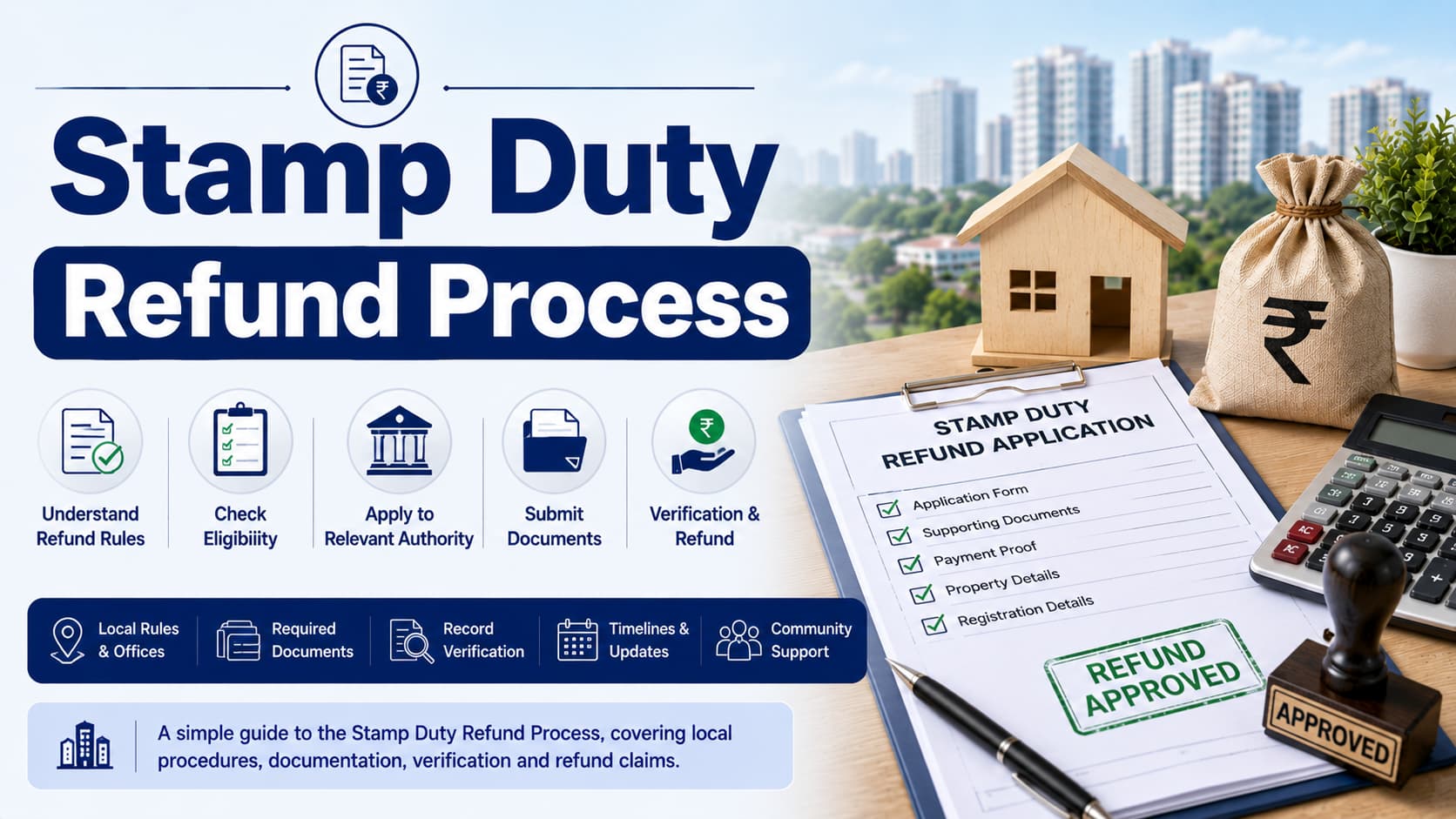
Stamp Duty Refund Process: The Complete 2026 Guide to Getting Your Money Back
The property transaction fails. The seller backs out, financing is declined, the title is found to be invalid, the buyer withdraws, and the developer goes bust. The important thing that most people only realize after it occurs to them is that by the time the transaction fails, the person concerned would have already paid the stamp duty, which is lakhs of rupees lying with the state government on an incomplete transaction.
It can be recovered. Most people never do, just because they are unaware of the deadline.
This guide covers the entire Stamp Duty Refund Process – when refunds are possible, what you will lose to processing fees, the countdowns already underway, and why the application submitted in month five will be rejected, while the same application submitted in month five minus a day will be approved.
When Can You Claim a Refund?
Eligibility for refunds comes under Sections 49, 50, and 52 of the Indian Stamp Act, 1899, as amended state-wise. Roughly speaking, there are four such classes.
Spoiled Stamps (under Section 49). The stamp is spoiled, misprinted or becomes unusable before execution of the document. This will include electronic certificates where the wrong party name has been printed or where the description of the instrument is wrong because of printing mistakes.
Unused stamp (Section 52). The duty is paid, the certificate is issued and the transaction never takes place. This class is the most voluminous — these are aborted deals before they could be registered.
Excess amount paid. You have paid more than you should have. This is normally due to the wrong classification of the locality or omission of the depreciation factor or valuation error. The excess paid can be refunded on the new valuation.
The fourth type is the trickiest one, with the laws varying widely from state to state.
The Deadline That Kills Most Claims
And here’s the one key point that you need to know throughout this entire document.
In most states, there’s a six-month limitation period from the date of the e-stamp certificate. This applies to Delhi, Uttar Pradesh, Haryana, and a few other states. Miss that deadline and your claim will be dead – not just compromised or subject to penalties, but dead.
There is an exception: Maharashtra. The relevant provision under Section 48 of the Maharashtra Stamp Act provides that the limitation period is six months from the date of the cancellation deed, and in Maharashtra, application for refund can be made up to two years from the date of the instrument in certain cases, for example, if the agreement is cancelled by a registered cancellation deed.
Six months in Karnataka. Six months in Tamil Nadu. Six months in Gujarat.
The catch is subtle. They wait for the agreement to be formally cancelled. They negotiate with the vendor. They try to save it. They talk to their lawyer in month four. They apply in month seven.
The clock starts from the stamp certificate date in most states — not from the date the deal died.
If your transaction is wobbling and you've already paid duty, calculate your deadline from the certificate date today, and work backwards. Do not wait for certainty.
What You'll Actually Get Back
Not all of it.
Most states retain a percentage as processing charges:
The Maharashtra tax rebate system is significantly more favorable than that of Delhi. The system provides for a rebate of 1%, with a maximum of ₹1,000 per year. This implies that the individual who paid ₹18 lakhs on a ₹3 crore property in Mumbai gets a tax rebate of ₹17,99,000.
This difference should not be ignored before taking the decision of claiming the refund.
What Isn't Refundable
Charges for Registration: Where registration has been done, the state provides the service and retains the charge. In case where the instrument was never registered, the registration charge can be recovered.
Corporate and Municipal Duties: This charge is refundable in addition to the stamp duty in all states, though this may vary from place to place.
Interest: No state gives any interest on duty that is refundable even if it remains for an indefinite period of time in the hands of the state; in case of ₹18 lacs kept for eight months, you have lost nearly ₹1 lacs in terms of opportunity cost.
Legal Charges, Commission and Drafting Charges: These do not go back.
The Stamp Duty Refund Process: Step by Ste
Step 1 — Establish Your Deadline
Before anything else, find the issue date on your e-stamp certificate and count six months forward. Write that date down. Everything else is subordinate to it.
Step 2 — Cancel the Transaction Formally
In cases where there is an execution of a deed, you would need a cancellation deed executed between the two parties. Such an instrument also comes under duty and usually attracts nominal duty – say between ₹100 and ₹500.
In cases where the deal had failed prior to any execution, it may be sufficient to have an affirmation from the other party stating that the transaction is now concluded.
However, where the seller is either unavailable or unwilling, you need a court order or a legal notice on record establishing that there has been no failure on your part in getting the deed executed. This is one area where refund applications tend to run into problems.
Step 3 — Apply on the State Portal
Most states now accept applications online.
Delhi: Via the Revenue Department/DORIS website to the Collector of Stamps of the respective district
Maharashtra: Via the IGR Maharashtra website where there is a special refund token module
Karnataka: Via the Kaveri online services portal
Uttar Pradesh: Via the Stamp & Registration Department website
Tamil Nadu: Via TNREGINET
The procedure followed in Maharashtra is highly digitized. You create an e-refund token, file documents, and monitor your application up to the point of disbursal. All other states, barring few exceptions, need you to come in person regardless of portal advice.
Step 4 — Submit Documents
The standard bundle:
Original certificate of e-stamp — not a duplicate but an original certificate
Form of claim for refund
Registered cancellation deed or document proving non-completion of transaction
Original agreement/sale deed, if any
Bank account particulars with a cancelled cheque
PAN number and Aadhar card of the applicant
Affidavit for unused stamp and non-completion of transaction
Proof of payment — bank passbook or challan
Indemnity bond, wherever required
Order from court, if any
The original certificate requirement catches people out constantly. If the broker kept it, the developer holds it, or it went missing during the collapse, you have a problem before you start.
Step 5 — Verification
The Certificate is checked by The Collector of Stamps on the basis of records maintained at SHCIL to see whether the transaction took place or not.
In case the document has been registered and later cancelled, the verification process is more complex as the records of Sub-Registrar need to be checked.
Step 6 — Order and Disbursement
The Collector passes a refund order. Disbursement follows by NEFT or RTGS to the account provided.
Realistic timeline: three to six months from a complete application. Maharashtra and Karnataka are faster. Delhi and UP are slower. Applications with any documentary gap can drift past a year.
Worked Example
A buyer paid duty on a ₹2.4 crore Delhi property, registered in a woman's name. The seller's title turned out to be defective during the buyer's due diligence, and the deal collapsed six weeks after the e-stamp was issued.
Refund calculation:
Along with nearly five months of lost interest on ₹14.4 lakh, and also the fee that the lawyer must have taken.
It’s not about how refunds are evil. It’s about paying stamp duty before completing your due diligence, which can be a costly affair. The cut in stamp duty by ₹1.2 lakh could easily have been avoided by conducting title due diligence first and then getting the certificate.
If you’re looking to buy a property and need some information about the location before making any decisions, we provide detailed guides for each of the localities. The most common choice for buyers from NCR is Sector 12, Gurugram.
The Seller Won't Sign the Cancellation Deed
Most typical barrier. Both signatures must be provided for a registered cancellation deed, and a seller who has taken an advance and is refusing to pay it back does not have an interest in cooperating.
Alternatives: serve a notice, which will be documented, and sue for a declaration and cancellation case. Thus, the three months procedure turns into years of litigation. Most buyers simply forget about their duty to pay.
Preventive measures: arrange the deal in such a way that the buyer pays his/her duty only after he/she verifies the title and secures the advance.
The Deal Died After Registration
After registration of a deed, the transfer takes place and cannot be undone except through a registered cancellation deed or a reconveyance, which in some states, is considered a new conveyance liable to payment of duty at full rates.
You therefore pay the duty when you go in, pay the duty when you come out, but get back only 90% of what you paid the first time. Your position is much worse than doing nothing.
In Maharashtra, there is more leeway and this is one reason why its refund system is considered the best in the country.
The Developer Went Under
A withdrawal from a delayed project under RERA gives the home buyer the right to receive his money back that he paid to the promoter with interest. But stamp duty is paid to the state, not to the promoter, and RERA has nothing to do with it.
Your case for the consideration will be pursued under RERA, while the Collector of Stamps will be approached for the duty separately. Two separate forums with two separate schedules, and the six months' period for the duty claim is ticking when RERA process is crawling.
File your application for the refund of the duty now; do not wait until the end of the RERA case.
The E-Stamp Has the Wrong Name
This is fixable, and cheaper than a refund. All states allow for either correction or issuance of a new certificate with respect to the old one, in the limitation period. This should be treated as a correction rather than a refund, so that there will be no 10% discount.
Why Applications Get Rejected
Case filed beyond the period of limitation. The biggest reason for this case. No discretion, no appeal on merit.
Original certificate cannot be shown. Photocopies cannot be considered.
There was no cancellation process. It is not cancellation of a deed because a WhatsApp chat says so.
Certificate already used. In case of the certificate being affixed to any registered document, it would have been exhausted.
Inconsistency between certificate and form. Mismatch of names, amount or description of property.
Incomplete banking details. Irrelevant, routine and prolongs the whole process.
Applicant is not the payer of duty. It can be refunded only to the person who has paid the duty.
Prevention Beats Cure
Each hour you put into the Stamp Duty Refund Process is wasted time. These structural solutions:
Complete title due diligence before creating the e-stamp. Certificate of Encumbrance, chain of title search, litigation search, and approval verification. You need to create the certificate as your final step, not the first.
Have your loan sanctioned in writing before paying the stamp duty. Conditional sanctions fall apart all too often.
Pay your stamp duty close to the date of registration. On the same day is ideal. The time from the payment to registration is risk alone.
Design your contract to allocate stamp duty risk. It's a valid provision, but almost always missing from agreements.
Know the terms that you are agreeing to. An agreement to sell vs. a sale deed will lead to different outcomes, and at different stages of the process – we discuss this further in our Sale Deed vs. Sale Agreement guide.
Don't give away the original certificate. Not to the broker. Not the developer. Yo
The Bottom Line
The SDRP itself works, but it runs on a clock that no one knows about. In most states, six months from the certificate date – not from the date your deal expired, nor the date you gave up hope.
A 10% loss from processing fees can be expected in most states; in Maharashtra, this will be just 1%. It will take three to six months for payment to be disbursed, and there will be no interest accrued while the money has been lying with the state government. The entire process will be delayed if the seller refuses to sign the cancellation deed or if the original certificate cannot be found.
The right thing to do lies upstream – verify title, arrange the loan, and get the e-stamp certificate at the last possible moment.
Frequently Asked Questions
1. What's the deadline for claiming a stamp duty refund?
Six months after the date of the e-stamp certificate in most states – Delhi, UP, Karnataka, Tamil Nadu, Gujarat, Haryana. Exception being Maharashtra - Six months after the registration of the cancellation deed which can be extended up to two years from the date of the instrument in certain situations. The time period begins from the date of the certificate and not from the date of failure of your transaction.
2. Will I get the full amount back?
No, most states keep 10%. Maharashtra keeps 1%, with a limit of ₹1,000 – that is, where the buyer paid ₹18 lakh for the duty, he will recover ₹17,99,000 in Maharashtra but only ₹16,20,000 in Delhi. Interest is never paid by any state, hence you lose out on that as well.
3. Are registration charges refundable too?
Only when there had been no registration at all. Where the Sub-Registrar registered the document, the services had been performed and the fees collected. Where the document was not brought, the registration fee would generally be recovered along with the duty. Corporation or Municipal Duty comes after Stamp Duty.
4. What if the seller refuses to sign the cancellation deed?
This is the most frequent impediment, and it is an unpleasant one. Both parties need to sign a registered cancellation deed, but when your seller has money from you in reserve, he has no reason to help. All that is left is filing a legal notice and then proceeding with a lawsuit for declaration and cancellation, thus turning a simple three-month affair into years-long proceedings.
5. How long does the refund actually take?
It takes three to six months from the time of completing the application form. The states of Maharashtra and Karnataka take less time and are better digitised. But the states of Delhi and UP take more time. Any deficiency in documentation may result in delays for more than a year.
6. I lost the original e-stamp certificate. Can I still claim?
Your problem is grave. The original is mandatory; photocopies are not accepted. In case it is with the broker, developer, or lawyer on your behalf, you must obtain it. This is the reason for keeping it with yourself.
7. My builder delayed the project and I'm withdrawing under RERA. Does that cover my stamp duty?
No. RERA gets you the refund of what you had paid to the promoter, along with interest. Stamp duty was paid to the government, which does not come under the purview of RERA. You will be approaching two different forums at two different points in time, and during the six months period for stamp duty refund, your RERA case will just be dragging.
8. My deed was already registered before the deal fell apart. Can I still get a refund?
It is much more difficult and not even worth the trouble. The reversal of the registered deed needs a cancellation deed or reconveyance, and some states consider the reconveyance to be a new conveyance, and thus the duty is levied once more. You pay when you buy and again when you sell, but get back 90 percent of the former payment.
9. The e-stamp has a typo in my name. Should I apply for a refund?
No – just do it as a correction, not a refund. Most states allow a correction or new certificate in exchange for the original within the period of limitation, with the original having to be surrendered. Refunding will unnecessarily cause you to lose out on the 10 percent deduction.
10. How do I avoid needing a refund at all?
The issuance of the electronic stamp certificate should be done as late as possible within the timeline of the registration process, preferably on the same day. Conduct title search and litigation verification before paying any amount. Make sure that you have written down the loan sanction letter in writing without being conditional in nature. Include the provision that the responsibility of duty failure lies with the seller.