Introduction
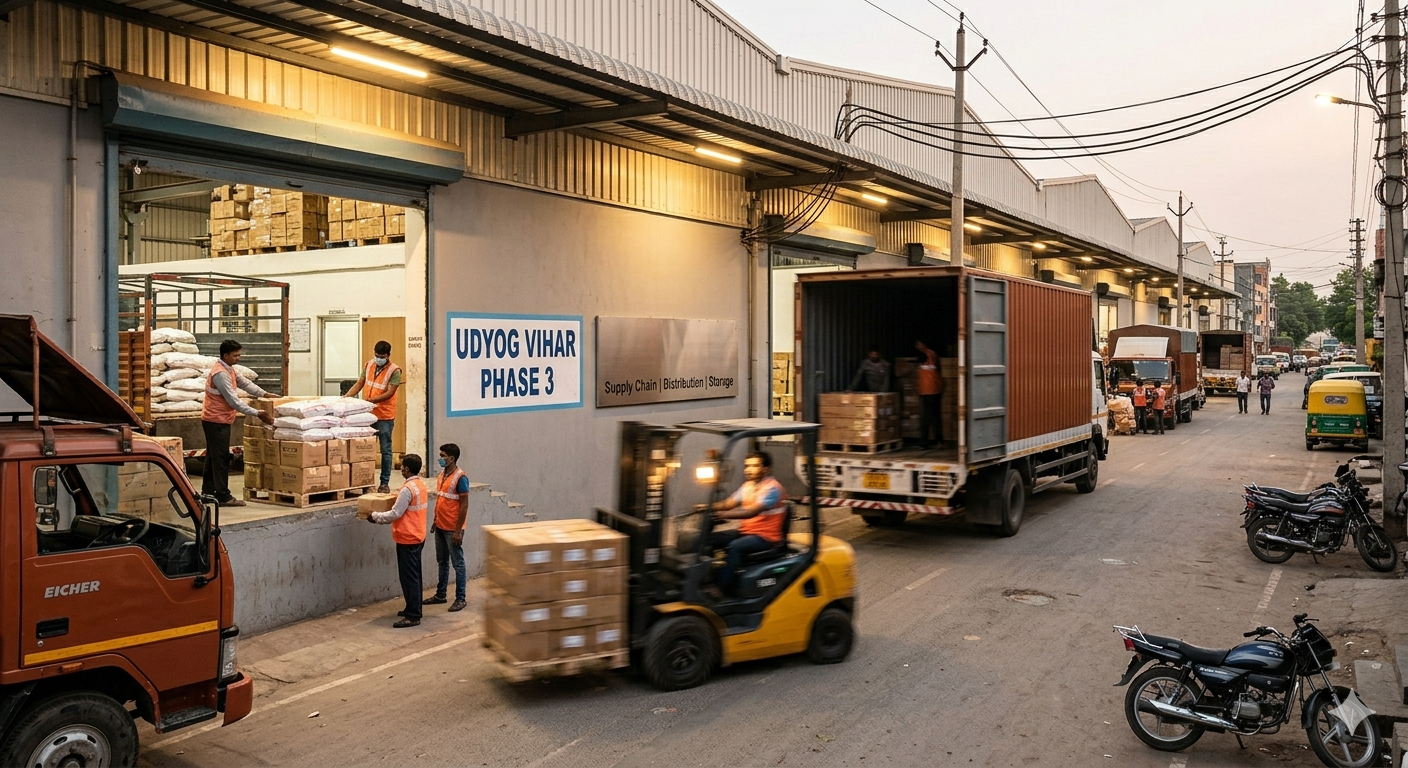
Phase three of Udyog Vihar represents an intermediate stage of industrial development that links the traditional industrial system in previous phases to the more systematic industrial system in subsequent phases in Gurgaon. It can be described as an intermediate industrial segment that brings together various industrial elements like manufacturing, warehousing, and services under one roof.
Unlike other production areas, this phase indicates gradual development and change towards organized industrial activities. It hosts various enterprises, such as small and medium enterprises alongside logistical and distribution businesses. Such combination enables this phase to function both as a supportive zone for production and distribution centers.
This phase demonstrates change and development through time, adapting itself to the emerging needs, primarily focusing on storage, distribution, and supply chains management. This is why it can be said that Phase three of Udyog Vihar plays a crucial role by establishing a connection between industrial processes and the neighboring commercial-corporate areas in Gurgaon.
Finally, it is necessary to mention that there is a relatively higher degree of organization regarding the layout and design of this phase, which is not as disorganized as the previous industrial pockets in the area. The layout of this phase is much more
Industrial Positioning & Development Pattern
The positioning of this area in terms of industrial location marks an improvement from the basic traditional manufacturing location to a more systematic industrial location. The phase of development can be referred to as one that goes beyond the basic production process to incorporate other functions within the industrial setting.
From the beginning, the pattern of growth in the area has been somewhat similar to that of previous industrial phases; however, due to changing business requirements, it has led to the emergence of storage facilities in addition to the basic industrial activity of manufacturing. This has added to the diversity and flexibility of the industrial setting.
One of the factors that define the positioning of this area is the integration of both traditional and advanced uses of industry. Whereas manufacturing units have remained a major feature of the location, there have emerged businesses involved in logistics coordination, management of inventory, and even distribution.
Planning and development have also contributed significantly to the evolution of this phase of development. There have been units designed to offer storage facilities in addition to production.
Thus, on the whole, the phase of development can be considered a transition phase from basic manufacturing activities to
Business Activity Profile (Hybrid Industrial–Logistics Focus)
In this context, the business ecosystem is characterized by a healthy blend of manufacturing and logistics-oriented operations. In contrast to previous phases which were dominated by manufacturing activities, here we see that a wide array of operations involving storage, distribution, services, and light manufacturing take place.
A considerable portion of activity is accounted for by warehouses and storage facilities. These businesses rely on the area as a place to store their goods, manage the inventory, and facilitate their dispatch. In this regard, it becomes an essential link in the supply chain, facilitating easy connectivity between manufacturing and commerce.
The logistics and distribution services also form an important part. The transporters, delivery, and logistic suppliers all operate from this location. Such activities help to improve the efficiency of the operations and help to maintain the uninterrupted industrial process.
Apart from the logistics operations, the light manufacturing and assembly operations also function here. They consist of small-scale production facilities, packaging facilities, and assembly businesses operating in conjunction with warehousing and logistic services. This helps in creating a hybrid industrial operation model.
Service-oriented businesses also form an important part of the business activity profile. It consists of maintenance, technical services, and other service providers for industrial and logistic operations. This helps in ensuring that the operations are not interrupted by any logistical problem.
The business activity profile indicates the adaptive nature of the industrial activity. It consists of manufacturing, warehousing, and logistic operations, thus forming an important part of the Gurgaon distribution and logistic chain.
Workforce & Operational Structure
The structure of the workforce is more organized than that during the previous stages due to the diversified nature of the industries in this zone. In this case, there is the availability of logistics workers, warehousing staff, technicians, and other support staff members who work together to facilitate both production and distribution processes.
There are many shift operations within most of the firms within the zones because of the requirement for continuous flow of goods from different areas of operation within these firms. Extended working hours are common for most businesses.
One unique characteristic of the labor force in this location is its involvement in logistics processing. The workers have a hand in activities like inventory management, packaging, loading/unloading, and logistics coordination. In addition to that, skilled technicians and machine operators are responsible for light manufacturing and assembly processes taking place in the vicinity.
Regarding recruitment, the process is fairly flexible, utilizing both regular workers and contractual laborers. Operations such as logistics and warehousing depend on scalable labor, whereas technical functions depend on skilled and semi-skilled labor.
Furthermore, labor mobility is another distinctive attribute of the workforce. As the area enjoys connectivity to neighboring residential districts, it becomes easier for the workforce involved in industrial and logistical activities to commute from one place to another.
In summary, the workforce and operational process is well-organized and activity-based, combining both industrial and logistics purposes.
Infrastructure & Development Level
The infrastructure of this area indicates a more organized and improved industrial infrastructure compared to previous stages. It has been constructed with an aim to facilitate both the industrial production process and the logistics process. This infrastructure is therefore suitable for firms looking for both production space and logistics facilities.
In terms of internal roads, the infrastructure appears better planned and wider than the road networks in most other industrial pockets. These roads allow for easy maneuvering of transportation vehicles. This infrastructure is appropriate for business establishments requiring efficient transportation of goods.
The provision of utilities like electricity and water is more consistent in this infrastructure compared to previous infrastructures. These facilities enable continuous functioning of industrial and logistics processes. For instance, machinery and equipment used in industrial processing can function effectively.
An important feature of this infrastructure is that it can facilitate warehousing and storage processes. Most of the units are designed to incorporate storage and packaging zones into the manufacturing unit. Therefore, companies that require warehousing facilities can utilize this infrastructure effectively.
Although the infrastructure might not be modernized, it exhibits signs of gradual improvements compared to previous industrial infrastructure. This infrastructure allows for flexible operations of firms in various industries.
Logistics Advantage & Distribution Role
Logistics strength is another notable characteristic of this zone and therefore plays a vital part in Gurgaon's logistics network. The previous stages only concentrate on the production process, but this stage engages in the logistics activities such as warehousing, inventory management, and distribution.
A huge chunk of business activities focuses on warehousing, inventory management, and distribution of products to other destinations. Companies can store their merchandise here, manage their stock, and organize dispatch processes conveniently. As a result, it is ideal for businesses that need to deliver their products shortly after storing them.
Connectivity will contribute significantly to improving the logistics strength of this area. It is easy to access major road networks, allowing the transportation of goods without encountering any challenges during the process. It not only facilitates local distribution in Gurgaon but also the movement towards Delhi and other adjacent areas.
Other critical players like transporters, couriers, and supply chain providers enhance the distribution network. They enable the delivery of products from warehouses to final destination points, ensuring smooth operation even at night when other businesses close.
Finally, this stage acts as an intermediary link between industrial processing and consumer markets. It receives goods that come from nearby
Market Nature & Real Estate Trend
The real estate market in this particular region depicts the balance of industry that is supported by the demand created both by logistics and small-scale industries. It should be noted that the mere presence of warehouses and distribution activities brings a certain dynamic in the field of property use and demand.
Most of the properties found here include industrial and storage properties, as well as their mixed form. There is a preference for units that provide for the possibility of carrying out storage and packaging of products in one unit. Therefore, such flexibility of property use distinguishes this region from others.
It can be argued that there is constant demand for rental properties in this region, as the need for warehouse space is always present, especially during the distribution and management of inventory. Enterprises engaged in logistics and storage actively seek rental space, thereby ensuring constant occupancy of properties in this region. Such activity cannot be attributed solely to industrial units.
In terms of pricing, there is always demand for logistics and ease of use of properties. It is worth noting that the prices will not be higher than in other areas, as the value of properties is associated with
Investment Perspective
The investment profile of the considered area appears more well-rounded than in case with other typical industrial zones, given the fact that it benefits not only from the presence of industries but also from the increase in logistics demand.
First of all, this zone attracts investors thanks to high interest shown by companies in the warehousing, transportation, and delivery sectors. Companies related to logistics are always seeking locations that can provide accessibility and efficiency.
Another favorable condition is that there are no exceptionally high entry costs in this area in comparison with premium-industrial or corporate areas. They are slightly higher than those in earlier developed zones owing to improved infrastructure and greater logistics importance of the area.
The rental yield will be relatively stable because of continuous demand from both SME and logistics-related businesses. These companies tend to stay at one place for a relatively long time due to various benefits provided by the specific location.
Finally, the zone is expected to appreciate gradually thanks to constant interest shown by logistics operators and companies in general.
Advantages vs Challenges
This industrial park is endowed with an excellent combination of efficiencies and logistics advantages, although it also poses some practical drawbacks. The nature of its status as a combination of the two areas makes it much more adaptable than conventional industrial parks despite having some drawbacks associated with its infrastructure and traffic situation.
Advantages
Good logistics and warehousing requirements for constant business operation
A balance between production and logistics in the industrial process
A better infrastructural setup than the previous stages of industrialization
Continuous rentals from logistics and SME companies
Well-connected location with respect to business zones
Challenges
Peak hour traffic because of freight movement
Some deficiencies in infrastructure in some old pockets
Not an area for top-level companies/commercial activities
There will be little development on the higher level
Demand pressure may create shortage of space in future
Pros & Challenges Overview
Connectivity & Infrastructure Overview (10 KM Radius)
Connectivity and the infrastructure make it possible for industries to function well by enabling the easy access to basic facilities and work places in the neighborhood.
FAQ
1. Why is this zone well-known?
It is popular for its industrial units and logistical operations, which facilitate supply chain activities.
2. Which kinds of firms can be found here?
The common firms in this sector include warehouses, distribution firms, light manufacturing units, packaging firms, and logistics firms.
3. Is this zone fit for logistics activities?
It is fit for logistics operations due to the availability of warehouse facilities.
4. How does it differ from previous industrial phases?
It is better in comparison to the previous industrial stages because it provides an integrated system of production and logistics.
5. Is this zone good for investments?
The zone is appropriate for investors because of its stable rent income and moderate growth rate due to logistics demand.
6. What is the level of connectivity within the area?
The area has reasonable connectivity with major roadways and commercial zones nearby.
7. What is the labor force like in this location?
The labor force consists of logistics employees, technicians, warehouse staff, and other auxiliary employees.
8. Is the infrastructure up-to-date?
The infrastructure is moderately advanced compared to other phases, particularly for logistics and warehousing purposes.
9. What creates the demand for this area?
Logistics firms, storage demands, and small and medium-scale industrial activities generate the demand.
10. Why is this area significant for Gurgaon?
This area serves as an essential link between manufacturing and logistics/distribution networks.
Conclusion
What makes this location distinct is that it represents a balanced industrial logistics area that combines not only production but also provides support in distribution. Combining warehousing services with light manufacturing, the location becomes more dynamic when compared to industrial phases.
Firstly, the existence of logistics-related demand as well as industrial demand will make sure that the location is actively used by those who need effective organizational structure for their business operations. Secondly, the location provides excellent connectivity to major roads and other commercial areas.
As a real estate location, the property in question is very promising, providing solid opportunities for any investor seeking stable property. In addition, this is one of the locations that can be used for effective business operations as well.
Overall, the location in question can be considered as a crucial element connecting the industrial and logistical components of the region’s business landscape.