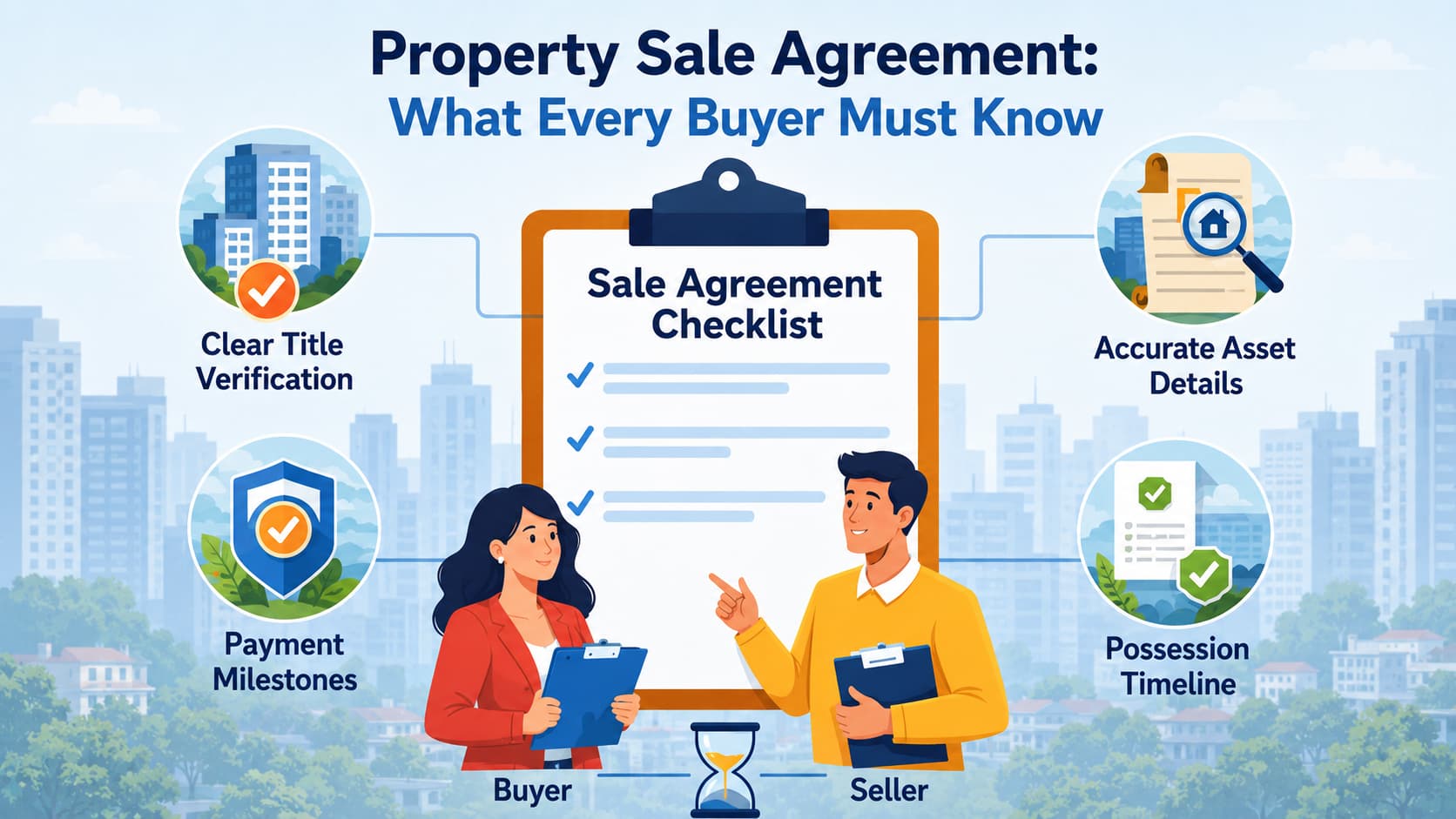
Purchasing a house is one of the most important decisions that most Indians ever take in their life and the sale agreement is that document that decides those terms and conditions for you well before transferring the property to your name. But most buyers just give a quick glance at the document assuming that its signing is just another formal step towards getting the documents registered. That’s the wrong approach. Because every term and condition which has been promised verbally by the seller, agent or developer finds a mention in this document. And if it doesn’t find a mention in the agreement, then it means that it never existed.
What Is a Sale Agreement?
The Sale Agreement is an instrument between a buyer and seller documenting their intent to conclude the property deal on agreed terms. It states the consideration, payment plan, timelines and conditions that need to be met by both sides prior to the transfer of property rights.
It is vital to distinguish between this contractual arrangement and the transfer of title. You become the legal owner only once the agreed transaction is completed. It is just a promise saying: "provided that both parties meet their obligations, ownership will pass on those terms and within the specified time limit". The transfer occurs later via a different instrument - the Sale Deed, registered at the local sub registrar's office.
At the same time, this contractual document is a legal document that can be enforced. Should one party breach its terms and conditions unjustifiably, the other can claim for relief according to the contract laws, ranging from specific performance in some cases to claiming for compensations. That is why the wording of the agreement is of crucial importance.
What Should the Agreement Include?
However, there is not one standard format for all cases; the specific clauses to be included will depend on what type of real estate property you want to purchase and the relevant legal framework prevailing in your state. Having said that, there are common elements in a good contract, which include:
Names, addresses, and powers of attorney in case of individuals acting through the power of attorney.
Detailed description of the property to be purchased including its address, the area in which it is situated, the plot number, and floor/unit number.
The total consideration to be paid along with the token or advance amount.
Time period up to which the agreement is binding on both sides till the registration of the deal takes place.
When and how will possession take place.
Title deeds, receipts for taxes, NOC, and other documents to be delivered by the seller.
Representations and Warranties of the Seller in regard to disputes, pending litigation, etc.
Duties and charges such as stamp duty, registration charges, society transfer charges, or any pending utility bill charges.
Consequences of the default of performance.
In case of termination of the agreement, what amount of the token or advance would be refunded back to the buyer.
Dispute resolution procedure.
Not every transaction needs every clause listed here, but skipping the ones that do apply to your deal is where trouble usually starts.
Important Clauses Buyers Should Read Carefully
The checklist gives you an idea of what to look out for while the rationale gives the reasons why they are crucial. Payments should be linked to verifiable events rather than arbitrary dates so that you do not pay ahead of schedule. The possession date clause should contain a firm date and a penalty for delay in delivery of the property by the seller; else the term reasonable time may be taken to mean several months. Title and ownership representation clause is the legal statement by the seller that he has the authority to sell the said property and hence the more detailed it is, the safer for you.
Clause for encumbrances and preexisting loans becomes very important since there are cases of resale properties where the property is still mortgaged and hence the contract needs to have clear terms for settlement of the mortgage in order to avoid transfer of the charge to your name. Clause for defaults is important to know the consequences in case there is delay in payment or delivery by the parties and the disposition of the advance.
The other protections involve force majeure provisions and provisions about handover, the precise items to be handed over such as fittings, fixtures, parking spaces and documentation. Lastly, a dispute resolution clause ensures that if there are future disputes, neither party goes through a costly and lengthy litigation process.
The danger in such clauses lies in vague language. A clause stipulating that the seller will "clear dues in due course" does not protect anyone. But if it includes the exact amount, the deadline and the consequences of defaulting, then you are protected.
What Should a Buyer Check Before Signing?
Before you sign anything or hand over any money, work through this practical checklist:
Establish the identity and authority of the seller. Is the deal being transacted between you and the owner himself or his representative? In case it is with the latter, establish the validity and relevance of the power of attorney in respect of the transaction.
Check title deeds. Ensure that the sale deed as well as other deeds evidencing the chain of ownership over several transactions is clear.
Establish the existence of any encumbrance or mortgage on the property. This can be done by obtaining an encumbrance certificate.
Find out the status of the payment of taxes/maintenance fees. Obtain latest tax receipts as well as a no-dues certificate from the housing society/municipality.
Check the approved plans. In case of under construction/newly constructed property, ensure that the plans match those which have been approved.
Verify Possession Status. Does the seller have the ability to deliver the vacant possession within the promised period?
Match Physical Attributes to Documentation. It is imperative to carry out a site visit to verify that everything matches the documentation.
Verify the presence of all legal co-owners. If there are co-owners in the transaction, all of them must sign the agreement.
Verify who can receive payments. Payment must be made only to the legitimate owner or authorized representative, not intermediaries.
Make sure to get proof of every payment. Every payment made must be documented.
What Documents Are Commonly Involved?
It makes sense to distinguish between two kinds of documents. The first type is documentation that is needed for preparation and execution of the agreement itself – identity and address proofs of both parties, their PAN information, and a draft of the terms being negotiated. The second type is documentation that a purchaser needs to look at on his own account in order to perform due diligence – title document or sale deed of the seller, his previous ownership history, an encumbrance certificate, receipts of last tax paid, society no objection letter and, if there is any, approved building plans of the project.
The list of specific documents will depend on the state, type of property (residential, commercial, plot or builder’s apartment), presence of more than one owner, inherited property, and any ongoing loans on the property.
When Should It Be Signed, and What Happens After?
It is common for the purchase agreement to be signed only after there is consensus between the two parties in regards to the price, as well as other details. This will happen when the buyer has committed to paying the required advance amount. Although both parties may be bound to the contract and to the timelines, ownership of the property has not been passed on yet.
The steps that follow signing of the agreement will normally be: payment of agreed instalments by the buyer based on certain milestones, completion of outstanding due diligence by both parties, clearance of dues/loans on the part of the seller, and finally execution/registration of the sale deed which will transfer the ownership.
Sale Agreement vs Sale Deed
This distinction trips up a lot of first-time buyers, so it's worth stating plainly:
A sale agreement is a promise to transact on agreed terms. It doesn't transfer ownership.
A sale deed is the actual conveyance document. Once executed and registered, it legally transfers ownership from seller to buyer.
Consider the agreement as the blueprint, while the deed represents the building itself. All the conditions agreed to in the agreement such as the amount, time, and obligations must seamlessly translate into the deed. If there are discrepancies between the two documents, it should definitely be sorted out.
The Risk of Getting This Wrong
Very often, problems encountered by us do not arise from bad intentions but rather because of lack of details. No penalty clause accompanying the date of possession. A milestone of payment which depends on a non-specific description rather than a real stage. Title representation which wasn't confirmed by checking the real chain of ownership. All those details may seem insignificant at the time of signing and become very costly when something goes wrong.
Think about the situation of a buyer who pays a considerable amount of money in advance in accordance with the verbal promise that the seller will settle his debts before registration. If such a promise wasn't specified in the contract, then there is nothing a buyer can use in case his debt isn't settled and it comes to registration. It's similar to the problem of delays in possession. A builder or a seller who guarantees just "a few weeks more" verbally has no reason to hurry as there will be no consequences if he doesn't reach the deadline in the contract.
Although a properly drafted sale agreement will not protect against all disputes, it makes sure that the burden of proof is at the right place and provides both parties with an important written record. As we advise all buyers viewing listings from prooperty.com, a few extra days spent with a lawyer in examining the contract may prove to be very helpful, rather than signing under the pressure of the deadlines set by the seller. The piece of advice for all buyers from Prooperty team is always the same - read the contract and make sure you know how any possible mistake or misstatement will be fixed without using phrases such as "we'll deal with that later".