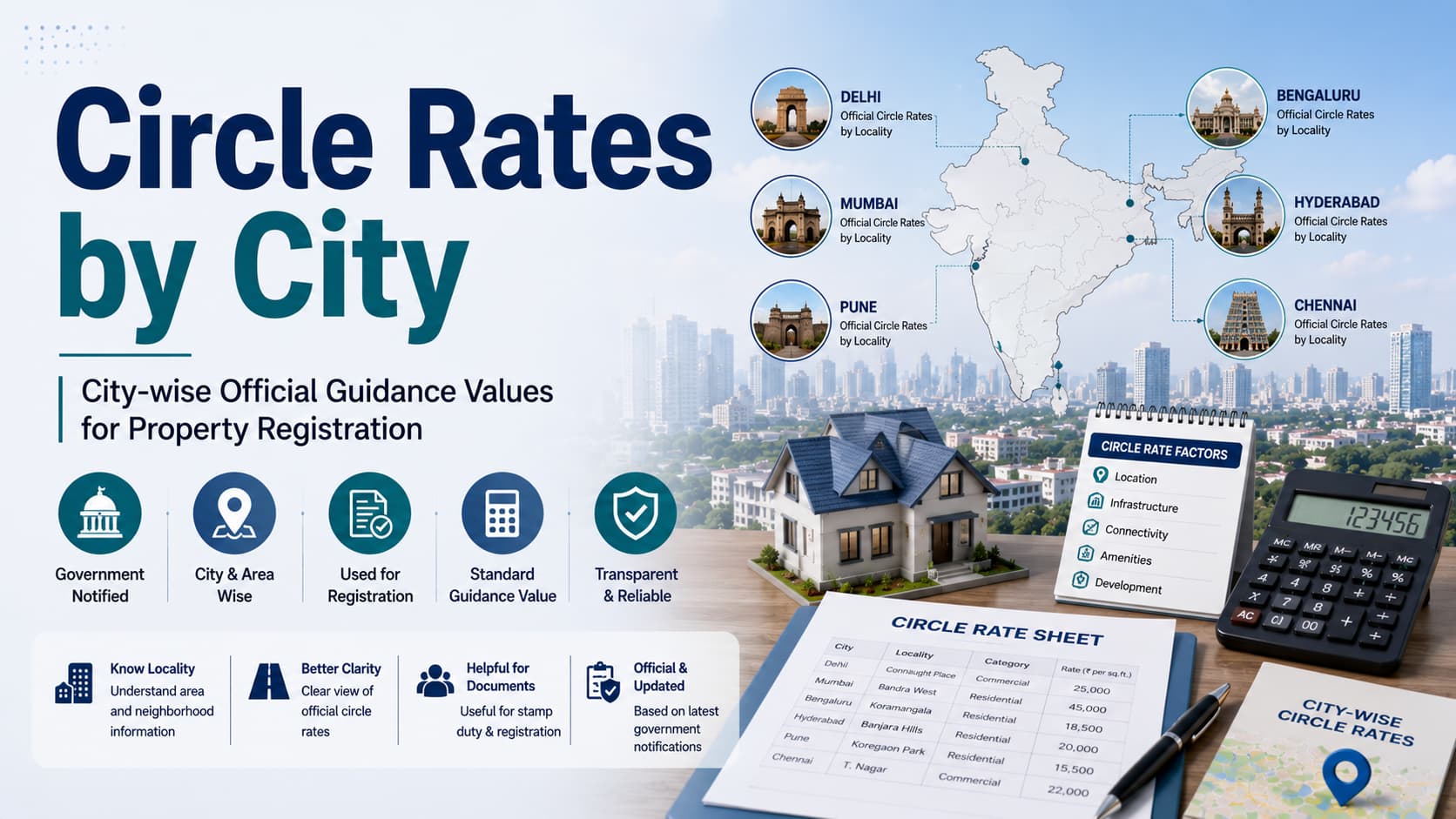
Circle rates are perhaps one of the most important considerations while dealing with real estate transactions in India. Irrespective of whether you are a buyer, seller, or investor in real estate, you need to have a complete understanding of the applicable rate in your respective city. This guide will give you information on how these rates differ across three metropolitan cities, namely Delhi, Noida, and Gurugram. Before getting into the specifics of city rates, we need to know what these government-determined rates are all about. The Government Guidance Value or Ready Reckoner Rate refers to the lowest value fixed by government authorities for properties in a particular locality. This is used as a benchmark to calculate the stamp duty on the property. These rates serve multiple purposes: Setting a benchmark for property taxation Ensuring appropriate stamp duty collection Preventing undervaluation of properties Providing a reference point for property assessment Protecting government revenue Each city and locality has its own unique rate structure based on factors like location, development, infrastructure, amenities, and market conditions. These rates are typically updated annually or biennially to reflect market changes. Delhi, the capital of India, is one of the most expensive real estate markets in the country. Property rates in Delhi vary significantly based on location, with prime central areas commanding much higher rates than peripheral localities. Delhi has multiple zones with varying government-assessed property values: Central Delhi Areas: Central Delhi localities like Connaught Place, Khan Market, and New Delhi have some of the highest government-assessed property values in the country. These premium areas see residential rates ranging from Rs. 1,50,000 to Rs. 3,00,000 per square meter. Commercial properties in these areas are even more expensive, with rates exceeding Rs. 5,00,000 per square meter. South Delhi: South Delhi includes affluent localities like Greater Kailash, Defence Colony, Vasant Kunj, and Malviya Nagar. These areas are known for their upscale properties and have government-assessed values between Rs. 80,000 to Rs. 1,50,000 per square meter, depending on the specific locality. West Delhi: West Delhi localities such as Vikaspuri, Paschim Vihar, and Dwarka have relatively moderate government-assessed values compared to central and south Delhi. Rates here range from Rs. 40,000 to Rs. 80,000 per square meter. East Delhi: East Delhi areas like Shahdara, Preet Vihar, and IP Extension have government-assessed values between Rs. 30,000 to Rs. 60,000 per square meter, making them relatively more affordable options within Delhi. North Delhi: North Delhi localities including Civil Lines, Model Town, and Kasturba Nagar have government-assessed values ranging from Rs. 50,000 to Rs. 1,00,000 per square meter. Delhi's government-assessed property values are influenced by several factors: Infrastructure Development: Areas with better metro connectivity, roads, and utilities generally have higher government-assessed values. Commercial Proximity: Proximity to business districts and commercial centers can increase property values. Educational Institutions: Areas near prestigious schools and colleges may command higher values. Historical Significance: Older, established neighborhoods often have higher government-assessed values. Recent Development: Newly developed areas with modern amenities may see increasing property values. For investors, understanding government-assessed property values in different Delhi localities helps identify: Undervalued properties with appreciation potential Areas experiencing rapid development Localities transitioning from residential to commercial zones Emerging markets with growth prospects The Ready Reckoner Rates in Delhi are updated by the Delhi Circle Rate Authority, and property buyers should check the latest rates before making any purchase decisions. Noida (New Okhla Industrial Development Authority) has emerged as one of the most sought-after real estate destinations in the NCR. The city offers a perfect balance of affordability and modern infrastructure, making it attractive for homebuyers and investors. Noida's government-assessed property values are generally lower than Delhi but higher than many other cities. The rates vary significantly based on the sector and proximity to the expressway: Prime Noida Sectors: Sectors like Sector 50, Sector 62, Sector 63, and Sector 137 are among the most developed areas in Noida. These sectors have government-assessed values ranging from Rs. 50,000 to Rs. 1,00,000 per square meter for residential properties. These areas feature planned layouts, good connectivity, and modern amenities. Mid-Range Sectors: Sectors such as Sector 18, Sector 31, Sector 37, and Sector 40 have government-assessed values between Rs. 30,000 to Rs. 60,000 per square meter. These sectors offer good connectivity and are popular among first-time homebuyers. Developing Sectors: Emerging sectors like Sector 120, Sector 121, and Sector 127 have government-assessed values in the range of Rs. 15,000 to Rs. 35,000 per square meter. These areas are witnessing rapid development and infrastructure expansion. Noida Expressway Impact: Properties near the Delhi-Noida Expressway may command higher values due to good connectivity. Government-assessed values can vary for properties located close to major transport corridors. Noida has experienced significant appreciation in government-assessed property values over the years due to: Industrial Growth: Established as an industrial hub with excellent manufacturing facilities IT and Corporate Centers: Multiple tech parks and corporate offices attract professionals Education Hub: Presence of quality educational institutions and universities Transportation: Well-connected via metro, expressway, and highways Master-Planned Development: Organized urban planning with green spaces Affordable Yet Modern: Offers modern amenities at relatively lower costs than Delhi Many investors prefer Noida for its: Lower entry price compared to Delhi High rental yields in prime sectors Strong appreciation potential Good rental demand from working professionals Upcoming infrastructure projects Gurugram has transformed from a small town into one of India's most prosperous cities. It's now a major financial and IT hub, attracting businesses and professionals from across the world. This growth is reflected in its rising government-assessed property values. Gurugram's government-assessed property values have seen significant growth, reflecting the city's economic development: Premium Localities: Some of the premium localities in Gurugram include Golf Course Road, DLF City, MG Road, and Sector 57, and they have higher rates compared to others. The government-assessed values for residential land in such areas are between Rs. 1,00,000 to Rs. 2,50,000 per square meter, while commercial properties are much higher. Central Business District: The CBD includes localities such as Sector 43, 44, and surrounding areas. The government-assessed values for this region are between Rs. 80,000 to Rs. 1,50,000 per square meter. South Gurugram: The localities included in South Gurugram are Sector 48, 49, 50, 51, 52, and Sohna Road. They have government-assessed values of Rs. 60,000 to Rs. 1,00,000 per square meter. These localities are undergoing significant development. New Gurugram: The localities in New Gurugram, such as Sector 102, 103, 104, and Ecotech Extension, have government-assessed values of Rs. 30,000 to Rs. 70,000 per square meter. Gurugram Haryana Side: Properties in the Gurugram side of Haryana have comparatively lower government-assessed values between Rs. 20,000 to Rs. 50,000 per square meter. Gurugram's rapid rate appreciation is driven by: Corporate Headquarters: Home to numerous Fortune 500 companies IT Industry: Major presence of IT companies and startups Modern Infrastructure: Well-developed roads, metro connectivity, and utilities International Standards: World-class malls, hospitals, and educational institutions Skilled Workforce: Attracts professionals and managers from across India Economic Growth: Consistent economic development and investment Real Estate Boom: High demand from end-users and investors Investors are attracted to Gurugram for: Strong capital appreciation history Excellent rental yields in commercial areas High demand from corporate employees Ongoing infrastructure development International quality amenities Strong resale value When comparing government-assessed property values across these three cities, several patterns emerge: Highest Rates: Delhi's central areas have the highest government-assessed values in NCR, with premium locations exceeding Rs. 3,00,000 per square meter. Mid-Range Rates: Gurugram's prime areas and Noida's developed sectors have comparable mid-range rates between Rs. 50,000 to Rs. 1,50,000 per square meter. Most Affordable: Developing areas in Noida and Gurugram offer the most affordable options with rates starting from Rs. 15,000 per square meter. Gurugram: Shows the highest growth potential with consistent appreciation due to economic development. Noida: Steady growth with emerging sectors offering investment opportunities. Delhi: Mature market with slower growth but stable values. Gurugram: Highest rental yields due to strong corporate demand. Noida: Good rental returns in developed sectors. Delhi: Moderate yields but strong property appreciation. Every city has its own features: Delhi is for heritage seekers, professional individuals, and location-oriented buyers. Noida is for first time buyers, value-for-money investors, and IT professionals. Gurugram is for corporate professionals, businessmen, and aggressive investors. Decide whether Delhi, Noida, or Gurugram suits your budget and lifestyle needs. Each city has distinct characteristics and circle rate structures. Always verify the latest government-assessed rates for your specific locality. These rates are updated regularly, and outdated information can lead to incorrect budgeting. Use the rate to calculate your approximate stamp duty liability. In NCR, stamp duty typically ranges from 4-5% of the rate. The rate is the minimum; actual market values can be significantly higher. Factor in current market prices when budgeting. Before making a decision, consult with local property experts who understand the nuances of your chosen city and locality. Delhi's government-assessed property values are maintained by the Delhi Stamp Department and are updated periodically. You can find the current rates through: Delhi Stamp Department official website Local circle office Property registration offices Real estate consultants Noida's government-assessed property values are updated by the NOIDA Authority and are available through: NOIDA Authority official portal Sub-registrar offices Local property consultants Real estate websites Gurugram's government-assessed property values are maintained by the Haryana government and can be accessed via: Haryana Property Registration Department Sub-registrar offices in Gurugram Local municipal corporation websites Property valuation guides Research your specific locality thoroughly as rates vary significantly Remember that Delhi's premium areas have limited property availability Consider ready reckoner rates while negotiating Factor in high stamp duty in your budget Monitor the rate trends in growing sectors Find places that have growth in infrastructure Comparing between sectors for more profitable investments Long term appreciation potential Invest in well-established sectors with demand for rentals Monitor corporate expansion plans Check out metro connection developments Proximity to business centers Understanding the Government Guidance Value in your city helps you: Work Out True Cost: Know the true cost of property purchase Plan for Loans: Plan with banks on loans Analyze Investment: Analyze the returns on investment in property Negotiate Price: Know how far you can negotiate prices Plan Ahead: Plan for future appreciation of the property Q1: How often are circle rates updated in Delhi, Noida, and Gurugram? A: The government-assessed rates are revised either annually or biennially, depending on the state. Generally, the rates in Delhi are revised once a year, similarly to Noida and Gurugram. It is recommended to check the revision dates from the concerned authorities, as they might differ. Q2: Which city has the highest circle rates among Delhi, Noida, and Gurugram? A: The highest government-assessed rates are found in Delhi, especially in the central and southern areas. In premium locations of Delhi, the applicable rate is above Rs. 3,00,000 per square meter, while in the premium locations of Gurugram, it can go up to Rs. 2,50,000 per square meter. Q3: Can I negotiate below the circle rate when buying a property? A: The rate refers to the minimum amount set by the government for paying stamp duty. Even though you may be able to negotiate a lower transaction cost with the seller, you still have to pay stamp duty according to the circle price (which may be higher than the negotiated cost). Q4: How does circle rate affect property loan approval? A: The rate impacts the sanctioning of loans indirectly. The rate is considered as a benchmark by the banks and they usually sanction loans on the basis of the lesser of the circle rate and the bank’s evaluation. It can make an indirect positive impact on the sanctioning of loans when the rate is significantly lower than the market price. Q5: Which city offers the best investment opportunity based on circle rates? A: Noida and Gurugram provide the best chances for investments because of low entry level prices and high possibilities of appreciation. Sectors that are still under development in Noida have high chances of growth. Established sectors in Gurugram have stable return on investment and good rentals. The chance of investing in Delhi is available only for investors who have more budget. Q6: What is the difference between circle rate and market value of property? A: The minimum amount fixed by the government for taxation purposes is called the circle rate, while the amount that the property is sold for in the existing market is called the market value. Market value is usually higher than the circle price and depends on various factors like the condition of the property and its location. Q7: How do I find the exact circle rate for a specific locality? A: The applicable rates can be determined by visiting the sub-registrar office of your locality, searching government property registration websites, or speaking to a local real estate agent. Every city has different sources where you can find the Ready Reckoner Rates for that area. Q8: Are circle rates the same for all property types in a city? A: No, there is no single rate for all property types. There are separate rates for residential property, commercial property, and plots in the same locality. These rates can differ according to the property's location, such as a main road or internal lane, as well as other applicable criteria. Q9: How do circle rates impact first-time homebuyers? Answer: These government-assessed rates can affect the stamp duty payable by first-time buyers at the time of registration. Understanding the applicable rates helps with budgeting. Suppose you want to buy a property in Gurugram. Knowing the applicable rate can help you estimate your overall expenditure. Q10: Can circle rates decrease, or do they only increase? A: Government-assessed rates have generally shown an upward trend, but this does not mean they increase every year. There may be years when these rates remain unchanged due to weak market conditions. During an economic downturn, the applicable rates may be kept at the same level or adjusted accordingly. When comparing circle price across Delhi, Noida, and Gurugram, it's crucial to understand how these rates fit into your broader property investment strategy. The Circle Rate Gurgaon can serve as a reference point for understanding how premium markets value properties, while comparing these rates helps identify emerging opportunities. Beyond just the Ready Reckoner Rates, you should also research the Government Guidance Value and Market Value of Property in each city to understand the gap between minimum government rates and actual market conditions. Utilizing a Property Value Calculator specific to each city can help you compare similar properties across different locations and make apples-to-apples comparisons. Additionally, consulting a comprehensive Property Valuation Guide that covers all three cities will provide you with the insights needed to identify which city offers the best value for your investment profile. Whether you're seeking capital appreciation in Gurugram, steady returns in Delhi, or growth potential in Noida, understanding how government-assessed values interact with market valuations across these cities is the foundation of informed real estate decisions. It is crucial for you as a buyer, seller, or renter of property to understand the applicable government-assessed values in Delhi, Noida, and Gurugram if you are associated with the real estate market in NCR. Each city has its own set of rates based on its development, infrastructure, and market dynamics. Delhi continues to remain a premium market for real estate with higher government-assessed values, while Gurugram is appreciated for its growth potential and modern infrastructure. Noida is comparatively affordable for buyers and also has good future prospects. Irrespective of whether you are a beginner or an experienced property buyer, having knowledge of the applicable rates in your selected city can be helpful. Stay updated with the latest government-assessed values, speak to local real estate experts, and consider Government Guidance Value while making property-related decisions in the NCR real estate market.Circle Rates by City: Complete Guide to Delhi, Noida, and Gurugram
What Are Circle Rates?
Understanding Circle Rates in Delhi
Delhi Circle Rate Structure
Factors Affecting The Rates
Investment Opportunities in Delhi
Noida Circle Rates: The Growing Satellite City
Noida Rate Overview
Why Noida Rates Are Competitive
Investment Strategy in Noida
Gurugram Circle Rates: The Corporate Capital
Gurugram Rate Structure
What Drives Gurugram Circle Rates?
Gurugram Real Estate Investment Perspective
Comparative Analysis: Delhi vs Noida vs Gurugram
Price Comparison
Growth Potential
Rental Yield Potential
Market Dynamics
How to Use Circle Rates for Property Purchase
Step 1: Identify Your Target City
Step 2: Check Current Circle Rates
Step 3: Calculate Stamp Duty
Step 4: Factor in the Market Value
Step 5: Consult a Property Expert
Circle Rate Updates and Where to Find Them
Delhi Circle Rates
Noida Circle Rates
Gurugram Circle Rates
Tips for Navigating Circle Rates in Each City
For Delhi Buyers
For Noida Investors
For Gurugram Properties
Impact of Government Guidance Value on Your Property
FAQs by City
Understanding Area Rates in the Context of Your Complete Property Investment Strategy
Conclusion