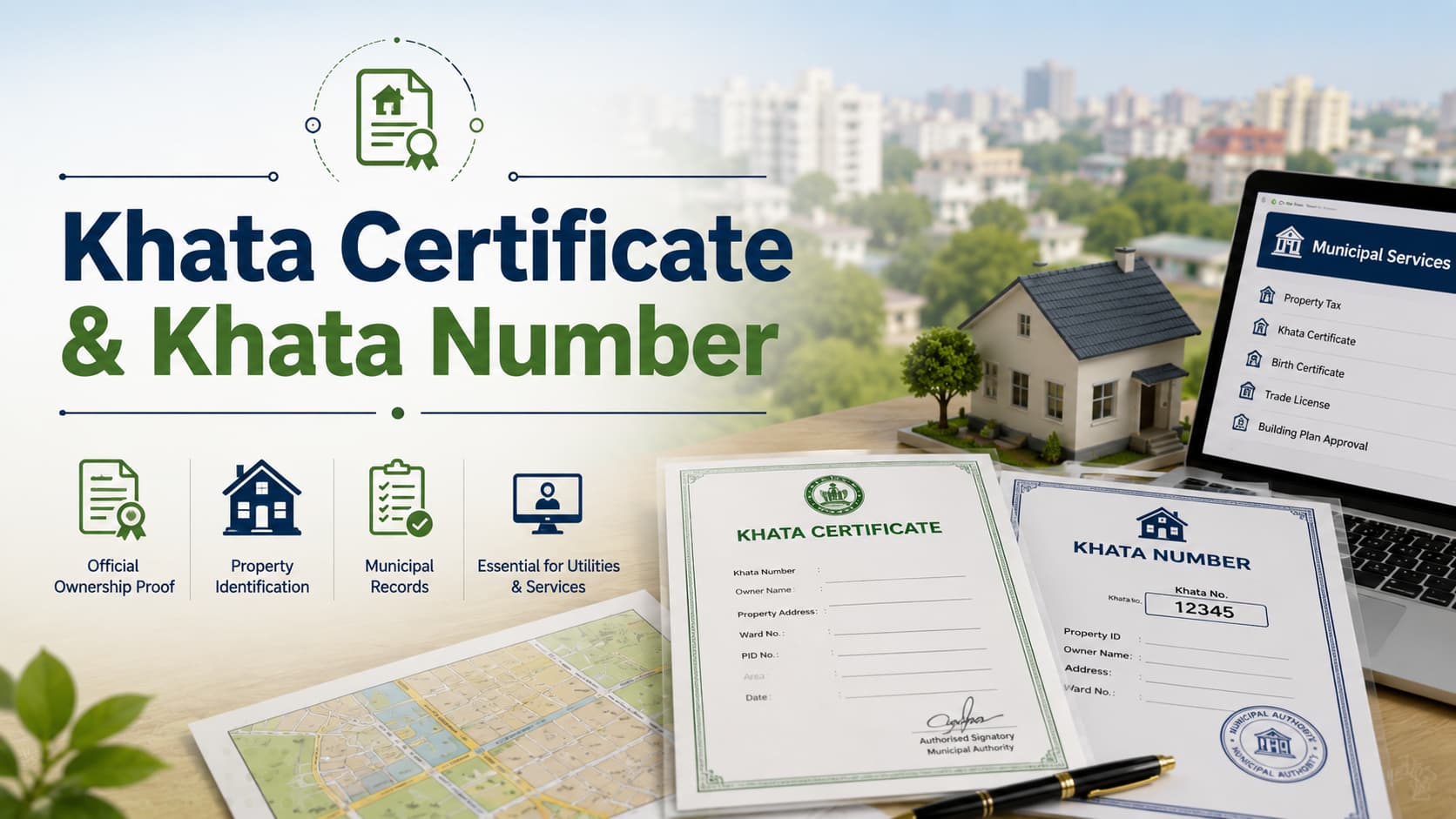
As a property owner in India, especially if you are based in urban municipal corporations, there are two extremely important documents which are key in determining the taxability of the property and its identification through the municipal corporation system: Khata Certificate and Khata Number. It is not merely an administrative matter; it forms the basis of all the legality of your property. A property identification number is a unique identification number assigned by municipal authorities to every property within their jurisdiction. This number serves as the official property identifier in municipal records, linking your property to tax assessments, utility connections, and ownership documentation. The municipal property document is the official record issued by municipal corporations that proves the existence of your property, establishes your ownership or occupancy rights, and confirms your tax assessment status. Understanding municipal property records and identification details is essential for every property owner because these documents directly impact your ability to access municipal services, pay property taxes, obtain no-objection certificates for transfers, and prove legitimate ownership. Without a valid municipal property record and understanding your property identification number, you cannot effectively manage property taxes, plan property transfers, or secure official documentation required for various transactions. Whether you own property in Sector 12 Gurugram, near Raja Nahar Singh Faridabad, or in any other municipal area, these records are absolutely critical for your property's legal and financial standing. A municipal property record is the document that is issued by the municipal corporation of your city/town and includes all the information regarding your property. There are several very important roles of this record in the property management and legal process. First of all, this official document is the record that proves the registration of your property by the municipal corporation and confirms its existence, location, and tax assessment. Information that is provided by this document includes such details as property's location, area, owner's name, tax assessment, and Khata Number of the property. There are two very important roles of this document in your property management and legal process. First of all, Khata Certificate is used as official confirmation of the property ownership in the municipal corporations. In order to obtain some services like connection of water/electricity and registration of property transfers/no-objection certificates, etc., one must submit this document. The municipal record also serves as supporting documentation when accessing online property records through Land Records Online portals. While Land Records Online systems display revenue records and ownership information, this municipal-level documentation complements these revenue records and proves your property's tax status within your local municipal corporation. A property identification number is an alphanumeric sequence that acts as an identifier of your particular property issued by the municipal corporation. It works as the basic code for any transaction involving your property in the municipal system. Knowing this number is very important since you will have to refer to it for most interactions with the municipal officials concerning your property. This identifier normally contains a sequence of numbers that carry information on the address of the property such as the ward number, street number, and serial number of the property within the particular locality. However, the format of this municipal number differs from one municipality to another, but it is unique to your property in the respective municipality. The assigned number is printed on your property tax bills, water connection papers, electric bills, and all official letters from your municipality regarding your property. While paying property tax to your municipal corporation, you mention this reference number so that the payment is attributed to your property. In case of loss of any document mentioning your identification details, it is easy to find them out by approaching your municipal corporation or going through online municipal records. This code is the connecting link between your property and the municipal tax system. If you do not know this number, then you cannot pay property tax, cannot check whether you have paid tax or not, and you cannot approach any municipal service related to property identification. During Land Record Verification processes when purchasing property, this municipal identifier becomes essential for cross-referencing municipal records with revenue department documentation. Verification requires confirming that the identification information matches across all municipal systems and that no outstanding tax dues exist against the property. When property ownership transfers following property purchases, the municipal corporation must amend the this records to reflect new ownership. The Mutation of Property after Sale process requires updating this number documentation with new owner information, ensuring that subsequent tax bills and municipal communications reference the new owner. Without proper Khata Number mutation, the previous owner remains the recorded owner in municipal systems, creating confusion about tax liability and municipal service responsibilities. Municipal corporations issue different types of property records based on property characteristics and ownership status. Understanding which type applies to your property helps you recognize what rights and responsibilities you possess. Residential Property Record applies to properties classified as residential in municipal records. This document applies to single-family homes, apartments, villas, and other properties designated for residential occupancy. Residential properties typically fall into different tax categories based on size, location, and value, with tax assessments calculated accordingly. Commercial Property Record applies to properties used for commercial purposes—such as shops, offices, showrooms, warehouses, and other business-related facilities. Commercial properties typically attract higher property tax rates than residential properties, and tax assessments are calculated separately based on commercial property valuation criteria. Industrial Property Record applies to properties used for industrial or manufacturing purposes. These properties follow distinct tax assessment and regulatory frameworks, with specific rules governing their use and development. Mixed-Use Property Record applies to properties containing both residential and commercial components—such as properties with shops on ground floor and residential apartments above. These records reflect the mixed nature of the property and calculate taxes based on the proportion of residential and commercial space. Vacant Land Property Record applies to undeveloped land within municipal jurisdiction. Even vacant land requires municipal registration and an applicable property record, with tax assessments based on land area and location value rather than structural improvements. Understanding which type of municipal property record applies to your property ensures you understand your tax obligations and property rights correctly. Misclassification can result in incorrect tax assessments, so verify that your property is classified appropriately in municipal records. Obtaining a Khata Certificate and Khata Number requires following specific municipal procedures that vary slightly between different municipal corporations across India. However, the fundamental process remains consistent. Step 1: Gather Required Documentation Collect essential documents including your property's registered sale deed, government-issued identification proof, address proof, property layout diagram, recent property photograph, and any previous property-related correspondence with the municipal corporation. For inherited or ancestral properties, gather succession certificates or legal documentation proving your ownership rights. Step 2: Submit Application to Municipal Corporation Visit your municipal corporation's property tax department and submit an application for Khata Certificate issuance. Many municipal corporations now allow online application submission through their websites or designated online portals. Complete the application form accurately, providing detailed property information including location, area, construction details, and ownership information. Step 3: Property Verification After submitting your application, municipal authorities will conduct physical property verification to confirm the property's existence, location, and condition. They'll visit your property, verify boundary details, examine construction quality, and confirm information provided in your application. This verification typically occurs within 5-15 days of application submission. Step 4: Document Scrutiny Municipal officials will review all submitted documentation to verify authenticity and completeness. They'll cross-reference your sale deed with revenue records, confirm your ownership through land records, and verify that property details match across all documentation. Any discrepancies identified during this stage will result in requests for clarification or additional documentation. Step 5: Tax Assessment Based on property verification and documentation review, municipal officials will assess your property's tax value. The assessment considers factors including property location, size, construction quality, age, and current market value. The assessed value determines your annual property tax liability. Step 6: Municipal Property Record Issuance Once all verification steps are completed successfully and no disputes exist, the municipal corporation will issue your Khata Certificate and assign your unique property identification number. You'll receive an official certificate document containing your property information, identification number, and tax assessment details. This document serves as official proof of your property's municipal registration. Step 7: Online Record Updates Many municipalities now update their online property records systems automatically following issuance of the municipal property document. Your property information will appear in municipal online portals, allowing you to access your records, verify tax payment status, and download duplicate certificates if needed. Knowing about the relationship between the municipal property record and the property documentation systems enables you to understand the whole picture about the property record in India. While the municipal property record signifies the perspective of the municipal corporation regarding your property, being the document that mentions about your property's tax status, area, and value within the municipality's territory, the revenue records available in Land Records Online portals signify the revenue department's perspective on your property. Here both the systems are independent of each other yet refer to the same property where the property identification number refers to your property in the municipal system and the property identification in revenue records would be denoted by the revenue property ID or reference number. You need to get both the revenue transfer and municipal record transfer upon purchasing the property. In Haryana, Jamabandi Haryana represents your ownership in revenue records, while your Khata Certificate represents your property's tax status in municipal records. Similarly, Bhulekh systems provide digital access to revenue records, creating a comprehensive system where both revenue and municipal records can be verified online. This is because the integration of these systems ensures that for a complete property documentation, you require not only revenue record updates (proved by Land Records Online and Jamabandi Haryana) but also the municipal record updates (proved by Khata Certificate updates and Khata Number). The municipal property record becomes indispensable in terms of making sure that the transaction goes smoothly while having all legal documentation in place. For Property Buyers, checking the municipal property record and property identification number of the seller prior to buying the property becomes critical. This document indicates that the property is duly registered with the municipal corporation and no pending municipal dues are there regarding the property. With a clear record, you make sure that you are buying the property with no pending issues with the municipality. For Property Sellers, showing the valid municipal property record and identification details to the prospective buyers is crucial for establishing your property's legality in terms of municipal registration. The buyers will be confident about the purchase with this piece of documentation. For Transfer Processing, on buying the property, the municipal corporation needs to modify the municipal property record in the buyer’s name. This involves submitting the sale deed along with other documents as proof of amendment. If this modification does not take place, then the old owner’s name will still be there in the municipal corporation's records. For Securing Financing, usually the bank/financial institution would like to see the municipal property document before issuing any loan. It verifies that the property is legally registered in your name and its valuation is done by the authorities. For Municipal Services, whenever you have applied for any municipal services, such as water connection, sewerage connection or building permissions, the municipal authorities will ask you to produce this official document as proof. The yearly property tax payable is determined by taking information recorded in your municipal property record into account. It is important for you to know how the property tax is assessed and when this document should be updated. Revaluation of the property takes place once in every 3-5 years as required by the municipal corporation. As the value of your property may increase or decrease with time, the tax value too will change according to the revalued amount. You should always notify the municipal corporation of any changes to the structure of the property such as the addition of floors and renovation. This would help you to get your municipal record updated and hence avoid future tax problems. Notifying the municipal corporation about changes made to the property will save you from having disputes with them as a consequence of discoveries and complaints. On the other hand, if there has been a decrease in the value of your property, you could apply for a reassessment. Attach relevant documents like pictures of the current state of the property, condition report, and its value. The municipal property record should accurately reflect your property's current status, improvements, and condition. Regular verification through Land Records Online and municipal portals ensures that your record shows correct information. Discrepancies between actual property conditions and recorded information should be corrected promptly to avoid legal complications. Another very important issue associated with municipal property records and identification details is the pending municipal dues. In case there are any pending municipal dues such as property tax, water, sewage charges, etc., these dues make it quite difficult to buy or sell the property. Whenever you purchase the property, all the pending municipal dues from the date of the last change of ownership become your liability. Even though the owner who accumulated the dues was the previous one, but now being the owner of the property, you have the financial liability to pay those dues. In order to avoid buying properties with any outstanding dues, make sure you ask for a dues certificate from the municipal corporation prior to completing the purchase. The dues certificate states all the dues, whether of taxes or utilities, which may be pending on the property. You can negotiate with the owner to pay off any pending dues as part of the transaction, or lower the total amount of purchase according to the dues that you will have to pay. Outstanding dues can keep you from getting any NOC for transferring the property or any building permission. It might also land you into trouble as municipalities can impose fines or take possession of your property for any unpaid dues. Most municipal corporations are today offering digital access to Khata Certificate data through online portals, allowing people to check their tax status without having to visit any municipal corporation offices. Many municipal corporations enable you to view property details using your Khata Number on their online portals and get details about current assessment for taxes, payment history, and unpaid dues if any. In some cases, portals also allow downloading of duplicate copies of Khata Certificate or extracts. Digital access to Khata Certificate data works along with other online systems that include Land Records Online and Bhulekh, providing you with complete digitized property data that is available at your fingertips. This digitization helps in speeding up procedures and also prevents loss of important documents. But when dealing with online systems, proper verification is required as well. Make sure that you are using official municipal portals instead of any third-party websites. Verify the portal through the official website of the municipal corporation. Take necessary precautions regarding your account details and never share them via emails or other sources. If you buy property, get inheritance, or undergo name change due to marriage or legal proceedings, then you need to make changes in your municipal property record. Transfer of Ownership in case of property purchase necessitates an amendment to the municipal record. For that purpose, you need to present your sale deed along with all other necessary papers at your local municipal corporation for updating the record. It takes 15-30 days to amend it. Change/Addition of Co-Owner in case your property is jointly owned by your spouse, business partner, or any other person necessitates an update in the municipal property document in order to accommodate all the co-owners. Removing a deceased owner when a property owner is deceased calls for an amendment that removes his/her name and includes the legal heir as the owner of the property. This involves the production of succession certificates and legal evidence showing proof of inheritance. Change in Legal Name when a person marries, adopts or is ordered by the court to change his/her name, requires amendment of the municipal property record in respect to his/her name. Proof of the change of name must be submitted, for example, a marriage certificate or court order. Change in Business Name when a business name is changed, and the business has property registered using its name, requires an amendment. Documents that prove the business name change must be provided. By amending your municipal property record in good time following changes in ownership, you avoid confusion, and ensure proper billing and correct records of ownership of your property. Although municipal property records and identification numbers are common documents used for property transactions and have a routine nature, there are some complications that usually arise while handling these papers. Lack of municipal property documentation arises when the property holder is unable to find the original record. Even though this situation may seem worrying, it can be sorted out by obtaining a copy of the same from the municipal corporation. It is essential to keep a backup or digital copy of this important document. Improper Property Information in the municipal record such as property address, wrong measurements, wrong ownership details, etc. must be addressed. Despite being routine administrative documents, municipal property records and identification details often encounter problems that complicate property transactions and create legal issues. Problem of Missing municipal property documentation results when the owners of properties are unable to trace back their records. Although this problem causes much worry, it is very easy to overcome it by issuing a duplicate document from the municipal corporation. It is advisable to have backup copies of this record to avoid losing it. Khata Certificate with Incorrect Property Information like address, wrong measurement of area or wrong ownership information need to be sorted out using amendment process. Misclassification of Property means that the municipality misclassifies your property; for example, it may consider your residential property as a commercial one or vice versa. This misclassification will lead to wrong tax valuation. Check your property classification and make a correction in case you find any mistake there. Dispute over Property Ownership is the situation where there are claims on the ownership of the property by different people. Such disputes usually result from improper transactions, fake documentation, or family problems. It requires legal action to resolve such disputes, and this process may take a long time. Outstanding Dues Preventing Transfers mean that your property taxes or other municipal payments are still pending and hence prevent the amendment of your Khata number for the purpose of transferring property. Khata Number Duplication is sometimes seen in municipal records because of the data entry mistakes, resulting in uncertainty regarding which record belongs to your property. 1. What is the difference between a municipal property record and a property deed? A municipal property record is a document confirming your property's registration with the local municipal corporation and its tax assessment status. A property deed is a legal document proving your ownership rights. You need both documents for complete property documentation—the deed proves ownership through revenue records, while the municipal record confirms municipal registration and tax status. 2. Is a municipal property record mandatory for all properties? A municipal property record is generally required for properties located within municipal corporation jurisdiction. Properties in non-municipal rural areas may not require the same municipal documentation, though they still require revenue registration. Check your property's location to determine if it falls within municipal limits requiring the relevant record. 3. Can I obtain a property loan without a municipal property record? Most banks require relevant municipal property documentation as part of their due diligence before approving property loans. The record helps confirm that the property is properly registered and assessed, reducing lending risk. Properties without the required municipal records may face significant difficulty securing financing. 4. What happens if I don't pay property tax on time? Unpaid property taxes accumulate as outstanding municipal dues, potentially resulting in penalties, interest charges, and property seizure in extreme cases. Some municipalities impose additional charges for late payment. Pay property taxes on schedule and maintain records of payment to avoid complications. 5. Can the municipal property record be transferred along with property sale? The municipal record itself isn't transferred, but the municipal corporation amends it to reflect the new owner's name following property sale. Submit the sale deed to the municipal corporation requesting amendment of the relevant property record to reflect the new owner's name. 6. How often should I verify my property identification number and property details? Verify your municipal property record and related property details annually, particularly before property transactions or when major property modifications occur. Regular verification catches errors or unauthorized changes in municipal records, allowing prompt correction. 7. Is it possible to correct errors in a municipal property record after issuance? Yes, errors in the municipal property document can be corrected through formal amendment requests to the municipal corporation. Submit documentation supporting the corrections needed, and the municipal corporation will amend the record accordingly. Corrections typically complete within 15-30 days. 8. What should I do if I lose my municipal property document? Request a duplicate municipal property record from your municipal corporation. You'll need to provide your property identification number or property address for identification. Many municipalities can provide duplicates within a few days, and some offer online download options for duplicate records. 9. Do I need a separate Khata Certificate for each property I own? Yes, each property receives its own unique Khata Number and Khata Certificate. If you own multiple properties, each will have separate municipal registration and tax assessment. 10. How does Khata Certificate relate to Land Records Online access and Bhulekh records? Khata Certificate is your certificate of municipal registration and taxation, whereas Land Records Online and Bhulekh are for the revenue and ownership registration of your property. The updating of both databases becomes necessary after buying any property to have legal proof for your property on all official databases. Municipal property records and identification details are essential in defining your property's status in terms of legality and finances within the municipal body. These documents define your property in terms of its legality, determine your liability towards paying taxes, and help you avail services provided by the municipality. Having knowledge about your municipal property record, keeping its details updated, and getting them amended after any change in your property is essential. In case you have purchased a property for the first time in Sector 12 Gurugram, in the vicinity of Raja Nahar Singh Faridabad, or any other municipality, it is essential that you obtain the relevant municipal documentation as soon as possible after purchasing your property. It is important that you keep a copy of the document and have your property identification details handy at all times. By understanding and actively managing your municipal property records, you transform these administrative documents from confusing bureaucratic requirements into useful tools for protecting your property rights, ensuring proper tax compliance, and facilitating smooth property transactions. Combined with revenue records accessible through Land Records Online, Jamabandi Haryana, and Bhulekh systems, your Khata Certificate completes the comprehensive documentation necessary for secure property ownership and transparent transactions throughout your property ownership journey.Khata Certificate & Khata Number: Complete Guide
What Is a Municipal Property Record?
Understanding the Khata Number
Different Types of Khata Certificates
How to Obtain a Khata Certificate and Khata Number
The Relationship Between Municipal Property Records, Land Records, and Bhulekh Systems
Importance of Municipal Property Records for Property Transactions
Tax Assessment and Municipal Record Updates
Outstanding Dues and Municipal Record Implications
Digital Access to Khata Certificate Information
Municipal Property Record Amendments and Name Changes
Common Issues with Municipal Property Records and Identification Numbers
Frequently Asked Questions
Conclusion