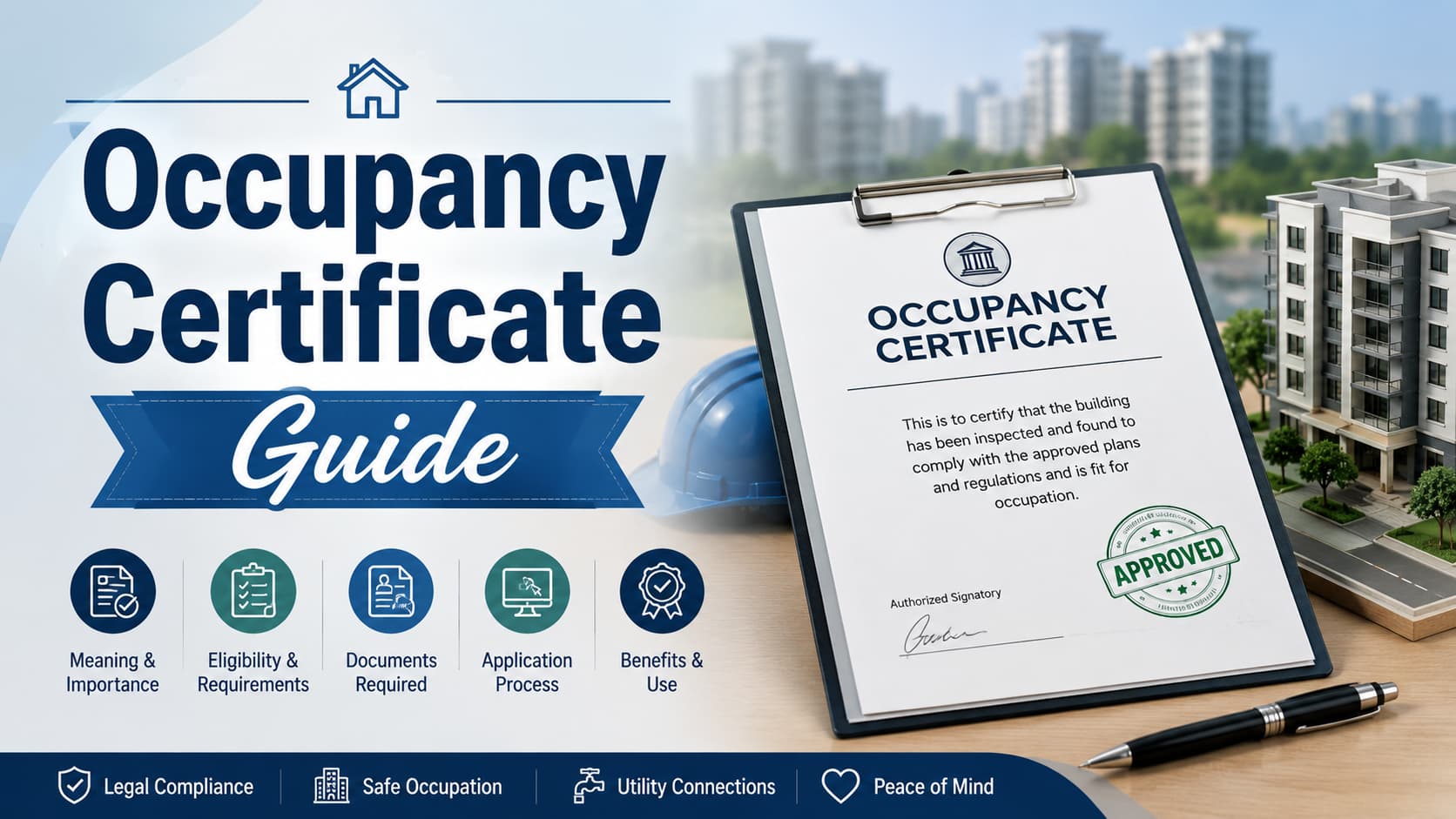
The correct property choice, home financing arrangement, and even a call from the developer for collecting your possession letter – all of this is now in place. But before taking that last step, there is just one question that will protect you from legal problems for decades ahead: Is the project already issued an Occupancy Certificate? Most of the buyers just move into the premises driven by excitement but realize much later that their building was not even certified for habitation. This guide explains the very important document of Certificate – the purpose of it, who issues it, and how to verify it. Regardless of whether you are buying a high-rise property in Sector 65 Gurugram or a builder floor in Sohna Road, everything mentioned here will be useful for every real estate purchase across the country. Occupancy Certificate, which is often abbreviated as OC, is a formal certificate given by the municipal or development authorities of the local governing body that declares a building built as per the approved plan and building regulations and safety standards to be ready for occupation by people. To put it simply, it is the government's formal confirmation that the building is safe and legal to occupy. The authorities conduct inspections to verify whether all the conditions required to be fulfilled before issuing an Occupancy Certificate have been met — that is, the building has been constructed as per the approved plan, safety systems such as structural safety, fire safety, water supply, sewerage and drainage, electrical works, and other facilities are installed in the building. It is only after the fulfillment of these conditions that the authorities will give the OC. This is why the Certificate forms the crux of any legal possession of property. If a flat lacks an Certificate, legally it remains unapproved for occupation. A Certificate is integral to the complete property acquisition process. When you sign a Sale Deed vs Sale Agreement with a developer, the OC becomes a condition for possession transfer. In new construction deals governed by a Builder Buyer Agreement Explained, obtaining the OC is typically a builder's obligation before handing over keys. The OC is then essential during the Registry Process in India, as most sub-registrars require it for official property registration. This sequential requirement ensures that you never take possession of an incomplete or unsafe building, making the OC a protective barrier at every stage of your property purchase journey. It is a big blunder to consider the issuance of Certificate as a mere procedural requirement. This is the reason why this one document is worth your entire attention before you take control over it. It ensures that your profession is legitimate. The Certificate is required because without it, occupying the building could be considered as unauthorised occupation. Notices can be issued, fines levied, and in extreme situations, sealing or demolishing of non-conformist areas could even be ordered by authorities. It ensures permanency in utility connections. Water supply, electricity connection, and sewage connection are provided permanently usually only after Certificate is issued. The banks and buyers require it. The lenders often need the OC before releasing the final installment of the loan or to finance a resale transaction. And when you go ahead and sell the property, an informed buyer from Sector 57 Gurugram or Golf Course Road will certainly need a Certificate, and lack thereof will reduce the value of your property. It ensures your legal safety. By having a proper Certificate in hand, you have undeniable proof that the construction is legal. In case there is no Occupancy Certificate, you become the owner of all the risk involved. To conclude, the OC makes an already constructed flat into a legal one. This difference lies in the heart of this OC guide. Beyond legal compliance, the Occupancy Certificate serves as a financial safeguard for both buyers and lenders. Banks and financial institutions require an OC before sanctioning a home loan or releasing funds, as it verifies the building's legitimacy. When combined with an Encumbrance Certificate Guide check, the OC provides comprehensive protection against financial liabilities tied to the property. Buyers should ensure they obtain certified copies of both documents before finalizing the purchase, as they form the foundation of your legal ownership rights. The OC, in particular, protects you from purchasing a property that could be sealed or demolished by authorities for non-compliance with building codes, a scenario that would result in complete financial loss regardless of how much you invested. These two documents tend to confuse buyers, yet both mean different things and serve different purposes as well. Completion Certificate Guide (CC) states that the construction process has been completed as per the approved plan of the building. It basically verifies that what has been constructed is as per the plan that has been approved by the concerned authorities. An Certificate (OC), on the other hand, goes beyond the Completion Certificate. These are both essential but it is the Certificate that legally gives authority to occupy the property. A builder who promises occupancy before obtaining the OC is taking a shortcut in the process which in terms of RERA requires the promoter to complete the required paperwork before handing possession to the purchasers. One useful addition in the revised RERA system is that the liability period in terms of structural defects starts after the date of possession and not from the date of the certificate. While the Certificate is crucial for new constructions, buyers should also familiarize themselves with other property transfer documents. A Conveyance Deed Explained is often used in resale transactions to transfer properties that already have an OC. Understanding the distinction between these documents helps buyers navigate different purchase scenarios effectively. Additionally, for properties that will be leased out, a Lease Deed Guide establishes the rental arrangement terms. When properties are inherited or transferred through family arrangements, documents like the Gift Deed Guide may be involved. Each of these documents works alongside the OC to create a complete legal framework for property ownership and transfer, ensuring all parties understand their rights and obligations. As urban planning takes place at the state and local government levels, the issuing agency differs based on where the land is located and who rules that area. Generally, the OC can be obtained by the local municipal corporation, the urban local body, or the concerned development authority, post-inspection of the building. For an extensive apartment complex, the developer will submit the OC application to the concerned authority when the construction work is completed and he has got the CC in his possession. The concerned authority will inspect the project and, if everything meets the approved plans and safety guidelines, it will award the certificate — sometimes for the entire project or even specific towers or blocks. States also have different timetables and processes under their respective building code. Many states require the concerned officer to either approve or reject the OC application within a specified time frame from the date of inspection. While the exact checklist varies by authority, developers and owners applying for an Occupancy Certificate are generally asked to submit: Approved building plans and approved modifications thereof. Completion certificate for the construction being completed according to plan. Evidence that structural stability and fire hazards are covered. Installation details for utilities including water supply, sewage system, drainage, and electricity. Photographs of completed buildings, in some areas. Evidence of all property dues being settled. Application and prescribed fee. As far as a single-family house is concerned, the same documents will be provided by the owner or his architect in a scaled form, which has a direct impact on the speed of issuance of the OC, as it is the most frequent cause of delayed applications. Obtaining a Property NOC Guide from relevant authorities is essential alongside the OC application in most jurisdictions. The NOC confirms that the property complies with environmental, pollution control, and municipal regulations, making it a mandatory supplement to the OC. In cases where the property owner is unable to personally appear for the OC application process, a Power of Attorney for Property may be executed to authorize an agent to handle the application. Maintaining properly documented records and certified copies of all submissions ensures smooth processing and helps prevent delays. Buyers should work closely with their property lawyers to ensure all documentation is complete and accurate, as even minor discrepancies can lead to application rejections and extended timelines. The journey to an Certificate typically follows these stages: Ensure that the construction is completed satisfactorily in accordance with the approved plan, including all the finishing, safety devices and utility installations. Get the completion certificate from the concerned local authority that confirms that the building complies with the approved plan. Make an application for a Certificate and make payment of the prescribed fee. Inspection is conducted in which the authorities check the safety of the structure, fire safety measures, sanitation and compliance with the approved plan. A decision is made, either the Certificate is granted or the applicant is told the reasons why the application is rejected. Many agencies now accept applications via their website. This will ensure increased levels of transparency and help keep track of one's application process along with payment. The duration of time varies based on state, agency capacity, and completeness of the application. When property ownership involves multiple owners or future succession planning, the Occupancy Certificate takes on additional significance. If a property must be divided among heirs, a Partition Deed Guide will create separate titles for each beneficiary, but the original OC remains the foundation of all divided properties. Similarly, if a property owner wishes to relinquish their rights in favor of another owner, a Relinquishment Deed Guide will be executed, though the OC itself does not change. For inherited properties, a Will & Succession Certificate Guide documents the transfer of ownership, but the property's OC remains valid and continues to serve as proof of its legal habitability. Understanding how the OC interacts with these succession documents helps property owners and heirs navigate complex ownership transfers with confidence and legal certainty. In relation to Gurugram Market, Certificate falls under the purview of Haryana town planning regulations. Based on the geographical location of the project, the Certificate may be managed either by the DTCP Haryana, GMDA, or MCG in those areas that fall under their jurisdiction, based on the guidelines issued under the Haryana Building Code. For instance, the GMDA operates a facility known as the e-Occupation Certificate, which enables developers to apply online for eligible land in the controlled area of GMDA. The point becomes particularly significant in relation to all the many colonies which are licensed and also corridors which have been witnessing rapid growth in the city. Whatever you choose, be it a piece of land in Sector 82 Gurugram, a high-end tower in Golf Course Extension Road or a brand new launch on Dwarka Expressway, it becomes critical to ensure about the occupancy certificate before going ahead with the purchase. There have been several cases where Gurugram has been enforcing against constructions which were being occupied or developed without the necessary certification. It must be noted here that while the Completion Certificate alone may not necessarily imply that the OC has been granted, there have been many instances where this has not been done. Confirmation of the Occupancy Certificate can be very useful for you during due diligence. This is how you should go about it. Ask the builder/seller about it directly. Ask him/her to give you an OC and ask the following details about it – the authority that issued it, the property address, the date of issuance, and the signature/seal of the officer. Approach the concerned body. Most bodies provide options for you to check on OC status through their website portals or through formal queries sent to the respective department. The DTCP Haryana, GMDA, and MCG of Gurugram are the sources of information based on where the project is situated. Check if it applies to your unit or tower. Sometimes, there are OCs that are issued in phases within the same project. It is important to check whether the certificate covers your exact block or unit and not an adjacent one. Check for its legitimacy. A legitimate OC bears the name of the issuing body, the name of the property, the issuance date, and also an official signature. This is because there could be inconsistencies that should raise a red flag. If you are purchasing a resale flat – say, near Sector 12 Gurugram – ask the present owner and resident welfare association if the structure has a legitimate OC. Being long occupied does not guarantee having an OC. The risks involved highlight the necessity for verification in the clearest possible terms. Risk of legal ramifications. The occupation of a property in absence of an OC can qualify as unauthorized occupation, giving rise to notices, fines, and other actions. Uncertainty with respect to utilities. The provision of permanent utilities such as water, electricity, and sewage lines may be postponed, and the buyer may have to depend on temporary sources that can be switched off at any time. Issues in securing finance and reselling. Banks will not finance a property without an OC, while potential buyers will be hesitant, resulting in reduced liquidity and valuations. Risk of demolition in worst case scenarios. In cases where the construction has deviated from approved plans, the demolition of these parts may be enforced by the authorities, a terrible outcome for any homeowner. Loss of bargaining power with the builder. By accepting possession without requesting the OC, the buyer loses his negotiating power in any future disputes. These risks make the verification of the OC one of the most rewarding activities in the whole buying process. Before you take possession or close a resale deal, run through this checklist: Make sure that your project has an Occupation Certificate – and not merely a Completion Certificate. Ensure that the Occupation Certificate is specific to your building and your particular flat especially when it is a phased development. Get yourself a copy of the Occupation Certificate and check the issue of authority, date and signature on it. Match up the particulars on the Occupation Certificate to those in your sales agreement and approved drawings. In case of under construction properties, ensure that you have made the Occupation Certificate a condition precedent to possession. Check whether your building will have the final utility connection sanctioned on the basis of Occupation Certificate. The Certificate verification should be among the first checks you perform during property due diligence, even before obtaining a Sale Deed vs Sale Agreement. Many first-time buyers focus on negotiating price and financing terms while overlooking the OC, which is a critical mistake. An OC serves as the foundation upon which all subsequent legal and financial protections rest. Without it, even the most favorable sale agreement becomes worthless if the building is later found to be non-compliant with building codes. Experienced property investors always prioritize OC verification alongside Encumbrance Certificate Guide checks to ensure comprehensive legal due diligence. This sequence of verification protects you from becoming a victim of unauthorized or non-compliant constructions, ensuring your investment is both safe and legally sound. What is an Certificate used for? It certifies that a completed building complies with the approved plan and safety norms and is legally fit for occupation. It is essential for legal possession, permanent utility connections, home loans, and future resale. What is the difference between an Occupancy Certificate and a Completion Certificate? A Completion Certificate confirms the building was constructed as per the approved plan. An Occupancy Certificate goes further and confirms the building is safe and legally ready for people to live in. The CC generally comes first, followed by the OC. Can I take possession of a flat without an Certificate? It is risky. Under RERA, builders are expected to obtain the OC before offering possession. Taking possession without it can expose you to legal, utility, and financing problems, so it is wise to make the OC a precondition of possession. Who issues this Certificate in Gurugram? Depending on the project's location, it is issued by DTCP Haryana, GMDA, or the Municipal Corporation of Gurugram, under the Haryana Building Code. Buyers can verify status through these authorities' channels. How can I check if a building has an Occupancy Certificate? Ask the builder or seller for a copy, verify the issuing authority and signature, cross-check it against your property papers, and confirm status with the relevant authority's online portal or department. Make sure the OC covers your specific tower and unit. The Occupancy Certificate is a small document with a huge weight on your house's safety, legality, and ultimate value. The certificate makes the difference between a flat which just seems ready and a home which is confirmed to be legally safe for living in. The Certificate Guide is a wake-up call to every buyer in all licensed colonies and upcoming zones of Gurugram and in every corner of India to make sure that your flat has the OC before the possession letter and not after. Do the verification on time, check that it pertains specifically to your flat, and keep a copy as a record. Do it right, and you will eliminate one of the major threats in every real estate deal.Occupancy Certificate Guide: What Every Homebuyer in India Must Know Before Taking Possession
What Is an Occupancy Certificate?
OC's Importance in Property Transaction Flow
Why a Certificate Matters
OC and Financial Security in Property Deals
Occupancy Certificate vs Completion Certificate
Understanding Related Property Deeds and Transfers
Who Issues an Occupancy Certificate?
Documents Required for an Occupancy Certificate
NOC and Documentation Standards for OC Application
How the Certificate Process Works
OC Implications for Property Succession and Division
Occupancy Certificate in Gurugram and Haryana
How to Check the Certificate Before Buying
Risks of Buying or Living Without an Certificate
A Practical Certificate Checklist for Buyers
Why OC Verification Should Precede All Other Property Checks
Frequently Asked Questions
Final Thoughts