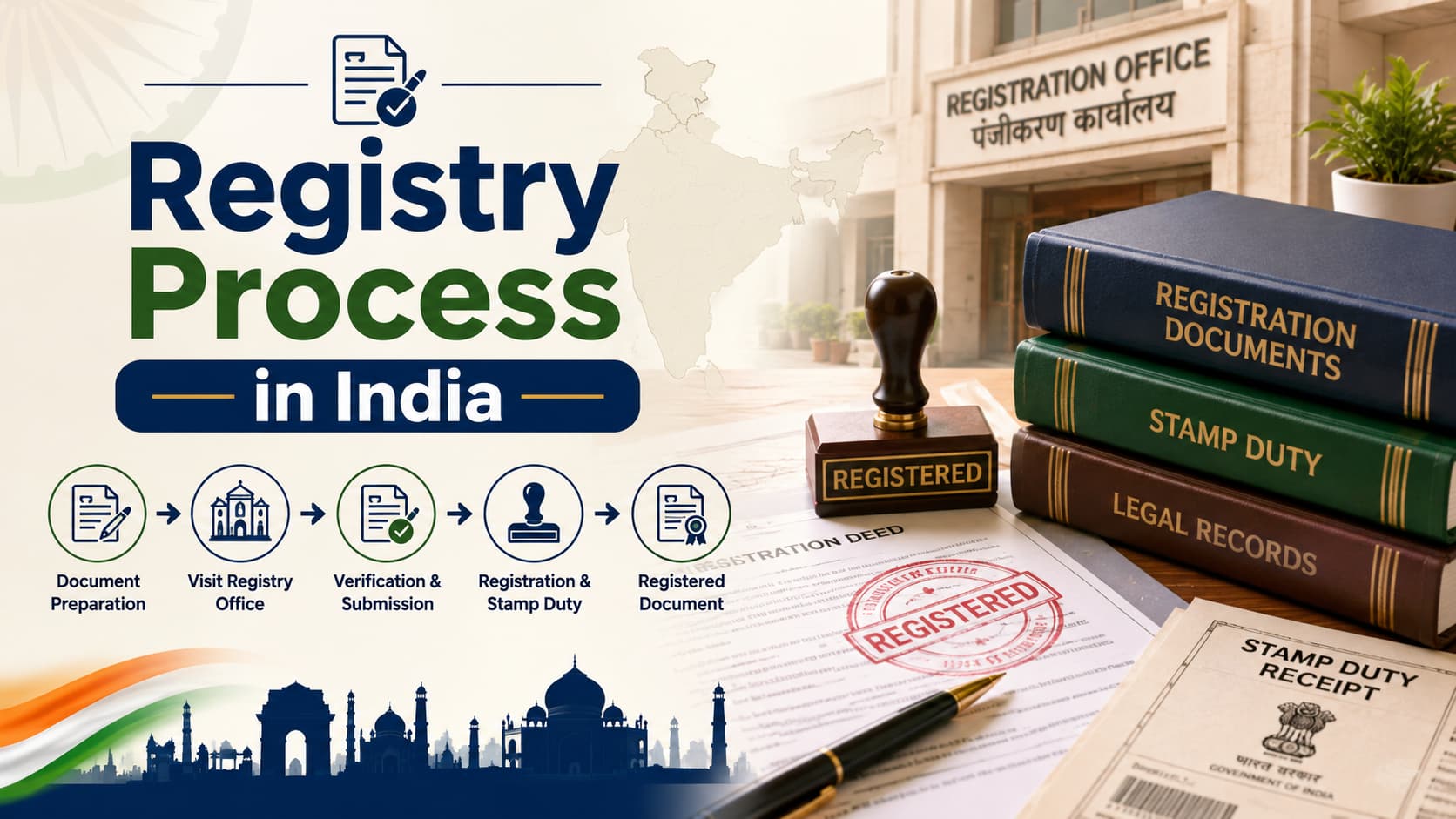
One of the most significant investments in a person's life is buying a house, but surprisingly, the most crucial step in the whole process remains largely unknown to most people. This is the process of Registry Process in India, the procedure of making a property sale legally documented in order to transfer its ownership to the buyer. Without completing the process, the buyer could pay for the property in full, get possession of the keys, but according to the law, he will not be the owner of the property. The Guide to Property Registration explains the whole procedure of registering a property in a layman's terms and will cover all steps from preparing documents to visiting the sub-registrar office. Regardless of whether you buy an apartment, independent floor or land, knowing the process of registration will help avoid any fraud, disputes, and other problems. Registry Process in India is referred to as the process by which the change in ownership of an immovable property takes place from the seller to the buyer and is made a part of the record with the government authorities. This is done through the process of registering the property at the office of the Sub-Registrar of Assurances under the Registration Act of 1908. Put simply, registry is the government seal of recognition of your ownership. This makes your personal contract between the two parties into an official one that can be accepted by courts, banks, and government agencies. After registering your property with your name, you get a legally valid title that will be necessary to sell the property in the future, take a home loan, or pass on the property to your successors. As per Section 17 of the Registration Act, any sale of immovable property having a value above a certain limit must be compulsorily registered. This makes it clear that the Registry Process is not just another formality but a legal process that is compulsory to follow. Many first-time buyers wonder if there is a way of not registering so that they could save on stamp duty and registration fees. The response is an unequivocal no. Unregistered deed of property will have very little weight in a court of law. This is how crucial the Process is: Ownership proof. A registered sale deed is the most credible document to prove your ownership of the property. Security from frauds. Registration helps establish a public record, making it much more difficult for a seller to sell the same property to multiple buyers. Eligibility for loan. Banks provide home loans only against properties which are registered and have a title deed. Easy resale. In case you wish to sell the property in the future, registration of all the documents will make the entire process hassle-free for the subsequent buyer. Relief of tension. With an accomplished registration, you do not have to worry about any future lawsuits and ownership conflicts. Preparation is the key to a smooth registration. Missing even one document can cause your appointment to be rejected or delayed. While requirements vary slightly from state to state, the following documents are generally needed for the Registry Process in India: Sale Deed vs Sale Agreement/Conveyance Deed Explained written on stamp paper of appropriate denomination. Buyer and seller sign an agreement regarding sale. Identities of both buyer and seller (through Aadhaar number, PAN card, passport, or voter ID). PAN card (necessary for all transactions above certain amount of money). Photos of buyer and seller in the size of passport. Documents proving property ownership and previous records of ownership. Encumbrance Certificate Guide certifying that property does not have any legal or financial liabilities. No Objection Certificate (Property NOC Guide) issued by concerned authority or housing society. Property tax and utility bills. Proof of stamp duty and registration fee paid. Identities of witnesses – usually two are necessary. If the property is being purchased through a home loan, the bank may also require a set of these documents, so keeping multiple certified copies ready is always a smart move. For a registration process to begin, the process must first be recorded in writing in two crucial documents that are usually misunderstood by buyers. The sale agreement is a binding contract that defines the terms and conditions for the sale, its cost, and the timelines involved, while the sale deed is the final document that transfers ownership. It is crucial to understand the difference between these two documents since a proper registry process revolves around these two documents, and it is only the sale deed that gets registered at the Sub-Registrar's office. For further information on the differences between a sale deed and a sale agreement, see this useful guide on sale deed vs sale agreement. Now let's walk through the actual step-by-step registration procedure. While minor procedural differences exist between states, the core sequence remains consistent across the country. Before everything else, ensure that the owner is the real owner and has the right to sell the property. Check the history of ownership for at least five years, get an encumbrance certificate, and make sure that there is no outstanding loan against the property. It is on this basis that you build a safe registry. After the due diligence process is complete, the lawyer/deed writer writes the sale deed. The sale deed must mention all the property information, sale amount, parties involved, and the method of conveyance. Go through the whole deed with care; making mistakes at this point is very costly to rectify later on. The stamp duty is an impost levied by the State on property transfers while the registration fee is another form of government impost levied for the registration of the document. The specific amount to be charged is based on the value of the property, location, and even the type of buyer because in many states, there are discounted prices for women buyers. Once the stamp duty amount is calculated, then you can pay the stamp duty either online using the e-stamping process or offline by buying stamp papers from authorized dealers. Remember to keep these payments safe as these receipts need to be shown at the time of registration. Paying insufficient stamp duty is the most common reason for registration delay. Today, many states have made it possible for buyers to schedule an appointment for registering the purchase online by selecting a suitable day and the appropriate Sub Registrar's office depending on where the property is situated. On the agreed date, both the buyer, the seller, and the two witnesses come to meet the Sub-Registrar. They sign the sale deed, place their fingerprints on the document, and present their photograph as well. They present the documents that support their claim. They verify identity and pay stamp duty. This meeting is the nucleus of the entire process of registry. Post-registration, the document will be scanned, recorded in the official record, and sent back to the buyer, which normally takes place within a period of a few days up to two weeks, depending on the state. When you have the registered sale deed with the Sub-Registrar's stamp and registration number, you become the rightful owner. The cost is one of the most crucial – as well as variable – components of the entire process. Since the stamp duty and registration fee are fixed by individual state governments, there can be a considerable difference between what you would be paying in Haryana versus Maharashtra, Karnataka, and Uttar Pradesh. In terms of benchmark figures, the stamp duty in most Indian states varies anywhere from 4% to 8% of the value of the property, whereas the registration fee stands at approximately 1% of the total value of the property (up to a maximum ceiling). There is also a concession of 1% to 2% in most Indian states for properties that are registered in the name of women. Since the rates are periodically updated, it is advisable to confirm the prevailing rate of stamp duty and registration fee for your city. Even a slight difference in percentages will have a huge bearing on the cost of a crores-valued property. Technology has eased some aspects of the process of property registration. In the case of the Indian Registry Process, one will find an interesting blend of technology and physical visits. Online processes include the payment of stamp duty via e-stamping, making appointments, and verification of documents. State governments have digitized their land records enabling the buyers to verify information about the ownership of the land and its encumbrances. The offline aspect is crucial too. The signing of the sale deed and its biometric verification need to take place in the Sub-Registrar's office. It means that even though you can do some initial processes online, you will still need to meet physically with the buyer, the seller, and the witnesses. While the process of property registration in India may be carried out within a similar framework of laws, the paperwork, verification of title, permissions, and other related documents can differ according to the type of property involved and other circumstances surrounding the transaction. It could be an apartment, builder floor, plot, independent house, or a resold property; the important thing is to check the appropriate documents before registering the property. The registration procedure usually requires checking the documents related to ownership and the transfer of the property. According to the case scenario, the buyer may have to see the documents like Sale Deed/Conveyance deed, previous ownership details, and the documents pertaining to the project. This would depend upon the nature of purchase as well. Either it is being purchased directly from the developer or the buyer is buying the property in a resale scenario. In any case, buyers should also cross-check the documents with the local authorities' records. In case of a plot or independent house, verification of the title is essential in the process of registration of the property. The buyers might have to verify the history of the previous owners, land use history, encumbrances, layout details, and necessary approvals for the construction/authorities. The list of documents will differ based on the location and land type. Thus, the process of registration of a residential plot might differ from that of a constructed independent house. In any case of resale, it is necessary that the history of the property's ownership be checked. In such cases, the buyers normally refer to sale deeds, transfers, titles and other records of the property to learn about the process of ownership. Another helpful measure is checking for encumbrances to see if there are any recorded claims or charges made on the property. This would help in settling outstanding dues and resolving any disputes prior to the registration process. In addition to that, there may also be extra requirements for agricultural lands and other lands falling under special categories. There may be differences in the terms and conditions of the land use, eligibility criteria, transfer conditions, etc., depending on the state laws. In the case of these lands, there may be additional requirements during the registration process apart from the sale deed and ID proofs. The buyer needs to clarify this beforehand. The registration process is also affected by the location of the property and the jurisdiction of the registration office that concerns the said property. Properties situated within various sectors, villages, municipalities, and developmental zones may have different sets of administration records and documentations. Buyers must confirm the proper registration jurisdiction, appropriate government fees, and the documents required prior to registration. The infrastructure, roads, facilities available in the vicinity, and development in the neighborhood will give buyers an idea about the place where the property is located but do not substitute the title and document check. Completion of the registry process is a huge achievement, but it is not the end of the process. The next process in the line would be the mutation process, also known as dakhil kharij process. It will help in making changes to the local municipality records with regard to property taxes. It may not bestow ownership rights like registration does, but it will definitely help in paying the taxes on behalf of your property. You must file for mutation immediately after completing the process and submitting the sale deed at the local municipality office. Even a straightforward transaction can go wrong if buyers overlook a few critical details. Watch out for these common pitfalls: Paying less stamp duty to save on cost, which may render the deed null and void along with inviting penalties. Missing out on title investigation and checking for any encumbrances before signing the documents. Neglecting to follow the sales agreement terms and directly proceeding to make a deed. Wrongly registering the documents at the Sub-Registrar's office that falls outside the area where the property belongs. Failing to undergo mutation after registering the documents. Avoiding these errors keeps your ownership secure and your future transactions hassle-free. Is property registration mandatory in India? Yes. Under Section 17 of the Registration Act, 1908, registering the sale of immovable property above the prescribed value is legally mandatory. An unregistered sale deed offers very weak protection of ownership. How long does the Registry Process in India take? The in-person registration at the Sub-Registrar office is usually completed in a single visit. Receiving the final registered document back can take anywhere from a few days to a couple of weeks, depending on the state and workload of the office. Can the entire Registry Process be done online? No. Several steps such as stamp duty payment and appointment booking can be done online, but the actual execution and biometric verification of the sale deed must happen in person at the Sub-Registrar office. What is the difference between registration and mutation? Registration legally transfers ownership and creates a public record of the sale. Mutation updates local revenue records for property tax purposes and should be done after registration. Who pays the stamp duty and registration charges? In most transactions, the buyer bears the stamp duty and registration charges, though this can be negotiated and mentioned in the sale agreement. "The Registry Process in India" refers to the critical process through which the acquisition of property becomes legal and official in terms of property ownership. The purpose of all steps from title verification to the sale deed preparation, stamp duty calculation, sub-registrar's presence and the rest is to ensure that your purchase is safe and you have a right to the property purchased. By pre-preparing documents, calculating stamp duty, picking the right sub-registrar's office and mutation thereafter, one can easily maneuver around the registry process without falling into disputes, which come unexpectedly to those who are not adequately prepared. Regardless of whether one buys in any busy sector in Gurgaon city or elsewhere, approaching the Process seriously will be the best thing for you to do in order to secure your most significant purchase in life.Registry Process in India: Complete Guide for Property Buyers
What Is the Registry Process in India?
Why Property Registration Is Legally Mandatory
Documents Required for the Registry Process
Understanding the Sale Deed and Sale Agreement
Step-by-Step Registry Process in India
Step 1: Conduct Title Verification and Due Diligence
Step 2: Draft and Finalise the Sale Deed
Step 3: Calculate the Stamp Duty and Registration Fee
Step 4: Pay the Stamp Duty and Registration Charges
Step 5: Book an Appointment at the Sub-Registrar Office
Step 6: Execute Registration at the Sub-Registrar Office
Step 7: Collect the Registered Document
Stamp Duty and Registration Charges Across States
Online vs Offline Registry Process in India
Registry Process for Different Types of Property
Apartment and Builder Floor
Plot and Independent House
Resale Property
Agricultural and Other Special-Category Land
Location and Local Authority Checks
After Registration: The Mutation Process
Common Mistakes to Avoid During the Process
Frequently Asked Questions
Conclusion