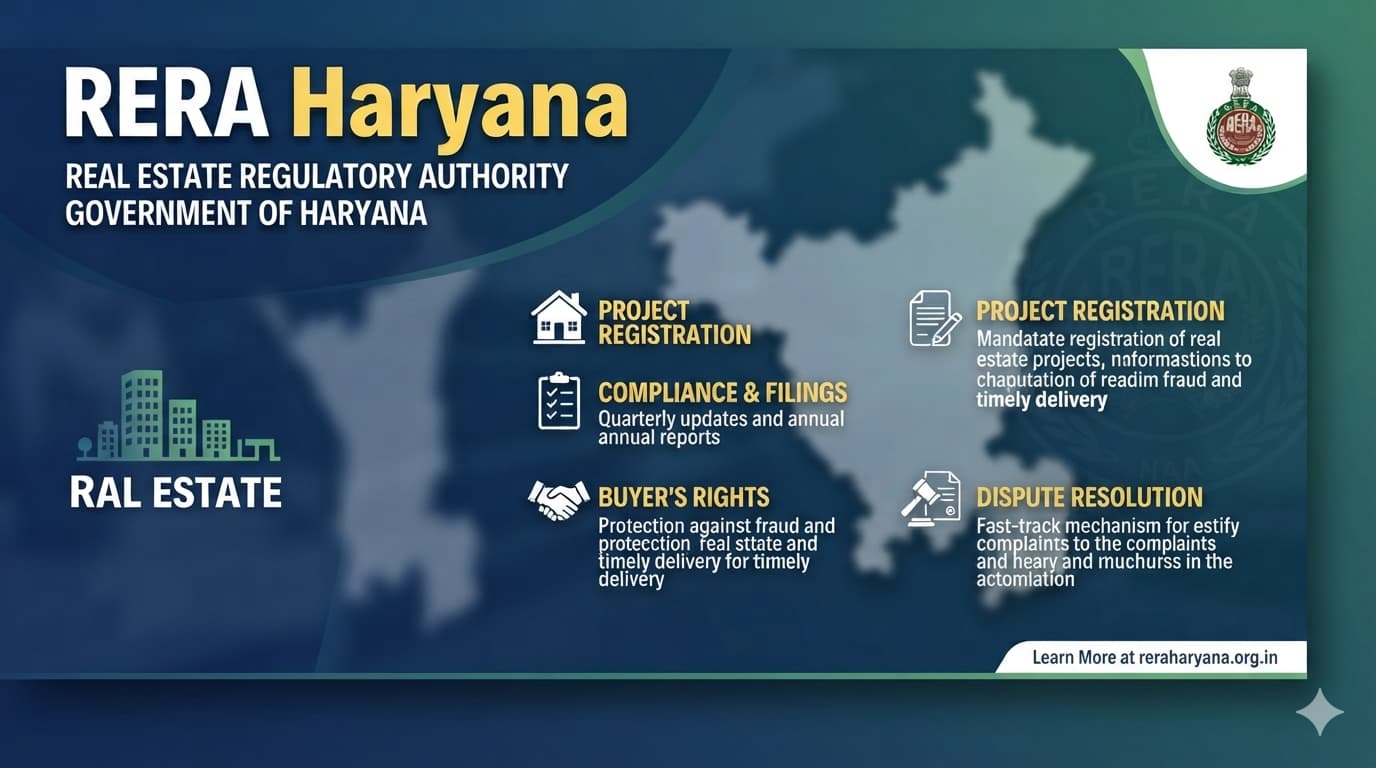
Buying property from any builder in Gurugram, Faridabad, or indeed anywhere in the broader NCR region, there is one organization standing between you and them – the RERA Haryana. That is why a developer can no longer fool you into buying a flat on the basis of glossy brochures and subsequently push back the date of possession by three years. That is why your booking amount is now placed in a separate escrow account rather than being used for some other construction somewhere else in the city. And that is the most potent weapon a regular consumer in Haryana has ever had at their disposal. However, most consumers remain in the dark regarding how RERA can help them, what a project registration number entails, and how they can file complaints against builders in case of default. This guide aims to cover all aspects – the registration process, consumer rights, the procedure of filing a complaint, penalties, and the necessary steps you can take before buying anything. The Real Estate (Regulation and Development) Act was introduced by Parliament in 2016, and all states had to create their own regulatory authority for its enforcement. In Haryana, this authority is known as RERA Haryana – or the Haryana Real Estate Regulatory Authority. What is somewhat special about this system in Haryana is the fact that there are two benches in total: one in Gurugram and another in Panchkula. The Gurugram bench works in Gurugram, Faridabad, Palwal, Mewat, Rewari, and Mahendragarh districts – this basically means that it deals with all real estate corridors in the state. For example, the projects bought in Gurugram on Dwarka Expressway or Sohna Road, as well as those in Sector 12 Gurugram, come under the jurisdiction of the Gurugram bench. The basic idea of this law is pretty straightforward: no developer may advertise, market, book or sell any apartment in a project of more than 500 square meters or eight units unless the project is registered with the regulator. Name of the Authority: Haryana Real Estate Regulatory Authority Year of Establishment: 2017 (RERA Act 2016) Bench Locations: Gurugram and Panchkula Area of Jurisdiction of Gurugram Bench: Gurugram, Faridabad, Palwal, Mewat, Rewari, Mahendragarh Website of the Authority: haryanarera.gov.in (Gurugram) & haryanarera.gov.in (Panchkula) Threshold for Registration: Projects more than 500 square meters or 8 units Prior to RERA Haryana, the entire Gurugram property market existed on the terms set out by the developer. The possession date was just an aspiration. There was no standardized concept of carpet area. The money invested in buying a tower at one site could be used by the builder to buy the land in some other place. In case of project delay, there was hardly any remedy for the buyer except taking a long-drawn fight in a consumer court. Here are the things that have changed in reality after implementation of RERA. The carpet area has been standardized. Now the developer has to sell the property on the basis of the actual carpet area and not on the super built-up area that included the clubhouse area as well. This brought about the fairness in comparing prices in different projects. The escrow account system safeguards your money. The 70% of the total money collected from buyers has to be deposited in a separate project account. A builder can no longer take your money for a tower on the Golf Course Extension Road and pump it into land somewhere else. Delays now cost the builder. If a developer misses the possession date registered under RERA, the buyer is entitled to interest on the entire amount paid, at the prescribed rate, for every month of delay — or a full refund with interest if they choose to walk away. This is the most useful lesson you'll learn from this entire guide, and one that you should always carry out prior to purchasing. Each project that registers gets a unique registration number, and all information related to registered projects is available on the portal maintained by the authority. The information can be found either through name of project, name of developer, location/district. The information provides you with a sanctioned plan, layout of the project, number of towers and units, registration date, performance of promoter, and most importantly the quarterly progress filing, which developers are obligated to do. If any project that is being offered to you isn't available on the portal or the developer doesn't provide a valid registration number, then this is an instant red flag. A project without a registration number is being sold in the area legally, regardless of its location being a premium road or developing sector. Always run this check no matter how high-profile the location may seem. The Act converted a long list of buyer grievances into enforceable legal rights. The most important ones are worth knowing verbatim. The five-year defect liability clause has been least utilized. In case there are any cracks, leaks, or plumbing problems within the first five years of possession, the developer will have to sort out the problem at no cost to you. If a builder defaults — on possession, on quality, on a promised amenity, or on refund — you do not need to start with a lawyer. RERA Haryana runs its own adjudication process, and it is deliberately built to be accessible. Step 1 — Gather your paperwork. The builder-buyer agreement, payment receipts, the project's registration number, and any written communication or advertisement you relied on. Step 2 — File online. RERA Complaints are submitted through the authority's portal against a nominal fee. You specify the project, the developer, the nature of the default, and the relief you are seeking — refund, compensation, or specific performance. Step 3 — Hearing. The matter is listed before the relevant bench. Both sides are heard. You can represent yourself, though many buyers with larger claims engage counsel. Step 4 — Order. The authority passes a binding order. If the developer fails to comply, the order can be executed as a recovery of dues — effectively treated like a revenue recovery, which gives it real teeth. The process is faster and cheaper than the older consumer-court route, which is precisely why it has become the default channel for aggrieved buyers across the Southern Peripheral Road and the newer sector developments. RERA is not a toothless registry. The Act prescribes serious financial consequences for non-compliance. The failure to register the project may result in a fine which is not more than 10% of the estimated project cost, with repeated failures incurring jail time. Deceptive advertisements earn fines amounting to a maximum of 10% of the estimated project cost. Failure to abide by the authority's directive results in a daily fine, which accumulates into a considerable percentage of the total project cost. Negligence with regard to structural defects leaves room for compensation claims by the owner. This has happened in several instances. There have been some developers operating in Gurugram who have had their projects subjected to recovery actions and fines. One thing that RERA Haryana achieved quietly but effectively is the professionalisation of the Gurugram market as a whole. Small developers using non-transparent accounting systems and changing deadlines found the process too cumbersome and have dropped out, leaving behind only bigger players who have adapted well and restored confidence in the corridors which have remained frozen for years. Nowadays, no matter if you are analysing a plot in a newly developed area, an apartment in a busy street, or a second-hand flat in an already developed one, the very first question that you should be asking yourself is whether the project is registered or not. This approach pays off. A registered project in a good area is indeed much safer today than it used to be 10 years ago. It is important to know the boundaries within which it will be applicable. RERA will apply to projects which are above the threshold size and planning areas which have been notified. Projects which are very small, below the threshold size of plotting and complete projects which have already been given their occupation certificate at the time of passing of the Act are not covered by it. So while RERA Haryana is your strongest shield for under-construction and newly launched projects, it does not replace the fundamentals: verify the title, check the conveyance and sale deed, confirm municipal approvals, and physically inspect the location and road access before committing. Not checking the registration number. A brochure claim is not registration. Verify the number on the portal yourself. Confusing project registration with agent registration. Both the project and the broker should be registered. Ask for both. Signing before reading the RERA agreement. The standardised agreement protects you — but only if the specific clauses match what was registered. Assuming the registered date is negotiable. The possession date on the portal is the legally binding one, not the salesman's verbal promise. Ignoring quarterly updates. Registered projects file progress reports. If they've stopped, that tells you something. Rely on it heavily if you are: Purchasing a half-finished flat from a builder Purchasing from a new launch in any corridor of Gurgaon Book off a floor plan which will take years to possession Anxiety about the past delivery record of the builder Do additional due diligence beyond RERA if you are: Purchasing a completed resale flat in an old colony Purchasing a plot whose value is less than the registration limit Purchasing a completed property which comes before the Act 1. What is RERA Haryana and who does it regulate? The RERA Haryana stands for the Haryana Real Estate Regulatory Authority and is constituted by the provisions made under the RERA Act 2016. It regulates all developers, real estate brokers, and projects in Haryana with the help of two benches located at Gurugram and Panchkula. The registration with it is mandatory for any project more than 500 square meters or eight units. 2. How do I check if a project is registered under RERA Haryana? Search the official portal for Haryana RERA through the names of the project, developer, or district to find out the registration number, sanctioned plan, number of units, registered date of possession, and quarterly update on the progress of the project. If the project is not listed, then it is not registered legally. 3. Does RERA cover both Gurugram and Faridabad? Indeed. The Gurugram bench of RERA deals with the areas of Gurugram, Faridabad, Palwal, Mewat, Rewari, and Mahendragarh. The other bench of Panchkula takes care of the rest of the districts. Thus, all of Haryana's valuable properties fall under RERA's purview. 4. What happens if a builder delays possession under RERA? When there is a failure of possession for any registered project beyond the possession date, the purchaser has the right to receive interest on the total payment made in respect of each month of delay at the prescribed rate or a refund with interest. 5. How do I file a complaint with RERA Haryana? Complaints are made on the RERA website at the cost of an affordable fee. All that you need to do is attach the buyer-builder agreement, proof of payments, registration number of the project, mention the breach of contract and relief sought. 6. Is my booking money safe under RERA? Largely, yes. RERA requires 70% of the funds collected from buyers to be held in a separate escrow account tied to that specific project, withdrawable only against certified construction progress. This prevents developers from diverting your money to other projects. 7. Does RERA Haryana apply to resale flats? No, generally not. RERA basically applies to construction sites and new launches. Ready resale flats in old colonies will be governed by sale deeds. It is always advisable to check on the title and approvals yourself when purchasing any resale flat. 8. Can real estate agents operate without RERA registration? No. Registered agents in relation to registered projects need to be registered under the RERA Haryana. It would be a wise decision on your part to know the registration number of the broker before engaging him. 9. What penalties can a developer face under RERA? The penalty for not registering is an amount not exceeding 10 percent of the cost of the project and also may lead to imprisonment for not adhering to the same. False advertising is punishable by the same way. Non-compliance with the directives of the authority leads to daily fines. 10. Does RERA registration guarantee a project will be completed? RERA considerably lowers risks but does not provide a complete assurance. Transparency, escrow account safety, compensation for delay, and discouragement of incompetent developers are the features of RERA. You need to evaluate the past performance, financial strength, and exact locality before purchasing the property. RERA Haryana represents a transformative framework designed to protect homebuyers, investors, and real estate professionals in Haryana. Understanding the RERA Haryana regulations is essential for anyone buying, selling, or investing in property within the state. The Real Estate Regulatory Authority has established comprehensive rules that govern property transactions, ensuring transparency, accountability, and fair practices across the entire real estate sector. Whether you're purchasing your first home or making a significant investment, knowledge of local property rules empowers you to make informed decisions and protect your interests. Before finalizing any property purchase in Haryana, conduct a RERA Project Search to verify project legitimacy and developer credentials. Ensure that your builder has completed RERA Registration and that your chosen project is officially registered with authorities. Understanding RERA Agent Registration requirements helps you identify authentic real estate professionals who operate within regulatory compliance standards. Additionally, familiarize yourself with Building Bye Laws that govern construction standards and property development in your specific locality. Knowledge of RERA Possession Delay & Compensation provisions protects you if developers fail to deliver projects on schedule. Should you encounter disputes or violations, understanding how to file a RERA Complaint ensures you have recourse through official channels. Together, these protections create a secure property investment environment for Haryana residents. RERA Haryana has been the biggest transformation the property market of this state has ever witnessed. It tilted the balance of power from being developer-centric to being consumer-centric. It ensures standardisation of carpet area, keeps your money safe, ensures possession time line and provides you a quick and cost-effective redressal mechanism whenever a builder fails to meet his obligations. However, RERA can only protect those buyers who follow it. The process is fairly simple: cross check the registration number before you shell out even a rupee, review the standardised agreement against the registered one, monitor the quarterly updates and never let the brochure take precedence over portal verification. Apart from that, do your basics as well. Verify the title deed, understand the sale deed and the reality of connectivity at the location, whether that's the Dwarka Expressway corridor, the Sohna Road belt, or an established pocket like Sector 12 Gurugram. The authority won't chase the developer on your behalf until you file. The tools are there. You have to pick them up.RERA Haryana Guide to Registration & Complaint Process
What Is RERA Haryana?
Quick Facts About RERA
Why RERA Matters So Much for Buyers
How to Verify a Project on RERA
Buyer Rights Under RERA
The RERA Complaint Process
Penalties Developers Face
RERA Haryana and the NCR Property Market
What RERA Does Not Cover
Common Mistakes Buyers Make with RERA
Who Should Rely on RERA Haryana
Frequently Asked Questions
Understanding RERA Haryana: Your Protection Guide
Final Thoughts