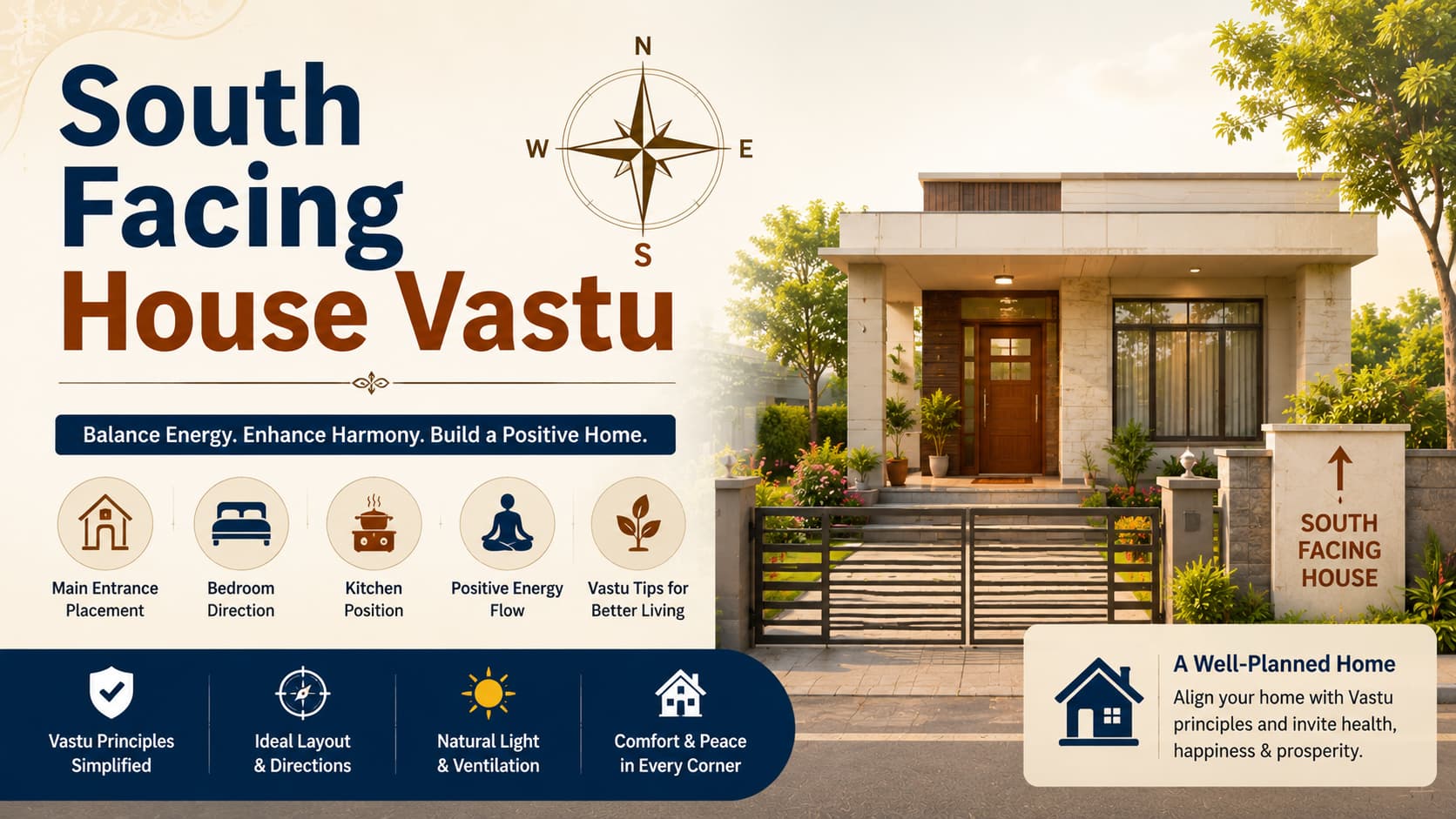
South Facing House Vastu: Dos, Don'ts & Remedies for a Prosperous Home Have you ever been on a home hunt on the Internet? If yes, then one thing would have definitely caught your eye - the advice to "avoid south facing homes as they give you bad luck". Such a popular misconception leaves many buyers without a house which, otherwise, could suit their expectations perfectly well. However, there is one important piece of information that nobody tells you – the given orientation is NOT bad in Vastu Shastra! Many of the richest and most famous Indian constructions, including business centers and even government offices, have the same orientation. The key aspect that makes the property bad or good is not only its direction but the way of the planning of the plot, entrance door and rooms inside it. This article will completely dispel your doubts regarding this question. You will find out all the recommendations of Vastu Shastra concerning south facing houses, their right layout, possible mistakes and ways to correct the problem even if your current construction does not correspond to ideal. This is due to a misconception about energy in the direction. According to Vastu, the north-western direction is governed by Yama, the god of death and disciple, and it relates to the element fire and the energy of ancestors. As a result, people believe this direction is negative. In reality, Vastu Shastra does not have anything to do with classifying directions as "positive" or "negative." Vastu Shastra is the practice of balancing five elements in a building: earth, water, fire, air, and space. This direction symbolizes strength, stability, and power when done properly. A house in this direction will lead to: The main entry is located in a good pada (section) of the respective wall. There is a raised platform of the building on that side and in the western direction. Room positioning inside the building occurs in accordance with natural elements. So the true answer is: It's not an issue, if the property is constructed and utilized properly. An improperly constructed northern-oriented house can be more problematic than a properly constructed house in any other orientation. Orientation is just one factor among others that goes into making Vastu - layout and balance are also important factors. Before construction even begins, the plot itself plays a major role in determining how favorable your home will be. Here's what to check when evaluating a plot with this orientation: The presence of a plot where the road comes straight in front of it is considered good provided the road is broad and the plot has enough space. The narrow roads coming straight to the entrance cause formation of pressure zones and these need to be rectified. Plots that are square or rectangle-shaped are perfect. Irregularities in a plot, particularly when a corner is missing in the northeast or southwest, tend to disrupt the energy flow of the property compared to others. Ideally, the plot would be positioned higher towards this side and western direction and lower on the side towards north and east. With such an orientation, the water will flow towards north/north-east, which symbolically invites prosperity into the house while grounding the “heavier” energy of that part of the plot. It is necessary to ensure that there are no large water bodies, crematoriums, or dead-end roads facing the entry point, since they intensify negative energies irrespective of the quality of the plot. It becomes much easier to correct any other Vastu dosha within the home after getting the basics of the plot sorted out. When the storyline is settled, it is the proper interior planning that actually decides the energy of this home. This is the checklist of do’s for each section of this property. The entrance is by far the most crucial aspect to be designed correctly. Instead of positioning it in the middle of the concerned wall, according to Vastu Shastra, one should divide the concerned wall into nine equal segments (padas), and position the entrance within the 4th, 5th, or 6th pada, which means within the southeastern to middle section of the concerned wall. Agni (fire) governs the southeast sector in the house, and it is best suited for the kitchen. As the kitchen already contains fire, putting it in the southeast will add strength to the energy within the house rather than create any imbalance. While cooking, one must face the eastern direction. The southwest area is believed to be where one can find stability, power, and lasting relationships. As such, this is the best place to have the master bedroom. The bed must be positioned in a way that its head faces either that area or the eastern direction. North and northeast areas possess a light, spacious, and inviting energy, making them ideal locations for a living room to welcome guests. This helps balance the heavy energy in other parts of the house layout. This northeast area, also referred to as Ishaan corner, is known to be the most sacred corner in any house. In a house with such an orientation, assigning the northeast corner for the pooja room serves to balance out the fiery energy of the other corners. The staircase is preferably constructed in the southwestern or western part of the house in a clockwise direction when seen from underneath. This helps in providing weight to the area, which is suggested by Vastu principles. Position bathrooms in the northern or northwestern sections, and make sure that toilets do not occupy the northeastern or central parts of the house, since these areas are believed to be the most sensitive energy-wise.. As buildings built in this orientation get exposed to bright afternoon sunlight, the building will require bigger windows and ventilation from the north and east directions, but keep the walls on the other two directions relatively more closed. "Don'ts": Common Vastu Blunders to Prevent While the best intentions may lead one to make some mistakes that can offset the advantages of constructing a well-built property, here are the mistakes you should avoid: Do not position the entrance door in the southwest. The southwest direction should be the most solid and closed direction of the building; having an entrance door here would be the worst among all Vastu flaws. Do not construct ct underground water tanks or borewells in the southwest. Water is connected to the north and northeast directions; its presence here causes elemental conflict. Do not clutter, enclose or neglect the northeast corner. This will weaken the only zone that should counteract fire energies in your home. Do not construct any extensions or increase height on the north and eastern sides of the plot compared to the rest of your property. Elevation should always be at the opposite side of the plot. Do not locate your septic tank in the northeast direction. It is very inauspicious to have a septic tank in such a sensitive zone. Do not leave your southwest corner light and airy; do not build a garden, swimming pool, or an open porch here – this zone should be the densest and most enclosed part of your home. The pada of the entrance should never be neglected. Just having an appropriately placed door is not sufficient; placing your door in an inappropriate pada (such as the far southwestern corner) will negate the positive aspects of good room placement. Not everyone can build a house from scratch or move to a new property. If you're already living in a home with this layout and some Vastu deviations, these remedies can help balance the energy without structural changes. Placing a small Vastu pyramid, Swastik symbol, or Vastu Dosh Nivaran Yantra near the main door is one of the most commonly recommended remedies for correcting entrance-related defects. If the main door faces an inauspicious pada or a defect exists on that wall, placing a concave or convex mirror (as recommended by a Vastu consultant) on the inner side of the entrance is believed to deflect negative energy. Placing a bowl of rock salt (sendha namak) dissolved in water in the southwest or affected corner, and changing it weekly, is a traditional remedy said to absorb negative energy. Placing a Tulsi (holy basil) plant just outside or near the main entrance is considered one of the simplest and most effective remedies to purify incoming energy. Since this direction is associated with fire, using warm tones like red, orange, maroon, or terracotta on the relevant wall (inside or outside) strengthens the elemental alignment. Avoid excessive blue or black in this zone, as these colors clash with the fire element. If the southwest zone feels "light" due to layout constraints, placing heavier furniture, wardrobes, or storage units there can help simulate the grounding effect Vastu recommends for this corner. Simply decluttering and lightening the northeast zone — even if you can't relocate rooms — has a noticeable effect according to Vastu practitioners. Keep this corner clean, well-lit, and free of heavy storage. Hanging a metal wind chime near the main entrance is a popular remedy believed to break up stagnant energy before it enters the home. If your water tank is already located in the southwest due to construction constraints, adding a Vastu remedy such as a copper coin or Vastu yantra near the tank is often suggested as a corrective measure. While these remedies help balance minor defects, significant structural issues (like a main door in the extreme southwest) are best addressed with the guidance of an experienced Vastu consultant before undertaking renovation. Myth: Houses that face south lead to losses financially. Fact: Money matters will be determined by many factors such as entrance, interior design, and even hard work. Myth: Never purchase land with this orientation. Fact: There are many profitable structures that have this orientation. The important thing is the proper pads of entry and proper zoning of elements. Myth: There is no way to fix such a house after construction. Fact: Though planning right from the beginning is best, there are numerous ways by which one can rectify a house that already exists. Myth: This orientation means the entire house has negative energy. Fact: Vastu evaluates each zone of the house individually. A home like this can have excellent northeast, southeast, and southwest zones if planned properly, offsetting any minor concerns tied to the entrance's orientation. Q1. Is south facing house bad according to Vastu? No. This orientation is not inherently bad. It becomes problematic only when the entrance is placed in an inauspicious pada or when room placements go against Vastu's elemental balance. Correctly planned, such homes can be highly prosperous. Q2. Which pada is best for the main door in a home with this orientation? The 4th, 5th, or 6th pada (roughly the southeast-to-central zone) is considered most auspicious for the main entrance. Q3. Can plots with this orientation be used for residential construction? Yes, such plots are commonly used for residential and commercial construction. Following proper Vastu guidelines for slope, entrance placement, and room zoning ensures the plot supports positive energy flow. Q4. What is the best remedy for an entrance facing this direction? Placing a Tulsi plant, Vastu pyramid, or Swastik symbol near the entrance, along with using warm colors on the relevant wall, are among the most effective and easy-to-apply remedies. Q5. Where should the kitchen be placed in a home with this layout? The southeast zone is ideal for the kitchen in any home, since it aligns with the fire element. Q6. Is it okay to have a garden at the rear of such a property? A garden or open space is more favorable in the north or east portions of the plot rather than the southwest, which should ideally remain more solid and enclosed. Q7. Do properties with this orientation cost less to buy? In some regions, due to lingering myths about the direction, such properties may be priced slightly lower — which can actually be an advantage for informed buyers who know how to apply the correct Vastu layout and remedies. South Facing House Vastu has historically been misunderstood as inherently inauspicious, yet modern Vastu practitioners recognize that south-facing homes are entirely capable of attracting prosperity, health, and harmony when properly optimized. The key to success with South Facing House Vastu lies in intelligent implementation of Vastu for Home principles tailored to this specific orientation. Unlike North Facing House Vastu homes that naturally attract wealth energy, South Facing House Vastu requires strategic color choices, careful Door Direction placement, and intentional room arrangements to transform its fire element energy into consistent prosperity. Your Main Door Vastu positioning becomes critically important in south-facing homes, requiring placement in the third or fourth pada (zone) for optimal energy flow. Implementing Vastu Tips for Kitchen Vastu placement, Bedroom Vastu orientation, and Bathroom Vastu positioning becomes especially effective when aligned with south-facing dynamics. Your Pooja Room Vastu should maintain proper distance from the main entrance, while Staircase Vastu and Balcony Vastu arrangements should enhance rather than drain energy. Conclusion: Direction Is Just the Starting Point The idea that buildings oriented to the south are unlucky may be one of the longest-running real estate misconceptions around, as well as the least accurate. The Vastu Shatra does not forbid any direction; all that is required is balance. As long as your building has been designed with appropriate placements of entryways, elements, and a little bit of remediation, there is no reason why it won’t thrive. Regardless of whether you are assessing a piece of land for purchase or looking to implement solutions for your existing building, here is the basic lesson to take away from this discussion: concentrate on design and balance, and not the fear of a particular orientation. Your building will turn out to be a true bastion of stability and prosperity.Is a South-Facing Home Bad? Here's What Vastu Really Says
Plot Vastu Guidelines Before You Buy
1. Road Position
2. Plot Shape
3. Elevation and Slope
4. Surrounding Structures
Complete Room-by-Room Vastu Guide (Dos)
Main Entrance
Kitchen
Master Bedroom
Living Room / Drawing Room
Pooja Room (Prayer Room)
Staircase
Bathroom and Toilet
Windows and Ventilation
South Facing House Vastu Remedies: Practical Fixes That Actually Work
1. Vastu Pyramid or Yantra at the Entrance
2. Mirror Corrections
3. Salt Water Remedy
4. Tulsi Plant Near the Entrance
5. Color Correction
6. Heavy Furniture Placement
7. Correcting Northeast Clutter
8. Wind Chimes and Bells
9. Sump or Water Tank Correction
10. Consult Before Major Renovation
Myth vs. Fact: Setting the Record Straight
Frequently Asked Questions (FAQs)
Mastering the Dynamics of South Facing House Vastu