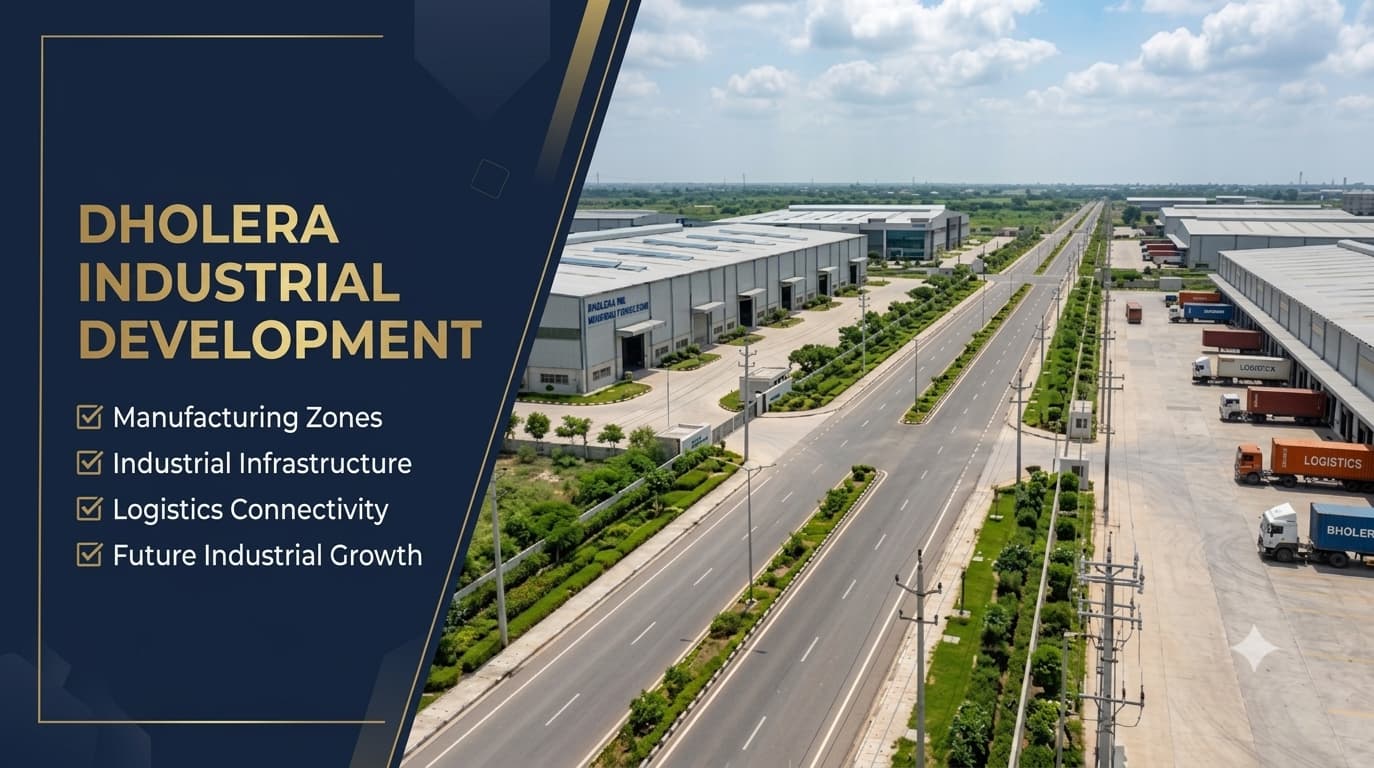
Industrial development is among the main reasons for planning of Dholera SIR. Although the project has gained popularity due to the smart city concept, its sustainable functioning in the long term largely depends on the development of an industrial environment that would foster manufacturing, logistics, technology, and economic development. Thus, Dholera’s industrial development has been provided for by designing industrial zones, infrastructure, transport network, and utility systems in order to create a structured business environment for various industries. Such an approach makes Dholera distinguishable from conventional industrial estates whose development takes place progressively. Industrial estates that develop in the proximity of existing cities, Dholera has adopted a greenfield approach to planning whereby the infrastructure of industries, transport facilities, utilities, residential zones, and commerce centers are planned together. Such an approach makes industries function within the confines of the developing region rather than within an existing city with its limitations. Thus, when choosing the industrial project, businesses should have an idea about both particular industrial zones and the whole infrastructure. Many businesses researching dholera industries, dholera industrial area, or industries in dholera are interested in understanding how industrial planning is structured, which sectors are expected to operate in the region, and what infrastructure has been planned to support industrial activities. Rather than focusing on promotional claims, this guide explains the planning framework, industrial ecosystem, connectivity, and infrastructure that contribute to Dholera's industrial development strategy. Understanding these aspects enables businesses, investors, and researchers to evaluate the region from a long-term planning perspective. The development of industries in Dholera follows a pre-planned framework whereby the manufacturing centers, logistics, transport systems, utilities and other business facilities are organized to form an ecosystem. The planning process does not entail forming separate industrial centers but instead aims to develop an environment where industries can thrive using the well-organized infrastructure and connectivity. According to the planning framework, for an industrial region to be successful, there is much more that is required apart from just manufacturing centers. This includes proper transportation systems, utility systems, telecommunication infrastructure, water management and electricity among others which help enhance industrial production. Industrial planning is also closely connected with the overall Dholera Smart City vision because industrial growth, residential development, commercial activity, and public infrastructure are expected to evolve together. Businesses considering future operations in the region should therefore evaluate industrial opportunities within the broader planning ecosystem instead of analysing industrial land in isolation. The multi-sector approach of Dholera is another important feature that has helped in creating an industrial growth plan for the city. Instead of developing only one particular industry, the plan focuses on developing various other manufacturing industries to boost the economy in the future. Diversification of the industrial cluster usually strengthens its resilience because no particular industrial sector is heavily relied upon while working together with each other. There are several sectors in the manufacturing industry which have been linked with the region’s industrial planning owing to the infrastructure required, logistics and growth potential in the long run. These sectors include engineering, electronics, renewable energy, defence manufacturing, pharmaceuticals, chemicals, logistics, and warehousing. Businesses evaluating dholera industrial projects, dholera manufacturing hub, or dholera industrial park should therefore consider not only individual industrial sites but also the surrounding ecosystem that supports manufacturing operations. Infrastructure, transportation, utilities, and business services all play important roles in determining how efficiently industrial facilities can operate. Industrial infrastructure is an essential component for a productive and efficient manufacturing area. The production facilities need proper roads, continuous electricity supply, water facilities, communications network, drainage facilities, and logistics to continue their efficient work. Considering these needs, the planning of Dholera focuses highly on the development of infrastructure that can meet the demands of future industrial growth. Planning of infrastructure is not confined to physical infrastructure only. With the emergence of modern industrial eco-systems, there is a need for digital connection and smart management of infrastructure. Efficient transport system is one of the top requirements for an industrial area because the availability of raw materials, products, machines, and labor force requires effective connectivity. Various transport projects have been considered in the case of Dholera in order to enhance the connectivity in the area and provide support to the industrial activities in the region. There has not been any emphasis on a specific mode of transport because the transport network in the region includes road connectivity, air connectivity, logistics, and future freight transport. Road connectivity is anticipated to be the most dominant factor for supporting industrial activities in the region. Efficient transportation networks could help in saving time and enhancing connectivity between the manufacturing units and the centers of commerce. The integration of transportation infrastructure with industrial planning can improve the movement of raw materials, finished products, equipment, and workforce across the region. Businesses evaluating dholera logistics, dholera freight corridor, or dholera industrial corridor should therefore assess how transportation projects support their operational requirements rather than considering industrial land availability alone. Get detailed transportation information can explore the Ahmedabad Dholera Expressway, and Dholera Distance, which explain how regional connectivity contributes to the overall development framework. Industrial sites vary from one another in terms of the benefits that they offer depending on the infrastructural facilities, the quality of planning involved, their accessibility, and expansion prospects. Dholera industrial planning aims at having a well-planned development setup whereby industries will be operated in a region that is ready for future expansion rather than adjusting to the current urban constraints. The benefit of such an approach to planning has seen the region becoming a focus of interest for firms considering their future industrial plans. Industrial planning on a large scale has the potential of giving several benefits including infrastructure facilities, utility planning, transportation network, and the presence of industrial zones. Businesses researching dholera industrial infrastructure often evaluate how different infrastructure components work together rather than reviewing them individually. Reliable utilities, transportation access, logistics support, and organised industrial planning collectively contribute to the operational environment. These factors are generally more important for long-term industrial planning than promotional marketing or short-term announcements. The modern industrial regions have been increasingly considering balancing between manufacturing expansion and resource efficiency. The planning system of Dholera includes utility connections, infrastructure planning, transportation and technology that are planned to aid industrial processes in the long run through efficient means. Sustainability in industrial planning is not only an environmental issue but also involves efficient land utilization, efficient distribution of utilities, transportation planning, digitalization of infrastructure and public services. This makes possible industrial environment which can sustain future technological developments and manufacturing needs. Industrial regions normally evolve through a number of stages, and hence companies need to know that the development of infrastructure, transport systems, and related facilities is a lengthy process. Although long-term planning presents many possibilities, it also demands that organizations adapt their plans to realistic development timescales rather than expect full functionality within the whole region in a very short time. The development of infrastructure can be different in various development areas, and therefore it is necessary for companies to confirm the existing state of infrastructure at their particular location rather than at the regional level. The process of industrial development must not be seen as something that stands alone in Dholera. It is one of the components of an integrated development plan that combines industries, transportations, utility, commerce, and residential development into a coherent whole. The integration is done to create an atmosphere that could sustain industries at various stages of their development and to promote diversification. Transport development like the Ahmedabad-Dholera Expressway, the upcoming international airport, logistics corridors, and regional road network improves the accessibility for industries. At the same time, residential developments help create houses for the future, while commerce supports businesses needed by industries. What is Dholera Industrial Development? Which industries are planned in Dholera? Is Dholera an industrial hub? What is the Dholera industrial corridor? How does Dholera support manufacturing industries? What role does the Ahmedabad–Dholera Expressway play? How is Dholera International Airport connected to industrial development? Why is logistics important for Dholera industries? Should businesses verify industrial projects before investing? Dholera Industrial Development represents the economic base of the Dholera Special Investment Region through the integration of manufacturing, logistics, transportations, utilities, and smart infrastructure under one holistic planning process. Instead of establishing segregated industrial zones, Dholera takes a holistic approach where industrial development is driven by modern infrastructure, land use planning, and connectivity. A diversified industrial system, which includes manufacturing, logistics, transportation, and utility sectors, has the possibility of fostering business activities and economic growth in the region. Meanwhile, it is important for companies to take an objective assessment of the industrial sector in terms of legal documents, infrastructure development, connectivity, feasibility studies, and timelines before deciding to conduct business activities. The industrial development is also linked to residential, commercial, airport, expressway, and smart city developments. Through the knowledge of these different elements, companies, researchers, and investors can obtain a more comprehensive understanding of the Dholera development plan and its place in the growing Gujarat industry.Dholera Industrial Development
Understanding the Industrial Development Framework
Major Industrial Sectors Planned for Dholera
Industrial Infrastructure Supporting Manufacturing Growth
Industrial Connectivity and Logistics Advantage
Why Industries May Choose Dholera
Industrial Development and Sustainable Planning
Challenges and Practical Considerations
Industrial Development Within the Dholera Ecosystem
Frequently Asked Questions
Dholera Industrial Development refers to the planned industrial ecosystem within the Dholera Special Investment Region (SIR). It includes industrial zones, manufacturing areas, logistics infrastructure, utility networks, transportation connectivity, and supporting facilities designed to encourage long-term industrial and economic growth.
The industrial planning framework includes sectors such as engineering, electronics, renewable energy, defence and aerospace, pharmaceuticals, chemicals, logistics, warehousing, and other manufacturing industries. The final establishment of industries depends on business investment decisions and regulatory approvals.
Dholera is being developed as a planned industrial and economic region supported by modern infrastructure, transportation projects, and smart city planning. Its objective is to create an integrated ecosystem for industries, businesses, logistics, and urban development.
The term generally refers to the planned industrial connectivity supported by transportation infrastructure, logistics networks, regional road systems, and the broader Delhi–Mumbai Industrial Corridor (DMIC) framework that includes Dholera as one of its major development nodes.
Manufacturing is supported through planned industrial zones, utility infrastructure, transportation connectivity, organised land-use planning, logistics facilities, and future-ready infrastructure designed for long-term industrial operations.
The Ahmedabad–Dholera Expressway improves regional road connectivity, supports industrial transportation, reduces travel time, and strengthens logistics movement between Dholera and surrounding economic centres.
The planned airport is expected to strengthen regional accessibility by supporting business travel and future air cargo movement, complementing the region's industrial and logistics infrastructure.
Efficient logistics improves the movement of raw materials, finished products, industrial equipment, and supply chains. Transportation infrastructure and logistics planning are therefore essential components of Dholera's industrial ecosystem.
Yes. Businesses should independently verify land ownership, regulatory approvals, infrastructure readiness, utility availability, planning compliance, and project documentation before making any industrial investment decisions.Conclusion