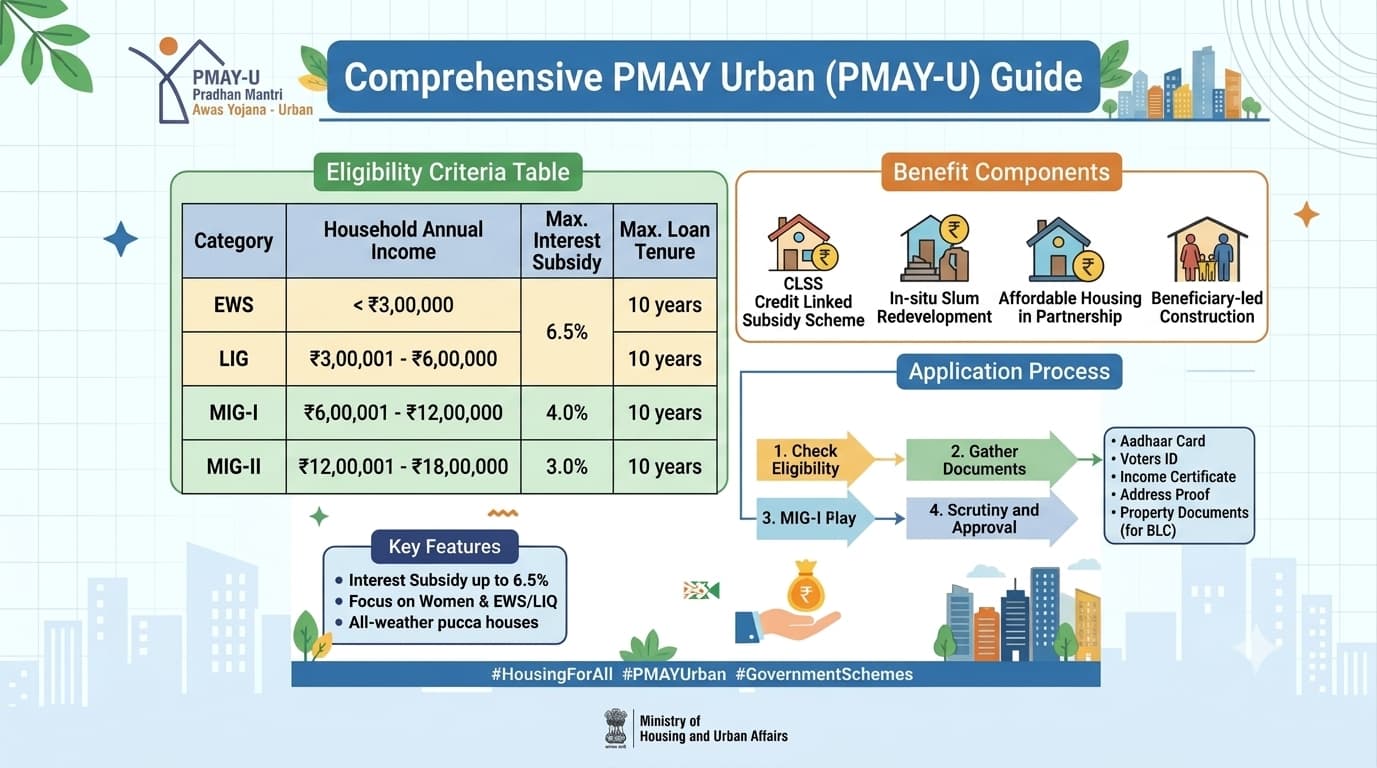
PMAY Urban is the name you’ve heard repeatedly during the decade that you’ve been looking to purchase a house in any major Indian city. But you have also left confused, since there are four verticals, two phases, income slab that has undergone changes, and an entirely new subsidy pattern that was introduced upon relaunching of this scheme. The articles found on the internet are talking about the 2017 scheme and are largely irrelevant now. This guide talks about the scheme as it exists today – how the verticals work, who qualifies for which vertical, what subsidy is actually available, how to apply, and what determines the success or rejection of your application in the next 6 months. Pradhan Mantri Awas Yojana-Urban is the housing scheme by the Government of India for urban areas, which is governed by the Ministry of Housing and Urban Affairs (MoHUA). The purpose of the scheme is rather simple: to ensure each qualified urban household receives a pucca home with basic facilities. The scheme has been introduced in 2015 under a timeline that has now been extended and reorganized. The current phase of the scheme, which is PMAY-U 2.0, has been sanctioned with the requirement to help another one crore urban households within a span of five years. These are two separate missions under the same umbrella name, and conflating them is the most common source of confusion. If your property is in a city, a statutory town, or a notified urban area, PMAY Urban applies. If it's in a village, PMAY-G applies. There is no overlap and no choosing between them. The math is straightforward. On an average home loan, the amount of subsidy available through PMAY scheme amounts to anything between ₹1.8 lakh and ₹2.67 lakh, which gets credited to the loan principal. Over a period of twenty years, this accumulates to about ₹4 lakh and ₹5.5 lakh in interest savings. For a family planning to buy an affordable segment flat, it doesn't matter whether it is a DDA flat in Delhi or an affordable housing society in New Gurgaon or state housing board flat in any Tier-2 city; such a sum of money means a lot when it comes to the purchase price. This forms the backbone of the process, and your knowledge of it will help you determine the right application procedure. Vertical 1: Beneficiary-Led Construction (BLC) Description: Financial aid provided directly to eligible families who have land and would like to build a home on it or upgrade their current kutcha/semi-pucca home into a pucca home. Target group: EWS families having land in an urban location. Type of assistance: Grant, not subsidy on a loan. The central assistance is paid out in instalments based on progress in the construction process; states supplement the same. Important criterion: Proof of legal ownership of the land by the beneficiary family. This is the point where most BLC applications fail because informal/undocumented land ownership does not make it. Interesting fact: BLC is managed through Urban Local Bodies. You need to contact the municipal corporation, not the bank. Definition: Collaboration between government and public bodies/developers for the development of affordable housing schemes. Units in such schemes can be purchased by eligible EWS households at subsidised prices with central assistance provided to bring down the unit cost. Eligibility: EWS households not owning land who want to buy a ready unit. Assistance: Central assistance per unit in an approved project, resulting in reduction in the price of the unit being bought by the beneficiary. For PMAY-U 2.0 scheme, there is a possibility of additional assistance for such projects which satisfy specific parameters of affordability and quality. Essential condition: The scheme/project should be approved under AHP. It is not possible to buy a flat and receive AHP assistance. Practice point: This is the vertical which is most pertinent for buyers where there is a state-level affordable housing policy in effect. Such projects under Haryana Affordable Housing Policy along the Sohna Road or Southern Peripheral Road corridor come under this vertical from time to time. What it is: Creation of a formal, affordable rental housing stock for urban migrants, industrial workers, students, and the urban poor who don't want to — or can't — buy. Who it's for: Urban migrants and working poor who need dignified rental accommodation near their workplaces. Two models: Model 1: Conversion of existing government-funded vacant houses into rental complexes, operated through public-private partnership or by public agencies Model 2: Construction, operation, and maintenance of new rental housing by public or private entities on their own land, with government incentives Assistance: Not a subsidy to the individual. Incentives — including technology innovation grants, tax concessions, and expedited approvals — flow to the entity creating the rental stock. Practical note: ARH is the least-understood vertical because it doesn't put money in an individual's hand. Its value shows up as availability of decent, regulated rental housing near industrial and commercial clusters. What it is: The successor to the old Credit Linked Subsidy Scheme (CLSS). This is the vertical most homebuyers actually engage with — an interest subsidy on home loans, credited upfront to the loan account. Who it's for: EWS, LIG, and MIG households taking a home loan to buy, construct, or enhance a house. Assistance under PMAY-U 2.0: Subsidy available on first Rs 8,00,000 of the home loan Loans up to Rs 25,00,000 On houses valued up to Rs 35,00,000 Income criteria of household up to Rs 9,00,000 Subsidy rate – 4% interest subvention Maximum subsidy – Rs 1,80,000 in 5-yearly installments Duration of This is the important distinction. The old CLSS framework – that involved four different slabs for EWS, LIG, MIG-I, and MIG-II; subsidy percentage of 6.5%/4%/3% respectively; and maximum subsidy cap of ₹2.67 lakh – was relevant in the previous scheme phase. The current PMAY-U 2.0 scheme has streamlined this into a new and simpler ISS framework. But remember that many online calculators and guides are using the older formula. Under the earlier phase, PMAY Scheme used four brackets: EWS: Annual household income up to ₹3 lakh LIG: ₹3 lakh to ₹6 lakh MIG-I: ₹6 lakh to ₹12 lakh MIG-II: ₹12 lakh to ₹18 lakh Under PMAY-U 2.0, the ISS vertical works with a consolidated eligibility ceiling of ₹9 lakh annual household income, covering EWS, LIG, and the lower MIG band. Other verticals — particularly BLC and AHP — remain focused on EWS. This trips up more applicants than any other rule. Household income under PMAY Scheme is the combined annual income of: The applicant The spouse Unmarried children who earn It includes salary, business income, rental income, agricultural income, interest income, and every other declared source. Entering only your own salary when your spouse also earns is not a shortcut — it's a misdeclaration. It will be caught at the verification stage when the Central Nodal Agency cross-references your ITR and bank statements, and it will get your application rejected. The beneficiary family should not have a pucca house in their possession in the entire country under the name of any of the members in the family. This should be clear from the scope mentioned above. This does not mean "not having a pucca house in this city," but it means that across the country, it will not happen. If your wife owns a hereditary property in her village or city, you cannot get into the list. However, one thing to be noted here is that if there is an earning individual in the family who is an adult irrespective of his marital status, he could also be considered a beneficiary family separately for certain categories. The applicant must not have availed of central assistance under any housing scheme from the Government of India previously. One family, one lifetime benefit. Under the earlier phase: EWS: 30 sq. m. LIG: 60 sq. m. MIG-I: 160 sq. m. MIG-II: 200 sq. m. For the PMAY-U 2.0 ISS vertical, eligibility is more or less pegged on the house price (₹35 lakh max) rather than any hard cap on carpet area for the ISS vertical, although other verticals still have area limits. There are two things that you need to know about carpet area: First. The carpet area is neither the built-up nor the super built-up area. It is simply the usable floor space within the walls of your unit, excluding the thickness of your internal walls and also balconies, verandas, and open terraces. Second. When there is an upper cap on carpet area, there is no tolerance band. You cross it by one square meter and you’re out, irrespective of your income. You will get the correct figure in the RERA registered project’s data, NOT the developer’s brochures. They always tend to give the super built-up area figure to make their units seem larger. In the case of EWS and LIG categories in newly constructed properties, it is expected that the ownership is with the lady member of the family or co-owned by her. There may be some exceptions like lack of lady member in the family, but by default, it is expected to be female-owned. Apart from meeting this requirement, one can also benefit because most states provide a reduced stamp duty for female buyers, around 1%-2% less than men. The property needs to be situated within a statutory town, according to Census 2011, or within a later notified town or planning area notified by an urban development authority. This appears straightforward, but is not necessarily so. The peripheral areas that have an urban feeling need not necessarily be statutory towns. While purchasing on the outskirts of a metropolitan influence zone, ascertain whether the town falls into the eligible category. The subsidy is not a flat percentage of your loan. It is the Net Present Value of the interest saved, discounted at 9% per annum. Simplified: Subsidy = NPV of (interest at your actual rate − interest at the subsidised rate) on the eligible loan portion, over the eligible tenure, discounted at 9% Where: Eligible loan = the lower of your actual loan and the scheme cap Eligible tenure = the lower of your actual tenure and the scheme cap Profile: Annual household income: ₹7,50,000 ✓ (within ₹9 lakh ceiling) Property value: ₹32,00,000 ✓ (within ₹35 lakh ceiling) Home loan: ₹24,00,000 ✓ (within ₹25 lakh ceiling) Tenure: 20 years Interest rate: 8.5% Calculation: Eligible loan amount for subsidy: ₹8,00,000 Subsidy percentage: 4% Duration of subsidy calculation: 12 years Subsidy amount: ₹1,80,000, released every 5 years into the loan account Impact: Effective reduction in principal: ₹1.80 lakh Approximate monthly EMI savings: ₹1,550 Approximate total savings in interest: ₹3.7 lakh To arrive at an exact value from your data, use the PMAY Subsidy Calculator, since the NPV calculation is complicated and leaves room for mistakes. For a precise figure based on your own numbers, run them through a PMAY Subsidy Calculator — the NPV math is fiddly enough that manual computation invites error It is here that one needs to change one’s expectations. The subsidy does not go into your bank account; it goes directly into your loan account. You will never receive it in cash form. It decreases your outstanding principal balance, thereby decreasing either your EMI or your loan period — whatever your lender allows you to choose. You cannot use this money for the down payment. You cannot withdraw this money. It is only a reduction of your principal, nothing else. Under the PMAY-U 2.0 scheme, the ISS subsidy is paid in installments every five years, rather than all at once as under the previous CLSS program. This is the path of least resistance for anyone taking a home loan. Loan Application made at Primary Lending Institution - designated commercial banks, housing finance institutions, regional rural banks, cooperative banks and NBFCs registered under this scheme. Application made declaring yourself eligible for Urban Scheme while applying - not after that. Attach subsidy declaration form along with other documentation of the loan. Then your case is forwarded by the bank to Central Nodal Agency - can be NHB, HUDCO or SBI. CNA processes and approves. Amount of subsidy credited to your loan account. Amortization schedule revised by the bank. The reason this route works better: your lender has done this hundreds of times, knows exactly what the CNA wants, and has a direct channel to submit and follow up. Go to the PMAY-U official website Select the Citizen Assessment option Select your relevant category and vertical Proceed with Aadhaar authentication Fill in the required information for yourself Submit the form and keep track of your application number For applicants without reliable internet access or comfort with online forms, CSCs across the country process PMAY Urban applications for a nominal fee. Bring all documents. It usually takes three to six months from application to credit towards the subsidy. It will take longer if the documentation is incomplete or the CNA asks questions. Don’t budget your finances on getting the subsidy on a certain date. Documents Required Identity and Address Aadhaar — mandatory for the applicant and all family members PAN card Voter ID / Passport / Driving Licence as supporting address proof Income Proof Salaried – Salary certificates of last 3 months, form 16, last 6 months’ bank statements Self-employed - ITRs of last 2-3 years, registration certificates of business, profit & loss account and balance sheet Unofficial income - Self-declaration of income and income certificate from a proper authority in case of state requirement Property Documents Letter of allotment or agreement to sale Deed of sale/conveyance, whichever is relevant Plan approved by the competent authority RERA certification of the project Ownership of land, (absolutely necessary for BLC vertical) No objection certificate from the builder/housing society Declarations Affidavit stating that no family member has a pucca house anywhere in India Declaration of first-time beneficiary Aadhaar form for consent 1. Declared income does not match ITR This is verified by the CNA. Should your declared income be inconsistent with your ITRs, the entire application fails. Recovery action follows in extreme cases. 2. Misunderstanding of carpet area This is the most common reason for rejection when area norms are applicable. Refer to the data available under RERA. 3. Property of spouse Applicants often fail to realize that a property of their spouse received by inheritance in another state would render the family ineligible. It is true. 4. Application after loan sanctioning Applications made retroactively are often rejected for being highly scrutinized. Declare on day one. 5. Property not in a statutory town Assumed urban ≠ notified urban. Check the classification. 6. Aadhaar mismatch Name spelling variations between Aadhaar, PAN, and bank records cause rejection. Reconcile these before applying. 7. Wrong vertical Applying under ISS when your situation actually calls for BLC, or vice versa. The verticals have different administering bodies and different application channels. 8. Using outdated subsidy expectations Applicants budget for ₹2.67 lakh based on old CLSS articles, then discover the current ISS ceiling is around ₹1.80 lakh. Plan against current rules. The most efficient use of Urban is layering it on top of an already-subsidised purchase. DDA Housing: The DDA flats belonging to EWS and LIG groups are amongst the most subsidized flats available under PMAY-Urban. The DDA Housing Scheme itself is priced lower than market; when combined with the ISS subsidy, it makes it even cheaper. Housing board flats: Haryana Housing Board, UP Awas Vikas Parishad, MHADA, and other similar agencies across the country are usually eligible for PMAY. AHP-Approved Private Projects: The Affordable Housing Projects that have been approved through the AHP vertical scheme get central assistance in unit price of the project, and then the buyer can also qualify for the ISS subsidy on the home loan. Stamp Duty Concessions in states: Get the registration done in the name of a woman and avail the savings in stamp duties ranging from 1% to 2%. And thus it can be seen that the benefits compound in true sense of the term. The savings on three fronts are made by a family while purchasing an EWS DDA flat. Worth stating plainly, because inflated expectations lead to disappointment: It doesn't fund your down payment. You still need 10–20% of the property value in hand. It doesn't guarantee loan approval. Your CIBIL score and repayment capacity still decide that. A subsidy on a loan you can't get is worth nothing. It doesn't cover stamp duty, registration, or interiors. Budget 8–12% above the property price for these. It doesn't apply to luxury or premium property. The value ceilings are firm. It doesn't help you buy a second home. One family, one house, one lifetime benefit. 1. What's the difference between PMAY Urban and CLSS? CLSS — the Credit Linked Subsidy Scheme — was one component of PMAY Urban's earlier phase, specifically the home loan interest subsidy piece. Under PMAY-U 2.0, that function is now performed by the Interest Subsidy Scheme (ISS) vertical, with revised income limits, loan ceilings, and subsidy amounts. If someone says "CLSS," they usually mean what is now called ISS. 2. I own a house in my village. Can I apply for PMAY Urban? No. The "no pucca house" condition applies nationwide, not just in the city where you're buying. If any family member owns a pucca house anywhere in India, the family is ineligible. A kutcha or semi-pucca structure may not disqualify you and could actually make you a candidate for the BLC vertical. 3. How much subsidy can I actually get? Under PMAY-U 2.0's ISS vertical, the maximum is approximately ₹1.80 lakh — 4% subvention on the first ₹8 lakh of a home loan, computed over 12 years, disbursed in five-yearly instalments. The older CLSS structure offered up to ₹2.67 lakh under different rules. Verify current parameters on the official portal, as they are periodically revised. 4. Can I apply for PMAY Urban after my loan is disbursed? Technically possible, practically difficult. Retrospective applications face substantially heavier scrutiny and a much higher rejection rate. The right time to raise the PMAY declaration is at the loan application stage, before sanction. 5. Which vertical should I apply under? If you're taking a home loan to buy a flat — ISS. If you own a plot and want to build — BLC. If you're buying a unit in a government-approved affordable project — AHP. If you need rental accommodation rather than ownership — ARH, though that vertical works at the project level, not the individual level. 6. Is my property eligible if it's a resale flat? Generally yes, provided it meets the value ceiling, is in a statutory town, and you satisfy all other conditions. Urban Scheme covers purchase of new as well as existing houses. What matters is the property's compliance with scheme norms and your eligibility — not whether it's first-hand or resale. 7. What if my income rises after the subsidy is credited? Nothing happens. Eligibility is assessed against your income at the time of application. A later increase does not trigger recovery, provided your original declaration was accurate and truthful. 8. Can husband and wife apply separately for two subsidies? No. Husband, wife, and unmarried children constitute one beneficiary family under Urban. One subsidy per family. That said, an adult earning member may qualify as a separate household in specific circumstances — worth confirming with your lender if it applies to your situation. 9. My builder says the project is PMAY-approved. Is that enough? Not by itself. Project approval under AHP is one thing; your personal eligibility for ISS is separate. A PMAY-approved project doesn't automatically qualify you for a subsidy — your income, property ownership status, and first-time beneficiary status still have to check out. Treat builder claims as a starting point, not a confirmation. 10. How do I check my Urban application status? Use your application number on the official PMAY-U portal's tracking facility. You can also track by name, father's name, and mobile number if you've misplaced the reference. If you applied through a lender, your relationship manager can pull the CNA status directly — usually faster than the portal. When you're ready to apply for Urban Scheme, it's important to understand the broader government housing landscape and how different schemes complement each other. Start by checking your PMAY Eligibility status based on your income, family composition, and property ownership. If your property is in a rural area, PMAY Gramin is your pathway instead. For urban buyers, consider leveraging government housing options like the DDA Housing Scheme, which offers some of the most affordable units in the country. When taking a home loan, most buyers benefit from the CLSS Scheme (now called ISS under PMAY-U 2.0) subsidy on their interest payments. State-specific opportunities, such as projects approved under the Affordable Housing Scheme Haryana, can provide additional layers of savings. To calculate your exact subsidy amount and understand the net benefit you'll receive, use the PMAY Subsidy Calculator, which applies the NPV formula and gives you a realistic picture of your investment savings PMAY Urban is not a freebie. It is a focused scheme with clear conditions, clear verification, and a clear cap on what it gives you. Treat it as that, and it will work for you. Expect free money from it, and you'll be left frustrated. The checklist to follow is simple. Verify the income of your household – the actual aggregate income, not just yours. Verify that no family member already owns a pucca house anywhere in India. Verify that the property is located in a statutory town. Verify the carpet area according to RERA, and not according to the brochure. Declare your eligibility right at the beginning of your home loan application, and not later. And budget with the currently applicable numbers for PMAY-U 2.0 and not those of CLSS quoted in older articles. Get the property fundamentals sorted out at the same time – ensure title clarity, distinguish a sale deed from a sale agreement, confirm RERA registration, and assess whether the story of connectivity is a reality or mere promise in case of Dwarka Expressway Corridor, Golf Course Extension Road or Sector 12 Gurugram.PMAY Urban Complete Guide to Eligibility & Application
What Is PMAY Urban?
PMAY Urban vs. PMAY Gramin
Why PMAY Urban Matters
The Four Verticals of Urban
Vertical 2: Affordable Housing in Partnership (AHP)
Vertical 3: Affordable Rental Housing (ARH)
Vertical 4: Interest Subsidy Scheme (ISS)
PMAY Urban Eligibility: The Full Picture
Income Categories
What "Household Income" Actually Means
The "No Pucca House" Rule
First-Time Beneficiary Requirement
Carpet Area Ceilings
Woman Ownership Condition
Location Requirement
How the Urban Subsidy Is Calculated
The Logic
Worked Example: PMAY-U 2.0 ISS
How the Money Reaches You
How to Apply for PMAY Urban
Route 1: Through Your Lender (Recommended for ISS)
Route 2: Direct Online Application
Route 3: Common Service Centres
Realistic Timeline
Common Reasons PMAY Urban Applications Fail
PMAY Urban and Government Housing Schemes: The Stack
What PMAY Urban Doesn't Do
Frequently Asked Questions
Understanding the Full PMAY Ecosystem
Final Thoughts