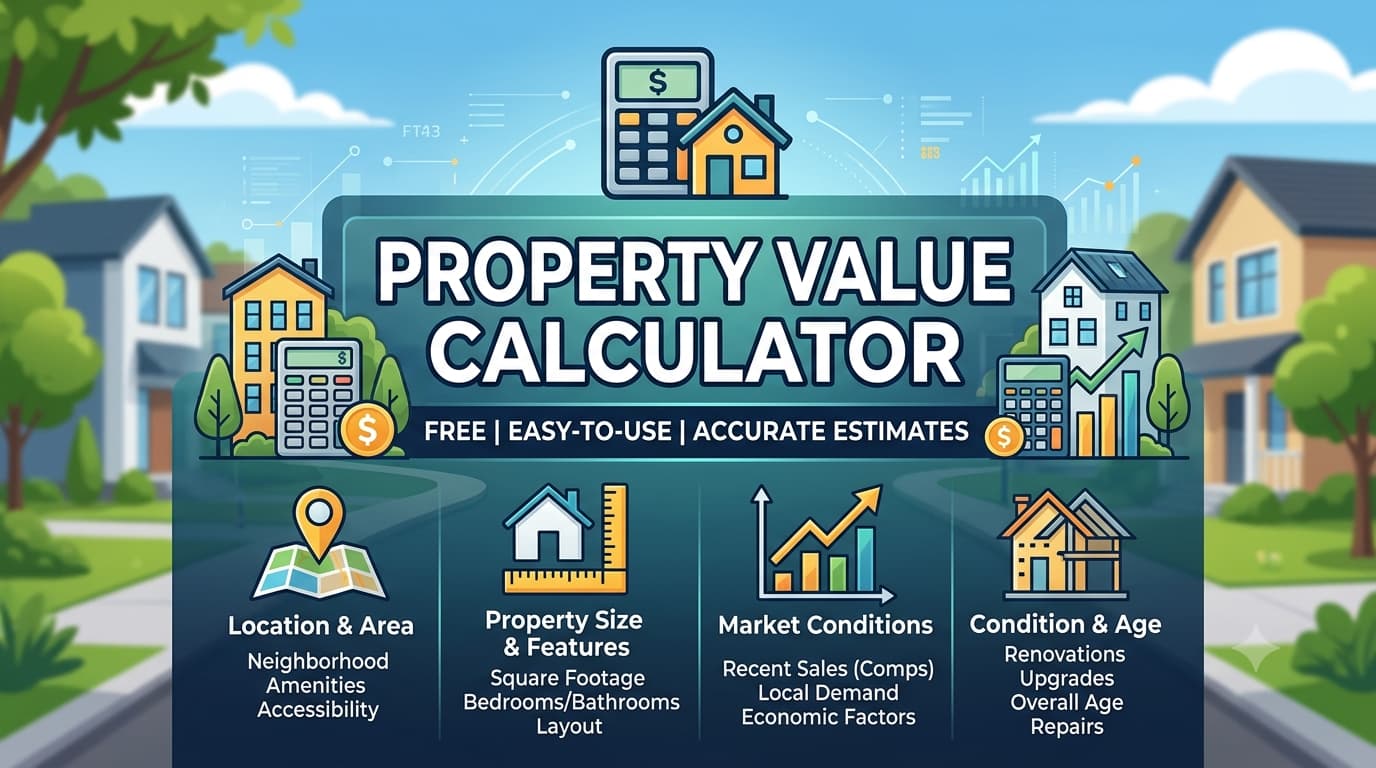
Those days are over when valuing a property meant booking several site inspections or employing highly paid experts. The Property Value Calculator has revolutionized the world of real estate providing one with all the necessary valuation data. If you consider buying your first house, broadening your investments portfolio, or refinancing your current property, then these instruments have become an indispensable part of the modern real estate decision-making process. The property market is extremely dynamic, and information is key. The buyer must be sure that he or she pays the market prices. The seller should have enough information to set up the price of his or her property at the competitive level. Investors should get instant evaluations of possible investments. Traditional methods of property valuation like surveys, appraisals, and comparisons may still come in handy, but they are rather expensive and time-consuming. However, this is not true for all of them. There are calculators that use old-fashioned methods, those which have no information about the local market, and there are those that do not take into consideration the unique characteristics of the property which influence its price a lot. Knowledge about these instruments, about their capabilities and possible mistakes is necessary to use them successfully. This book shows how to do that. A Property Value Calculator is an internet-based application that calculates the market value of a piece of property. These online applications make use of algorithms which take into account several variables and factors to come up with an estimated market value of a property. This is accomplished without the need for expert appraisers and thorough research. How does this tool work? First of all, it collects data regarding the property – its location, size, age, state of repair, and other amenities. The collected data is then compared with a database consisting of information regarding recent sales of similar properties. The main advantage of using such online valuation tools is the possibility to obtain rough estimates of the value instantly. It is a very useful tool during the preliminary research of the property, to determine its selling price, and just to get an idea of the range of property market values. Understanding the mechanics behind Property Value Calculator tools helps you use them more effectively: The first step involves gathering information about your property. Calculators ask for location address, property type, lot size, building size, number of bedrooms and bathrooms, construction year, and property condition. Some advanced tools ask about specific features like garage type, heating systems, and recent renovations. The calculator's core algorithm analyzes recent property sales in your area. It identifies properties similar to yours—same neighborhood, similar size, comparable condition—and examines their sale prices. This comparable market approach forms the foundation for value estimation. The calculator adjusts for differences between comparable properties and your property. If comparable properties sold for higher prices due to superior condition or additional features, the calculator adjusts downward. Conversely, if your property has features comparable properties lacked, adjustments go upward. Advanced calculators incorporate current market conditions. Interest rates, inventory levels, days-on-market, and supply-demand dynamics all influence property values. Calculators assess whether the current market favors buyers or sellers, adjusting estimates accordingly. After analyzing all data, the calculator generates an estimated property value. Most calculators also provide value ranges, acknowledging uncertainty in the estimation. The range typically shows low, mid, and high value estimates based on different assumptions. Online property valuation tools offer several advantages for property research: Unlike professional appraisals requiring weeks and thousands of rupees, online calculators provide instant value estimates. This speed makes them ideal for initial property research when you're comparing multiple properties or exploring market values. Using an online valuation tool costs little or nothing. Most online calculators are free or require minimal subscription fees. This affordability makes them accessible to anyone interested in understanding values of property without significant financial investment. Online valuation tools are available 24/7. You can access them from anywhere, anytime, without scheduling appointments or visiting offices. This convenience makes preliminary property research straightforward and quick. When researching several properties, an online calculator lets you quickly compare values across different properties and neighborhoods. This comparison capability helps identify which properties offer better value relative to their prices. Real estate investors use online valuation tools to screen potential investments quickly. By rapidly evaluating multiple properties, investors can identify properties for deeper analysis before committing time and resources. The many values of property websites take into account official government valuation figures such as the Circle Rates while dealing with property in India. In most cases, the Circle Rate is used as a point of reference by the calculators after which the adjustments due to the market situation are made to come up with a figure. Knowing that the circle rates are considered as point of reference in coming up with the calculator estimate makes it easy to understand the estimated figure. In a growing market such as Gurgaon, the estimated figures tend to be above the Circle Rates. This is due to real market demands. Calculators rely on property data and market information but cannot evaluate actual property condition. They can't identify hidden structural problems, needed repairs, or maintenance issues that professional inspectors would discover. This limitation means calculated values may not reflect properties requiring significant repairs. Calculators use broad market data but may miss nuances of specific neighborhoods or micro-locations. Experienced real estate agents often know local factors influencing values that algorithms don't capture. Properties near noisy intersections, power lines, or flood zones might be discounted by savvy buyers but not adequately by algorithms. If your property has unusual features—architectural significance, special purpose, or highly customized improvements—calculators may not value these appropriately. Unique properties often require professional appraisals rather than algorithmic calculations. Calculator databases use recent sales data, but there's always some lag between actual sales and data incorporation. In rapidly changing markets, calculators may not reflect the most current conditions immediately. Different calculators use different algorithms and data sources. Results may vary significantly between calculators, reflecting underlying methodology differences. Relying on a single calculator may produce skewed results. One of the examples of such guides can be found in the Property Valuation Guide, which mentions various methods of valuations, including the one with the use of calculators. The guides claim that calculators are just one of the possible methods of valuation together with the other existing methods. It is necessary to keep in mind that calculators are used in the context of other methods of valuation. The Market Value of Property is what educated buyers and sellers believe to be the value of property under existing market conditions. A professional market value evaluation takes into account comparative market analyses of past sales, market trend analysis, and expert judgment. An online valuation tool tries to simulate such an analysis. Calculations and market values can vary, though. Professional evaluators take into account factors like neighborhood perceptions, development possibilities, and economic factors that cannot be easily quantified using automated tools. Calculation estimates should only be taken as approximate numbers. Various specialized calculator types serve different purposes: Generic home value calculators estimate residential values of property based on location, size, and general condition. These are most common and readily available online through real estate portals. Specialized calculators for income-producing properties incorporate rental income, operating expenses, and capitalization rates. These tools help investors analyze whether rental properties meet their investment criteria. Some calculators estimate property tax liability based on assessed valuations and tax rates. These help property owners anticipate tax obligations. While focused on loan payments rather than values of property, mortgage calculators help buyers understand how different down payments and loan terms affect monthly payments, informing purchase decisions. Specialized tools for commercial properties analyze lease terms, tenant quality, and operating expenses. These cater to commercial real estate investors' specific analytical needs. Most online property valuation programs make use of Ready Reckoner Rates as standard reference data. The official valuation rates from the government serve as benchmark figures for these calculators, which then calculate their results based on these and the current market situation. Knowing how online valuation tools employ Ready Reckoner Rates is helpful in comprehending their results. When the results from the calculators show significant increases over Ready Reckoner Rates, this may indicate high market demand. Official baseline valuations, like Ready Reckoner Rates, serve as reference figures for property assessment. Online valuation tools often use these values as calculation starting points. Some tools even highlight the relationship between estimated values and official valuation benchmarks. For property registration and taxation purposes, official valuations matter more than calculator estimates. However, online valuation tools help you understand how actual market values relate to official valuations, providing perspective on valuation gaps. Modern calculators offer increasingly sophisticated features: Many calculators display value trends over time, showing how estimated values have changed over past years. This historical perspective helps identify appreciation patterns and predict future value movements. Advanced calculators compare property values across neighborhoods, showing how your property's value compares to similar properties in different areas. This comparison feature helps identify neighborhoods with better value propositions. For properties that can be rented, some calculators estimate potential rental income based on market rates. This feature helps investors analyze rental property investment potential. Some calculators score nearby schools, shopping, healthcare, and other amenities. These scores influence calculated values, reflecting how amenities affect property desirability. Advanced tools provide market indicators showing whether your neighborhood market is appreciating, declining, or stagnant. These trends help predict future value movements. Online property valuation accuracy varies based on several factors: Calculators relying on comprehensive, current market data produce more accurate results than those using limited or outdated information. The quality of underlying databases significantly impacts accuracy. When sufficient recent comparable sales exist in your area, calculators produce better estimates. In markets with few recent sales, accuracy decreases due to limited comparison data. In stable markets with consistent pricing, calculators produce reliable estimates. In volatile markets with rapid value changes, calculated estimates may quickly become outdated. For standard properties similar to recent sales, calculators produce reliable estimates. Unique or unusual properties present estimation challenges that calculators struggle with. Understanding appropriate uses for calculators ensures you leverage them effectively: Use calculators to get ballpark values when initially researching properties or markets. These quick estimates help narrow down property options without detailed analysis. When comparing multiple properties, calculators provide quick relative value assessments. Understanding whether one property offers better value than comparable properties helps guide purchasing decisions. If you already own property, periodic calculator checks help monitor your property's estimated value over time. While not professional appraisals, these estimates indicate whether your property is appreciating or depreciating. Use calculators to understand general market trends in areas you're interested in. Value trends across many properties reveal whether markets are appreciating or declining. Knowing when to seek professional appraisals instead of relying on calculators is equally important: Banks won't accept calculator estimates—they require professional appraisals. When refinancing or obtaining mortgages, professional appraisals are legally required. Insurance companies need professional valuations to determine appropriate coverage levels. Calculator estimates don't meet insurance requirements for replacement value determination. When settling estates or dividing property among heirs, professional appraisals provide legally defensible valuations. Calculator estimates don't carry sufficient authority for legal proceedings. For major investment decisions or large-dollar transactions, professional appraisals justify the cost. The accuracy and credibility of professional assessments protects your interests. When valuations are disputed or challenged, professional appraisals provide expert testimony supporting valuations. Calculators lack this evidentiary value. The valuation features of DDA properties are different from other types of property. The property calculators which include DDA properties have data on scheme valuations, location preferences, and valuation trends. The value calculators know that DDA properties appreciate steadily and the prices of such properties are likely to be higher than the official valuation. The investors who are seeking to invest in DDA properties will find value calculators useful for getting value estimates on this specific type of property. When choosing a Calculate the values of property, look for these valuable features: Better calculators allow detailed property information input—not just basic facts but specific features affecting value. More input options enable more precise estimates. Ensure calculators use recent property sales data. Calculators updating data regularly produce more accurate estimates than those using outdated information. Good calculators provide value ranges rather than single point estimates. Ranges acknowledge estimation uncertainty while providing useful guidance about reasonable value expectations. Calculators showing comparable properties used in calculations help you evaluate methodology. Seeing actual comparable properties increases confidence in results. Calculators displaying value trends over time show how your property's estimated value has changed. This perspective helps identify appreciation patterns. Calculators providing explanations about methodology and factors influencing calculations help users understand results better. Educational content improves interpretation accuracy. Intelligent real estate experts use more than one calculator to double-check their findings. Since various calculators use varying sets of information and calculation processes, it gives a better perspective by using multiple calculators than using just one calculator. When various calculators give similar value ranges, then there is increased certainty in the estimation. However, where there are differences between various calculators, then professional appraisers will need to be involved. Property valuation technology continues advancing: AI algorithms analyze increasingly sophisticated property and market data to generate more accurate valuations. These systems improve over time as they process more transactions and market data. Property valuation increasingly incorporates vast datasets analyzing prices, market trends, economic indicators, and demographic information. Big data capabilities enable more comprehensive analysis. AVMs use algorithms to generate automated property valuations. Many lenders and appraisers now supplement professional judgments with AVM outputs, improving valuation consistency. Technology enabling remote property inspections using 3D tours and drone photography may eventually enhance calculator accuracy by incorporating property condition assessments. Some emerging platforms explore using blockchain technology to create transparent, immutable property valuation records. These innovations could revolutionize valuation documentation. Accuracy varies based on market conditions and property characteristics. In stable markets with abundant comparable sales, calculators typically provide estimates within 5-10% of actual market values. In volatile markets or for unusual properties, accuracy decreases significantly. Calculators should be considered approximations requiring verification through other methods. Different calculators use different algorithms, data sources, and analytical approaches. Some emphasize comparable sales, others incorporate tax assessments or rental income data. These methodology differences explain value variations. Using multiple calculators and averaging results often provides better estimates than relying on a single calculator. No, property taxes are based on assessed values set by tax assessors, not calculator estimates. However, calculators can help verify whether assessments seem reasonable by comparing them to estimated market values. If calculator estimates significantly exceed assessed values, you might challenge your assessment. Some calculators allow you to specify recent renovations, adjusting estimates upward accordingly. However, renovation values depend on quality and market acceptance. Luxury renovations in average neighborhoods may not return full investment, a nuance calculators may not fully capture. While some calculators show historical trends suggesting future appreciation, they cannot reliably predict values. Future values depend on economic conditions, interest rates, and development changes that calculators cannot accurately forecast. Treat trend analysis as context rather than predictions. Calculator estimates provide starting points for pricing discussions, but asking prices should also consider market conditions, property condition, and comparable listing prices. Properties priced at calculator estimates may require adjustment based on actual market response. Overpriced properties languish; underpriced properties cost sellers money. Yes, if calculator estimates seem significantly lower than your expectations, professional appraisals help determine actual value. Calculators may undervalue unique properties or miss local factors affecting value. Professional assessment verifies whether low calculator estimates reflect reality. For properties you own, quarterly or semi-annual checks provide reasonable monitoring frequency. More frequent checks add little value since values of property change slowly in most markets. Monitor more frequently if your market is rapidly appreciating or depreciating. No, lenders require professional appraisals for refinancing decisions. Calculator values provide preliminary information but don't meet lender requirements. However, if calculator estimates suggest your home has appreciated significantly, this information justifies requesting a professional appraisal to determine if refinancing makes sense. First, verify that input information is accurate—incorrect location, square footage, or property type data produces incorrect results. If inputs are correct, try other calculators to see if results align. Consider professional appraisals if multiple calculators produce unexpected results or if you're making major financial decisions based on the valuation. Online property valuation tools prove to be great sources for all those who have an interest in learning more about values of property. This technology helps people get quick and affordable estimates that can prove useful for research, comparison, and understanding property values. With the emergence of these tools, everyone can perform research related to real estate values without expert help. Nevertheless, online valuation tools should be seen as just a way to get a preliminary estimate of the value of property. They cannot substitute an appraisal, as their calculations do not include a comprehensive analysis of the property, professional judgment, or an evaluation performed at the location where the real estate is situated. Experienced real estate specialists use these tools as additional resources to obtain preliminary estimates of values of property. Whether you are going to buy your first home, invest money in real estate, sell your property, or learn more about values in your neighborhood, these tools can help you obtain useful information. Get familiar with how these tools work, compare results from different calculators, and use professional appraisals for important financial decisions.Property Value Calculator: Essential Guide for Real Estate Valuations
What is a Property Value Calculator?
How Property Value Calculators Work
Data Collection
Comparable Sales Analysis
Adjustment Factors
Market Condition Analysis
Value Generation
Why Use a Property Value Calculator?
Quick Preliminary Estimates
Cost-Effective Research
Easy Accessibility
Multiple Property Comparison
Investment Analysis Assistance
Understanding Circle Rate Gurgaon and Calculator Estimates
Limitations of Property Value Calculators
Cannot Assess Physical Condition
Local Market Knowledge Gaps
Lack of Unique Property Characteristics
Time Lag in Data
Algorithm Limitations
The Property Valuation Guide and Calculator Tools
How Calculators Compare to Market Value of Property Assessment
Different Types of Property Calculators
Home Value Estimators
Investment Property Calculators
Tax Assessment Calculators
Mortgage Payment Calculators
Commercial Property Calculators
Using Ready Reckoner Rates with Calculator Tools
The Role of Government Guidance Value in Calculations
Advanced Property Value Calculator Features
Historical Value Trends
Neighborhood Comparison
Rental Income Analysis
School and Amenity Scoring
Market Trend Indicators
Accuracy and Reliability of Calculators
Market Data Quality
Sufficient Comparable Sales
Market Volatility
Property Uniqueness
When to Use a Property Value Calculator
Preliminary Property Research
Comparative Shopping
Monitoring Your Property
Market Research
When NOT to Rely on Calculators
Mortgage Applications
Property Insurance
Estate Settlement
Significant Investment Decisions
Property Disputes
How Calculators Use DDA Housing Scheme Property Data
Top Features to Look for in a Calculator
Comprehensive Property Input Options
Current Market Data
Value Range Presentation
Comparable Property Display
Historical Trend Display
Expert Information
Using Multiple Calculators for Cross-Verification
Technology Trends in Property Valuation
Artificial Intelligence and Machine Learning
Big Data Analysis
Automated Valuation Models (AVMs)
Virtual Property Inspections
Blockchain Integration
Frequently Asked Questions (FAQs)
How accurate are Property Value Calculators?
Why do different calculators give different values for the same property?
Can I use a calculator's value to determine my property tax?
Do calculators account for recent renovations?
Can calculators predict future property values?
Are calculator estimates useful for setting asking prices?
Should I get a professional appraisal if a calculator suggests low value?
How often should I check my property's calculator value?
Can I use calculator values to refinance my mortgage?
What should I do if my calculator value seems incorrect?
Conclusion