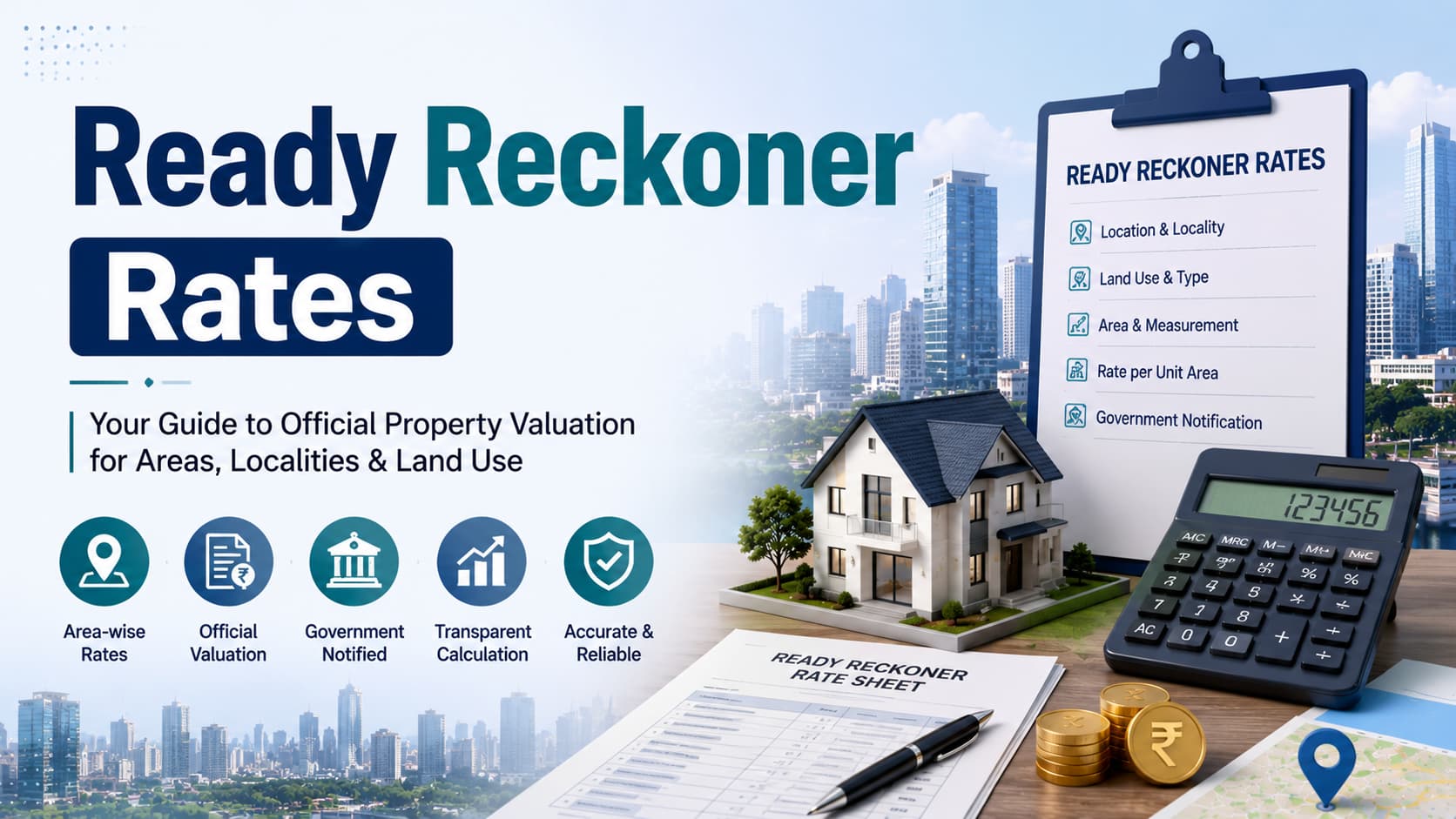
Ready Reckoner Rates Guide When purchasing or selling property in India, it is impossible not to come across a term that is the basis for tax assessments and payment of registration fees – Rates. Standardized valuations constitute the cornerstone of the Indian property market infrastructure. So what are they, and why should they be taken into account by all property buyers, sellers, and investors? Contrary to variable market prices, which depend on demand, local prestige, and the condition of the property, standardized valuation benchmarks are set values established by governmental bodies. Valuation benchmarks are used to calculate stamp duty payments, calculate registration fees, aid in property tax calculation and serve as base references for all legal transactions. Thus, it is important for everyone working with real estate and buying homes to understand them and use this information while making decisions. The gap between standardized valuations and market prices confuses many homebuyers and sellers. Properties are sold way over the valuation benchmarks in prestigious locations but can go under them in new areas. This guide will provide you with comprehensive knowledge about them and help you estimate how they affect your property costs and investment decisions. The popularly referred to as RRR, are standard property valuations set and updated by government bodies. The rates are the minimum valuations at which properties can be registered with the government in certain geographical regions. They offer base valuations for properties depending on location, type of property, and size. The name 'ready reckoner' stems from the fact that these rates offer an easy way of calculating the values of properties without doing individual property valuation assessments. The government classifies properties depending on the geographical region and the type of property. Standardized rates are set according to the classification of the properties. It is important to note that the are different from market values. While the former refers to the government's official valuations used for registrations and taxation purposes, the latter refers to the real price at which properties sell and buy in the market. The creation of made property valuation processes more transparent and standardized. Prior to the creation of , property valuation was very subjective, resulting in differences and disagreements. created systematic processes for the valuation of property. Governments over time have continued to improve on the Rate systems by updating the rates at regular intervals to match the changes in market conditions. Every state and municipality has its own Rate systems that are suited to local conditions. Updating of rates ensures that these rates stay somewhat in line with market conditions. The process of establishing standardized property valuation rates involves several steps: Government authorities conduct extensive market research analyzing recent property transactions in different areas. This analysis examines actual sale prices, market trends, and area development status. The research forms the foundation for rate determination. Properties are classified based on location characteristics. Prime areas command higher rates, while developing areas have lower rates. Classification considers proximity to business centers, transportation, educational institutions, hospitals, and other infrastructure. Different property types receive different valuation rates. Residential properties, commercial properties, industrial properties, and special-purpose properties have distinct rate structures. This categorization reflects the different value drivers for each property type. Based on research and classification, government authorities calculate standardized rates for different area-property type combinations. These calculations undergo review and approval processes before implementation. Once finalized, are officially published through government gazettes and official websites. Property owners, buyers, sellers, and registration authorities are informed about new rates through public notifications. The Circle Rates, in places such as Gurgaon, are the application of in the respective cities. The Circle Rate is thus the minimum value of the property that can be registered in the city of Gurgaon. The Circle Rate will differ depending on the location and type of property. affect the payment of stamp duty and registration fees. At the time of registration, the registering agency will use the relevant as the minimum value of the property. Stamp duty and registration fees are computed as a percentage of this value. In case the market value of your property is greater than the , then you have to pay stamp duty and registration fees either as per the actual price of the property or the , whichever is greater. This is done in order to ensure that proper revenues are collected by the government on account of actual values of transactions. Knowing about helps you prepare for transaction costs. You know in advance how much stamp duty and registration fees to pay. There is a difference that needs to be made clear regarding the and market value. are rates determined by the government, whereas market values are the true prices at which properties can be traded on the market. In almost all cases where there is a growing market in real estate, the market value will be much higher than . It is due to the increased market demand compared to official valuations. Properties in high-demand locations could cost between 20% and 50% more than the . But it may happen that market values will equal or even drop below the in non-prosperous markets. The difference between those two rates will give information about the state of the market. The Government Guidance Values are similar to the because they are basically the government valuations made official. They may be termed differently in various locations but their meaning remains the same. These values are minimum values which have been made official for property transactions. Understanding the Government Guidance Values allows you to understand how official valuations function in other regions too. They may be named or Guidance Values but their meaning remains the same. In practical property transactions, standardized property valuation rates play several important roles: While actual transaction prices depend on market conditions and negotiations, provide floor prices. Buyers and sellers understand that properties cannot be registered below the applicable , establishing a minimum price threshold. Stamp duty and registration fees are calculated based on either the Rate or actual transaction price, whichever is higher. This calculation method ensures fair taxation based on actual property values while maintaining consistency through the standardized rate system. Banks and lenders use alongside market values when approving property loans. Lenders typically advance 70-80% of the appraised value, using both official rates and independent appraisals in their assessments. During property registration, the registering authority verifies that the declared property value meets minimum Rate requirements. If you try to register below the applicable rate, the authority may reject the application or reassess the value. Standardized property valuation rates vary significantly by region, reflecting different market conditions and development levels: Major metropolitan areas like Delhi, Mumbai, Bangalore, and Gurgaon typically have higher than smaller cities. Within metropolitan areas, prime locations command substantially higher rates than developing neighborhoods. Tier 2 cities have moderate , typically lower than major metros but higher than smaller towns. These growing cities show steady rate increases as they develop infrastructure and attract businesses. Smaller towns and rural areas have relatively lower prices reflecting lower property demand and development levels. However, strategic locations near highways or planned development areas may have higher rates than surrounding areas. Properties in Special Economic Zones sometimes have distinct Rate structures reflecting their unique commercial purposes and higher values. are an integral part of any complete system of property valuation. A complete guide to property valuation considers what should be considered within the overall methodology in conjunction with market comparison method, cost approach, and capitalization of income approach. Valuators know that they give important guidelines, yet do not substitute for proper property valuation. The use of different methods of valuation in addition to gives better results. Are usually revised on one or two occasions per year by the relevant government departments. The common times for revision are April (start of fiscal year) and October (midway through the fiscal year). Certain places might also revise their rates at any other time depending on changes in the markets. It is important for property owners and investors to be aware of the revisions of rates as they have an impact on valuation of properties, registration charges and taxation obligations.. Several resources provide access to current standardized property valuation rates: State and district government websites publish current for their jurisdictions. These official sources provide authoritative, up-to-date rate information. Each state maintains its own system, so you'll need to access the specific state's website for your locati Local municipal corporations maintain Rate records. Visiting the registration office or municipal corporation office provides access to physical rate documents and official staff who can answer questions about specific properties. Major real estate portals maintain databases of . While not as official as government sources, these platforms provide convenient access to rate information for various properties and locations. Experienced real estate agents, property dealers, and valuers have ready access to current . These professionals can quickly provide rate information for specific properties and help interpret how rates affect transactions. Real estate investors monitor standardized property valuation rates as indicators of market conditions and development: Rising typically indicates that government authorities believe areas are appreciating in value. Investors interpret these increases as positive signals about area development and future appreciation potential. Stable suggest that area valuations have reached equilibrium. These areas may offer steady returns rather than rapid appreciation but provide predictable investment environments. Declining are rare but indicate that authorities believe areas are depreciating. Investors interpret this negatively, viewing it as a warning about area prospects. If you believe that the applicable standardized property valuation rates for your property are incorrect, you have the right to appeal: Most jurisdictions allow formal appeals challenging . You'll need to submit documentation supporting your position, such as recent comparable sales at lower prices or evidence of market conditions supporting lower valuations. Gather evidence including recent property sales, professional appraisals, market reports, and any documents showing why official rates are excessive. The more comprehensive your evidence, the stronger your appeal. Appeal evaluations typically take several weeks to months. Authorities review your evidence and may revise rates if they find merit in your arguments. Be prepared for the process to take considerable time. Rates influence property tax calculations through several mechanisms: Some places base their property taxation on the applicable standardized property valuation rates. High rates mean high tax liabilities. Knowing the right rates will help you know the tax liabilities. Property owners can also contest property tax assessments based on the applicable standardized property valuation rates. In case the property is taxed beyond what it should be because of erroneous rate application, this will lower your tax liability. In most cases, Online Property Valuation Tools employ the purpose of valuation. The online calculators utilize official as well as market data to provide estimates on the value of the property. With knowledge that the calculators employ , it is easy to know that the value provided by the calculators is based on official and market rates. Valuation of the DDA properties has some values depending upon the principles of . The valuation of the DDA properties is done according to the government prescribed rates, but in many cases, the valuation of such properties is much higher than those prescribed rates. One should know about the in connection with DDA properties valuation as these properties built up by the government are greatly appreciated. Technology is modernizing Rate systems: The online portal makes the process of checking the latest rates from the easy. The property owner is not required to go to an office to do this. Using the digital process, it becomes automatic for the system to calculate the fees of registration on the basis of property value and applicable standardized valuation rates. Some places have started employing more regular rate updates through technological means. With more regular rate updates, there will be better correlation between the actual rates and the true market situation. The use of big data analysis by governments has enabled them to be able to detect market trends and when rate changes are necessary. The Rate systems continue evolving: Authorities may implement more frequent rate updates to keep pace with rapidly changing markets. Quarterly or even monthly updates might replace traditional annual or semi-annual adjustments. Enhanced market analysis and data collection methods should improve the rate accuracy. Rates that better reflect actual market conditions would reduce gaps between official valuations and market prices. Blockchain and other technologies might revolutionize how property valuations are recorded and updated. These innovations could create more transparent and trustworthy valuation systems. As markets become more complex, the rate systems may implement more granular geographic divisions. Micro-location factors might influence rates more than current broad area classifications. No, represent government-set minimum valuations while Market Values reflect actual prices at which properties buy and sell. Market values typically exceed in growing markets. are static (updated periodically), while market values change continuously based on market conditions. The registration authority will reject your application or reassess the property value at the applicable Rate. You cannot register properties below these minimum rates. The property must be registered at either the Rate or the actual transaction price, whichever is higher. Banks use alongside independent appraisals when evaluating loan applications. Lower might result in smaller loan amounts if banks use these rates to determine collateral values. However, independent appraisals often override official rates if they're significantly higher. Yes, though decreases are rare. They typically occur only if authorities determine that property values in areas have significantly declined due to economic downturns or changed market conditions. Most markets see stable or increasing rates over time. Government authorities—typically state governments or district administration offices—determine and publish . Different states maintain their own rate systems tailored to local market conditions. These rates are established through systematic analysis of property transactions and market conditions. Most jurisdictions update standardized property valuation rates twice yearly, typically in April and October. However, some may update annually or implement special updates when significant market changes warrant. Staying informed about update schedules ensures you have current rate information. No, different property types have different Rate structures. Residential, commercial, industrial, and agricultural properties typically have distinct rates reflecting their different value drivers and market characteristics. This differentiation ensures rates appropriately reflect value differences between property types. No, the standardized property valuation rate represents the minimum registration value. Properties cannot be legally registered below this rate. However, you can negotiate purchase prices during transactions—the standardized property valuation rate establishes only the minimum registration value, not the maximum negotiated price. Significantly. Prime locations, proximity to business centers, transportation access, and local infrastructure all influence rates. Properties in established residential areas typically have higher rates than those in developing neighborhoods. Some cities have dozens of different rate zones reflecting location variations. You can file a formal appeal with the relevant government authority providing documentation of comparable sales at lower prices, professional appraisals suggesting lower values, or evidence of market conditions supporting lower valuations. The appeals process typically takes several weeks to months. Success depends on having strong supporting evidence. form an essential component of India's property registration and valuation systems. These standardized rates provide baseline valuations for properties, simplify the registration process, and ensure consistency in taxation. Understanding is crucial for anyone buying, selling, investing, or mortgaging property. While providing important reference points, they represent official government valuations rather than actual market prices. Savvy property professionals use alongside market analysis to understand both official valuations and real-world property prices. This comprehensive approach ensures informed decision-making for property transactions. continue evolving as technology advances and market conditions change. More frequent updates and improved analytical methods should enhance rate accuracy over time. Staying informed about current rates in your area and understanding how they influence transactions protects your interests and improves your real estate outcomes. Whether you're a first-time homebuyer, experienced investor, property professional, or government official, this comprehensive guide provides the foundation for understanding and their role in property valuation. Apply these principles, stay updated on rate changes, and you'll navigate property transactions with greater confidence and success.What Are Ready Reckoner Rates?
Historical Background of Ready Reckoner Rates
How Ready Reckoner Rates Are Determined
Market Research and Analysis
Area Classification
Property Type Categorization
Rate Calculation and Approval
Public Notification
Understanding Circle Rate and Reckoner Rates
The Circle Rates play an integral role in Gurgaon property transactions. These rates provide minimum registration values and are used in calculating stamp duties. However, in cases where there are high demand areas such as Gurgaon, the market price tends to be higher than the Circle RateImpact on Stamp Duty and Registration Fees
How Ready Reckoner Rates Differ from Market Value of Property
Ready Reckoner Rates and Government Guidance Value
Using Reckoner Rates in Property Transactions
Price Determination
Tax Calculations
Loan Approvals
Property Registration
Regional Variations in Ready Reckoner Rates
Metropolitan Areas
Tier 2 Cities
Smaller Towns and Rural Areas
Special Economic Zones
The Property Valuation Guide and Ready Reckoner Rates
Frequency of Ready Reckoner Rate Updates
How to Find Current Ready Reckoner Rates
Official Government Websites
Municipal Corporation Offices
Real Estate Websites and Portals
Real Estate Professionals
Impact of Ready Reckoner Rates on Investment Decisions
Rate Increases as Positive Signals
Rate Stability Indicating Market Maturity
Declining Rates as Warning Signs
Challenging Ready Reckoner Rates
Appeal Process
Required Documentation
Evaluation Timeline
Ready Reckoner Rates and Property Taxes
Tax Base Determination
Tax Assessment Appeals
Understanding Property Value Calculator
The Role of Ready Reckoner Rates in DDA Housing Scheme Properties
Technology's Impact on Ready Reckoner Rate Systems
Digital Rate Access
Automated Calculation
Real-Time Updates
Data Analytics
Future of Ready Reckoner Rates
Increased Frequency of Updates
Improved Rate Accuracy
Technology Integration
Regional Customization
Frequently Asked Questions (FAQs)
Are Ready Reckoner Rates the same as Market Value?
What happens if I try to register a property below the Ready Reckoner Rate?
How do Ready Rates affect property loan amounts?
Can Reckoner Rates decrease?
Who determines Ready Reckoner Rates?
How often are Ready Reckoner Rates updated?
Do Reckoner Rates apply to all property types equally?
Can I negotiate property prices below the Ready Reckoner Rate?
How does location within the same city affect Ready Reckoner Rates?
What should I do if I believe the Ready Reckoner Rate for my property is too high?
Conclusion