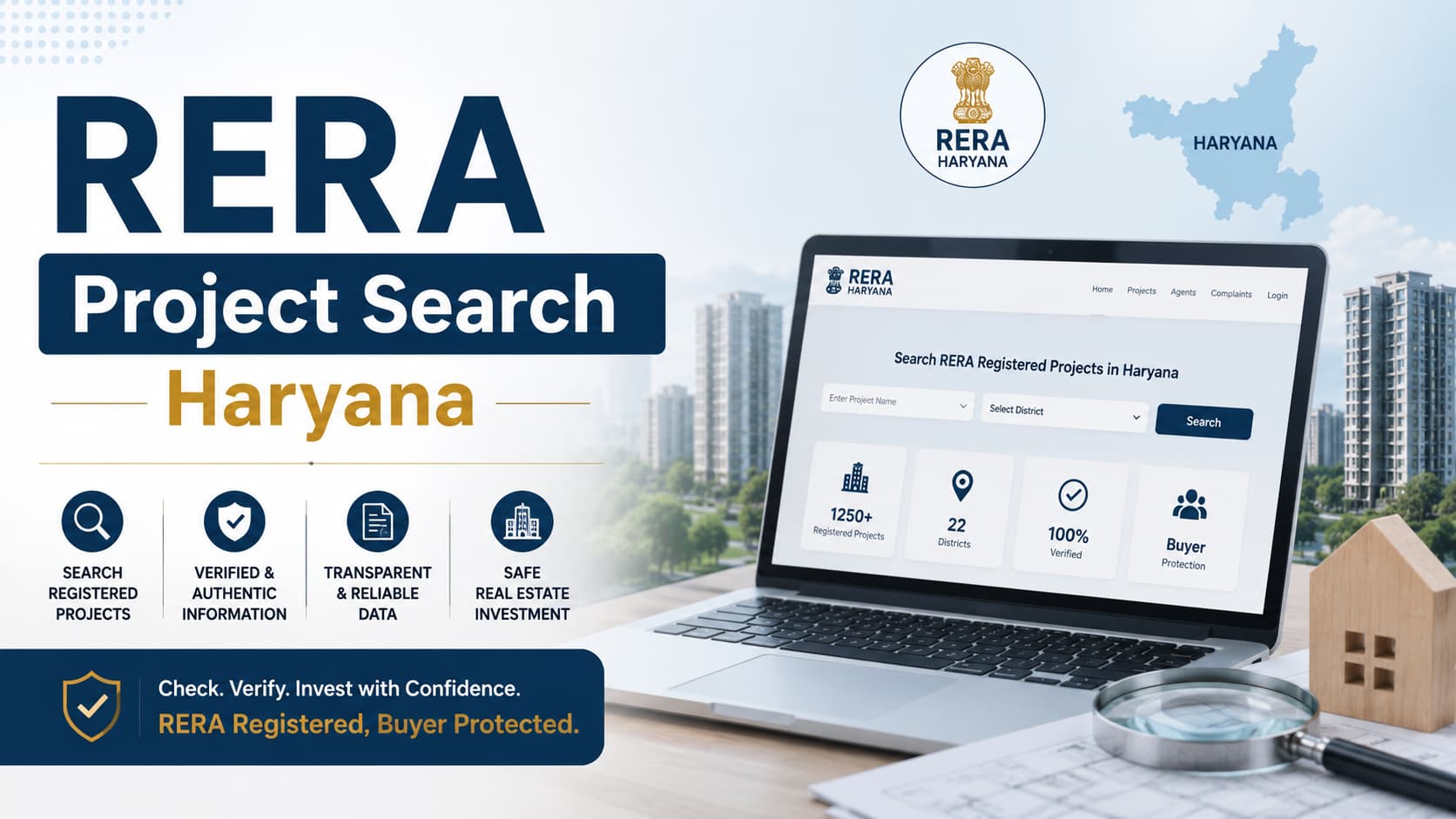
There is one habit that makes a buyer get cheated and another one that keeps him safe, and it requires no more than five minutes: searching the project database. Before paying any booking fee, signing any agreements or even taking a developer’s timeline seriously, you enter the project into the website of the regulator and read what the law says about it. Everything related to any registered project in India is available there – its plans, permissions, the date when it should be ready to hand over and progress reports – all of which have been released by the developer because he was obliged to do that. But buyers usually don’t do it the right way, or look for the registration number without understanding how to interpret the information about the project. This guide aims to correct that. Searching for a real estate project through RERA means accessing any real estate project on the official website of the Real Estate Regulatory Authority in order to check whether it has been registered and then access the details about it that have been disclosed. Under the RERA Act 2016, all projects that qualify for registration need to do so and disclose their details. The benefit is straightforward. Rather than relying on the brochure and marketing team, you are actually seeing what the developer has stated on his own in writing to the government authority. The committed possession date will be enforceable by the government. The carpet area will be standardized. The sanctioned plan will be an approved one. In Haryana, projects are searchable on the state authority's portal. Whether the project sits along the Dwarka Expressway, the Sohna Road belt, or an established pocket like Sector 12 Gurugram, you can pull its full record online. Where: State RERA portal Search by: Project name, developer name, registration number, or district Cost: No cost Time required: Five minutes Details revealed: Registration number, drawings, total units, possession date, promoter, updates on project Can also search for: Registered real estate brokers Best to use: Before booking, signing or paying anything Step 1 — Go to the correct state portal. RERA is administered state by state, so a project in Haryana is searched on the Haryana portal, not a central one. Identify the state where the project is located. Step 2 — Choose your search field. You can search by project name, developer/promoter name, the registration number if you already have it, or by the location and district. If you only know the builder, searching by developer name pulls up all their registered projects. Step 3 — Open the project listing. Click into the specific project. This opens the full public record the developer filed. Step 4 — Read the key fields. Note the registration number, the registered possession date, the sanctioned plan, the number of towers and units, the promoter's details and past projects, and the quarterly progress updates. Step 5 — Cross-check against what you were told. Compare the portal's possession date, unit count, and carpet area against the brochure and the salesman's claims. Discrepancies are your negotiating leverage — and sometimes your warning to walk away. Run this the same way regardless of how premium the address is. A project on a marquee corridor deserves exactly the same scrutiny as one in a developing location. A project record contains far more than a registration number. Here's what each part tells you. Underutilized areas are past project experience and quarterly updates. An advertiser with a spotless record in terms of delivery is a much safer investment, and a project that has not been updated for a while tells you something that the salesperson does not. Registration validity and currency. It must be valid and not out of date without an extension. Date of possession. Check the construction stage. If the portal suggests that possession is coming next year but the construction is just ground, be suspicious. Correct unit and area figures. Make sure that the carpet area and number of units as per the portal agree with what is offered. Trusted promoter. Research previous projects of the developer. Consistent project delay is a pattern, not bad luck. Construction update. Current quarterly filings indicate an active and complying developer. Absence of filings is a danger sign. Apply these checks whether you're evaluating a project on the Southern Peripheral Road or in a newer sector — the search works identically everywhere. The project isn't listed at all. If a project in a notified area doesn't appear, it's likely being marketed illegally. Do not pay. No registration number on the brochure. Legitimate registered projects display the number in all advertising. Its absence is deliberate. An expired registration with no extension. This suggests the project is delayed and the developer hasn't regularised it. Missing quarterly updates. A compliant developer files regularly. Silence often precedes trouble. Mismatched figures. If the portal's carpet area, unit count, or possession date differs from what you were told, someone is misrepresenting the project. A promoter with a trail of delayed projects. The search lets you see their portfolio. Use it. Not only are you able to search for projects using the portal; you are able to check for agents as well. An agent involved in selling projects that have been registered has to be registered as well, and the registration can be checked online. When making deals with agents in your search for a project, it is important that you verify whether their registration is genuine. Using an unregistered agent in a notified area means you are working illegally. An RERA project search is not only a safeguard but a negotiating tool too. With the possession date being registered by the portal, you will be able to insist on your rights in case of delay and get compensation. The record of past projects of the promoter will serve as a good cause to make better terms regarding payment and cost. In case the progress update is satisfactory, then your purchase is safe. In addition, the project search makes it easy for you to file a complaint at a later stage. With everything being registered, including the possession date, plan sanction, and numbers, all you have to do is to go ahead and raise the issue. 1. Searching the wrong state portal. RERA is state-administered. Match the portal to the project's location. 2. Stopping at the registration number. The number confirms registration exists; the record behind it tells you whether the project is healthy. Read it. 3. Ignoring past projects. A promoter's history is one of the strongest reliability signals available. Don't skip it. 4. Not checking progress updates. Stale filings are an early warning. Look at the dates. 5. Trusting a brochure over the portal. Where they conflict, the portal is the legally-binding record. 6. Forgetting to verify the agent. The broker needs registration too. Search them. Always search if you are: Purchasing a property that is under construction by the developer Considering a newly launched property in any corridor Having a definite date for possession Hiring a broker for the transaction Still do wider due diligence if you are: Purchasing a resale property that falls outside the purview of RERA Purchasing a land parcel that is below the registration limit Purchasing a completed project pre-Act 1. What is a RERA project search and why does it matter? The project lookup is a process of searching for a particular project at the Real Estate Regulatory Authority website for its registration and information disclosure. It is significant since it provides you with legal declarations regarding the possession date, the approved plan, the number of units, and the progress rather than a sales pitch of the builder. 2. Is a RERA project search free? Absolutely, yes. This is because this portal is an open disclosure system, which means that looking for a project or an individual through it is free of cost and will take only a couple of minutes. 3. How do I search for a project on RERA? Log in to the RERA website of the relevant state, since RERA is run state-wise. Search for your desired project based on project name, developer name, registration number, or even the district. Then you need to access the detailed project record from there. 4. What information does a RERA project search show? The document will contain the registration number, possession date, approved drawings, number of towers and units, information about the promoters and their previous projects, statutory clearances, and quarterly updates on the progress of the project. This will help you to ascertain the legitimacy and feasibility of the project. 5. What if a project doesn't appear in a RERA project search? In case a project that qualifies for a notified area is not available on the portal, then the project must be being sold illegally, and hence one should not pay the booking charges. You may seek from the developers a valid registration number to be confirmed. 6. Can I search for a real estate agent on RERA? Yes. Agents helping with sales of registered projects need to be registered too and can be found using their names or company names through the portal search. It is always important to check that any agent you are dealing with is actually registered. 7. How do I read the possession date in a RERA listing? The registration date for possession in the portal is the binding date and not the one verbally communicated by a salesman. It should be checked with respect to the construction phase – when the date is close but the site is undeveloped, then it acts as a red flag. 8. What are the biggest red flags in a RERA project search? Lack of listing for the project, absence of any registration number on advertisements, expired registration without renewal, absence of quarterly reports about progress, discrepancies between the brochure and the facts and a project promoter having a record of delayed projects are some reasons to beware. 9. Does a RERA project search work the same in every state? The definition is same across the board; however, each state has its own portal and registration takes place independently. Therefore, you have to look on the portal that belongs to the state in which your project lies; for instance, if it is a Haryana project, you have to look on the Haryana portal. 10. Can a RERA project search help me if I already have a dispute? Absolutely. The official record – the date of possession, approved plan and figures declared – is precisely what the authority uses in its complaint. Everything that you establish through this process serves as documentation that you will need in case you ever decide to take legal action against the developer. RERA Project Search is your most critical first step before making any property investment in Haryana. This powerful tool allows you to access comprehensive project records within the RERA Haryana database, enabling you to verify essential information about developers, projects, and their regulatory compliance status. A thorough RERA Search reveals whether your chosen project has completed mandatory RERA Registration and provides transparency about project specifications, timelines, and developer credentials. By conducting this search before committing funds, you significantly reduce investment risk and protect yourself from unregistered or fraudulent projects. During your RERA Search, verify that your real estate agent holds legitimate RERA Agent Registration credentials and operates within regulatory guidelines. Check whether the developer has any history of RERA Complaint filings, delays, or violations. Confirm that the project complies with Building Bye Laws and municipal standards established for your locality. Understanding The Project Search procedures and interpreting search results empowers you to make evidence-based decisions about your property investment. Should issues arise later—such as RERA Possession Delay & Compensation matters your initial RERA Search documentation provides crucial reference points. This due diligence transforms RERA Project Search from a simple database query into a comprehensive protection strategy within the RERA Haryana framework. An analysis of a RERA project is the most inexpensive, fast, and effective way for a home buyer to secure his interest. In only five minutes without cost, you can learn whether the project is legitimate, whether the schedule is realistic, whether the developer has a record of delivering on time, and whether construction is progressing -- based not on the claims in some glossy pamphlet but on the official records. The process is straightforward. Look up the correct state website, read the entire record rather than merely the number, consider the history of the promoter and the progress reports, and cross-check it all with what you are hearing.Verify the agent too. And do the fundamentals alongside it confirm the title, understand the sale deed, and judge the real connectivity of the location, whether that's the Dwarka Expressway corridor, the Sohna Road belt, or an established pocket like Sector 12 Gurugram.RERA Project Search: How to Find Registered Projects
What Is a RERA Project Search?
Quick Facts About the Project Search
How to Run a RERA Project Search: Step by Step
How to Read a RERA Project Listing
What to Look for in a RERA Project Search
Red Flags a RERA Project Search Can Expose
How to Search for a RERA-Registered Agent
Using a RERA Project Search to Protect and Negotiate
Common Mistakes in the Project Search
Who Should Run The Project Search
Frequently Asked Questions
Verify Before You Invest: The Power of RERA Project Search
Final Thoughts