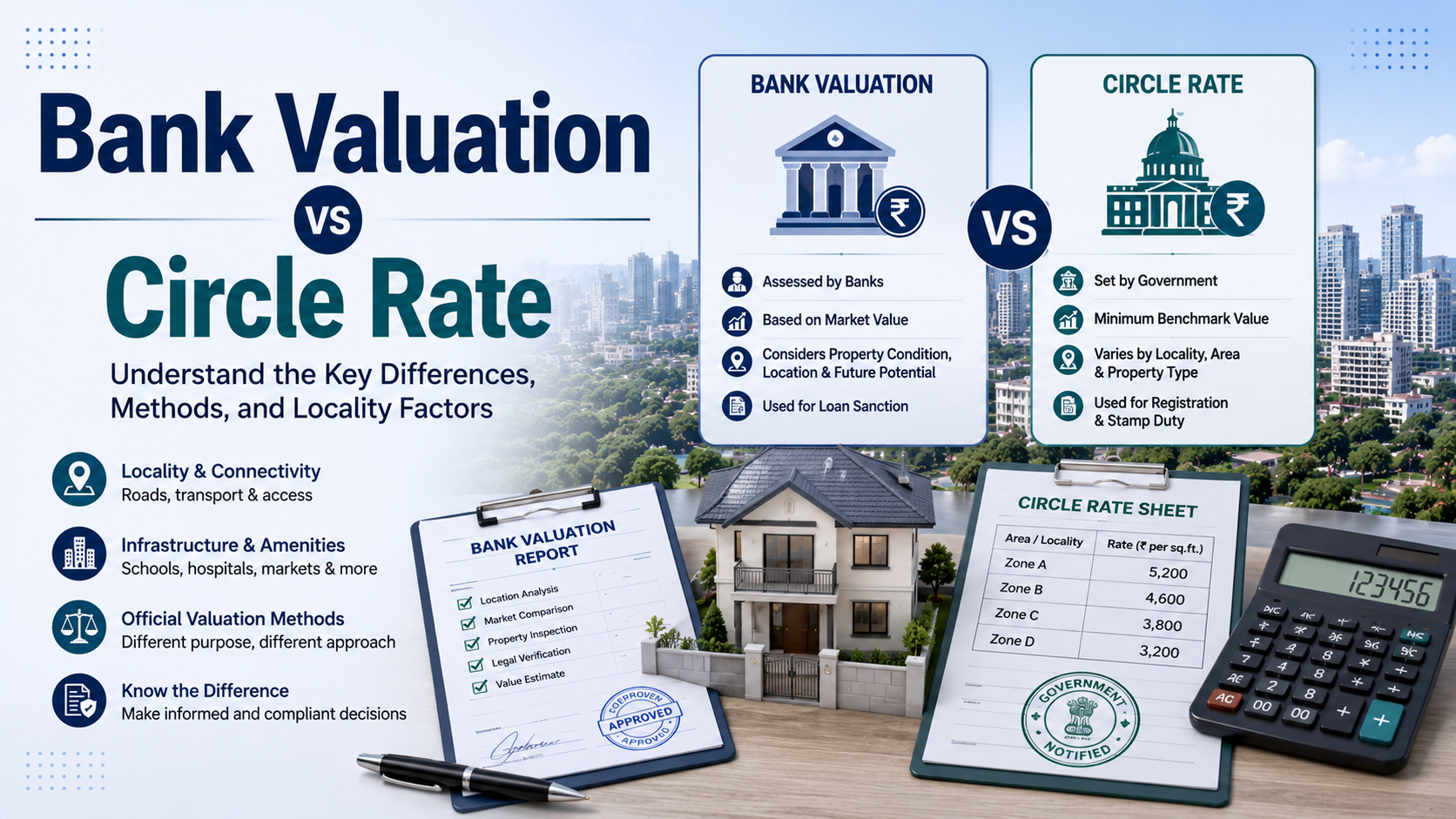
Whether it is about buying, selling, or mortgaging a property in India, two important terminologies that arise frequently are 'bank valuation' and 'circle rate'. Most homeowners and buyers get confused about which one among these two to rely on, resulting in a misunderstanding of the value of their property. In this detailed guide, we discuss the distinctions and similarities between both types of valuations. The minimum rate of valuation fixed by the government authority for a particular property in a certain region is known as the government-assessed minimum value. It can also be referred to as Ready Reckoner Rates (RRR) or Government Guidance Value. This value is used as a standard to prevent the undervaluation of properties for tax purposes and to help ensure that the proper amount of stamp duty is collected. Different municipalities or local government bodies determine the applicable value, which depends upon many factors: Location of the property Size and dimensions of the property Type of property (residential, commercial, agricultural) Accessibility and proximity to major roads Development infrastructure in the area The government-assessed minimum value is mandatory and cannot be ignored. In case of property registration, the stamp duty should be calculated according to the applicable prescribed value, with whichever is higher between the transaction value and the prescribed value being considered. What is mortgage valuation? Also called property valuation, this refers to the valuation process performed by an authorized valuer from the bank to ascertain the value of the property. This is done when you apply for a home loan; it is not based on the price you are willing to pay. Instead, an independent valuation is conducted to check whether the property provides sufficient security for the loan amount. The main aim of conducting this valuation is to protect the bank's interest by making sure the property value is enough to cover the loan in case of a default. Banks usually have certified valuers who are professionals accredited by RBI. Factors considered during bank valuation include: Condition and age of the property Construction material quality used in the building Location and surrounding environment Similar property values nearby Status of the property legally Future appreciation value Proximity to necessary facilities Although both valuation methods are quite significant in real estate deals, there are notable distinctions between them: Purpose: The government-assessed minimum value is used for taxation and set by government bodies. Mortgage valuation is conducted for lending purposes and determined by private valuers for financial institutions. Flexibility: The government-assessed minimum value is relatively inflexible and applied to properties belonging to the same category in a certain area. Mortgage valuation is flexible and depends on the unique features of a particular property. Method of Calculation: The government-assessed minimum value is determined using information about similar properties and government regulations. Mortgage valuation uses property inspection and market analysis techniques. Applicability: The government-assessed minimum value is relevant in property deal registration. Mortgage valuation is generally required when obtaining home loans from financial institutions. Frequency: Government-assessed minimum values may be revised annually or periodically by government bodies. Mortgage valuation is conducted individually for each property and loan request. There may be a huge gap between the government-assessed minimum value and the mortgage valuation in many instances. In case you wish to buy a property: If the market value or mortgage valuation is less than the government-assessed minimum value, then even in that case, you may have to pay stamp duty based on the applicable government-assessed value because it is the responsibility of the government to ensure that the rightful amount of taxes is collected from such transactions. However, you may receive a bank loan according to the lender's valuation, which could be much lower. On the other hand, if the mortgage valuation is much more than the government-assessed minimum value, the bank may determine the loan amount according to its own valuation and lending criteria. It is important for budgetary reasons to understand this relationship. New buyers are often surprised to realize that they may have to pay stamp duty based on the government-assessed minimum value even when the agreed property price is lower. Mortgage valuation is critical for several reasons: Loan Amount Determination: The loan amount you can borrow is directly linked to the lender's valuation. If the lender values your property lower than your purchase price, you'll need to arrange additional funds from your own pocket. Interest Rate Implications: Some banks may offer different interest rates based on the loan-to-value (LTV) ratio, which is calculated using the lender's valuation. Future Refinancing: Property valuations on record can influence your ability to refinance or take additional loans against the property in the future. Insurance Purposes: The valuation may also help determine the insured value of the property, which can affect your insurance premiums. The government-assessed minimum value holds its own significance in property transactions: Stamp Duty Calculation: This is one of its primary purposes. Stamp duty is generally calculated with reference to the prescribed value, and it is a mandatory expense in many property transactions. Property Transfer Tax: In some states, the prescribed value can also affect other taxes related to property transfers. Dispute Resolution: In cases of legal disputes or property-related litigation, the government-assessed value may serve as a reference point for determining the property's value. Investment Decisions: Real estate investors may consider trends in government-assessed values to understand market dynamics and evaluate property-related decisions. First-Time Property Calculation: Those looking to understand the Ready Reckoner Rates can get an overview through the applicable valuation system implemented in their locality. We can take an example to understand the distinctions more clearly: Let us assume that you are buying a residential plot worth Rs. 50 lakhs in Gurgaon. The government-assessed rate for the locality is Rs. 55,000 per square meter and your property size is 80 square meters. It would mean that the applicable value for your particular property is Rs. 44 lakhs (55,000 × 80). Then the bank would conduct its evaluation and come up with a market valuation of Rs. 48 lakhs. In this scenario: Stamp duty would be payable for Rs. 50 lakhs (actual transaction value, which is more than the applicable value of Rs. 44 lakhs). The bank may provide a loan based on its valuation of Rs. 48 lakhs, subject to its lending criteria. If you have bought the property at a price below the applicable government-assessed value, stamp duty may be payable based on the prescribed value. This example illustrates why understanding both valuations is essential before making a property purchase decision. While you cannot change the government-assessed minimum value itself, understanding it helps in financial planning: Make sure you always know the current applicable rate in your target area before making any offer. Remember that stamp duty will generally be levied based on the higher applicable value as prescribed by law. Include the applicable minimum value in your budget planning while purchasing the property. Negotiate on the transaction rate while still keeping the applicable minimum value in mind. Choose locations where the government-assessed value is proportionate to the prevailing market value. The Market Value of Property encompasses both rate and bank valuation considerations. It represents what a property would reasonably sell for under normal market conditions. This is different from: Assessed Value: Used for property taxation purposes Book Value: The value at which a property is recorded in financial books Appraised Value: The value determined by a professional appraiser Understanding the Market Value of Property helps in making informed decisions whether you're a buyer, seller, investor, or property owner seeking a loan. Different states and cities have their own criteria for valuation. The rate in Gurgaon is often revised according to prevailing market trends. It becomes absolutely necessary to refer to Property Valuation Guide material related to your locality for comprehending market dynamics prevailing there. The rate in developed locations such as Gurgaon is always higher than that of developing ones. Also, the property located near big roads and business centers will fetch higher Rate of Circle. It becomes necessary for you to refer to Property Valuation Guide material available with respect to your locality. Many property buyers make mistakes due to misunderstanding between valuations: Error 1: Assuming that the valuation of the bank will always be the same as the price of the transaction. Error 2: Not taking the government-assessed minimum value into consideration when negotiating the price. Error 5: Not doing a bank valuation prior to buying a property. When navigating the world of property valuations: Pre-Approval of Loan Amount: Know how much you can borrow according to the valuation parameters of the bank. Circle Rates Check: Always check the rate applicable to your targeted locality before offering any deal. Independent Valuation Report: Think of hiring an independent property valuation report apart from the bank’s valuation report. Loan-To-Value Ratio Knowledge: Learn the LTV ratio used by the bank for disbursing the loans. Bank’s Valuation Report Review: Learn the valuation report of the bank and the rationale behind its valuation. Valuation Report Variations in Different Banks: Be aware that different banks may value the same property in a varied manner. Documentation: Maintain a documentation of valuation reports, rates certificate, and other relevant documents. If you're selling a property, understanding these valuations helps in: Determining the right competitive price according to market dynamics Understanding the reason for the low loan by the bank for the buyer Successfully negotiating with buyers who get conservative valuation from their banks Preparing paperwork that can be helpful in valuation Real estate investors use both government-assessed minimum values and bank valuations to: Spot properties that are undervalued and appreciate in value Know the rental return and capital appreciation possibilities Decide how to leverage in their investment portfolio Evaluate the exit strategy and resale possibilities Q1: Can bank valuation be higher than circle rate? A: Yes, the lender's valuation can be higher than the government-assessed minimum value. The government-assessed minimum value is the minimum rate set by the government, while the lender's valuation reflects an assessment of the property's value based on its specific characteristics. In many cases, particularly in developed locations, the lender's valuation may be higher. Nevertheless, lenders may limit the loan amount based on their lending policies and applicable loan-to-value requirements to manage risk. Q2: Is stamp duty calculated on Rate of Circle or transaction price? A: Stamp Duty is levied on the higher of the transaction value and the government-assessed minimum value. Even if you negotiate your purchase below the applicable minimum value, you may be charged stamp duty based on that value. That is why understanding the applicable rate before negotiation is essential. Q3: What happens if bank valuation is lower than my purchase price? A: In case the value assigned by the bank is lesser than your buying price, then you will have to secure further funds. For instance, if you have bought an asset worth Rs. 50 lakhs but the value assigned by the bank is Rs. 45 lakhs, you might get a loan of Rs. 45 lakhs (depending upon LTV) only. The balance of Rs. 5 lakhs would have to be paid out of your own pocket. Q4: How often is circle rate updated? A: The revision of rates is determined by the state and locality where one is from. Typically, these revisions take place either annually or biennially. However, there are those places that revise their rates more often due to some changes in the market. Q5: Can I negotiate the bank valuation? Answer: Bank evaluations are professional valuations and they cannot be bargained. But if you think that the valuation is not accurate, then you could ask for a new valuation or an alternate opinion from other banks. Some banks would also reconsider the evaluation if there have been improvements to the property. Q6: Does circle rate affect property investment returns? A: Yes, indirectly. The rates impact the stamp duty and transaction expenses, which ultimately determine your total return from investments. Another way is through the increasing rates in an area, indicating market growth and thus pointing towards potential for investment. Q7: What is the difference between circle rate and property tax assessment? A: The rate is established by the government as the lowest value for calculating stamp duty, whereas the tax valuation of the property is calculated independently by municipal bodies to impose annual property taxes. They can have separate values for their own specific uses. Q8: Can I challenge the bank's valuation? A: Yes, but you can contest the value at which the bank has valued your property if you feel that the value is not correct. You can give them documentation that supports your position, such as sales records for similar properties, or you can even get a third party to do the valuation. But ultimately, the decision rests with the bank. Q9: How does location affect circle rate and bank valuation? A: The location plays a major role in determining the valuation. Those in central or developed areas with proper infrastructures, being close to commercial centers, and with more facilities tend to be valued higher compared to those found in rural or undeveloped areas. Q10: What documents do I need for bank valuation? A: In most cases, documents like title deeds, sale deed, past tax records, utility bills, and even an on-site check-up may be required. The valuation process is carried out by the bank using these documents along with market research. It is good to have all documents handy since it helps in fastening the process. The paragraph flows naturally as a step-by-step guide and includes: Circle Rate Gurgaon - "Start by checking the Rate Gurgaon or your respective city's rates" Government Guidance Value - "The Government Guidance Value sets the minimum threshold for stamp duty purposes" Property Value Calculator - "utilize a Property Value Calculator to get a preliminary estimate" Ready Reckoner Rates - "refer to the Ready Reckoner Rates for your locality" Market Value of Property - "provide you with the Market Value of Property—the actual price you should expect" Property Valuation Guide - Already present earlier in the blog The difference between Bank Valuation and Circle Rate is essential for those who make real estate deals in India. This is the minimum amount that the government prescribes to be taken into consideration when calculating tax payments, while bank valuation serves the purpose of providing a value of the property needed to arrange a mortgage loan. Both terms are equally essential for the property market system; none of them is more or less important than the other one. These valuations have great importance for any of your decisions related to real estate, be it your first home purchase, investment, or arranging a mortgage loan. Knowing the purpose of each of these valuations, you will be able to make the right decisions.Bank Valuation vs Circle Rate
What is the Circle Rate?
Understanding Bank Valuation
Key Differences Between Bank Valuation and Circle Rate
How Rate of Circle and Bank Valuation Interact
Why Bank Valuation Matters
Why Circle Rate is Important
Practical Example: Bank Valuation vs Circle Rate Scenario
How to Reduce Stamp Duty Through Circle Rate Understanding
Market Value of Property: The Broader Perspective
Circle Rate Gurgaon Guide and Regional Variations
Common Mistakes to Avoid
Error 3: Not calculating the stamp duty by considering the applicable government-assessed minimum value in advance.
Error 4: Using only the government-assessed minimum value to assess the true market price.Tips for Homebuyers
For Property Sellers
Investment Implications
Frequently Asked Questions
Complete Property Valuation Framework: From Circle Rate to Bank Assessment
Conclusion